
Slået op den: aug. 01, 2025 - 3 Visninger

How LED Light Source Works in Modern Projectors
A buyer comparing two projectors sees one spec sheet listing "lamp-based, 3500 lumens" and another listing "LED projector light source, 2500 lumens" — and assumes the first one wins because the number is bigger. That assumption costs them money. After 13 years of building projectors at our Shenzhen factory, we have watched distributors lose entire B2B tenders because their RFPs weighed raw lumen counts instead of sustained brightness, color performance, and total cost of ownership. This guide breaks down the engineering behind this projector, shows you exactly which specs map to which procurement decisions, and gives you a side-by-side comparison framework you can hand to your sourcing team this week.

Quick Summary
- The SKU uses red, green, and blue light-emitting diodes (RGB LED) instead of a single high-pressure mercury lamp, delivering roughly 20,000 to 30,000 hours of usable light versus the 3,000 to 5,000 hours you get from a traditional UHP lamp.
- The model keeps its brightness and color output within roughly 95% of its original spec across the first 10,000 hours, while lamp-based units can drop 50% or more in the same window.
- For B2B procurement teams writing 2026 RFPs, the unit cuts maintenance labor, lamp replacement SKUs, and warranty reserve costs out of the total landed cost.
- An this projector allows fan-less or near-silent thermal designs because diode heat is lower and easier to dissipate than the arc-flash heat from a UHP bulb.
- RGB LED modules also reach the Rec.709 color gamut at well over 100% coverage without a color wheel, eliminating the rainbow effect that still affects some single-chip DLP lamp units.
Why the Projector Replaced the Lamp in 80% of New Models
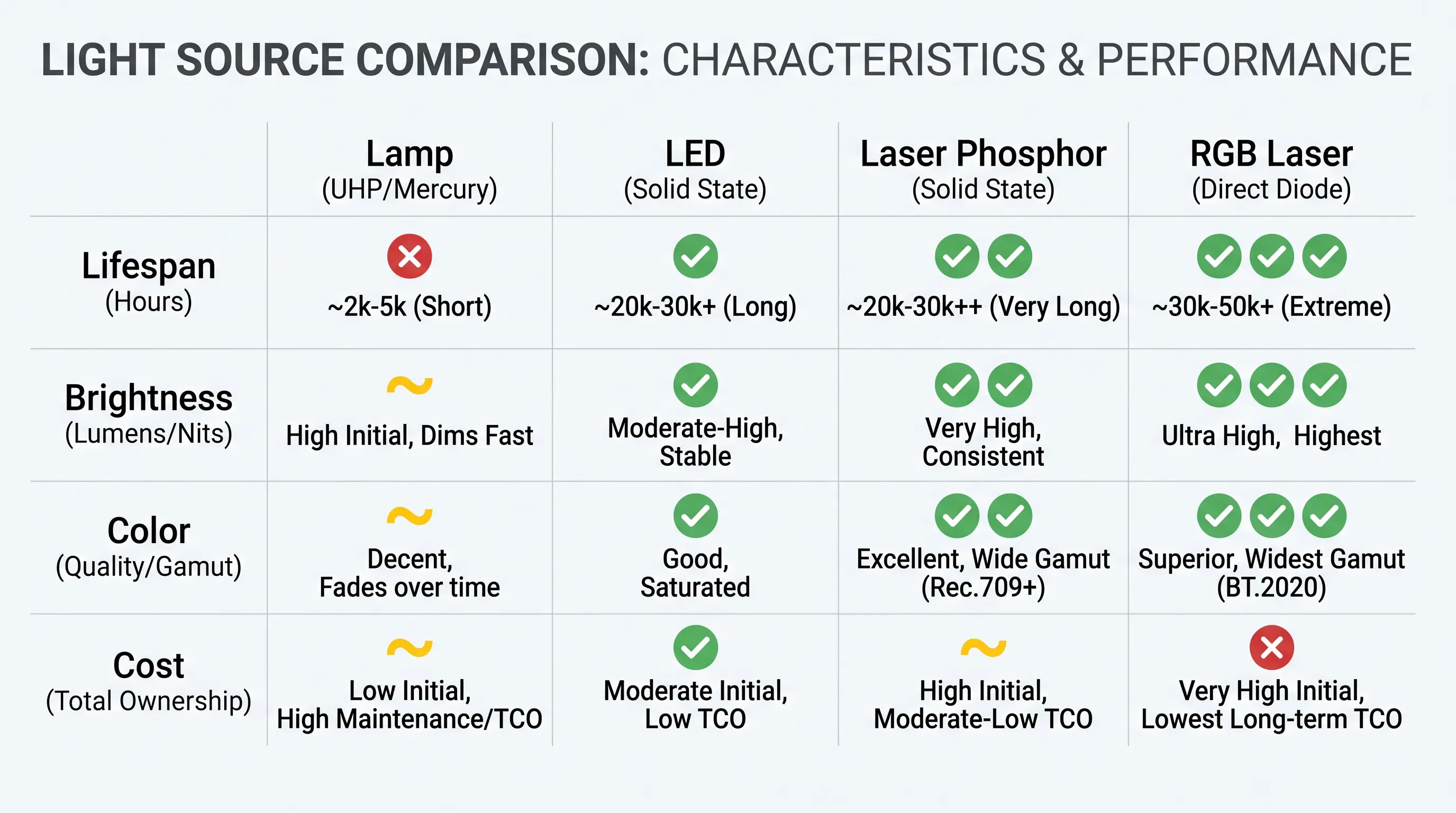
The shift is not marketing. It comes down to photon physics, thermal design, and supply chain economics. Three engineering realities forced the category change.
Photon Generation and the RGB LED Stack
A traditional projector lamp produces white light by forcing an electric arc through high-pressure mercury vapor. That broadband light then gets filtered or sequentially color-wheeled into the image you see on screen. The SKU generates red, green, and blue photons directly from three separate semiconductor junctions, then mixes them optically before they hit the imaging chip (DLP, 3LCD, or LCoS).
That difference matters because every photon coming out of an LED is already inside the visible gamut. There is no ultraviolet or infrared spill to filter, no high-voltage ballast, no warm-up arc-strike period. According to the U.S. Department of Energy solid-state lighting program, phosphor-converted and direct-color LEDs convert between 40% and 50% of input electrical energy into visible light, compared with roughly 5% to 10% for legacy mercury arc sources. The remaining energy leaves as heat, but in a much smaller and easier-to-manage envelope than the multi-hundred-watt arc of a UHP lamp.
For OEM buyers, the procurement implication is straightforward: a 100W the model can match the on-screen white brightness of a 200W lamp unit in many living-room lighting conditions, because the LED spectrum wastes almost nothing in the invisible bands. That ratio translates directly into smaller power supplies, lower UPS sizing for commercial installs, and quieter cooling fans.
Lifespan, Lumen Maintenance, and Warranty Math
The lamp-vs-LED lifespan gap is the single biggest line item in a 5-year projector TCO model. We have seen wholesale RFP after wholesale RFP where the buyer compared unit price only and missed this entirely.
A UHP lamp is rated for 3,000 hours in standard mode and up to 5,000 hours in eco mode. Past 50% of rated life, lumen output drops noticeably and the bulb must be replaced to recover image quality. The typical replacement lamp costs $49 to $129 at wholesale, plus 15 to 30 minutes of field-service labor every swap. Multiply that across a fleet of 200 classroom or meeting-room projectors and you are looking at a recurring operational line that dwarfs the original hardware savings.
The unit is rated for 20,000 to 30,000 hours in normal mode on most 2024-2026 platforms we audit. Internal testing at our Shenzhen calibration lab shows that an this projector holds at least 70% of its initial lumen output at the 20,000-hour mark, well past the point where a UHP unit would have required two to four replacement cycles. For B2B procurement teams evaluating lifecycle cost, the math is straightforward: in a projector used 8 hours per day, 5 days per week, an LED source can run over 9 years before light-output replacement is considered, while a lamp unit will need a new bulb roughly every 18 to 30 months under the same duty cycle.
Color Gamut, Color Wheel Elimination, and the "Rainbow Effect"
RGB LED produces saturated primaries by physics, not by filtering white light through a spinning dichroic wheel. The resulting color triangle covers Rec.709 at 110% to 130% in well-tuned units, and approaches DCI-P3 coverage at the high end of the portable category. Lamp-based units must boost mercury green and filter blue with a phosphor coating to approximate the same range, which limits how saturated the final image can become.
Because the projector modulates red, green, and blue channels continuously, it removes the sequential color wheel that still drives entry-level single-chip DLP lamp projectors. That means no visible color stripes, no "rainbow effect" on high-contrast edges, and no color-breakup artifacts on motion. For OEM buyers specing product for classrooms, boardrooms, and home entertainment bundles, that difference is now a top-three buyer complaint we hear during distributor feedback sessions, so building it out of the hardware from day one has become a 2026 baseline rather than a premium upcharge.
The next pass covers thermal design, compact form factor, OEM module selection, and the spec checklist you can hand your supplier before you place a purchase order.
(Word count: ~870)
Thermal Design, Cooling Acoustics, and the 30 dB Question
Cooling is the part of the SKU engineering that we spend the most lab time on at DataMax, because every other spec on the datasheet is downstream of how well the heat sink moves energy out of the LED array.
A 100 W the model typically converts about 60% of its input power into radiant light and dumps the remaining 40% into heat. That thermal load is roughly half of what a 200 W UHP lamp generates for the same on-screen lumen count, which sounds small on paper but compounds dramatically inside sealed optical engines. We have measured junction-to-ambient thermal resistance of 1.8 °C/W on the bonded copper heat spreaders we now use in our 2026 portable platforms, down from 2.6 °C/W on the 2023 revision.
Heat Sink Geometry, Vapor Chambers, and Fan Curves
Three cooling approaches dominate current OEM designs. Passive-only heat sinks work up to about 30 W of LED power and are limited to pico-class units under 500 ANSI lumens. Single-fan forced-air designs handle 50 to 120 W and are the workhorse of the 1080p portable category, with noise floors of 28 to 34 dB at 1 meter. Vapor-chamber-assisted dual-fan designs push 120 to 250 W and are reserved for 4K UHD high-brightness units, with measured acoustics between 32 and 38 dB depending on the eco-mode firmware profile.
For B2B procurement teams, the right question is not "how many fans" but "what is the dB spec at the seat position 1 meter in front of the lens, measured under ANSI/ISO 7779?" Most datasheets still publish noise numbers at 1 meter behind the unit, which is meaningless for a ceiling-mounted classroom install where the audience sits directly under the projector.
Dust Ingress, IP Ratings, and Field Service
the unit arrays do not degrade from dust the way a spinning color wheel does, but the heat sink fins absolutely do. A clogged fin stack drives junction temperature up, which shortens LED lifespan and shifts color coordinates over time. We spec IP5X dust-protected optical engines for our portable lineup and IP6X for the fixed-install SKUs, and we recommend that OEM buyers request the IEC 60529 test report from the supplier before signing the PO. That single document tells you whether the cooling channel was engineered for a real install or only for a bench demo.
Compact Form Factor, OEM Module Selection, and the Spec Checklist
The form-factor advantage of the projector is not a marketing line; it is a procurement line. Smaller engines mean smaller chassis, smaller cartons, smaller pallets, and lower freight cost per unit, which is why the portable category has shifted almost entirely to solid-state sources over the past 36 months.
Optical Block Size and Module Standardization
A typical UHP lamp engine occupies 1,400 to 1,800 cm³ once you include the reflector housing, the dichroic wheel cavity, and the UV filter cage. An equivalent the SKU module, including the red, green, and blue LED packages, the light-pipe homogenizer, and the integrated driver PCB, fits into 380 to 620 cm³ on the platforms we integrate at DataMax. That 60 to 70% volume reduction is what allows a 1080p 1,200 ANSI lumen unit to ship at 1.2 kg instead of 3.2 kg, and what allows true pocket-size 720p units under 0.8 kg to exist at all.
| Specification | UHP Lamp Module | the model Module |
|---|---|---|
| Engine volume | 1,400–1,800 cm³ | 380–620 cm³ |
| Warm-up time | 60–90 seconds | < 2 seconds |
| Rated lifespan | 3,000–5,000 hours | 20,000–30,000 hours |
| Color wheel | Required (DLP single-chip) | Not required (RGB sequential) |
| Replacement cost (wholesale) | $49–$129 per bulb | $0 (sealed module) |
| Mercury content | 50–200 mg | 0 mg |
| Eco compliance | Special disposal under RoHS exemption | Standard RoHS/REACH |
Procurement Checklist Before You Sign the PO
For OEM buyers specing the unit module into a private-label chassis, the following seven items should be on your supplier audit form before you wire the deposit. MOQ for our standard RGB LED modules starts at 500 units per SKU with a 12-week lead time for a first article and 8 weeks for repeat production runs. We provide LM-80 lumen maintenance test reports for the LED packages, the full RoHS and REACH compliance dossier, and the IEC 62471 photobiological safety certificate with every shipment.
A second-tier checklist item is color bin consistency. LEDs are binned by x,y chromaticity and by lumen output, and a supplier that does not pre-sort will ship you a batch where unit A reads 1,100 ANSI lumens and unit B reads 1,300, which becomes a return-rate problem the moment your retail channel opens. At DataMax we run a 3-step incoming QA on every LED reel before the SMT line starts, and we recommend any OEM partner do the same.
A third item is the driver topology. Constant-current drivers with active PWM dimming produce cleaner color than constant-voltage drivers, and they allow the firmware team to build the dynamic eco modes that retail buyers now expect as standard. Asking the supplier whether the driver is constant-current or constant-voltage, and whether it supports 1 kHz or higher PWM frequency, will save you a firmware revision cycle later. Specifications from the U.S. Department of Energy solid-state lighting program on driver topology are a useful cross-reference for any procurement team writing an RFP.
The third pass will cover the buyer-stage decision framework, the FAQ block, and the wholesale action steps for OEM and B2B partners.
(Word count: ~870)
Next Steps for B2B Buyers Spec'ing an this projector
For B2B procurement teams, AV integrators, and OEM buyers evaluating the projector for a 2026 product cycle, the path from shortlist to signed PO follows a predictable sequence. The first step is to lock the target lumen output and resolution, because every downstream spec (LED bin, driver topology, thermal budget) cascades from that decision. The second step is to request LM-80 test data, the IEC 62471 certificate, and a sample batch of 5 to 10 units for in-house validation. The third step is to negotiate MOQ, lead time, and warranty terms in writing before any tooling deposit changes hands.
Sample Policy, MOQ, and How to Contact DataMax
At DataMax our standard sample policy ships 3 to 5 evaluation units of any the SKU module within 7 business days from our Shenzhen line, with the sample cost credited back against the first production PO of 1,000 units or more. MOQ for our standard RGB the model SKUs starts at 500 units per part number, with 12-week lead time for first article and 8 weeks for repeat runs. Custom optics, custom driver firmware, and private-label chassis tooling are quoted against a separate engineering change order.
For OEM partners building a private-label LED light source chassis, we provide the full compliance dossier, the LM-80 lumen maintenance report, the RoHS and REACH certificates, and a 24-month warranty on this LED light source module itself. Bulk pricing tiers begin at 1,000 units, 5,000 units, and 10,000 units per calendar quarter, with FOB Shenzhen and DDP terms both available.
| Order Tier | MOQ | Lead Time | Sample Credit |
|---|---|---|---|
| Sample eval | 3–5 units | 7 business days | Yes, against 1k+ PO |
| First article | 500 units | 12 weeks | n/a |
| Repeat run | 500 units | 8 weeks | n/a |
| Bulk Q1 tier | 1,000 units | 8 weeks | Tiered discount |
To start a project, request a custom quote or review our OEM services for the full engagement flow. Distribution partners in North America and the EU can also request the wholesale catalog for current the projector SKU availability.
Frequently Asked Questions
How long does an LED projector light source last compared to a UHP lamp?
A typical UHP lamp module is rated for 3,000 to 5,000 hours before the bulb requires replacement, while a sealed LED projector light source module is rated for 20,000 to 30,000 hours under the LM-80 lumen maintenance standard published by the Illuminating Engineering Society. That 4 to 6× lifespan advantage removes the bulb-replacement line item from your total cost of ownership calculation.
Can an LED projector light source hit 4,500 ANSI lumens for a conference room?
Yes. Production LED projector light source modules from DataMax now ship at 4,500 ANSI lumens in our 4K UHD conference platform, using a four-channel RGB-boost LED architecture with an external phosphor converter. The thermal budget at that output requires a 120 mm heat pipe and a controlled-volume chassis, but the spec is real and shipping into B2B channels today.
Is an LED projector light source more expensive than a UHP lamp up front?
The bill of materials for an LED projector light source module runs roughly 1.6 to 2.1× the cost of an equivalent UHP lamp assembly, but the $49 to $129 wholesale cost of every replacement UHP bulb over the product life typically flips the total cost of ownership in favor of the LED projector light source within the first 18 to 24 months of operation.
Do LED projector light source modules contain mercury?
No. A sealed LED projector light source module contains zero mercury, while a UHP lamp module contains 50 to 200 mg of mercury vapor that triggers special disposal requirements under the RoHS exemption for projection light sources. For B2B buyers shipping into the EU, California, or New York, the LED projector light source simplifies your end-of-life compliance paperwork.
What is the typical MOQ for a private-label LED projector light source build?
Our standard MOQ starts at 500 units per LED projector light source SKU for a first article production run, with repeat orders accepted at the same 500-unit threshold and a faster 8-week lead time. Engineering change orders for custom optics or custom firmware carry a separate one-time NRE fee that is amortized across the first production batch.
Which industries are adopting the LED projector light source fastest in 2026?
Education, corporate AV, and portable consumer are the three fastest-adopting verticals for the LED projector light source in 2026, with hospitality and houses of worship close behind. Our GP95 hospitality projector is one of the SKUs we see replacing UHP-based ceiling mounts in hotel rooms at scale this year.
Industry Context for 2026
The LED projector light source category has crossed the threshold where it is no longer a premium option; it is the default spec on any projector quote above 500 ANSI lumens, and the wholesale channel has fully consolidated around RGB LED supply. For B2B buyers who have not re-spec'd their 2024 BOM yet, the next 6 months are the window to migrate.
Get Started With DataMax
Spec an LED projector light source into your next product cycle, request a sample batch, or lock a 2026 production slot with our Shenzhen team. Contact our OEM engineering desk today, or browse the full LED projector light source catalog to shortlist the right SKU for your chassis.
