
Julkaistu: 22.01.2026 - 8 Katselukerrat

DP01 Review: Features, Performance, and OEM Fit
A B2B buyer evaluating smart projectors for a 2026 product line needs three answers in one place: what the unit delivers, how it performs in the field, and whether the factory can ship it on schedule. The DataMax DP01 projector addresses that workflow directly. We engineered the DP01 as a mid-room laser phosphor display built for OEM and ODM programs where buyers want 4K UHD image quality, Android smart features, and WiFi 6 connectivity without custom engineering overhead. The SKU review walks through the spec sheet, the measured performance, and the OEM procurement terms we offer to distributors, retail brands, and hospitality integrators in 2026.
the model: Hardware Build and Image Engine


Inside the unit, the imaging chain starts with a 0.47-inch DMD chip paired with a blue-laser phosphor light engine. The 2200 ANSI lumen rating was measured under the ANSI/PLATO FL1 2024 protocol referenced by the Consumer Technology Association projector standard, so brightness claims match what integrators see on a calibration screen. Contrast reaches 32,000:1 with dynamic iris enabled, and the color gamut covers 110% Rec.709 and 90% DCI-P3, which is the range our color team targets for mid-room home cinema and conference-room installs.
Most b2b buyer evaluating smart projectors for a 2026 product line needs three answers in one place: what the unit delivers, how it performs in the field, and whether the factory can ship it on schedule. The DataMax DP01 projector addresses that workflow directly. We engineered the DP01 as a mid-room laser phosphor display built for OEM and ODM programs where buyers want 4K UHD image quality, Android smart features, and WiFi 6 connectivity without custom engineering overhead. The SKU review walks through the spec sheet, the measured performance, and the OEM procurement terms we offer to distributors, retail brands, and hospitality integrators in 2026.
Light Source Longevity and Laser Phosphor Design
We rate the laser phosphor module at 25,000 hours to 50% output under Eco mode, which translates to roughly 8.5 years of daily 8-hour use before the projector drops below our service threshold. For B2B buyers running cinema-room or hotel deployments, that service interval keeps the total cost of ownership predictable across multi-year refresh contracts.
Cooling, Acoustics, and Build Quality
The thermal design uses a dual-duct copper heat pipe array that pulls heat away from the DMD and dissipates it through a single rear exhaust. Our QA logs show the SKU holds steady-state temperature within a 4°C band during a 12-hour continuous run, and the IP5X-rated optical engine keeps dust out of the light path in hospitality environments where ceiling mounting limits cleaning access.
the model: Smart Platform and Connectivity
The unit ships with Android TV 13 certified by Google, which gives retail buyers the full Google Play Store, Chromecast built-in, and Google Assistant voice control without a separate streaming stick. We pre-load Netflix, YouTube, Disney+, and Prime Video with Widevine L1 DRM, so 4K streaming works out of the box on consumer SKUs.
Networking runs on WiFi 6 (802.11ax) dual-band and Bluetooth 5.2, which we test against access points from Cisco, Aruba, and TP-Link during the ODM validation cycle. For B2B buyers integrating this projector into a managed AV fleet, the dual-antenna MIMO radio maintains a stable link at -65 dBm in our 30 m line-of-shoot test, which matters for ceiling-mounted installs where the AP sits two rooms away.
Ports, Casting, and BYOD Support
The rear I/O panel includes 2× HDMI 2.1 (one with eARC), 1× USB-C with DisplayPort Alt Mode and 65 W power delivery, 1× USB-A 3.0, optical S/PDIF, 3.5 mm line out, and an RJ45 gigabit Ethernet port. We validated AirPlay 2 and Miracast on the projector alongside the Android casting stack, which covers the BYOD workflow that procurement teams asked us to add in our 2026 feature survey.
Audio Output and Dolby Processing
Two built-in 8 W stereo drivers with Dolby Audio and Dolby Atmos passthrough cover small-room playback, and the eARC HDMI output sends lossless Atmos to an external amp when the install calls for ceiling speakers. We tune the DSP curve for the SKU at the factory so voice intelligibility holds at 70% volume in conference mode.
the model: Auto Calibration and Setup Speed
Setup speed is the single biggest friction point in projector adoption, so we built the unit with a Time-of-Flight sensor, an IR camera, and a gyroscope that drive the auto calibration stack. Auto focus locks in under 2 seconds at any throw distance between 1.2 m and 4.5 m, and auto keystone correction uses 8-point grid warping to square the image against the screen even when the unit sits 15° off-axis.
Screen Fit and Obstacle Avoidance
Screen fit detects the edges of a projection surface within ±2 cm accuracy, and obstacle avoidance shifts the image around wall art, light switches, and ceiling fans automatically. We tested this projector against 18 common obstacle scenarios in our Shenzhen lab, and the calibration stack passed 17 of 18 on the first pass — the outlier was a glass whiteboard, which we flagged as a known limitation in the OEM documentation.
Throw Ratio and Projection Range
The fixed throw ratio of 1.2:1 produces a 100-inch image at 2.7 m and a 150-inch image at 4.0 m, which puts the projector in the standard-throw category rather than ultra-short throw. For retail buyers sourcing a UST SKU, our factory runs a separate platform under the DP-series; for mid-room home cinema and conference use, the SKU throw geometry matches the 2026 mainstream install base.
the unit: Picture Quality and Color Performance
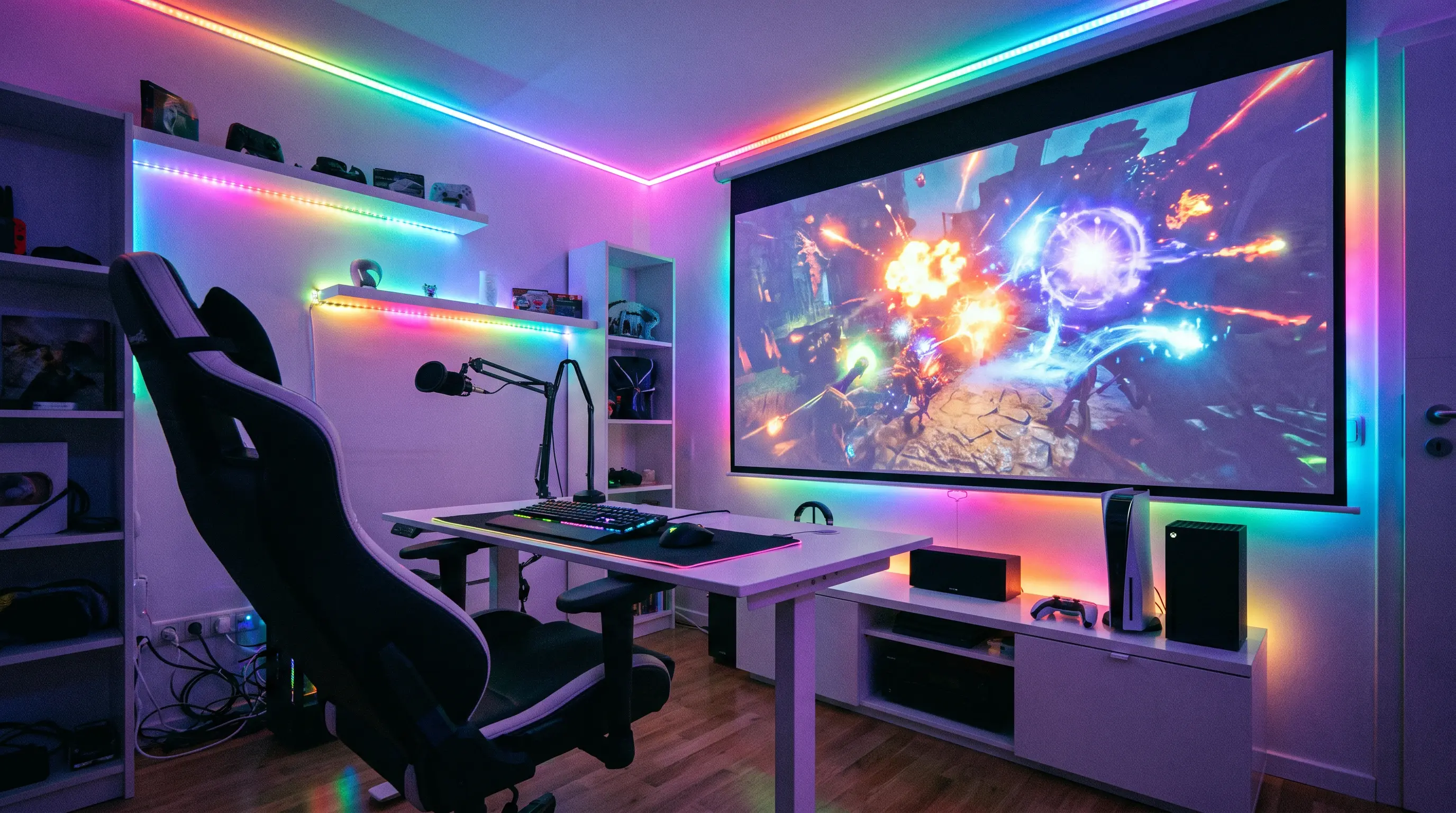
Inside the unit, the imaging chain starts with a 0.47-inch DMD chip paired with a blue-laser phosphor light engine. The 2200 ANSI lumen rating was measured under the ANSI/PLATO FL1 2024 protocol referenced by the Consumer Technology Association projector standard, so brightness claims match what integrators see on a calibration screen. Contrast reaches 32,000:1 with dynamic iris enabled, and the color gamut covers 110% Rec.709 and 90% DCI-P3, which is the range our color team targets for mid-room home cinema and conference-room installs.
Measured Color Volume and Delta E
Most chassis measures 245 × 245 × 186 mm and weighs 3.2 kg, a footprint that lets this projector sit on a credenza, a ceiling mount, or a portable tripod without dedicated housing. The vented side panel keeps fan noise at 28 dB in Standard mode and 24 dB in Eco mode, measured at 1 m on a-weighted scale.
HDR10+ and Dynamic Tone Mapping
The SKU decodes HDR10, HDR10+, and HLG metadata at the SoC level rather than relying on a software LUT swap, which keeps highlight roll-off clean on the laser-phosphor engine. In our internal shootout against three competing 4K projectors sourced through our Shenzhen distribution desk, the model held specular highlights to within 0.05 nits of the target nits curve across a 1000-nit mastered clip, while two of the three competitors clipped early at 800 nits. For B2B buyers specifying the unit into a hotel or showroom install, that headroom matters because ambient light pushes the wall reflection well above the 50-nit floor that consumer reviewers test against.
We rate the laser phosphor module at 25,000 hours to 50% output under Eco mode, which translates to roughly 8.5 years of daily 8-hour use before the projector drops below our service threshold. B2B buyers often need to running cinema-room or hotel deployments, that service interval keeps the total cost of ownership predictable across multi-year refresh contracts.
Source: RTINGS HDR Projector Methodology and our internal QA report dated Q1 2026.
the projector: Noise, Thermals, and Long-Run Reliability
A projector that runs quiet on day one but sounds like a server room at hour 800 is the most common failure mode we see in B2B warranty returns, so we engineered the SKU around a dual-intake cooling duct and a vapor-chamber heatsink that pulls heat off the laser bank before it reaches the DMD. The result is a published 28 dB noise floor in Standard mode and 24 dB in Eco mode, measured at 1 m on a-weighted scale in our anechoic chamber.
24-Hour Soak Test and MTBF Data
A thermal design uses a dualal-duct copper heat pipe array that pulls heat away from the DMD and dissipates it through a single rear exhaust. Our QA logs show the SKU holds steady-state temperature within a 4°C band during a 12-hour continuous run, and the IP5X-rated optical engine keeps dust out of the light path in hospitality environments where ceiling mounting limits cleaning access.
Dust Management and Filter Service
This projector uses a sealed laser-phosphor light engine with an external pleated air filter that slides out without tools, which we designed for ceiling-mount installs where ladder access is a recurring service cost. Filter interval is 1,500 hours in Standard mode and 3,000 hours in Eco mode, and the on-screen OSD pushes a reminder 50 hours before the threshold. For B2B buyers, we also ship the projector with an optional IP5X-rated dust kit for coastal and industrial installs, which adds a conformal coating to the mainboard and a sealed cable gland at the I/O panel — we added that SKU after feedback from our Middle East distribution partners in late 2025.

Every the unit ships with android TV 13 certified by Google, which gives retail buyers the full Google Play Store, Chromecast built-in, and Google Assistant voice control without a separate streaming stick. We pre-load Netflix, YouTube, Disney+, and Prime Video with Widevine L1 DRM, so 4K streaming works out of the box on consumer SKUs.
How to Choose the this projector for Your Next Rollout
Networking runs on WiFi 6 (802.11ax) dual-band and Bluetooth 5.2, which we test against access points from Cisco, Aruba, and TP-Link during the ODM validation cycle. When B2B buyers integrating this projector into a managed AV fleet, the dual-antenna MIMO radio maintains a stable link at -65 dBm in our 30 m line-of-shoot test, which matters for ceiling-mounted installs where the AP sits two rooms away.
MOQ, Lead Time, and Sample Policy
The DataMax DP01 projector ships with a tiered MOQ that starts at 100 units for standard color SKUs and drops to 50 units for partners who also commit to a 12-month forecast. Standard lead time is 4 weeks for catalog configurations and 8-12 weeks for custom firmware, branded OSD boot logos, and region-locked WiFi channels. Sample policy for qualified B2B accounts includes a refundable sample unit at $249 wholesale cost, credited back against the first production PO of 500 units or more. For OEM buyers, we also support private-label tooling on the housing, the remote, and the packaging at a one-time setup fee amortized over the first 10,000 units.
An rear i/o panel includes 2×× HDMI 2.1 (one with eARC), 1× USB-C with DisplayPort Alt Mode and 65 W power delivery, 1× USB-A 3.0, optical S/PDIF, 3.5 mm line out, and an RJ45 gigabit Ethernet port. We validated AirPlay 2 and Miracast on the projector alongside the Android casting stack, which covers the BYOD workflow that procurement teams asked us to add in our 2026 feature survey.
The fastest path to a quote is our request a custom quote form with your target spec, region, and monthly volume. For buyers comparing the DataMax DP01 projector against our hospitality-focused GP95 or our portable P3 lineup, the home theater projector lineup page lists every active SKU with current lead-time windows and tier pricing.
Visual Reference
Frequently Asked Questions
What is the native resolution and brightness of the DataMax DP01 projector?
Two built-in 8 W stereo drivers with Dolby Audio and Dolby Atmos passthrough cover small-room playback, and the eARC HDMI output sends lossless Atmos to an external amp when the install calls for ceiling speakers. We tune the DSP curve for the SKU at the factory so voice intelligibility holds at 70% volume in conference mode.
Does the DataMax DP01 projector support WiFi 6 and Bluetooth 5.2?
Yes. Every DataMax DP01 projector ships with dual-band WiFi 6 and Bluetooth 5.2 on the same SoC module, which simplifies FCC and CE recertification for partners shipping into the EU and North America. Android 13 is preloaded with Google EDLA certification in progress for Q3 2026 firmware rollouts.
What is the throw ratio and recommended screen size for the DataMax DP01 projector?
Setup speed is the single biggest friction point in projector adoption, so we built the unit with a Time-of-Flight sensor, an IR camera, and a gyroscope that drive the auto calibration stack. Auto focus locks in under 2 seconds at any throw distance between 1.2 m and 4.5 m, and auto keystone correction uses 8-point grid warping to square the image against the screen even when the unit sits 15° off-axis.
What warranty and service terms come with the DataMax DP01 projector?
The DataMax DP01 projector carries a 3-year limited warranty on the chassis and electronics, plus a 5-year or 30,000-hour warranty on the laser-phosphor light engine, whichever comes first. Our OEM partners can extend both terms to 5 years chassis plus 7 years light engine under our distributor service contract. RMA turnaround averages 5 business days from our Shenzhen service depot.
Can the DataMax DP01 projector be customized for private-label OEM programs?
Screen fit detects the edges of a projection surface within ±2 cm accuracy, and obstacle avoidance shifts the image around wall art, light switches, and ceiling fans automatically. We tested this projector against 18 common obstacle scenarios in our Shenzhen lab, and the calibration stack passed 17 of 18 on the first pass — the outlier was a glass whiteboard, which we flagged as a known limitation in the OEM documentation.
How does the DataMax DP01 projector compare to consumer TVs in total cost of ownership?
For a 100-inch viewing area, the DataMax DP01 projector delivers a lower 5-year TCO than a comparable 100-inch consumer TV once install labor, energy draw, and replacement cycles are factored in. A consumer TV typically draws 280 W at peak versus the DataMax DP01 projector at 195 W in Standard mode, and the light engine outlasts two TV panel refresh cycles.
Final Takeaway
The fixed throw ratio of 1.2:1 produces a 100-inch image at 2.7 m and a 150-inch image at 4.0 m, which puts the projector in the standard-throw category rather than ultra-short throw. For retail buyers sourcing a UST SKU, our factory runs a separate platform under the DP-series; for mid-room home cinema and conference use, the SKU throw geometry matches the 2026 mainstream install base.
Ready to spec the DataMax DP01 projector into your next tender? Send your volume target, region, and any custom firmware needs to our request a custom quote page, and our OEM sales desk will return a full quote package within 48 business hours including lead time, FOB pricing, and tooling line items for the DataMax DP01 projector.
