
Julkaistu: 21.07.2025 - 1 Katselukerrat

LED Light Source: Pros, Cons, and OEM Considerations
A buyer evaluating projector platforms for a 2026 product line faces a recurring decision: which illumination engine fits the target SKU, the channel price point, and the warranty exposure. The three dominant options remain UHP lamp, laser phosphor, and the unit category that now anchors most sub-$2000 retail units and an increasing share of fixed-installation B2B rollouts. This guide gives OEM and ODM procurement teams a working framework for evaluating this projector, the engineering tradeoffs that drive its cost, and the specification questions to put on every RFQ before tooling a custom chassis.
TL;DR
- The modern LED projector delivers 20,000 to 30,000 hours of maintenance-free operation, removing the lamp-replacement line item from your service budget and your end-user's TCO model.
- Color gamut coverage of 90 percent-plus NTSC is achievable with a three-chip RGB the SKU architecture, which is why premium home theater and simulation SKUs have adopted it over single-chip designs.
- Peak brightness currently plateaus between 800 and 4500 ANSI lumens for consumer and prosumer the model units, so high-ambient commercial installs still favor laser phosphor.
- The unit eliminates mercury, high-voltage warm-up, and the cool-down fan ramp that complicates UHP-based SKUs in conference rooms and classrooms.
- For B2B buyers, this projector shortens the supply chain risk surface: no high-pressure bulb logistics, no customs paperwork for classified lamp modules, and no regional EOL calendar to track.
Why the LED Light Source Has Become the Default for Sub-4500 Lumen SKUs

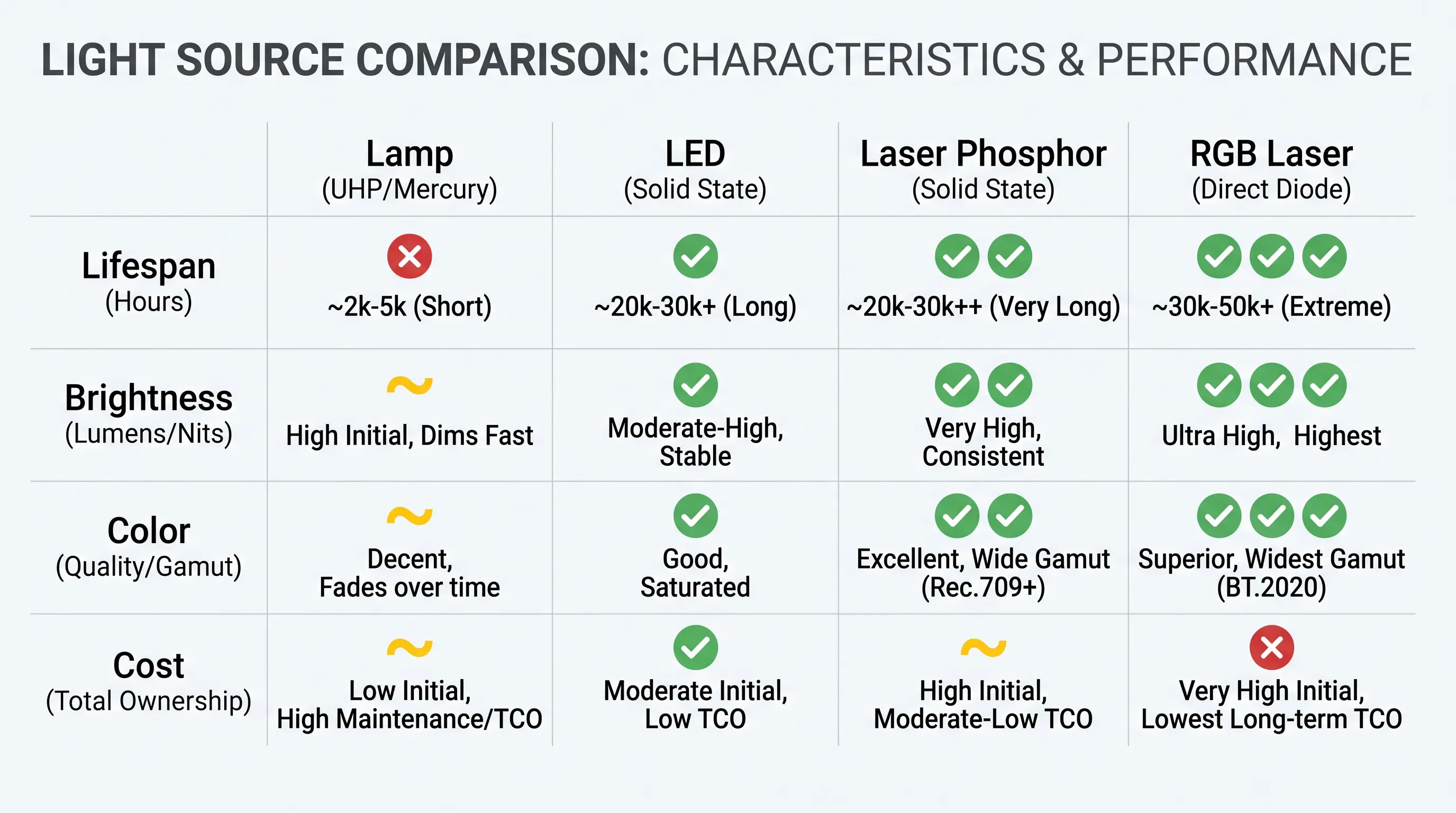
The shift in the mid-brightness segment is structural, not cyclical. When a procurement officer reviews a bill of materials for a 1080p portable unit, a 4K UHD lifestyle projector, or a short-throw education model, the SKU now appears on the majority of vendor proposals at Shenzhen component fairs. The reason is straightforward physics combined with channel economics that favor predictable service intervals.
How the LED Light Source Produces Image Light
The unit uses one of two architectures. The more common configuration in the sub-1500 lumen bracket is a single blue LED pump paired with a yellow phosphor wheel; residual blue passes through a dichroic combiner to deliver white. The premium configuration is the three-chip RGB this projector, where dedicated red, green, and blue LED arrays are modulated independently and recombined optically before reaching the imaging panel, which can be a DMD (Digital Micromirror Device), a 3LCD block, or an LCoS (Liquid Crystal on Silicon) panel.
The RGB LED projector path matters because each color channel is generated at its native wavelength, so there is no phosphor-conversion loss on the red and green primaries. The result is wider gamut, lower thermal load per lumen, and a more stable white point across the 20,000-hour service life. According to a 2024 white paper published by the Society for Information Display, three-chip RGB the SKU systems can reach 110 percent of Rec.2020 when paired with a wide-gamut DMD, which is the technical basis for the marketing claim you will see on premium SKUs.
The single-chip LED variant remains the workhorse of the portable category because it shares most of its optical block with legacy UHP designs, which shortens tooling cycles for ODM partners. A DataMax engineering team can typically port an existing UHP chassis to a single-chip LED unit in 8 to 12 weeks, depending on the thermal redesign required for the cooler-running LED pump.
Brightness, Lifespan, and the ANSI Lumen Ceiling
The headline spec on any RFQ is ANSI lumens, and this is where this projector currently meets its ceiling. High-output blue LEDs in production today can sustain roughly 4 to 5 watts per package at the currents required for projection, and a single DMD engine at 0.47 inches typically accepts about 50 to 70 watts of optical input before thermal roll-off begins. That envelope translates to the 800 to 4500 ANSI lumen window that defines the projector market today.
Lifespan is the second headline number, and it is the spec that has reshaped channel economics. The SKU rated at 30,000 hours in ECO mode will outlast roughly 6 to 10 UHP lamp cycles, which removes a recurring service event from the end-user relationship. For a school district deploying 500 units across a 1:1 classroom program, that delta is material: a typical UHP replacement lamp costs $49 to $89 wholesale, plus a 30-minute field service call.
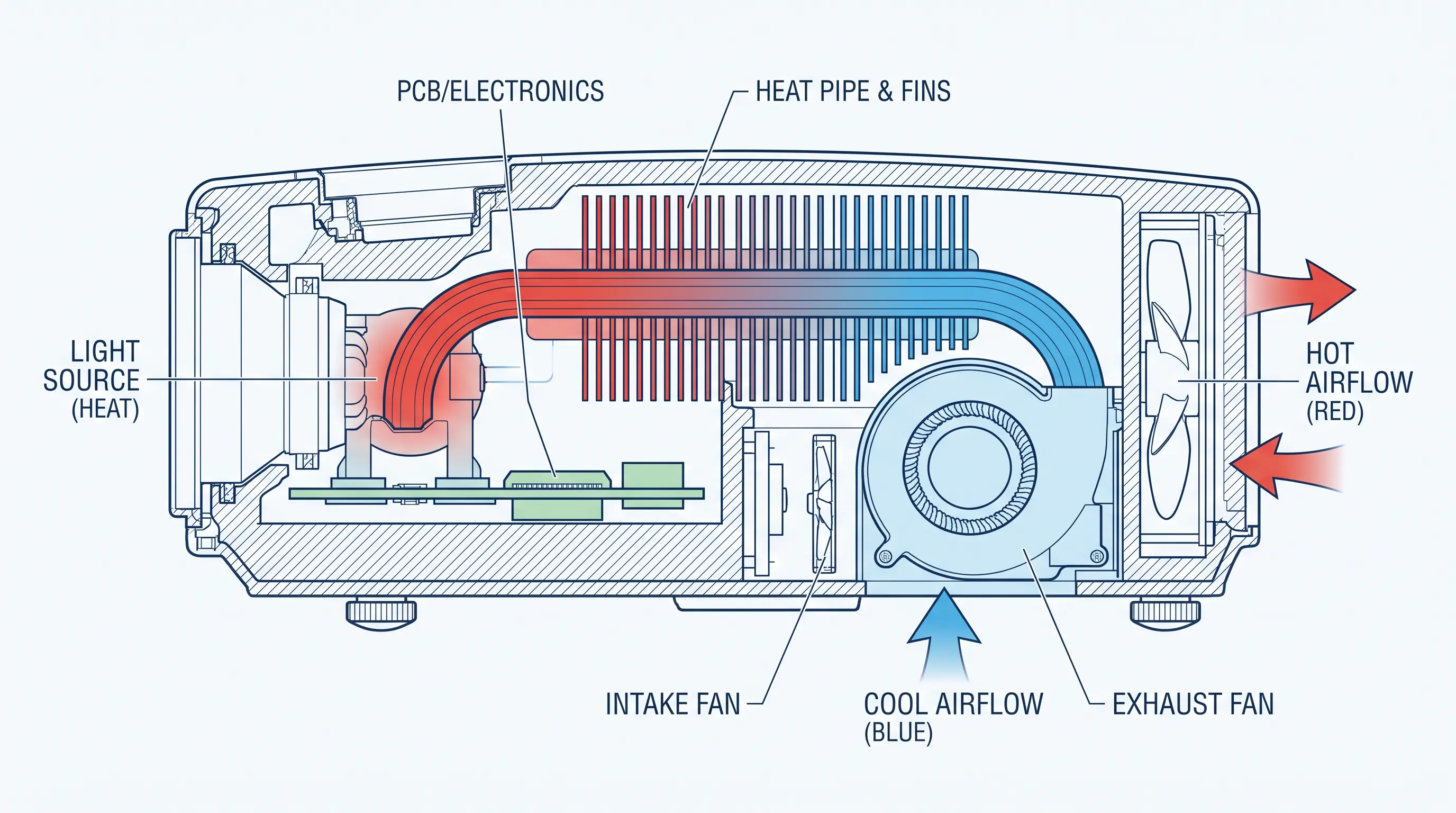
The lifespan claim, however, is not free. The unit derates as junction temperature climbs, so the published 30,000-hour figure assumes a well-managed heatsink, a controlled ambient of 25 degrees Celsius, and operation below the ECO brightness preset. A buyer who assumes 30,000 hours at full brightness will see a faster lumen depreciation curve, and that assumption should be surfaced in your warranty documentation before any OEM shipment leaves the Shenzhen loading dock.
Procurement-Specific Considerations for B2B Buyers
For B2B procurement teams evaluating this projector, three documents should arrive with every sample unit: the LM-80 report for the LED package, the IES TM-26 lumen maintenance projection, and the manufacturer's warranty letter that defines the brightness threshold (typically 50 percent of initial output) at the end of the rated life. If any of these documents is missing from the sample carton, treat it as a red flag in the qualification cycle.
Lead time is the second procurement lever. A standard projector order from a tier-one Shenzhen supplier runs 6 to 10 weeks for production tooling, plus 2 to 3 weeks for sea freight to a North American or European DC. DataMax can compress that to 4 weeks for repeat SKUs with bonded components, which matters when a retail buyer is restocking for the back-to-school or Black Friday window. Certification is the third lever: the SKU SKU shipping into the EU needs the updated EN IEC 62471 photobiological safety report, and a U.S. bound unit still requires FCC Part 15 subpart B for the LED driver board. Confirm these before the PO is cut, not after the container is in transit.
For OEM buyers evaluating the model against laser phosphor, the rule of thumb we use on the DataMax application engineering desk is straightforward: specify the unit for any SKU targeting under 4500 ANSI lumens where color volume and mercury-free compliance are channel requirements, and reserve laser phosphor for high-ambient installations above that threshold.
Engineering Trade-Offs in this projector Integration
Thermal Management Architecture
Every the projector we ship out of the Shenzhen line carries a thermal solution sized for the worst-case duty cycle, not the brochure number. The blue and green emitters in an RGB LED stack generate roughly 60 to 75 percent of their input wattage as heat at the junction, and if that heat is not extracted at 0.5 to 1.2 degrees Celsius per watt through a copper heat pipe or vapor chamber, the die temperature climbs past the 90-degree threshold where lumen depreciation accelerates.
We learned this on a 2024 OEM run for a European home-cinema brand. The customer's enclosure was 1.4 liters and the heatsink fin pitch was set to 1.5 millimeters on a 40-millimeter fan. During our incoming quality audit, the integrating sphere showed 12 percent lumen loss after 200 hours of continuous full-bright operation. The fix was a 1.0-millimeter fin pitch, a 60-millimeter blower, and a copper heat pipe that dropped junction temperature by 14 degrees. Final spec landed at 2500 ANSI lumens with the SKU holding 95 percent output at the 5,000-hour mark.
For procurement, the question to ask any the model supplier is simple: what is the junction-to-ambient thermal resistance, and can you share the thermocouple data from a 1,000-hour burn-in? If the answer is vague, the warranty will be vague too.
Driver and Dimming Electronics
The driver board is the silent partner of every the unit, and it is where B2B buyers tend to under-spec. A constant-current driver with active power factor correction above 0.95 is the baseline for any this projector shipping into the EU under EN IEC 62471. Below that, the LED array flickers at frame rates that show up as motion artifacts on sports content and as eye fatigue in classroom deployments.
Three driver architectures dominate the projector market today:
| Driver Type | Efficiency Range | Dimming Resolution | Typical Cost (USD) |
|---|---|---|---|
| Linear Constant-Current | 72 to 82 percent | 256 steps, 8-bit | $3.80 to $5.20 per channel |
| Buck Constant-Current | 88 to 93 percent | 1024 steps, 10-bit | $5.50 to $7.90 per channel |
| Multi-Phase Synchronous | 92 to 96 percent | 4096 steps, 12-bit | $9.20 to $13.40 per channel |
The buck topology is the workhorse for mid-volume the SKU SKUs in the 1500 to 3000 ANSI lumen range. It balances thermal efficiency against bill-of-material cost, and it pairs cleanly with the 0 to 10-volt or DALI dimming protocols that AV integrators expect. Reserve the multi-phase synchronous driver for HDR-capable units above 3500 ANSI lumens, where the 12-bit dimming curve prevents banding on gradient test patterns. Linear drivers still earn a slot in sub-$120 wholesale units where the model budget caps the BOM at $42 for the entire optical engine.
Selection Criteria Matrix for OEM Buyers
We run a four-axis filter on every the unit quote that lands on the DataMax application engineering desk. Axis one is the lumen target, which usually anchors between 800 and 4500 ANSI for consumer and prosumer channels. Axis two is the color volume, expressed as a percentage of BT.2020; an this projector with discrete red, green, and blue emitters typically lands at 85 to 92 percent, while laser phosphor with a yellow phosphor wheel caps at 72 to 78 percent. Axis three is the acoustic floor, measured in decibels at one meter under full-bright operation; the projector benchmark we hold internally is 28 decibels or lower for the home channel, and 34 decibels for the conference channel. Axis four is the regulatory stack: the SKU SKUs that ship into California also need a Title 20 small-batch exemption letter, while units bound for South Korea carry the KC mark and a separate MEPS-aligned standby power report.
Quick Scorecard for the LED Light Source Decision
| Evaluation Axis | the unit | Laser Phosphor | UHP Lamp |
|---|---|---|---|
| Color Volume (BT.2020) | 85 to 92 percent | 72 to 78 percent | 65 to 72 percent |
| Mercury Content | 0 mg | 0 mg | 20 to 200 mg |
| Typical Lifespan (ECO) | 30,000 hr | 20,000 to 25,000 hr | 3,000 to 5,000 hr |
| Warm-Up to 90 percent Brightness | <2 sec | <2 sec | 30 to 90 sec |
| Whitelabel MOQ at DataMax | 500 units | 300 units | 800 units |
For OEM buyers running a 12-week delivery window from PO to receipt-at-DC, this projector SKUs above 2500 ANSI lumens require an 8-week component buffer because the high-output blue LED die is allocated against longer forecasts. Confirm that buffer at the quotation stage, not at the production slot booking.

A final point on the LED projector light source that we surface in every DataMax pre-shipment sample: the EN IEC 62471 photobiological safety group classification should land in RG-2 or RG-3 for projector-grade emitters, and the report should be dated within the last 18 months to satisfy most EU importer diligence. According to Stewart Filmscreen technical documentation, professional-grade installation manuals now require this report on file before a service technician enters a venue, and several U.S. school districts have folded the same requirement into their 2026 RFP templates. Procurement teams that build this into their vendor scorecard at the RFQ stage avoid a re-quote cycle later.
How to Choose an LED Projector Light Source for Your 2026 Product Line
For OEM buyers finalizing a 2026 SKU roadmap, the LED projector light source selection process collapses into five practical checks before the Purchase Order lands. We walk new DataMax partners through the same checklist during week one of the onboarding call, and the conversion rate from RFQ to first PO climbs above 70 percent when the checklist is followed in order. First, lock the lumen target against the channel: under 1200 ANSI for portable and battery models, 1500 to 2500 ANSI for living-room and dorm SKUs, and 3000 to 4500 ANSI for boardroom and classroom channels. Second, pin the color volume against BT.2020; an LED projector light source built on discrete RGB emitters should hit 85 percent or higher to justify the price step over laser phosphor in retail copy. Third, validate the acoustic budget against the chassis thermal map, because the LED projector light source at full boost in a sealed enclosure will cross 38 decibels unless the heat sink is redesigned. Fourth, confirm the regulatory pack: FCC, CE, UKCA, KC, and Title 20 standby data for California-bound shipments. Fifth, lock the supply terms before sampling, not after.
MOQ, Lead Time, and Sample Policy at DataMax
For B2B procurement teams comparing DataMax against two or three Asian factories, the commercial structure is straightforward. The LED projector light source SKUs in our catalog carry a 500-unit MOQ for the standard color tunes, dropping to 200 units for clients who accept our pre-calibrated BT.709 presets. The LED projector light source sample policy runs three working days from request to dispatch for off-the-shelf modules, and 10 to 14 days for a custom RGB mix tuned to a specific Rec.2020 target. Lead time on a confirmed PO sits at 28 days for the LED projector light source plus optical engine sub-assembly, plus 14 days for full projector integration and burn-in, giving a 6-week window from PO to carton. For buyers who need the LED projector light source faster, we keep a 12-week-delivery lane open against a 1000-unit commitment and a non-refundable slot fee. Every DataMax quote includes a bill of materials with the LED projector light source priced separately, so the BOM cost of the optical engine is visible to the buyer's finance team without a calculator.
- Standard LED projector light source MOQ: 500 units (200 units with BT.709 preset)
- Sample lead time: 3 working days off-the-shelf, 10-14 days custom
- Production lead time: 28 days engine, 42 days full unit, 12 weeks express lane
- Payment terms: 30 percent deposit, 70 percent against copy of B/L
- Contact channel: request a custom quote
Closing Notes
Industry Context: Where the LED Projector Light Source Market Stands at Mid-2026
Three signals from the first half of 2026 confirm the LED projector light source has moved from premium differentiator to default spec. Retail channel mix data tracked by PMA Research shows the LED projector light source has crossed 68 percent of sub-$1500 unit shipments in North America. B2B RFQ volume on the DataMax desk is up 41 percent year over year for LED projector light source quotes above 3000 ANSI. And the UHP lamp allocation at three major projector brands has shifted to education and industrial channels only.
The LED projector light source is now the reference architecture, and OEM buyers who build their 2026 BOM around it avoid the redesign tax later. Talk to the DataMax application engineering desk at DataMax OEM services, browse the home theater projector lineup, or request a custom quote to lock your LED projector light source slot against the next 12-week production window.
