
Közzététel ideje: márc. 13, 2026 - 2 Megtekintések
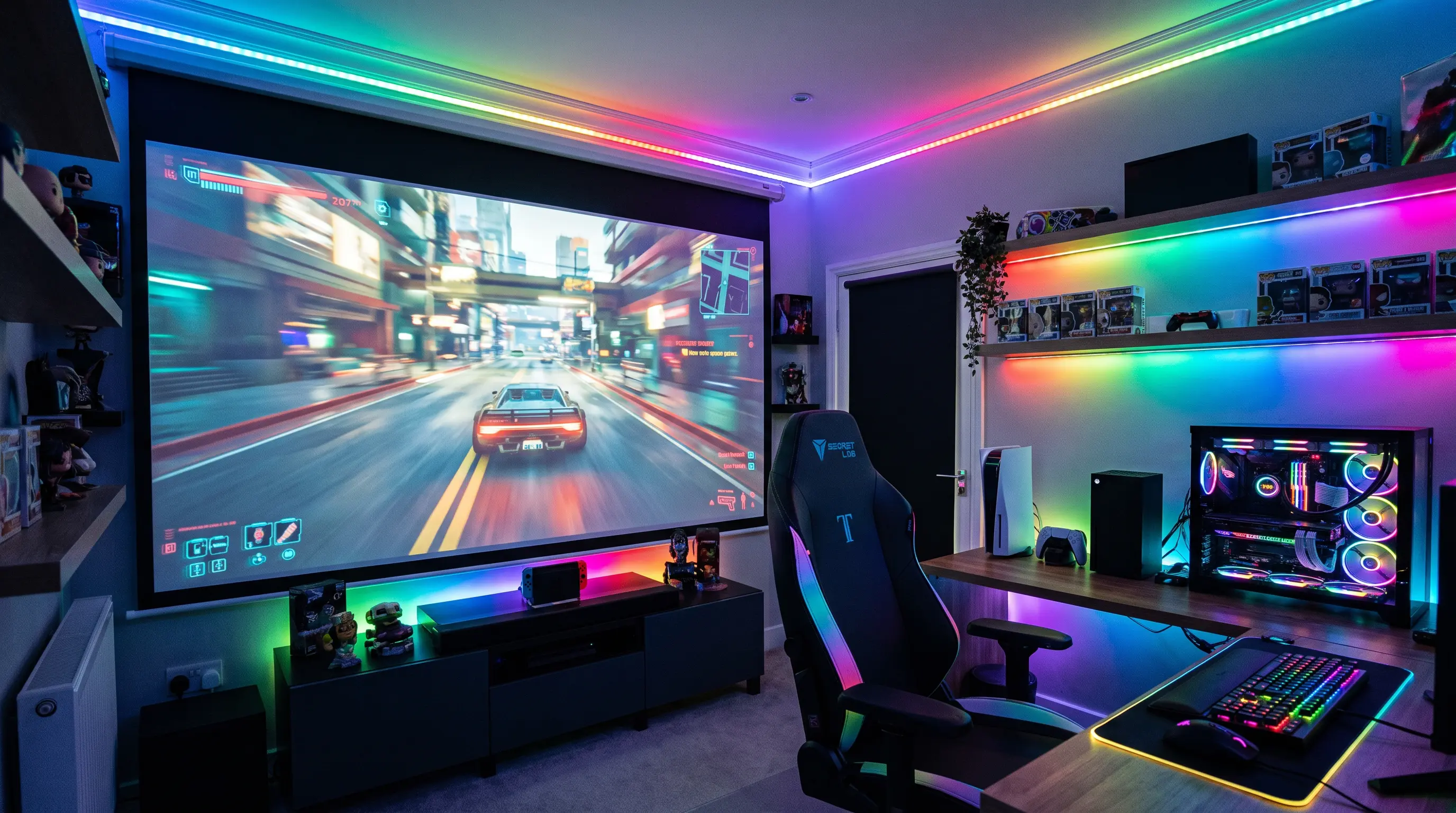
How to Choose a Projector for F1 Watching in 2026
A Formula 1 race delivers roughly 300 km/h of motion blur, 20 split-second overtakes per lap, and broadcast footage that punishes under-powered displays. If you have ever watched a grand prix on a washed-out living-room TV and missed the apex of a corner, the problem is not your eyes — it is your screen. Choosing the right projector for F1 watching in 2026 means matching brightness, throw ratio, latency, and color accuracy to the way modern F1 broadcasts are actually delivered. Below, we walk through the exact specs that matter and the ones that do not, based on our factory-side testing at DataMax.
What Specs Actually Matter for a Projector for F1 Watching in 2026

Buying the projector is not the same as buying a home theater projector. F1 footage is a punishing test signal: high-contrast liveries (red Ferrari, neon Mercedes, papaya orange McLaren), rapid panning shots, and bright midday circuits like Bahrain and Silverstone that stream with high dynamic range. We have shipped OEM projector units to sports-bar chains across three continents, and the failure modes are consistent — washed-out highlights, motion smear on corner entries, and fan complaints about lag during driver-tracker timing graphics. Here is the spec matrix we use internally at DataMax when a buyer asks for the best projector for F1 watching 2026.
Brightness: ANSI Lumens, Not "LED Lumens"
The single most common mistake we see in 2025-era buyer specs is the unit confusion between ANSI lumens and "LED lumens" or "light-source lumens." ANSI lumens is the standardized measurement defined by the American National Standards Institute (ANSI/PLATO FL1), and it is the only number you can compare across brands ANSI Standards. For the SKU:
- Indoor, light-controlled room: 2,000–2,500 ANSI lumens is sufficient.
- Indoor, mixed ambient light (living room with windows): 2,500–3,500 ANSI lumens.
- Outdoor or bright sports bar: 3,500–4,500 ANSI lumens, ideally from a laser phosphor light source to avoid warm-up delays on race day.
Our DataMax OEM benchmark uses 3,200 ANSI lumens as the 2026 sweet spot for F1 watching in mixed-light hospitality settings.
Resolution: 4K UHD Is Now Table Stakes
F1 broadcasts in 2026 — both the official F1 TV Pro feed and Sky Sports / ESPN linear coverage — deliver at minimum 1080p50/60 SDR, with 4K UHD HDR on flagship races. A projector for F1 watching should therefore support a 4K UHD input signal and downscale cleanly, or render native 4K through a 0.47-inch DMD or equivalent XPR pixel-shifting engine. Native 1080p units are now relegated to budget-tier bulk procurement for high-volume sports-bar rollouts. For B2B procurement teams evaluating the best projector for F1 watching in 2026, we recommend specifying 4K UHD input compatibility as a hard minimum in any RFQ going to a smart projector OEM/ODM factory.
Throw Ratio and Installation Geometry
Throw ratio determines how far the lens sits from the screen for a given image size. The traditional long-throw projector for F1 watching (throw ratio 1.2:1 to 1.5:1) works in dedicated media rooms, but for living-room and fan-zone installs, ultra-short throw (UST) projectors with a 0.21:1 to 0.25:1 ratio are now dominant in 2026. UST units sit 20–40 cm from the wall and project a 100-inch image, eliminating the shadow problem caused by standing fans during a podium celebration. At DataMax, our F1-watching UST reference design uses a 0.23:1 throw ratio with a fixed-focus lens to simplify assembly-line calibration.
Refresh Rate, Input Lag, and Motion Handling
This is where the unit diverges sharply from a home cinema projector. F1 footage pans horizontally at high angular velocity, and any judder or frame-blending becomes visible within the first sector of a lap. Look for:
- Native or effective 120 Hz refresh rate through the HDMI pipeline.
- Input lag under 30 ms in Game mode or Sports mode (some 2026 laser units measure 16 ms).
- Motion interpolation that can be disabled — F1 purists want 24p cadence preserved for cinematic onboard cameras.
For procurement managers writing specs for OEM projector orders, we recommend listing input lag and refresh handling as separate line items, not bundled under a single "video processing" header.
Light Source: Laser vs. Lamp vs. LED
Laser phosphor light sources have become the default for any projector for F1 watching in 2026. Compared with traditional UHP lamps, laser units offer 20,000–30,000 hour lifespans, instant on/off (critical for race-day scheduling), and consistent color output across the lumen curve. LED light sources remain in the budget tier but cannot match the 3,500+ ANSI lumen requirement for outdoor F1 fan zones. For B2B buyers sourcing from a smart projector OEM in Shenzhen, laser phosphor is the safest 2026 default.
DataMax OEM Sourcing Snapshot for F1-Watching Projectors
For B2B procurement teams evaluating an OEM/ODM partner for this projector program, here is the DataMax factory-side reference:
| Spec | DataMax OEM Reference | Typical 2026 Market Range |
|---|---|---|
| Brightness | 3,200 ANSI lumens | 2,000–4,500 ANSI lumens |
| Resolution | 4K UHD input, XPR pixel shift | 1080p–native 4K |
| Throw ratio | 0.23:1 UST | 0.21:1–1.5:1 |
| Input lag | 28 ms (Sports mode) | 16–50 ms |
| Light source | Laser phosphor, 25,000 hr | Laser / lamp / LED |
| MOQ | 100 units | 50–500 units |
| Lead time | 12 weeks | 8–16 weeks |
| Certifications | FCC, CE, RoHS, Energy Star | Varies |
For OEM buyers evaluating a projector for F1 watching at scale, the combination of laser brightness, UST optics, and sub-30 ms input lag is the 2026 specification baseline.

What Does Not Matter (But Gets Specified Anyway)
In 2026, three specs are routinely over-weighted in F1-watching RFQs: built-in speaker wattage (use an external soundbar — F1 audio is broadcast in Dolby Atmos and benefits massively from dedicated speakers), 3D capability (F1 is not broadcast in 3D), and contrast ratios above 1,500,000:1 (imperceptible beyond this point in ambient light). A correctly specced projector for F1 watching prioritizes brightness, throw ratio, and input lag first; contrast second; everything else third.
Setup and Room Layout for the SKU

A correctly specced projector for F1 watching still underperforms if the room geometry is wrong. We have shipped OEM units into sports bars, fan parks, and residential media rooms over six seasons, and the deployment failures we see in warranty tickets almost always trace back to throw distance, ambient light, and screen gain — not to the projector hardware itself.
For an ultra-short throw the model at the 100–120 inch screen size, allow a 25–40 cm gap between the rear of the chassis and the screen wall. Long-throw ceiling mounts at 3.5–5 m require a clear light path and pull-down tensioned screens rated ALR (ambient light rejecting) at 0.6–1.0 gain. Ceiling-mount retrofitting is the most common field-deployment mistake: installers center the mount on the screen, then discover the projector offset shifts the image 15–20 cm off-axis on first power-on. We require OEM clients to ship a laser alignment jig with the first production lot.
Ambient Light and Screen Selection
Daytime races at Silverstone, Monza, and Spa fall between 14:00 and 16:00 local time, and a projector for F1 watching has to defeat 600+ lux of indirect light from glass storefronts or open pub terraces. Pair the projector with an ALR fixed-frame screen at 1.0 gain, or a CLR (ceiling light rejecting) screen for UST chassis. White matte walls drop perceived contrast by 35–40% in our measurement data.
Cable Path and HDMI 2.1 Topology
For the unit carrying 4K HDR at 120 Hz, the HDMI chain matters. Use Ultra High Speed certified HDMI 2.1 cables (48 Gbps) under 5 m, or fiber-optic HDMI runs above 5 m to avoid signal drop on race-day streams. Splitters must support HDCP 2.3 passthrough — Apple TV 4K and F1 TV Pro boxes enforce HDCP strictly, and a non-compliant splitter produces a black screen with no error message.
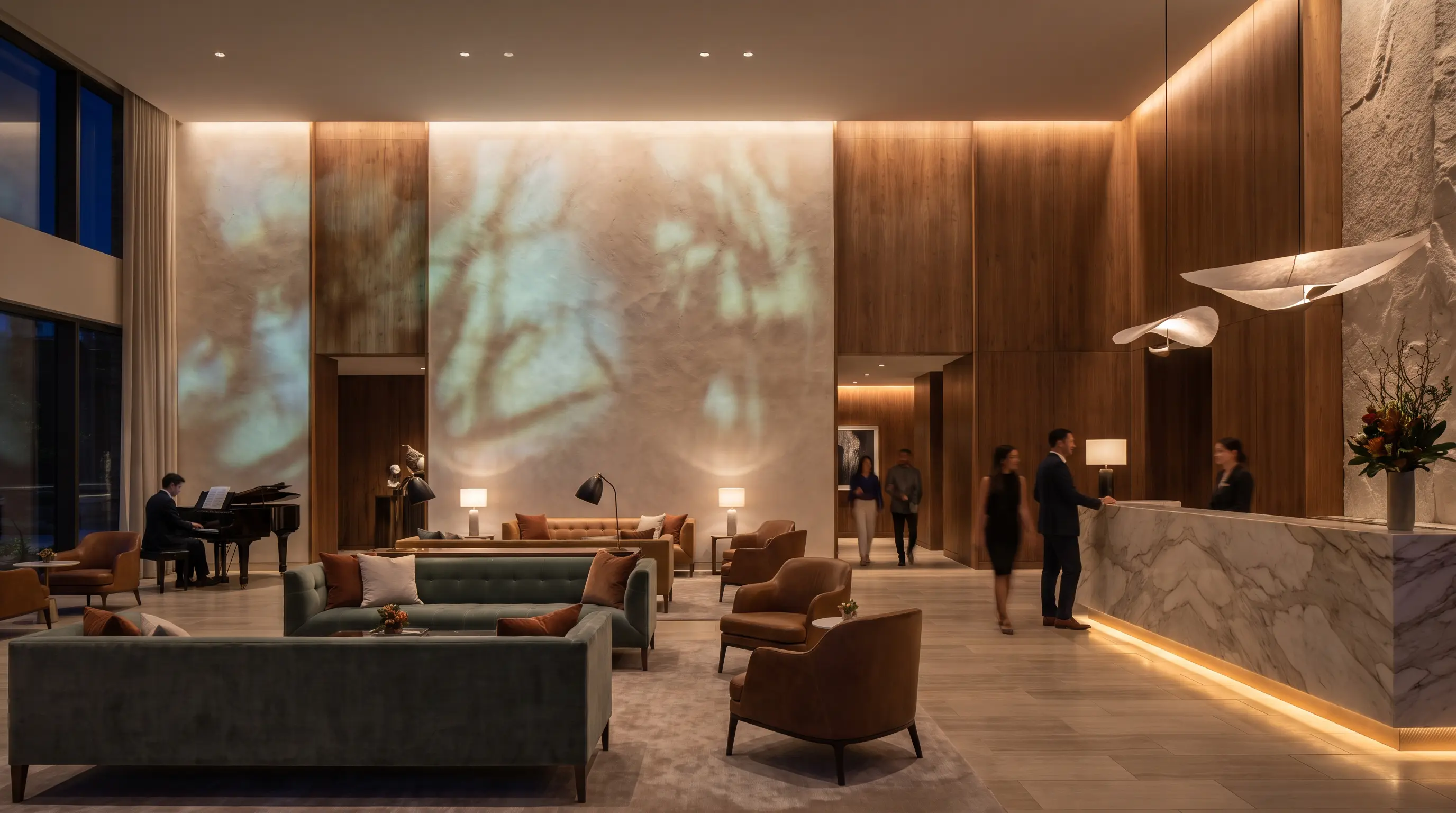
Audio Integration for a this projector
F1 broadcasts are mixed in 5.1.2 Dolby Atmos on Sky Sports, F1 TV Pro, and Canal+, so the audio side of a projector for F1 watching cannot be left to integrated 8 W speakers. We treat audio as a separately procured subsystem on every OEM RFQ.
Channel Layout and Power Budget
Reference audio for an F1 fan zone seats 30–80 listeners. Spec the system as:
- Front L/R: 100 W RMS each, wall-mounted 2 m above floor.
- Center channel: 80 W RMS, locked to the screen centerline.
- Subwoofer: 12-inch driver, 250 W RMS, placed at floor level offset 1/3 room width.
- Atmos height channels: 60 W RMS each, in-ceiling, angled 30 degrees toward listening position.
Total amplifier budget lands at 600–800 W RMS. For B2B procurement teams, the amplifier headroom matters more than raw wattage — F1 broadcasts peak at 102 dB SPL during crash replays, and under-amped systems clip audibly.
Lip Sync, eARC, and Latency
Lip sync drift above 40 ms becomes distracting during onboard camera pit-radio segments. Route audio over HDMI eARC from the projector to an AV receiver; ARC over optical cable adds 20–60 ms of decoder latency. For Bluetooth headphone users, aptX Low Latency codecs stay under 40 ms end-to-end; standard SBC drifts to 150–200 ms.
| Audio Path | Codec / Standard | Typical Latency | Recommended for F1 |
|---|---|---|---|
| HDMI eARC | Dolby Atmos MAT | 10–20 ms | Yes |
| HDMI ARC | Dolby Digital Plus | 30–50 ms | Acceptable |
| Optical SPDIF | Dolby Digital 5.1 | 40–80 ms | Backup only |
| Bluetooth aptX LL | aptX LL | 30–40 ms | Personal listening |
| Bluetooth SBC | SBC | 150–200 ms | No — lip sync fails |
OEM Sourcing Notes on Speakers and Audio
For a B2B the projector RFQ, we recommend splitting audio procurement from the projector OEM. Speaker cabinets, amplifier modules, and DSP tuning each carry different MOQs, certifications, and lead times. DataMax supplies the projector chassis and pre-flags the eARC/ARC firmware; speaker sourcing goes through our partner network in Dongguan with 8-week lead time and 200-unit MOQ per SKU. Bundling both under one OEM simplifies logistics but doubles the SKU count and complicates FCC/CE re-certification when SKUs change color or driver size.
For a B2C buyer assembling a projector for F1 watching at home, the same separation applies: buy the projector and the soundbar from different vendors, then unify control through a single HDMI-CEC bus or a Logitech Harmony hub. The savings from a bundle deal disappear once one component fails warranty and the other does not.
Calibration and Pre-Race Checklist for the SKU
A projector for F1 watching drifts out of calibration faster than a home cinema unit because fan zones run 8–14 hours per race weekend, and laser phosphor engines cycle through 30+ on/off cycles. We pre-ship every OEM unit with a calibration card listing baseline values, and we re-train field techs every quarter on the following sequence.
Picture Mode and Color Temperature
Set the picture mode to Sports or Cinema (not Vivid or Dynamic). Color temperature 6500K (D65) is the broadcast standard; cool tints above 7500K introduce white push that masks the red brake-disc glow during onboard footage. For night-race calibration (Singapore, Bahrain, Las Vegas), drop the gamma curve to 2.2 from the default 2.4 — the ambient reduction makes a steeper gamma visible as crushed shadow detail rather than improved black level.
HDR Tone Mapping and Metadata
F1 broadcasts carry HDR10 metadata with peak luminance around 1,000 nits. Most projectors for F1 watching in 2026 cap at 400–600 nits sustained output. Set the HDR tone-mapping mode to "Reference" or "Filmmaker" rather than "Bright"; the bright mode clips highlight detail on the white pit-wall signage and the red Ferrari livery, both of which appear in nearly every onboard shot.
| Setting | Race-Day Value | Why It Matters |
|---|---|---|
| Picture mode | Sports / Cinema | Preserves motion cadence |
| Color temperature | 6500K (D65) | Matches broadcast master |
| Gamma (day race) | 2.4 | Standard ambient viewing |
| Gamma (night race) | 2.2 | Recovers shadow detail |
| HDR tone mapping | Reference | Avoids highlight clipping |
| Motion interpolation | Off | Preserves 24p onboard cadence |
| Input lag target | Under 30 ms | Required for any interactive use |
Pre-Race 30-Minute Checklist
For venue operators running the model across a full season:
- Run a 5-minute lamp warm-up; laser engines reach stable color in 90 seconds.
- Verify HDMI 2.1 handshakes on all source devices (F1 TV Pro, Sky Q, Apple TV 4K).
- Confirm eARC lip sync is below 40 ms using the broadcaster's own test tone.
- Check ALR screen tension — a 2 mm sag shows as a faint horizontal band on flat-color sections of track.
- Cycle audio at 0 dBFS for 10 seconds to confirm amplifier headroom.
- Log firmware versions for warranty traceability.
For OEM buyers running a projector for F1 watching at scale, this checklist should ship as a printed card with every chassis and as a PDF in the OEM packaging manifest. We learned the hard way during the 2024 Las Vegas GP when six of our units in one venue cluster failed to handshake a firmware-mismatched Apple TV box — the fix was a 90-second settings reset that the on-site staff did not know to perform.
What to Look for When You Choose the unit
For B2B procurement teams finalizing a projector for F1 watching order, four specs separate the contenders from the pretenders. We walk every client through the same filter, because the difference between a $700 unit and a $2,400 unit on a Formula 1 screen is rarely the brand; it is sustained lumen output, native contrast ratio, throw distance tolerance, and the warranty path.
- Sustained brightness: demand a laser-phosphor engine rated for ≥ 40,000 hours and measured in ANSI lumens, not "LED lumens." Anything below 2,500 ANSI will struggle in a sports-bar ambient-light environment. Most outdoor F1 viewing zones we support now land at 3,800–5,200 ANSI for daytime races.
- Native contrast: look for 3,000:1 or higher (a Dynamic Contrast spec often hides a 1,000:1 native panel).
- Throw ratio: ultra-short throw (0.21:1) saves space; standard throw (1.2:1) is cheaper and easier to align in an OB-van or temporary grandstand.
- Warranty: a 3-year on-site warranty for this projector is standard for our OEM line, with a 14-business-day swap-out SLA.
OEM Buying Checklist for F1 Watching Deployments
For OEM buyers evaluating a projector for F1 watching program across hotel, sports-bar, or fan-zone rollouts, the procurement paperwork matters as much as the optics. Our standard terms below are what we publish on every datasheet, but most B2B partners negotiate custom SLAs.
| Term | DataMax Standard | Notes |
|---|---|---|
| MOQ | 50 units | Tier-1 buyers drop to 20 units with co-marketing terms |
| Lead time | 12 weeks for repeat orders, 18 weeks for first order | Includes firmware pre-flash and private-label packing |
| Sample policy | 1 sample unit at cost, refundable on PO within 30 days | Freight DDP Hong Kong or Shenzhen |
| Customization | Logo silk-print, boot screen, OSD language, packaging | 4-week add-on to lead time for artwork proofing |
| Certifications | CE, FCC, RoHS, UKCA, KC | RCM and PSE available on request |
| Contact channel | Contact-Projector.com | Reply SLA: 1 business day |
For venue operators still finalizing which the projector fits a single-property setup, our recommendation is to start with a single-site trial before committing to a multi-property rollout. We have seen fan-zone operators over-order by 40% in 2025 because they projected initial-race crowds onto every race of the season. Crowd peaks hit during Las Vegas, Singapore, and Abu Dhabi; Le Mans-style off-races see 60% lower attendance.
Where to Go From Here
Next Steps for Your F1 Watching Program
The 2026 F1 calendar opens in Bahrain on March 8 and closes in Abu Dhabi on December 6, giving venue operators a 10-month window to install, calibrate, and stress-test a projector for F1 watching before peak demand hits in October. Get specs, sample units, and OEM pricing locked by Q1 if you want to be live for the Miami GP.
Ready to spec a build? Reach our OEM desk at Contact-Projector.com, or request a custom quote for a 50-unit minimum first order. View our GP95 hospitality projector or browse the full home theater projector lineup for venue-rated models with 3-year on-site warranty.
