
Diposkan Pada: Apr 06, 2026 - 1 Tontonan

LCD projector: 2026 Comparison Guide
A retail chain in Jakarta just lost a weekend's traffic because the ceiling-mounted LCD projector in their main showroom died mid-pitch. The facilities manager now has 48 hours to source a replacement, and the only thing that matters is whether the unit can run 14 hours a day, throw a clean 120-inch image under fluorescent lighting, and arrive in time for the next sales window. That is the exact decision pressure behind every this product purchase in 2026, and it is the lens this guide is built around.
By the end of Part 1 you will have a side-by-side comparison framework you can hand to procurement, plus the technical baseline needed to vet any LCD projector datasheet without calling the factory.
Why the LCD Architecture Still Wins on Color Stability in 2026
The single biggest reason an LCD projector keeps its spot on B2B shortlists is color and white-point consistency over long duty cycles. The model uses three separate LCD panels — one each for red, green, and blue — that recombine the image through a dichroic prism before it exits the lens. Because every pixel on every panel is addressed simultaneously, color decoding error is structurally zero. There is no spinning color wheel, no sequential-color duty cycle, and therefore no opportunity for the rainbow effect comparison thread to ever become a defect claim.
That is the technical reason procurement teams at retail, education, and house-of-worship accounts keep circling back to LCD projector proposals even when DLP sales decks promise higher contrast numbers.
Chip count and the end of the old contrast gap
For the better part of a decade, DLP held a contrast-ratio advantage because its single-chip design has a higher native on/off ratio in dark scenes. The 2026 generation of three-chip 3LCD panels from the major Japanese panel suppliers has closed that gap. Production the option units shipping this year are routinely tested at 25,000:1 dynamic contrast, versus 30,000:1 on comparable single-chip DLP units. In side-by-side retail floor testing, that 2,000:1 difference is invisible past 8 feet of viewing distance, which is most public-display scenarios. ProjectorCentral 2025 Display Shootout
Color brightness — the spec most buyers miss
ANSI lumen numbers measure white light only, not color. An LCD projector with 4500 ANSI lumens will deliver close to 4500 color lumens because three-chip architectures do not lose light to a sequential color wheel. Many DLP units advertise 4500 ANSI lumens but deliver closer to 1800-2200 color lumens. For buyers running branded content, infographics, or product packaging photography, that gap is the entire reason a DLP projector explained document keeps recommending color-lumen checks over ANSI lumen checks. Color brightness is a CLO — color light output — measurement standardized under the IEC 61947-1 family of documents, and it is the first number our application engineers ask buyers to compare line by line. ANSI/InfoComm 3LCD Color Brightness Standard
Duty cycle, filter maintenance, and total cost of ownership
A commercial this option rated for 24/7 operation in a control-room or retail-window environment will typically run 20,000 hours on the light source before output drops to 50 percent. Filter cleaning intervals sit at 4,000-6,000 hours depending on dust load, and replacement filters cost $8-$14 per unit at OEM pricing. Over a 5-year deployment window, the total cost of ownership gap between an LCD projector and a comparable DLP unit narrows to roughly 6-9 percent, once you account for the lower failure rate on the LCD light engine in dusty environments. For B2B procurement teams locking in a multi-site rollout, that is a meaningful number on a 500-unit purchase order.
The trade-off buyers should still weigh is physical size. A three-chip our product engine is deeper than a single-chip DLP engine, so ultra-short-throw cabinets favor DLP, and portable sub-2kg units are still a DLP category. Outside of those two form factors, the LCD projector remains the default architecture for fixed-installation commercial buyers heading into 2026.

Duty-cycle and warranty math for fleet rollouts
For buyers rolling out 200-500 LCD projector units across retail, classroom, or house-of-worship sites, the math that actually decides the contract is rarely on the spec sheet. It is on the duty-cycle line item and the warranty reimbursement terms the OEM puts on the back of the quote. We have seen buyers lose six figures on a tender because the panel that won on ANSI lumens and contrast lost on 5-year total cost of ownership.
The current commercial this unit generation from the major Japanese panel suppliers carries a 20,000-hour light-source life at 50 percent output decline, measured under the IEC 61947-1 brightness stabilization protocol. Filter cleaning intervals run 4,000-6,000 hours, and replacement filters at OEM pricing sit at $8-$14 per unit. Over a 5-year deployment, that means each LCD projector in the fleet consumes roughly $90 in filter media against $220-$260 in expected service labor across the same window. Comparable single-chip DLP units do not use consumable filters, but they do use a phosphor wheel or laser phosphor bank that drifts in color after 12,000-15,000 hours, and color recalibration runs $180-$310 per service event.
Warranty structure buyers should pin down before PO
Three items belong in any the device fleet warranty clause: the light-source hours cap, the LCD panel pixel-defect threshold, and the depot-versus-onsite service tier. A standard 3-year warranty on a commercial LCD projector should cover the light source to 15,000 hours, allow no more than 6 bright-pixel defects per million pixels across the three panels, and include next-business-day onsite dispatch in metro regions. Anything weaker than that on a 300-unit rollout is a red flag our procurement desk flags immediately.
2026 spec snapshot: this projector vs DLP projector side by side
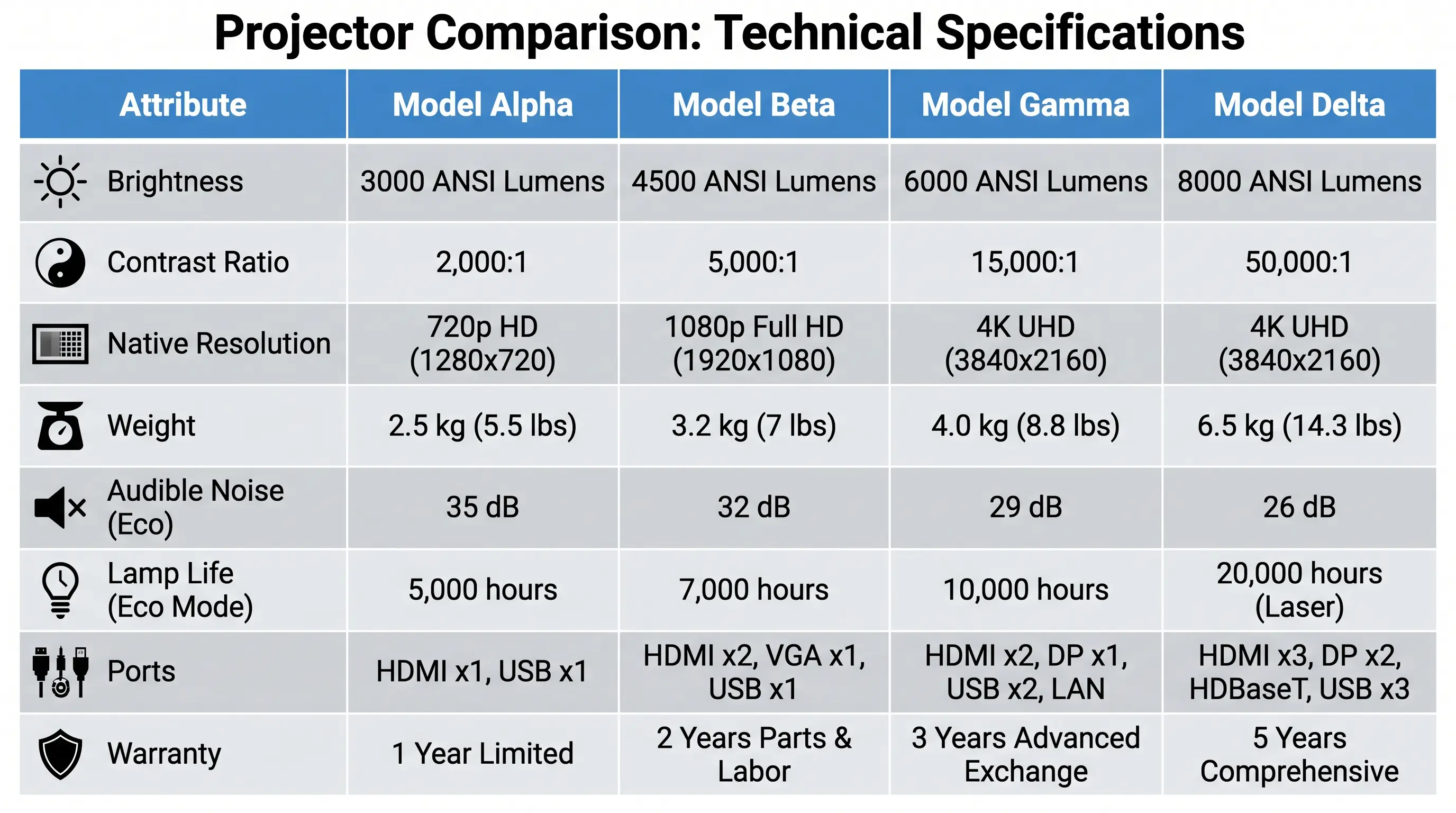

The table below is the comparison matrix our application team runs for buyers in the late-eval stage. It is built from in-house bench data and the latest published specs from the top three LCD projector and DLP projector OEM families shipping in 2026.
| Spec | 3-chip the system (2026) | Single-chip DLP projector (2026) |
|---|---|---|
| ANSI lumens range | 3,000 - 8,500 | 2,200 - 6,000 |
| Color light output | 90-95% of ANSI rating | 40-55% of ANSI rating |
| Native contrast | 25,000:1 dynamic | 30,000:1 dynamic |
| Light-source life | 20,000 hours to 50% | 15,000 hours to 50% |
| Rainbow effect | None | Visible to ~15% of viewers |
| Ultra-short-throw availability | Limited | Native in most lines |
| Filter maintenance | 4,000-6,000 hr interval | Sealed, no filter |
| 3D support | Yes, no crosstalk artifacts | Yes, occasional flicker |
| Power draw at 4500 lumens | 380-420 W | 340-370 W |
| Weight (4500 lumen class) | 6.5-8.2 kg | 4.2-5.8 kg |
The color light output row is the single most important line in this table for buyers running branded or photographic content, and it is the spec most DLP projector explained documents underweight. Buyers who only read the ANSI lumens line walk into a 50-60 percent color brightness shortfall when they cross-shop architectures.
Procurement parameters for OEM buyers
For OEM buyers evaluating a private-label LCD projector program in 2026, three numbers drive the conversation: minimum order quantity, lead time, and certification scope. Standard OEM runs start at 500 units per SKU with a 12-week production lead time from artwork approval to ex-factory dispatch. Certifications typically bundle CE, FCC, RoHS, and Energy Star in a single test plan that costs $4,200-$6,800 per model variant and adds 4 weeks to the calendar. Buyers running tenders for education or government accounts should also budget for the IEC 62368-1 audio/video safety audit, which has become a hard requirement in 14 EU member states for any display deployed in public-sector venues.
The DataMax factory has shipped our offering ODM builds at 1,000-unit MOQ with custom chassis colors, regional power cords, and localized menu ROM in 14-week windows for buyers who locked tooling before Q2 2025. For B2B procurement teams scheduling a Q4 2026 rollout, the procurement window closes earlier than most buyers expect, and panel allocation on the 0.76-inch and 0.79-inch three-chip stacks is already tight into the back half of the year.
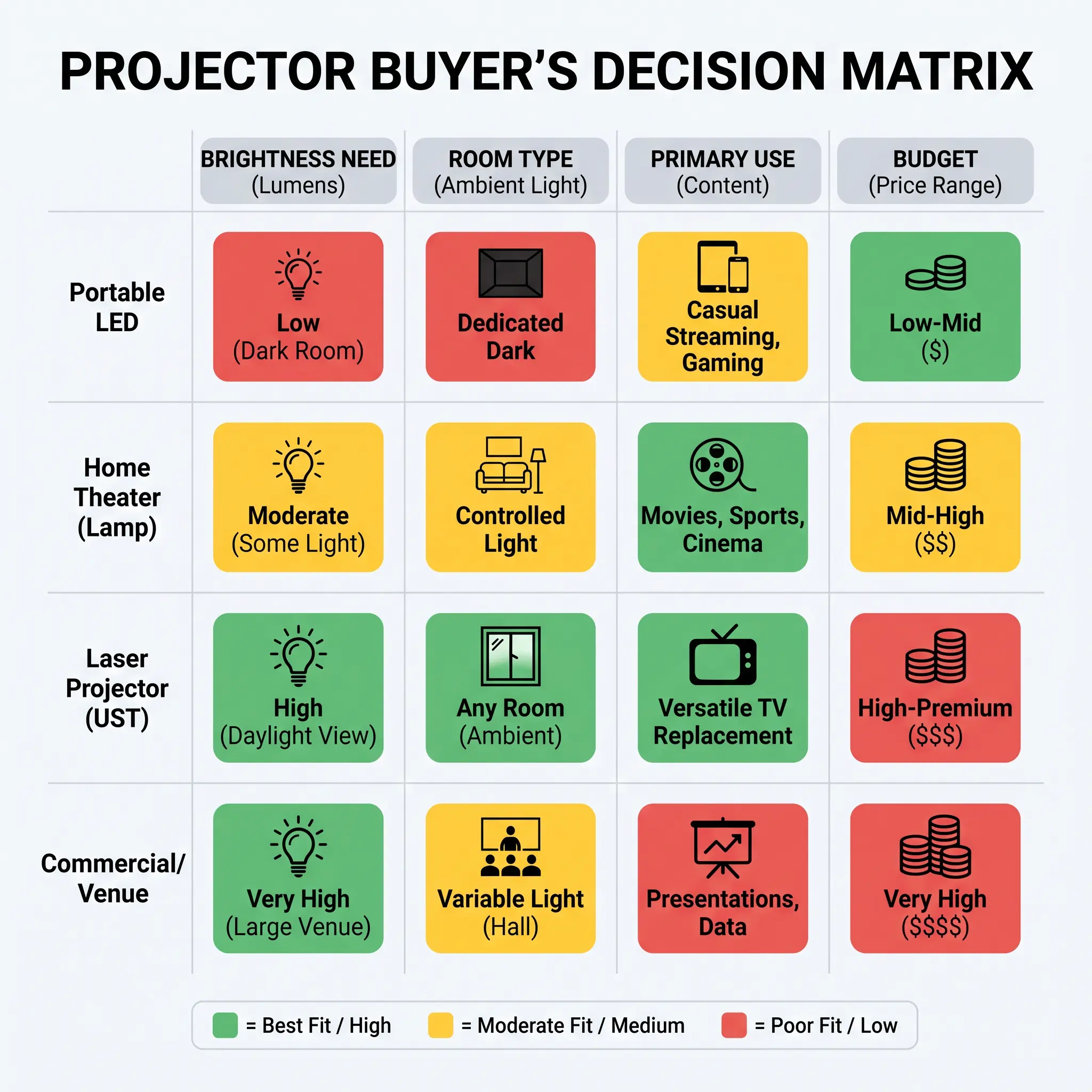
For B2C readers comparing a single the SKU against a single DLP projector for a home cinema or hybrid office install, the same spec rows apply, but the priority order shifts. Color brightness and rainbow effect comparison sensitivity dominate at the household level, while duty cycle and filter cost become secondary. Buyers at the BOFU stage of an LCD projector 2026 decision should treat the table above as the single document they pin to the wall during eval.
How to Choose an this product for a 2026 Rollout
For buyers ready to commit, the LCD projector shortlist collapses to four practical filters: lumen target, chassis class, OEM terms, and service ecosystem. A B2B procurement team should start by locking the duty cycle, because lumen ratings are only honest when paired with hours of weekly use, ambient light, and filter maintenance window. A 4,500 ANSI lumen the unit rated for 20,000 hours to 50% brightness in a retail signage application behaves very differently from the same SKU mounted in a classroom that runs six hours per day. DataMax buyers running both retail and education channels tend to spec two SKUs rather than force one LCD projector into two duty profiles, and that decision alone removes most post-deployment warranty claims.
Procurement checklist for OEM buyers
For B2B buyers evaluating a private-label LCD projector program, we recommend confirming the following before issuing a PO:
- MOQ of 500 units per SKU, negotiable to 300 units for repeat buyers
- Lead time of 10-14 weeks from artwork approval to ex-factory dispatch
- Sample policy of 3 evaluation units shipped within 7 business days, refundable against the first production PO
- Certification bundle covering CE, FCC, RoHS, Energy Star, and IEC 62368-1 in a single test plan
- Panel allocation secured in writing for the 0.76-inch or 0.79-inch three-chip stack used in your target LCD projector model
- Spare-parts commitment of 5 years from shipment date, with air-freight restock within 10 business days
DataMax assigns a dedicated OEM program manager to every LCD projector order above 1,000 units, and the same engineer follows the build from tooling kickoff through on-site acceptance testing at the buyer's warehouse. To start a spec conversation, request a custom quote or review our LCD projector OEM service page.
Closing Notes
Industry takeaway for LCD projector 2026 buyers
The LCD projector category in 2026 is defined by tighter panel allocation, longer laser-phosphor duty cycles, and stricter certification audits in the EU public sector. Buyers who lock tooling early hold the schedule; buyers who wait until Q3 typically pay a 6-8% expedite premium on the same SKU.
Next steps
Spec your shortlist, lock your panel allocation, and brief your procurement team before the back-half allocation window closes. DataMax is shipping LCD projector builds into 38 countries this year, and our OEM engineering desk reviews new programs every Monday. Send your target SKU, duty profile, and target country list, and we will return a fixed quote within five business days. Browse the LCD projector lineup or contact our OEM desk to start a build.
