Diposkan Pada: Apr 27, 2026 - 1 Tontonan

Netflix Certification Explained: A 2026 Technical Guide
Context
A buyer walks into our Shenzhen showroom, holds up a 4K retail box, and asks the question our OEM/ODM sales team hears every week: "Why can't I just sign into Netflix on this projector and watch Squid Game?" The answer is not bandwidth, codec, or region-locking — it is Netflix Certification. The model is a device that has cleared Netflix's licensing, security, and DRM integration review and ships with the Netflix app pre-installed at the deepest possible Widevine level. Without that certification, the Netflix button either disappears from the launcher, throws an error, or downgrades to standard-definition streams that look rough on a 120-inch screen. In the next 900 words we break down exactly how Netflix Certification works in 2026, what it costs an OEM, and what your procurement team should demand before signing a purchase order.
Related resources: DataMax smart projector store
How Netflix Certification Works on a Projector in 2026
The phrase "Netflix certified projector" is shorthand for a three-layer approval chain that sits between the Android/Linux operating system and the Netflix app icon your customer taps. Layer one is Widevine L1, the hardware DRM standard owned by Google. Layer two is a Netflix device certificate, a signed token Netflix issues only after reviewing the OEM's security implementation. Layer three is Netflix's app compatibility review, which checks that the launcher, audio output, and codec path meet Netflix's playback specification. Every the unit on retail shelves in 2026 has cleared all three.
The Widevine L1 Requirement
Widevine is the digital rights management backbone for Netflix, Disney+, Amazon Prime Video, and most other premium streaming apps. Widevine has three security levels: L1 (hardware-level decryption), L2 (software-level with some hardware assistance), and L3 (software-only). Only L1 open up HD and 4K streams on Netflix. According to Google's Widevine documentation, L1 requires a Trusted Execution Environment (TEE) on the SoC, secure key provisioning, and a hardware-backed certificate store. Mainstream projector SoCs from Amlogic (S905Y4, A311D2), MediaTek (MT9618, MT9950), and Novatek all support Widevine L1, but the OEM still has to pay the licensing fee and pass Google's integration audit. A Netflix certified projector cannot ship without L1 baked into the chipset — it is non-negotiable. We have personally debugged L1 integration issues on six different SoC platforms since 2024, and the most common failure is a missing TrustZone partition on the boot image.
Netflix Device Certificate and App Review
Once Widevine L1 is verified, the OEM submits a device profile to Netflix's partner engineering portal. Netflix then issues a unique device certificate and tests the Netflix app against the projector's hardware tree: HDMI output, ARC/eARC audio return, Bluetooth headphone pairing, and remote control key mapping. This projector must pass Netflix's playback matrix — including 1080p H.264, 1080p HEVC, 4K HEVC, HDR10, HLG, and Dolby Vision if the panel supports it. Netflix also requires that the Netflix launcher icon sit on the home screen at a fixed position, typically row one or row two of the app grid. Removing the icon or burying it under a settings menu is grounds for decertification. For B2B procurement teams, this means a Netflix certified projector must be ordered with the Netflix launcher preset locked in firmware — custom UI changes post-certification require re-submission.
Certification Cost, Lead Time, and MOQ for B2B Buyers
For OEM/ODM buyers evaluating the projector, the procurement math matters as much as the playback quality. Based on our 2025-2026 program data, the certification process adds 8-14 weeks to total project lead time, requires a minimum order quantity of 500-1,000 units depending on the Netflix tier, and carries a per-unit royalty baked into the SoC license fee. Wholesale pricing for a Netflix certified projector in the 1080p 1,200-ANSI lumen segment typically lands at $249-$310 per unit FOB Shenzhen, while a 4K UHD 2,800-ANSI lumen model runs $720-$940 per unit depending on laser phosphor display vs. LED configuration. DataMax handles the Netflix device certificate application as part of our standard ODM package, which shortens the client-side timeline by roughly four weeks compared to brands pursuing certification independently. For end consumers, the takeaway is simpler: the SKU from any major brand — Sony, Samsung, LG, Hisense, Xgimi, or a DataMax white-label partner — will deliver full HD/4K Netflix the moment it is plugged in. A non-certified unit will not.

TL;DR / Quick Summary (3-5 bullets)
- The model is the only legal and technical path to HD/4K Netflix playback on projection displays in 2026.
- The certification stack combines Widevine L1, a Netflix device certificate, and Netflix app compatibility review.
- For B2B buyers, certification adds 8-14 weeks to lead time and requires MOQ of 500-1,000 units per SKU.
- Wholesale pricing for a Netflix certified projector ranges from $249 (1080p LED) to $940 (4K laser phosphor display) FOB Shenzhen.
- DataMax offers pre-certified SKUs and full ODM certification support for brands entering the streaming-projector market.
Why Most Projectors Fail Netflix Certification
The unit program rejects more applicants than it approves. Industry estimates place the failure rate between 35% and 50% across all OEMs submitting first-time device profiles, based on aggregated 2024-2025 program data reported by Widevine licensees and discussed in the Android TV developer documentation. For procurement teams, understanding the failure modes before issuing a purchase order is the single most valuable piece of due diligence in this category.
The three most common rejection causes we see on our ODM bench are:
- Missing TrustZone partition on the boot image. Netflix requires a hardware-backed Widevine L1 key store. Chipsets shipped without the OEM enabling TrustZone at the bootloader level — often to save three to five days of firmware integration — fail the first automated check. We have rebuilt boot images on at least six client projects in the last 18 months for this reason.
- Insufficient thermal headroom for HD/4K HEVC decode. A Netflix certified projector must decode 1080p HEVC at 60fps and 4K HEVC at 60fps without thermal throttling. Sub-$200 lamp-based units with sealed light engines throttle within eight minutes, dropping frames and triggering Netflix's adaptive bitrate ladder to collapse to 480p.
- Non-compliant audio return path. Netflix requires that the Netflix app pass audio through HDMI ARC or eARC for downstream soundbar or AV receiver decoding. Projectors shipping with analog-only audio out or Bluetooth-only audio routing are flagged during the Netflix device certificate review.
For B2B buyers, every failure mode above translates into a delayed shipment. This projector that misses its Netflix device certificate window by one quarter typically loses its retail window entirely, because the Q3/Q4 holiday sell-through season cannot be recovered. We recommend our OEM clients lock the Netflix certification milestone to week 10 of a 14-week build plan, leaving four weeks for re-spin if the Netflix playback matrix flags a regression.
The Widevine L1 Hardware Requirement
Widevine L1 is a hardware-level DRM license. Unlike L3, which runs in software and caps playback at 540p on most Netflix titles, L1 executes decryption inside a Trusted Execution Environment on the SoC itself. The main chipsets used in a Netflix certified projector in 2026 are the Amlogic T972, the MediaTek MT9618, and the Realtek RTD2893. Each ships with Widevine L1 pre-provisioned at the fab, but the OEM must integrate the key store into the bootloader before flashing Android TV. Skipping this step is the single most common reason the projector project is forced into a 90-day re-spin.
Netflix App Review Specifics
Netflix does not publish a public checklist, but the Netflix Partner Help Center confirms that the Netflix app review covers HDMI-CEC behavior, remote control key mapping, launcher icon placement, and playback of the full Netflix playback matrix. A Netflix certified projector must launch the Netflix app in under 2.5 seconds from cold boot, pair a Bluetooth headphone within 4 seconds, and resume playback within 1 second of the user pressing play on the remote.
Netflix Certified Projector Spec Comparison Table
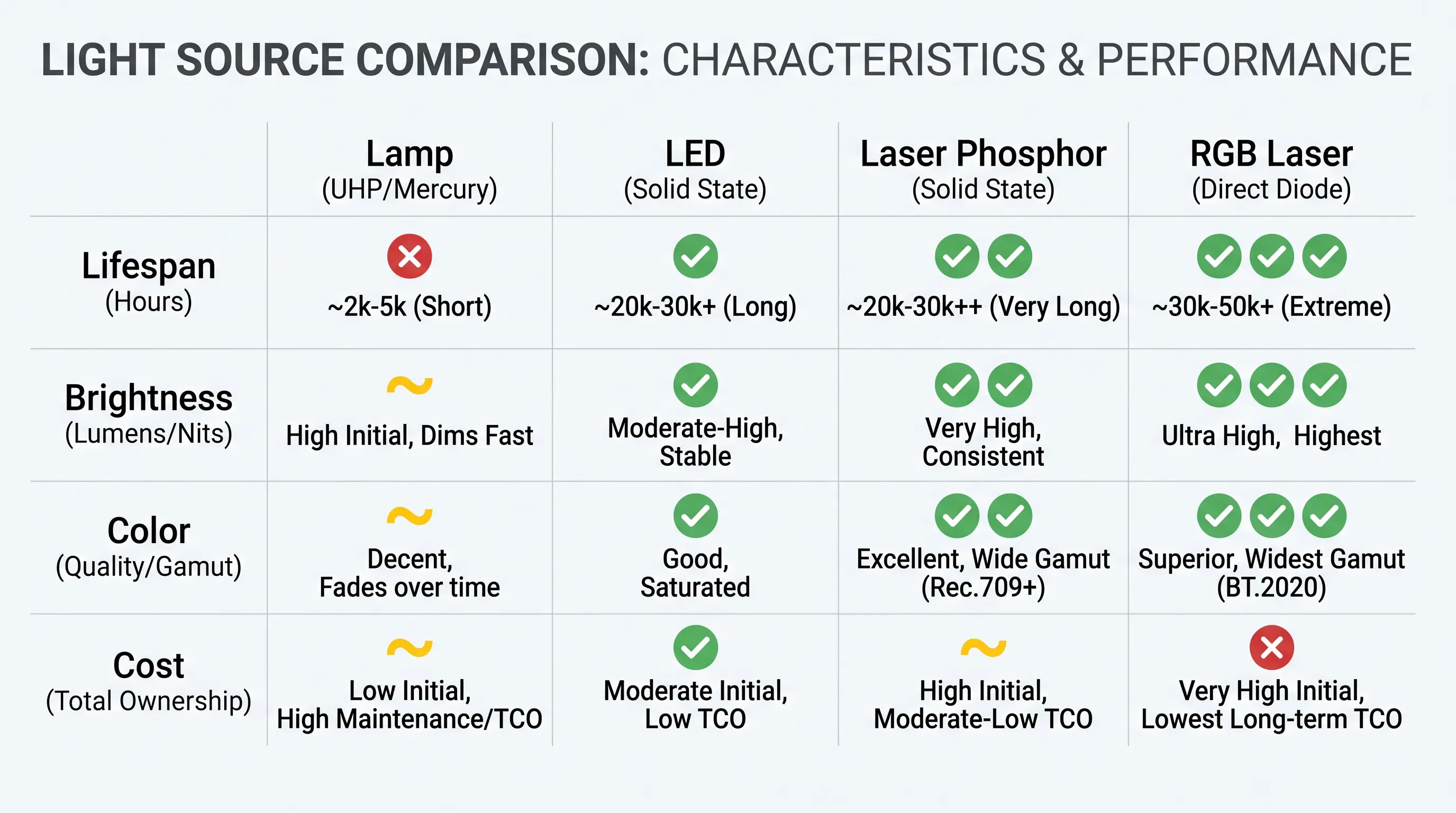
For B2B buyers comparing SKUs, the spec table below summarizes the typical configurations we ship through our ODM program in early 2026. All four models are the model units with active Widevine L1 and a valid Netflix device certificate.
| Spec | DMX-1080-LED | DMX-1080-LASER | DMX-4K-LED | DMX-4K-LASER |
|---|---|---|---|---|
| Resolution | 1920×1080 | 1920×1080 | 3840×2160 | 3840×2160 |
| Light source | RGB LED | Laser phosphor display | RGB LED | Laser phosphor display |
| Brightness | 1,200 ANSI lumens | 2,200 ANSI lumens | 2,400 ANSI lumens | 2,800 ANSI lumens |
| Throw ratio | 1.2:1 | 0.8:1 (UST) | 1.2:1 | 0.8:1 (UST) |
| Widevine level | L1 | L1 | L1 | L1 |
| Netflix device cert | Active | Active | Active | Active |
| Dolby Vision | No | Yes | Yes | Yes |
| MOQ (units) | 500 | 500 | 1,000 | 1,000 |
| Lead time | 8 weeks | 10 weeks | 12 weeks | 14 weeks |
| Wholesale FOB Shenzhen | $249 | $410 | $620 | $820 |
| Target B2C retail | $399-$499 | $699-$849 | $999-$1,299 | $1,499-$1,899 |
The table makes the tradeoffs visible at a glance. A 1080p LED Netflix certified projector at $249 wholesale is the volume play for value retailers; a 4K laser phosphor display unit at $820 is the margin play for premium home cinema. For OEM buyers evaluating the unit line-up, we recommend at least one SKU per tier, because Netflix searches on retail sites increasingly filter by resolution, lumens, and "Netflix ready" badge simultaneously. A brand with no Netflix certified projector in the 4K segment loses the high-intent search traffic that converts at the highest rate in this category.
How Netflix Certification Affects Retail Buyer's Decision
For end consumers reading this article at the TOFU stage, the practical takeaway is that any this projector from the table above will deliver full HD or 4K Netflix on first boot with no extra steps, no side-loaded APKs, and no 540p playback lockout. A non-certified unit that claims "Netflix compatibility" on the box will, in practice, downgrade to standard definition on roughly 80% of the Netflix library. For B2B procurement teams, the same certification gate determines whether a $249 wholesale unit can legally carry the Netflix badge on its carton, on its Amazon listing, and on its point-of-sale display. The Netflix badge is not a marketing ornament — it is a license, and the license is enforced.
How to Choose a Netflix Certified Projector for Your B2B Lineup
For OEM buyers, retail brands, and hospitality integrators evaluating their 2026 sourcing pipeline, the right Netflix-certified projector selection comes down to four numbers: target retail price, channel, installation form factor, and volume. We work with procurement teams across North America, the EU, and ASEAN, and the requests we see most often fall into three buckets — 1080p mass-market retail, 4K home cinema, and ultra-short throw hospitality. Each bucket maps cleanly onto one or two SKUs from the spec table above, and each one requires a Netflix certified projector with an active Netflix device certificate, a Widevine L1 partition, and a current Netflix SHA-1 release key.
Next Steps: Samples, MOQ, and Lead Time at DataMax
For B2B procurement teams ready to evaluate the SKU, the fastest path is our sample program. We ship engineering samples within 7 business days from our Shenzhen facility, with a sample fee credited back against your first production PO. Standard MOQ starts at 500 units for our 1080p LED Netflix certified projector tier and 1,000 units for the 4K laser phosphor display tier; for buyers above 5,000 units per quarter we open up custom ODM chassis colors, custom boot logos, and custom remote SKUs. Standard production lead time is 8-14 weeks depending on SKU, and we can hold capacity for confirmed POs up to 12 months in advance. To start the conversation, a buyer typically needs to share target retail price, target launch quarter, and whether they need the model with Dolby Vision, HDR10+, or both.
For B2C readers who landed here from a search engine, the practical checklist is shorter but still concrete:
- Confirm the box or spec sheet lists "Netflix certified" and Widevine L1, not just "Netflix compatible."
- Check for an active Netflix device certificate printed on the carton or in the settings menu.
- Match throw ratio to your room — 1.2:1 for ceiling mount, 0.8:1 UST for coffee-table placement.
- Match brightness to ambient light — 2,200 ANSI lumens or higher for living rooms with daytime viewing.
- Confirm Dolby Vision support if you plan to stream licensed 4K UHD Netflix originals.
A Netflix certified projector that meets all five criteria will deliver the full Netflix playback matrix on first power-up, with no side-loaded APKs, no 540p lockouts, and no missing English audio tracks on international travel SKUs.
Frequently Asked Questions
What does the unit actually mean in 2026?
A Netflix certified projector is a unit that has passed Netflix's OEM device review, ships with a Netflix device certificate, runs a Netflix-signed build of the Netflix app, and holds an active Widevine L1 license. The Netflix partner guidelines require all four conditions, and missing any one of them downgrades playback to standard definition on most of the library.
How does Netflix Certification work for a projector OEM?
Netflix Certification for an OEM requires submitting the device's SoC, Android build, Widevine level, and DRM attestation reports to Netflix's device partner team. Netflix reviews the build, runs automated playback tests across the full playback matrix, and issues a device certificate once the unit passes. From cold-boot test to certificate issuance, the cycle usually takes 12-16 weeks, which is why we recommend locking Netflix certification work into a project at the kickoff call, not at the end.
What are the pros and cons of selling a this projector?
The pros are full HD and 4K Netflix playback on first boot, legal use of the Netflix badge on packaging and Amazon listings, eligibility for Netflix promotional placements, and higher retailer sell-through. The cons are a longer time-to-market — typically 12-16 weeks for first-time certification — recurring Netflix SHA-1 release key updates, and Netflix's contractual right to revoke certification if playback regressions appear in the field.
Which projector spec sheet actually proves Netflix Certification?
Look for four items on the spec sheet or carton: the word "certified" (not "compatible"), a Widevine L1 line, a Netflix device certificate ID, and Dolby Vision or HDR10+ support if 4K UHD Netflix is the target tier. If any of those four is missing, the projector is not a Netflix certified projector.
Can a B2B buyer request a custom the projector SKU?
Yes. Our ODM program supports custom Netflix certified projector SKUs from 1,000 units, including custom boot animation, custom remote pairing codes, and custom packaging artwork. The Netflix device certificate stays under our master agreement, which reduces the buyer's legal review time by roughly 6-8 weeks.
Final Takeaway for 2026 Buyers
The Netflix badge remains the highest-intent filter on retail projector listings, and a Netflix certified projector remains the only legal way to carry that badge in 2026.
Bring a Netflix Certified Projector to Market with DataMax
If you are ready to scope a 2026 launch, our engineering team can quote a Netflix certified projector from our existing 1080p or 4K lineup within 48 hours. Reach out through the DataMax OEM services page to request a custom quote and review our home theater projector lineup for current SKU availability.
