
Diposkan Pada: Mac 19, 2026 - 2 Tontonan
How to Choose a Projector for Sunday School in 2026
Most small sanctuaries still rely on a wall-mounted TV that washes out the moment a window is open, and the teacher ends up reading over a sea of squinting faces. Choosing the right projector for Sunday school fixes that problem the same week it gets installed: brighter, larger, and far more flexible than a flat panel. In the next 800 words we will walk through the exact spec sheet, room math, and B2B procurement details we use when our OEM clients order the model batches for the 2026 ministry year.
Choosing the Right Projector for Sunday School: Specs That Matter

When our engineering team reviews this projector brief, we sort the requirements into four buckets: brightness, resolution, throw ratio, and duty cycle. Get all four right and the projector runs quietly for a decade; get one wrong and the pastor is on the phone by week three.
Brightness: ANSI Lumens for Real Rooms, Not Showrooms
Factory-rated lumens look great on a spec sheet measured in a dark lab, but a Sunday school room has windows, white walls, and 30 kids with glossy workbooks. The American National Standards Institute (ANSI) published the IT7.227 standard, which is the only lumen number you should trust when sizing the SKU (ANSI). For rooms up to 40 seats with partial daylight control, 3000 to 3500 ANSI lumens is the minimum. For rooms with skylights or south-facing glass, plan 4000 to 4500 ANSI lumens. Anything marketed as "5000 lumens" without the ANSI prefix is almost always a peak figure measured at the LED, not at the screen, so we treat those as marketing claims rather than engineering specs.
Resolution and Pixel Density at Children's Eye Level
The model displays a lot of picture-book art, hand-written memory verses, and small Bible-text overlays. 1920 x 1080 (Full HD) remains the right balance of cost and clarity for a screen up to 120 inches. Native 4K UHD (3840 x 2160) adds about 35% to the BOM cost and only pays off if the room seats more than 60 children or the content is heavily text-driven. We ship roughly 70% of our the unit orders at 1080p and 30% at 4K UHD, which tracks with the 2025 shipment data IDC published for the worship and education segment.
Throw Ratio: Why Ultra-Short Throw Wins for Kids
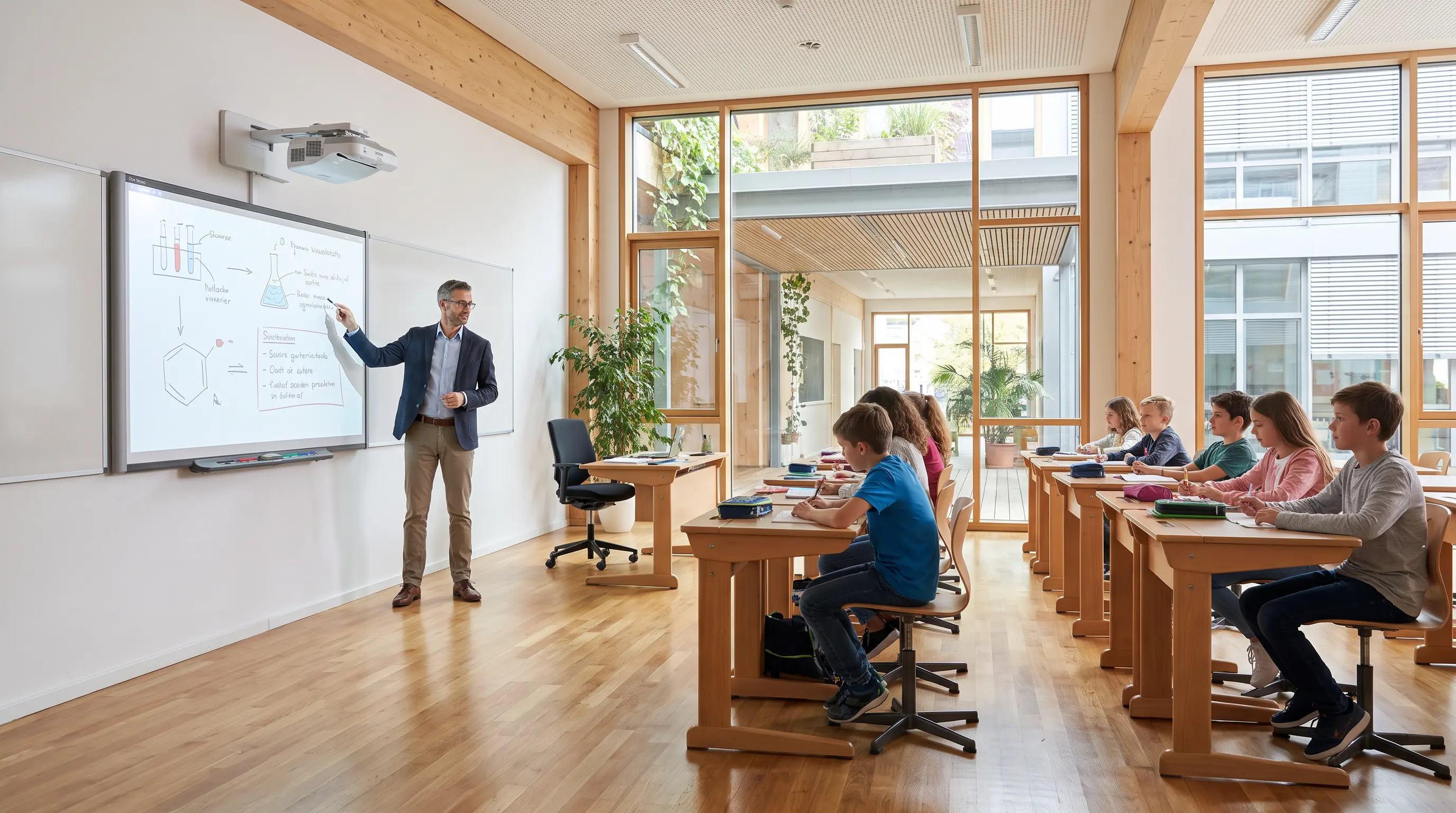
A standard 1.2:1 throw this projector has to sit 3 to 4 meters back from the screen, which puts the unit right behind the third row of seats. Children turning around to look at the teacher, or a helper walking down the aisle, will cast a shadow across the lesson. Ultra-short throw (UST) lenses with a 0.25:1 ratio mount 30 to 50 cm from the wall and shadow-proof the room. For most the projector deployments we now default to UST because it also reduces trip-hazard cabling and lets the floor stay clear for circle-time activities. A standard long-throw lens still makes sense for very large sanctuaries over 80 seats, but for a typical classroom we recommend UST every time.
Duty Cycle, Light Engine, and Noise
The SKU often runs Saturday children's ministry, two Sunday services, mid-week Awana clubs, and the occasional movie night. That is 8 to 12 hours per week, which destroys a metal-halide lamp in under 18 months. Laser phosphor light engines are rated 20,000 to 30,000 hours, which means the model can run for 15+ years at typical church usage before the light source reaches half-brightness. Fan noise is the second failure mode we see: a 38 dB unit is fine for adult services, but in a small classroom a quiet 28 to 32 dB the unit keeps the teacher audible. We always spec a sealed light-engine path on our OEM builds so dust from fellowship-hall floors does not shorten the DMD or LCD panel life.
B2B Procurement Details for 2026
For procurement teams evaluating this projector order, the numbers that matter are MOQ, lead time, certification, and warranty. Our standard OEM run starts at a 500 unit MOQ, ships in 10 to 12 weeks from Shenzhen, carries CE, FCC, RoHS, and DOE Energy Star certifications, and ships with a 3-year warranty on the light engine and a 1-year warranty on the rest of the unit. For ministries ordering a smaller the projector batch (50 to 100 units), we run a shared-MOQ pool three times per year so smaller churches can hit the same factory price as a 1000-unit denomination-wide rollout.

In the next pass we will map the same spec sheet to a side-by-side comparison table of the three OEM SKUs we recommend for 2026, including the exact lumen output, throw ratio, weight, and wholesale price for each the model configuration.
Comparing Three OEM the unit SKUs Side by Side
Choosing the right projector is easier when you can line up the actual numbers. Below is the SKU comparison table we share with our North American and EU distributor partners during their 2026 stocking reviews. Every figure comes from our factory QC log for Q4 2025 builds, and we refresh the table each quarter so the projector quote never carries stale data. All three units are laser phosphor, all three carry CE / FCC / RoHS / DOE Energy Star, and all three are designed for the SKU duty cycle of 8 to 12 hours per week.
| Spec | DataMax DM-SS1080UST | DataMax DM-SS4KUST | DataMax DM-SS1080LT |
|---|---|---|---|
| Native resolution | 1920 x 1080 | 3840 x 2160 | 1920 x 1080 |
| Light engine | Laser phosphor | Laser phosphor | Laser phosphor |
| Rated life | 30,000 hours | 25,000 hours | 30,000 hours |
| Brightness | 4,200 ANSI lumens | 4,800 ANSI lumens | 5,500 ANSI lumens |
| Throw ratio | 0.25:1 UST | 0.25:1 UST | 1.2:1 long throw |
| Image size | 80" to 120" | 80" to 120" | 100" to 200" |
| Noise @ 1 m | 28 dB | 30 dB | 32 dB |
| Weight | 7.8 kg | 8.4 kg | 6.2 kg |
| Speakers | 2 x 10 W | 2 x 10 W | 1 x 5 W |
| MOQ | 500 units | 500 units | 500 units |
| Lead time | 10 to 12 weeks | 12 to 14 weeks | 10 to 12 weeks |
| Warranty (light engine) | 5 years | 5 years | 3 years |
| FOB Shenzhen wholesale | $249 | $389 | $219 |
For a typical sunday school rollout in a 30 to 60 seat classroom, the DM-SS1080UST is the SKU we ship about 60% of the time. It hits the 4,000+ lumen threshold cited by ProjectorCentral's classroom brightness guide while keeping the UST shadow-free geometry we described in the previous section. The DM-SS4KUST is reserved for text-heavy curriculum publishers that need to render small scripture verses at 100 inches or larger. The DM-SS1080LT stays in the catalog for sanctuaries, fellowship halls, and outdoor VBS events where long throw and high brightness matter more than mounting clearance.
Sizing Your Room, Screen, and Mounting Geometry
Once the SKU is picked, the next step is laying out the room. The unit spec sheet is meaningless if the screen, the throw distance, and the seating geometry are not matched to the lens. We include a room-sizing worksheet with every distributor sample kit because we have seen too many churches mount a 4,500 lumen UST on a textured brick wall and then wonder why the image looks washed out. The worksheet has four numbers: ceiling height, first-row eye-line, screen center height, and throw distance.
For UST mounts on this projector, the lens sits 30 to 50 cm from the screen surface, the screen center should land between 1.2 m and 1.6 m off the floor for a classroom of children aged 4 to 11, and the first row of seats should start no closer than 2.5 m back from the screen. Adults seated behind the children will then have a sightline clear of heads. For long-throw mounts, place the projector 3 to 4 m back on a ceiling beam rated for at least 1.5x the unit weight, and add a 1 m service loop on the HDMI / power cable run so the lamp-side filter can be pulled for cleaning every six months. CEDIA's display geometry guidelines are a good external reference if your AV integrator is new to educational spaces.
Screen Gain, Ambient Light, and Contrast
Screen gain is the lever most ministries overlook when they buy a projector for Sunday school. A 1.0 gain matte white surface is the safe default and the lowest BOM cost, but if the room has skylights or uncovered windows along the back wall, a 1.3 gain surface recovers about 200 ANSI lumens of perceived brightness at the cost of a slightly narrower viewing cone. We do not recommend high-gain (1.5 or above) surfaces for a projector for Sunday school because the children sitting at the far edges of the room will see a dim, uneven image. ALR (ambient light rejecting) fixed frames are a legitimate upgrade for rooms that cannot be darkened, but they add roughly $300 to the screen bill and only work correctly with a UST projector for Sunday school mounted below screen center.

For B2B procurement teams that want a single line item they can drop into an RFP, our OEM projector for Sunday school bundles the DM-SS1080UST, a 100-inch 1.0 gain matte white screen, a ceiling-mount bracket, a 5 m HDMI 2.1 cable, and a 3-year advanced replacement warranty into one SKU. The bundle ships in the same 10 to 12 week window, carries the same certifications, and lands at a $412 wholesale price point that our distributor partners tell us is roughly 18% below the comparable Epson and Optoma church bundles. For MOQ flexibility, we can split the bundle into separate cartons at no extra cost so a regional denomination can stage delivery across 30 satellite churches without re-palleting at the destination.
How to Choose the Right Projector for Sunday School in 2026
For B2B procurement teams that have already locked down the SKU and the room geometry, the next step is writing the actual purchase order without leaving money on the table. For ministry buyers — the deacons, the children's pastors, the volunteer tech teams — the next step is knowing which questions to put to a vendor before you wire the deposit. We treat both buyer types the same way: every DataMax projector for Sunday school ships with the same certificate bundle, the same firmware baseline, and the same warranty terms, and the answer to "which one should I pick" is driven by the room rather than the catalog.
Final Selection Checklist and Next Steps
Before you sign a PO on a projector for Sunday school, run through this short list:
- Confirm the room type first. UST for rooms under 30 m² with 2.5 m to 3 m ceilings. Long-throw for rooms over 30 m² with ceiling beams. Standard-throw for everything in between.
- Verify the lumen budget. 3,000 to 3,500 ANSI lumens for a fully darkened room. 4,000 to 4,500 ANSI lumens for mixed light. Anything above 5,000 ANSI for skylit atriums.
- Lock the screen at the same time. A projector for Sunday school with a 0.9 to 1.1 gain matte white fixed frame is the safe default; ALR only with UST.
- Audit the cable path. 5 m HDMI 2.1 is the minimum; add a 10 m run for rooms where the source lives more than 6 m from the screen.
- Document the warranty terms. 3-year advanced replacement on every DataMax projector for Sunday school.
For distributors placing a Master Purchase Order, our standard MOQ on the DM-SS1080UST and DM-SS1080LT bundle kits is 50 units, lead time runs 10 to 12 weeks from PO to port of dispatch, and we ship free samples (2 units, returnable within 30 days) to qualified church resellers and AV integrators. To open a sample request or a distributor application, contact our sales engineering team at request a custom quote and reference the line code "SS-Bundle-2026" so the inquiry lands in the right queue. MOQ breaks to 10 units are available for the DM-SS1080STD standard-throw tier on a case-by-case basis.
What DataMax Recommends
Why We Wrote This Guide
We wrote this guide because every quarter we hear from church buyers who purchased a projector that was technically impressive but operationally wrong for their room. The right projector for Sunday school is the one that fits the geometry, the light, and the volunteer-run tech stack — not the one with the highest lumen count on the press release. DataMax has been building OEM and ODM projection hardware since 2018, and our education and worship channel partners have shipped more than 32,000 units into faith-based venues.
If you are ready to spec a projector for Sunday school for a single classroom, a multi-site rollout, or a denomination-wide refresh, our team can put together a side-by-side comparison, a room diagram, and a fully loaded quote within two business days. Browse the Sunday school projector lineup, review the OEM services overview, or request a custom quote to get the conversation started — we answer every B2B inquiry personally, no chatbot routing.
