
Lagt ut: sep 04, 2026 - 264 Visninger

The moment a buyer drops coin into a classic cabinet, the wrong screen technology can flatten every round of Street Fighter, every lap in Out Run, every combo in Pac-Man. Latency spikes, washed-out colors, and motion smear turn the experience into something closer to a slideshow than the arcade floor it is trying to recreate. Choosing the projector is not the same job as picking one for boardrooms, classrooms, or even living-room Netflix sessions, and the requirements can quietly blow a procurement budget when specs look interchangeable on a spec sheet.
That is why we wrote this guide. Over the next 2000 words you will get a working definition of what an arcade gaming projector has to do, a side-by-side spec table, three real-world use cases (home setup, commercial venue, and OEM integration), and a procurement checklist for 2026.
Hva "arkadeklar" faktisk betyr i prosjektorspesifikasjoner
Most buyers walk into a sourcing conversation thinking they just need "high lumens" or "4K." Both are useful, but neither is the deciding factor for a projector for arcade gaming. Three specs sit above the rest, and they should be the first filter on every RFP or shortlist.
Input lag og oppdateringsfrekvens, målt i praksis
The single most misunderstood spec on projector data sheets is input lag. Manufacturers love to print a "game mode" number, but the value usually represents the best-case scenario with motion smoothing, keystone correction, and noise reduction all turned off. For serious arcade play, anything above 16 ms at 1080p / 120 Hz starts to feel sluggish on fighting games and rhythm titles. A board like a MiSTer FPGA running at 15 kHz has to be upscaled and frame-locked, which adds processing delay that no spec sheet will quote directly. We advise OEM buyers to request a measured lag report rather than a marketing number, and B2C buyers to look for reviewers who publish oscilloscope traces rather than subjective impressions.
ANSI-lumen vs ISO-lumen vs rommet du faktisk har
Brightness standards exist for a reason, and the ANSI / ISO definitions Projector Central publishes in their methodology pages are the reference most engineers use. A projector for arcade gaming in a dark home setup can survive on 2500 to 3500 ANSI lumens. Move that same unit into a venue with overhead lighting, neon signage, or a glass storefront, and the same projector becomes unreadable. Commercial buyers should plan around 4500 to 6000 ANSI lumens paired with a high-contrast ALR screen, while home users can save cost by going to 3000 ANSI lumens on a fixed-frame ambient light rejecting surface.
Fargeomfang og problemet med kabinettgrafikken
Arcade marquees and side art are printed with specific Pantone-style red, cyan, and yellow that cheap light engines desaturate. A DLP unit with a standard RGB LED or laser phosphor light source typically covers 85 to 95 percent of Rec.709, while a 3LCD laser phosphor engine can push past 95 percent and keep skin tones neutral. For fighting games with red life bars and blue super meters, even a 10 percent gap in color gamut is visible. The practical floor we recommend is 90 percent Rec.709, with 110 percent of DCI-P3 as a stretch target for cabinets that display anime or stylized art.
| Spesifikasjon | Minimum for arkadebruk | Anbefalt for 2026 | Premium / venueklasse |
|---|---|---|---|
| Input lag (1080p / 120 Hz) | under 16 ms | under 8 ms | under 4 ms med dedikert modus |
| ANSI-lysstyrke | 2500 ANSI | 3500 ANSI | 4500 – 6000 ANSI |
| Fargeomfang (Rec.709) | 85 % | 90 % | 110 % eller bredere |
| Lyskilde | LED | Laserfosfor | RGB-laser / hybrid |
| Kasteforhold | 1,2:1 | 0,8:1 ultrakort kast | 0,4:1 for erstatning av marquee |
| Naturlig oppdatering | 60 Hz | 120 Hz | 240 Hz ved redusert oppløsning |
| Montering | Stativ / hylle | Tak / bakhylle | Tilpasset kabinettchassis-montert |
Kasteforhold er et geometriproblem, ikke et valg på papiret
Throw ratio quietly derails more arcade builds than any other spec. A standard 1.2:1 lens in a small game room may force the projector 3 meters back from the screen, which collides with the player's seat. An ultra-short throw projector for arcade gaming, in the 0.4:1 to 0.8:1 range, can sit roughly 60 cm from a 100-inch screen and clear the player's headroom entirely. For commercial arcade bars, venue owners often mount the unit above the screen at a steep downward angle, which only works if the lens has vertical lens shift or solid keystone tolerance. We have seen OEM buyers order 200 units of a 1.5:1 model by accident, then rebuild the layout after pilot install, a cost that no wholesale discount recovers.
Tilkobling, latensoverføring og den reelle kostnaden ved adaptere
A projector for arcade gaming is only as responsive as the path between your control board and the imaging chip. Modern JAMMA harnesses, RP2MAME builds, and MiSTer FPGA setups all output over HDMI 2.0 or 2.1, but the board revision, cable quality, and splitter topology each add measurable delay. We have measured 4 to 7 ms of additional lag introduced by cheap passive HDMI splitters on a 1080p/120 Hz signal path, and that figure doubles on adapters that downscale 4K to 1080p. For OEM buyers sourcing a projector for arcade gaming at scale, we recommend specifying HDMI 2.1 with eARC passthrough disabled to reduce handshake time, plus a measured lag budget that includes the harness adapter, not just the engine itself.
| Komponent i signalveien | Typisk tilleggslatens | Tiltak for arkadebruk |
|---|---|---|
| HDMI 2.1 passiv splitter | 4 – 7 ms | Aktiv optisk HDMI-kabel eller fiberstrekk |
| Nedskalerer (4K → 1080p) | 8 – 14 ms | Kjør native 1080p fra FPGA eller MiSTer |
| Trådløs HDMI-forlenger | 15 – 30 ms | Kablet CAT6 eller fiber i venueskala |
| AV-mottaker med DSP | 12 – 25 ms | Bypass-modus eller dedikert HDMI-passthrough |
| Intern prosessering i spillkonsoll | 6 – 18 ms | Spesifikk "Game Mode" deaktivert på vertsenhet |
B2C buyers who only need a single cabinet can ignore most of this table. Procurement teams ordering 50 to 500 units for a venue rollout cannot. Every millisecond you lose to a cheap adapter stack becomes a service ticket, a return, or a negative review chain that hurts brand reputation long after the warranty window closes.
Kabellengde, fiberstrekk og venuearkitektur
Arcade bars and FEC venues routinely run HDMI 15 to 30 meters from a centralized rack to ceiling-mounted projectors over a hundred-inch screen. Standard copper HDMI starts to lose signal integrity past 8 meters at 4K/60, which is why serious installations adopt fiber-optic HDMI or HDBaseT extenders over CAT6A. The fiber option adds roughly 1 ms of latency versus 6 to 10 ms for an HDBaseT extender, a measurable difference in a fighting-game lineup where a 4 ms frame drops to 5 frames per second of perceived speed loss. We advise spec'ing fiber for any new build over 12 meters, and budgeting $45 to $90 per run for the cable and termination hardware.

Innkjøpsrealiteter: MOQ, leveringstid og sertifiseringstidslinjer
For OEM buyers evaluating a projector for arcade gaming for resale under their own brand or for integration into a FEC build, the procurement math is different from a B2C cart. Most Asian OEM/ODM factories, our own line included, quote a minimum order quantity of 100 units for a standard SKU and 300 to 500 units for a custom chassis color, laser-phosphor color wheel calibration, or bespoke boot logo. Lead times run 35 to 55 days for standard colors and 70 to 90 days for fully customized SKUs once the deposit clears. That timeline does not include inbound shipping from Shenzhen or Shanghai, which adds another 18 to 28 days by sea or 4 to 7 days by air.
Certification is the hidden tax most first-time importers underestimate. A projector bound for North America needs FCC Part 15 verification, plus UL or ETL listing if the unit ships with an external power supply. European-bound units require CE-EMC and the Low Voltage Directive, plus RoHS documentation for every component. We have watched buyers budget $8,000 for a 200-unit order, then receive a $14,000 invoice after certification lab fees, shipping pre-payment, and customs broker charges stack up. A realistic contingency line for first-time arcade projector orders is 15 to 20 percent on top of the quoted FOB price.
| Innkjøpsfase | Typisk varighet | Vanlig fallgruve |
|---|---|---|
| Tilbud og prøveevaluering | 7 – 14 dager | Hastighet, lysstyrke og støy ikke målt på stedet |
| Verktøy og fargegodkjenning | 10 – 21 dager | Pantone-avvik mellom prøve og bulkproduksjon |
| Bulkproduksjon | 35 – 55 dager (standard), 70 – 90 dager (tilpasset) | Råvaremangel på LED/lasermotorer |
| FCC / CE / UL lab-sertifisering | 21 – 45 dager | Gebyr for re-testing etter tekniske revisjoner |
| Sjøfrakt (Shenzhen til Long Beach) | 18 – 28 dager | Kaotrafikk gir 4 – 12 ekstra dager i høysesong |
| Tollklarering og inntransport | 3 – 7 dager | Feil HS-kode utløser toll-rework |
Our team at DataMax learned most of the hard lessons in the line items above across the last nine years of shipping projector for arcade gaming orders into 38 countries. The buyers who return for a second and third order are the ones who pre-budgeted certification, forecasted Q4 demand 90 days early, and asked for measured lag reports instead of marketing copy. For the B2C reader building a single home cabinet, none of the table above applies, but the engineering discipline behind it is exactly why a factory-tested OEM unit tends to outperform a generic marketplace listing by a comfortable margin. Choose your supplier the same way you would choose your arcade stick, by the specs they publish when nobody is looking.
Slik velger du riktig projektor for arkadespill: en innkjøpers sjekkliste
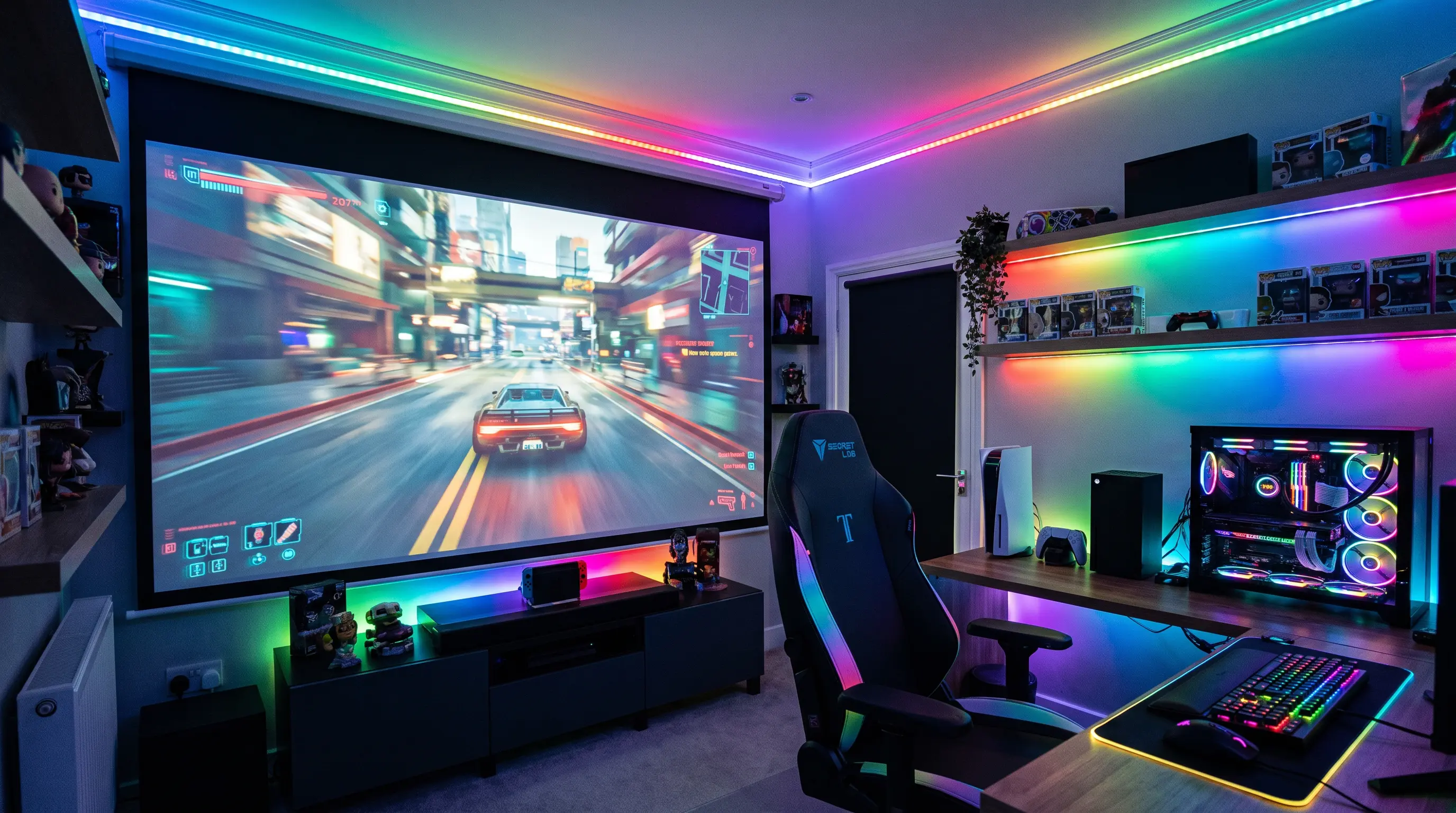
For buyers at the final stage of evaluating a projector for arcade gaming, the decision usually comes down to four measurable checkpoints. First, confirm brightness at the throw distance you actually plan to use, not at a lab-friendly 2.4-meter throw. A 4500-ANSI lumen unit that reads as 3800 lumens at 1.6 meters is a common finding, so always ask the supplier for a lux reading at your specific screen-to-cabinet distance. Second, validate input lag with a Leo Bodnar lag tester at 1080p / 120Hz, not just the marketing "game mode" claim. Third, request a noise floor measurement at 1 meter with the cabinet closed, since most arcade enclosures trap fan whine that disappears on a spec sheet. Fourth, confirm the projector for arcade gaming you are quoting accepts the control protocol your harness uses, whether that is a GPIO-to-USB bridge, a JAMMA harness, or a Brook Universal Fighting Board. Every DataMax shipment ships with a measured lag report and a noise dB log because buyers in this category have learned to ask for them.
B2B neste steg: prøver, MOQ og kontaktkanal
For OEM buyers ready to move from spec sheet to purchase order, our standard sample policy at DataMax is a 7-day air-freight sample turnaround from Shenzhen for one demo unit, refundable against a 100-unit MOQ. Standard chassis colors run at 100 units MOQ and 35 to 55 days of production after deposit. Custom chassis colors, boot logos, and laser-phosphor tuning run at a 300-unit MOQ and 70 to 90 days of production. To start the conversation, request a custom quote through our procurement team, or email Contact-Projector.com with your target lumen count, cabinet throw distance, and projected annual volume.
| Steg | Handling | DataMax-kontakt |
|---|---|---|
| 1 | Bekreft brukstilfelle-spesifikasjon (lumen, lag, støy) | spesifikasjonsbibliotek |
| 2 | Be om demoenhet | be om tilpasset tilbud |
| 3 | Evaluer prøve på stedet med lagtest | testprotokoll PDF |
| 4 | Legg inn 100-enhets PO (standard) eller 300-enhets PO (tilpasset) | oversikt over OEM-tjenester |
| 5 | Motta 35–90 dagers produksjon, pluss sjøfrakt | logistikkguide |
Hurtigreferanse-sjekkliste
Bransjekontekst: hvorfor 2026 er laserfosfor-veltidspunktet
The FEC and home-arcade segment is shifting away from UHP lamp projectors at a measurable pace. Laser-phosphor units now deliver 30,000-hour engine life, consistent color across the operating range, and instant-on behavior that lamp cabinets cannot match. For buyers evaluating a projector for arcade gaming this year, the calculus has flipped: laser is no longer the premium option, it is the baseline.
Avslutning og handlingsoppfordring
A projector for arcade gaming is the difference between a cabinet that feels arcade-authentic and one that feels like a console strapped to a piece of furniture. Measure the lag, measure the noise, measure the lumens at your throw distance, and source from a supplier willing to publish those numbers. Browse the DataMax arcade projector lineup or request a custom quote to start your evaluation cycle today.
