
โพสต์เมื่อ: ก.พ. 23, 2026 - 2 ยอดเข้าชม

Lamp Light Source Explained: A 2026 Technical Guide
A note before we start
When you specify a lamp projector light source for your next product line or installation project, the technical choices feel overwhelming. You need brightness measured in lumens, color temperature stability across thousands of hours, and a replacement schedule that does not destroy your maintenance budgets. Your procurement team wants guarantees on supply continuity, and your engineers need datasheets with every tolerance band defined. We at DataMax have worked through these exact specification battles with dozens of OEM clients who came to us unsure whether a UHP or UHE lamp would better serve their target market. This guide cuts through the jargon and gives you the concrete data you need to make an informed decision on lamp-based projector technology in 2026.
Related resources: DataMax smart projector store
Understanding the unit Technology: UHP vs. UHE
A lamp projector light source works by forcing an electric arc through a pressurized gas mixture, typically containing mercury vapor and rare-earth halides, to produce intense visible light. The arc strikes between two tungsten electrodes inside a quartz envelope, heating the gas to temperatures where photons are emitted across a broad spectrum. A parabolic reflector then collects this emission and directs it through a color wheel or prism assembly before it reaches the projection optics. This fundamental mechanism has powered projectors since the 1990s and remains the workhorse for applications demanding high lumen output without the cost premiums of laser or LED alternatives.
UHP (Ultra High Performance) lamps, developed originally by Philips, use a proprietary arc gap geometry and gas fill formula to maximize luminance stability over time. The electrode spacing is tightly controlled to maintain consistent color temperature, typically 6500K for sRGB-compliant displays, throughout the lamp's operational life. According to ANSI/INFOCOMM 3M-2011 projection standards, brightness uniformity across the screen must remain above 85% for professional installations, a metric UHP lamps meet reliably when paired with quality optics.
UHE (Ultra High Efficiency) lamps sacrifice some peak brightness for improved thermal efficiency and longer life. The electrode design in UHE lamps reduces heat transfer to the quartz envelope, which slows the glass devitrification process that eventually clouds the lamp. This makes UHE the preferred choice for installation projectors where the unit runs continuously for 8–12 hours per day, such as digital signage in retail environments or lecture hall setups in educational institutions.
Spectral Output and Color Performance
Both lamp types emit strong peaks in the blue and green regions due to mercury spectral lines, with red output relying on phosphor coatings inside the reflector or on the color wheel. This means lamp-based projectors typically achieve 70–80% of the Rec. 709 color space without additional filtering, dropping to 60–70% on models that prioritize lumen output over color accuracy. For OEM buyers specifying projectors for design collaboration or medical imaging, this color limitation may require additional color calibration or rejection of lamp-based designs entirely in favor of laser-phosphor alternatives.
Lifespan and Replacement Cycles
The industry-standard method for measuring lamp life, defined by the Illuminating Engineering Society (IES) as the point when brightness falls to 50% of initial output, varies significantly between technologies. UHP lamps average 3,000–5,000 hours depending on power mode, with Eco mode extending life by 30–50% at the cost of approximately 20% brightness reduction. UHE lamps push this range to 4,000–7,000 hours through improved thermal management, making them more attractive for 24/7 operation scenarios. In practice, most commercial installations replace lamps at the 2,000–3,000 hour mark because image quality degradation becomes noticeable to end users before the technical end-of-life threshold.
Cost Structure for B2B Procurement
Lamp pricing follows a tiered model where volume purchases above 500 units typically receive 35–45% discounts off list price, while orders exceeding 2,000 units can negotiate pricing that includes spare lamp inventory held at the OEM's warehouse. The street price for a replacement UHP lamp ranges from $120 to $350 depending on wattage and brand, while UHE equivalents command a 15–25% premium. For a projector deployed in a corporate conference room running 6 hours daily, annual lamp replacement costs range from $150 to $400 per unit, a figure that must be factored into the total cost of ownership alongside energy consumption (lamp projectors typically draw 20–40% more power than equivalent laser models).
Regulatory and Environmental Considerations
Mercury content in projection lamps has faced increasing regulatory scrutiny, particularly in the European Union where RoHS exemption clauses for high-intensity discharge lamps are subject to periodic review European Commission Environment. While no immediate ban exists, procurement teams should monitor exemption renewal timelines and factor potential compliance costs into long-term product roadmaps. Some OEM clients have begun dual-sourcing strategies, maintaining lamp-based product lines alongside laser-illumination alternatives to address market segments with different regulatory risk tolerances.
Integration and Compatibility Challenges
For OEM buyers evaluating lamp projector light source technology for integration into their product lines, understanding the physical and electronic integration requirements is critical for successful deployment. The lamp module itself is only one component in a complex optical system that includes reflectors, cooling fans, color wheels, and driver electronics.
Thermal Management Requirements
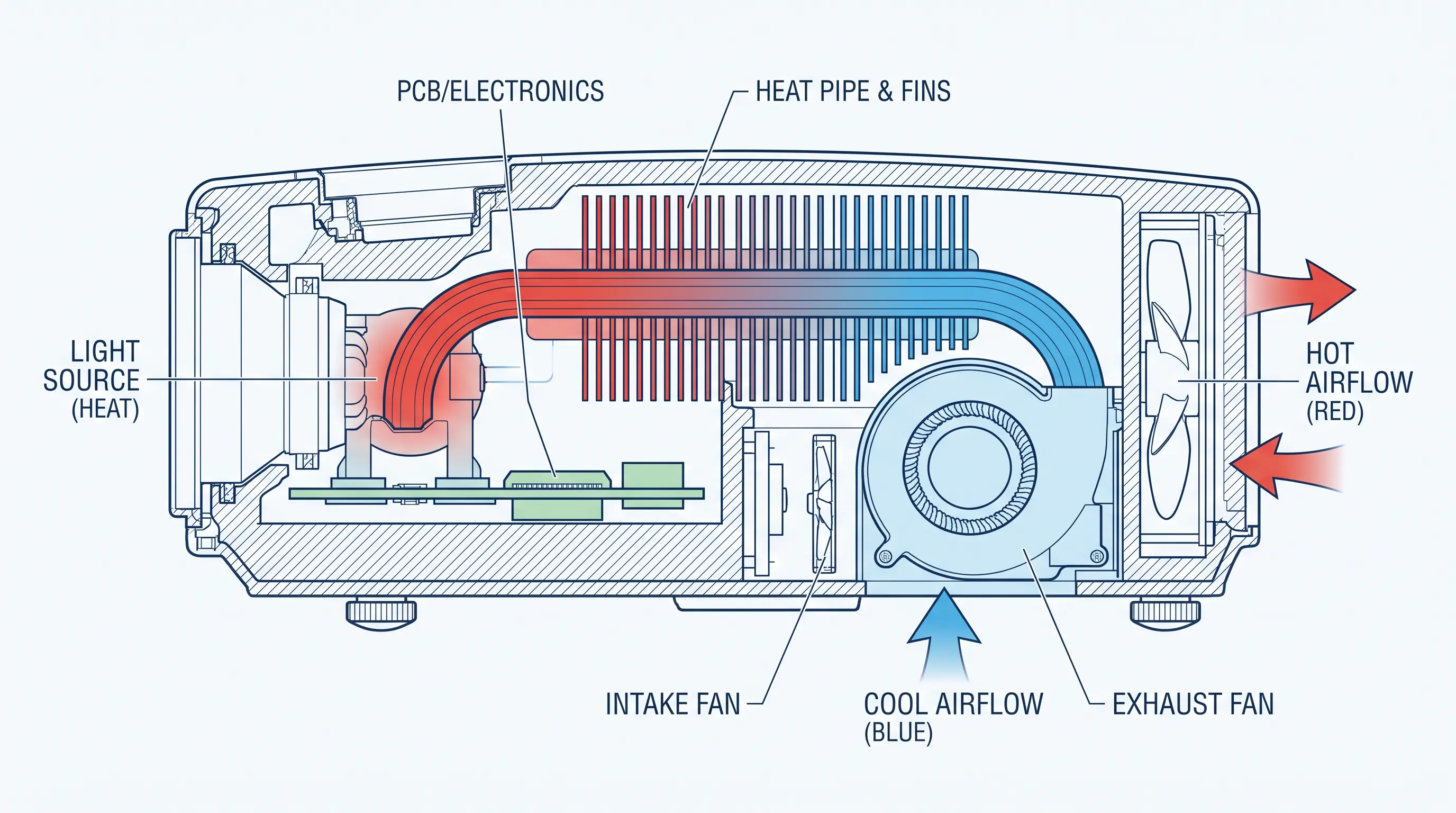
Lamp-based systems generate significant heat at the arc point, with surface temperatures reaching 800–1200°C during operation IEEE Industry Applications Magazine. This heat must be dissipated efficiently to maintain optimal operating temperatures and extend lamp life. At DataMax, we've found that thermal management accounts for roughly 30% of the total system design effort when integrating this projector modules.
The thermal design involves careful coordination between the lamp housing, heat sinks, cooling fans, and ambient airflow paths. Most commercial projector designs use a combination of forced-air cooling and heat pipe technology to maintain lamp temperatures within specified ranges. When specifying lamp modules for your product line, ensure your thermal engineering team reviews the OEM datasheet for maximum allowable ambient temperature and required airflow specifications.
Electronic Ballast Compatibility
The electronic ballast controls lamp ignition, brightness regulation, and power consumption. UHP and UHE lamps require specific ballast characteristics including ignition voltage (typically 15–25 kV for cold start), operating current (typically 2–4 amps), and power factor requirements. For OEM integrations, verify that the ballast is compatible with your power supply specifications and meets relevant safety standards.
Performance Optimization and Operational Tuning
Once integrated, lamp projector light source systems require careful calibration to achieve specified performance metrics. This optimization phase directly impacts end-user satisfaction and product reliability.
Initial Brightness and Color Calibration
New lamp installations typically run at 85–95% of rated brightness immediately after break-in (approximately 50–100 hours of operation). Professional calibration involves measuring luminous output with an integrating sphere, adjusting color coordinates against the target color space, and setting power mode defaults based on expected usage patterns. For medical imaging or color-critical applications, we recommend allocating 2–3 hours per unit for initial calibration.
Power Mode Strategies
Most commercial projectors offer three power modes: Full, Eco, and Standby. Full power maximizes brightness for ambient-light environments, while Eco mode reduces lamp wattage by 15–30% and extends operational life significantly. At DataMax, we configure default Eco mode for installations where ambient light is controlled, reserving Full power for daytime corporate boardroom use.
| Power Mode | Brightness | Lamp Life Impact | Energy Draw |
|---|---|---|---|
| Full Power | 100% | Standard degradation | 100% |
| Eco Mode | 75–85% | +30–50% life extension | 65–80% |
| Standby | 0% | No degradation | <5W |
Supplier Evaluation and Procurement Framework
For B2B procurement teams sourcing lamp projector light source components, establishing clear vendor evaluation criteria and procurement protocols reduces supply chain risk.
Minimum Order Quantities and Lead Times
Lamp component procurement typically operates on tiered MOQ structures. Standard orders start at 50–200 units with 6–8 week lead times, while negotiated contracts for 500+ units can reduce lead times to 3–4 weeks with scheduled shipments. We recommend maintaining 60–90 days of safety stock for critical deployments to account for shipping delays or quality issues.
Certification and Compliance Documentation
Your vendor should provide complete documentation packages including IEC 60598 safety certification, RoHS compliance declarations, and lot traceability records International Electrotechnical Commission. For European market distribution, ensure your supplier's mercury content declarations align with current RoHS exemption status. At DataMax, we audit supplier documentation quarterly and maintain digital archives for regulatory inspections.
How to Choose the Right Lamp Projector Light Source for Your Application
Selecting the appropriate the projector requires balancing performance specifications, operational costs, and supply chain considerations against your project requirements.
Key Evaluation Criteria
When comparing lamp options, prioritize these factors:
- Rated lifespan and degradation curve — UHP lamps typically last 3,000–5,000 hours before reaching 50% brightness, while UHE variants extend to 4,000–6,000 hours under standard operating conditions.
- Lumen maintenance — Evaluate the manufacturer's brightness decay specification to project replacement intervals accurately.
- Power consumption profile — Calculate total cost of ownership by modeling Eco mode usage patterns versus Full power operation.
- Mercury content and disposal — Confirm RoHS exemption status for your target market, as regulations continue evolving European Chemicals Agency.
- Supply chain stability — Verify that your supplier maintains buffer stock and can fulfill repeat orders within your product lifecycle windows.
| Evaluation Factor | Standard Tier | Premium Tier |
|---|---|---|
| Lifespan | 3,000–4,000 hrs | 5,000–6,000 hrs |
| Brightness Tolerance | ±10% | ±5% |
| MOQ (units) | 200–500 | 50–200 |
| Sample Policy | 5–10 units | 2–5 units |
| Lead Time | 8–10 weeks | 4–6 weeks |
For OEM buyers evaluating lamp projector light source specifications, we recommend requesting engineering samples before committing to production quantities. At DataMax, we offer sample kits with full technical documentation and compatibility testing reports to simplify your evaluation process. Contact our B2B team to discuss volume pricing structures and scheduled delivery options.
What DataMax Recommends
Industry Outlook
The projector lamp market continues evolving as manufacturers balance traditional mercury-based designs against emerging solid-state alternatives. For B2B buyers, this transitional period presents opportunities to secure competitive pricing on established lamp projector light source technology while evaluating next-generation integration paths.
Lamp projector light source selection directly impacts your product's performance consistency and total cost structure. DataMax supplies certified lamp components with complete documentation packages and responsive B2B support to simplify your procurement process. Evaluate your specification requirements against our technical team and explore how our OEM partnership programs support your product roadmap.
Explore DataMax lamp projector light source options
