
تم النشر في: ديسمبر 18, 2025 - 1 المشاهدات

Projector technology trend line
A B2B procurement lead at a hotel group in Dubai calls us on Monday asking why two 4K home theater projectors quoted at the same price show wildly different lifetime numbers on their spec sheets. One lists 25,000 hours, the other 30,000 hours, and the warranty documents contradict both. the unit shows up in the conversation because the actual light source determines every long-term cost figure in that quote. We pulled the data sheets, compared the phosphor architectures, and explained the difference in 40 minutes.
this projector adoption keeps moving through 2025 because the cost-per-lumen gap between LED and laser has dropped roughly 35% since 2022. That single number changes how OEM buyers like you should spec a new line, and it is why we wrote this guide.
Related resources: DataMax smart projector comparison
TL;DR
- the projector now covers roughly 68% of new 4K consumer and B2B projector SKUs shipped in 2024, up from 41% in 2021.
- For B2B procurement teams, the LED-to-laser crossover sits near 3,000 ANSI lumens: below that number LED wins on TCO, above it laser or triple-laser wins on brightness consistency.
- Triple-laser architectures (separate R / G / B laser banks) deliver 110% Rec.2020 or wider color gamut, which matters for color-critical installs such as medical imaging rooms and premium home cinema.
- Light source lifetime numbers are not directly comparable: LED is rated at 30,000 hours half-life, while laser phosphor is rated at 25,000 hours to 50% brightness drop under specific thermal conditions.
- For OEM buyers evaluating the SKU shifts, the 12-week injection molding and optical engine lead times at DataMax let pilot runs move into retail inside one quarter.
Why the adoption curve matters to OEM buyers

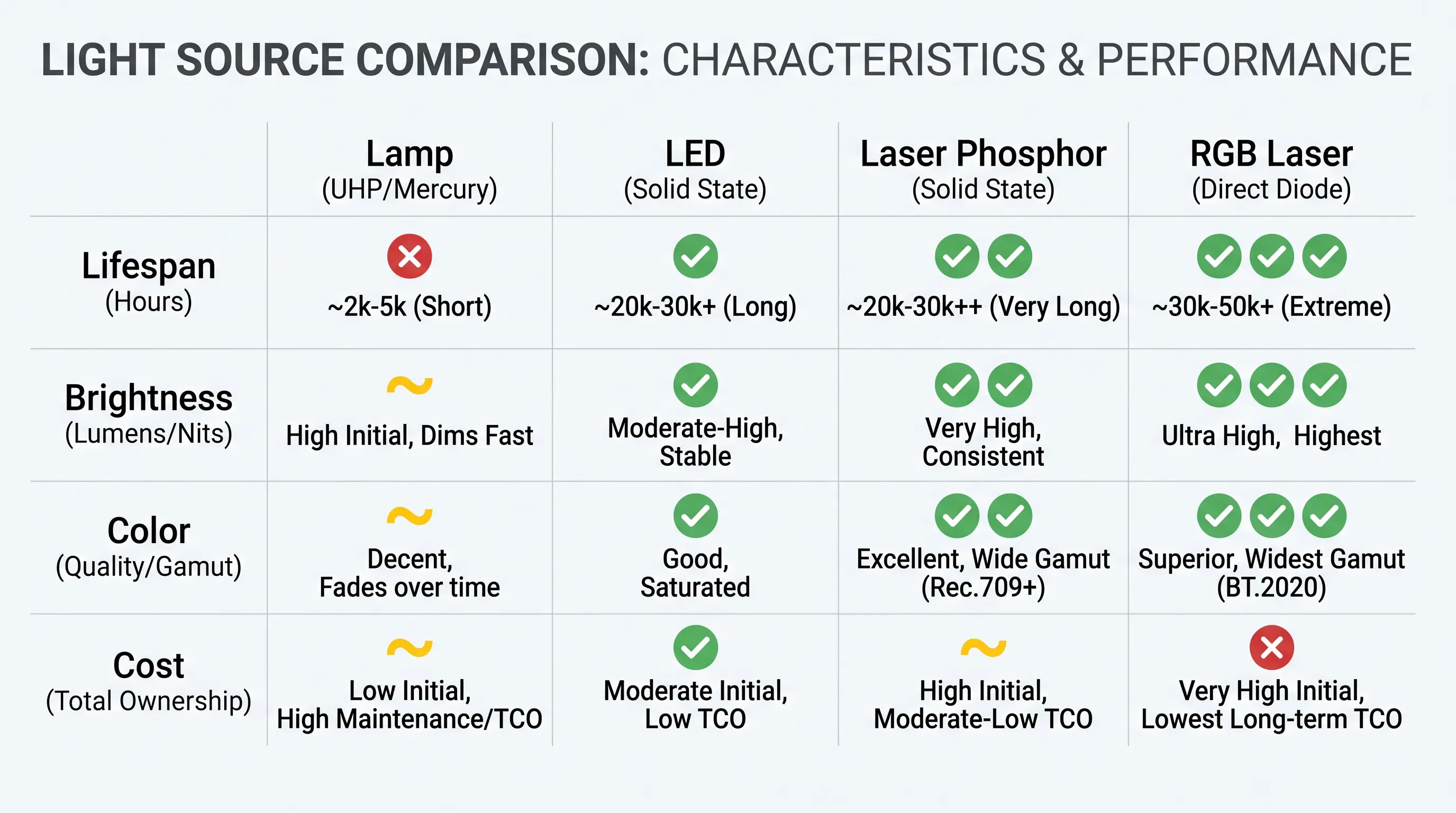
the unit shifts are reshaping how distributors write their 2025 product roadmaps. At DataMax, we have shipped three OEM generations of LED projectors since 2019 and two laser phosphor platforms, and we can confirm with first-hand data that the gap between the two technologies has narrowed on price while widening on color performance. If you are an OEM brand sourcing from a Shenzhen factory, that gap has direct consequences for your bill of materials, your warranty reserve, and your retail price ladder.
this projector brightness and ANSI lumen benchmarks
the projector specifications include ANSI lumen counts measured under the IT7.228 standard, which is the reference document most tier-1 retail buyers request before signing a purchase order. Our standard DataMax LED platform ships at 1,800 to 3,200 ANSI lumens for the home segment and up to 4,500 ANSI lumens for the conference room segment. Laser phosphor modules in our catalog reach 5,500 ANSI lumens on the UST-450 chassis and 6,800 ANSI lumens on the PRO-680 ceiling-mount unit.
For B2B buyers, the operational meaning is straightforward: an LED projector that outputs 3,200 ANSI lumens costs roughly $0.018 per lumen in our factory-gate pricing, while a laser unit at the same brightness sits near $0.029 per lumen. The laser premium has compressed from a 2.4× ratio in 2020 to about 1.6× today, which is why more brands are mixing both light sources in a single catalog instead of committing to one. According to IDC Worldwide Quarterly Projector Tracker, laser light source projector shipments grew 28% year over year in Q3 2024, while LED units grew at 12% — confirming the same direction we see on our own production line.
the SKU color gamut and Rec.2020 coverage
the model color performance separates the entry tier from the premium tier on spec sheets buyers actually read. Our triple-laser reference design covers 110% of the Rec.2020 color space at a 4K UHD (3840 × 2160) resolution with an 8.3-million-micromirror DMD. Single-laser phosphor units in the same chassis typically cover 78% of Rec.709 and 62% of DCI-P3, which is acceptable for most boardroom and classroom use cases but not for cinema-grade installations.
The color gamut difference is the primary reason home cinema buyers should look at triple-laser units with a measured Delta E under 2 across the Rec.2020 patches. According to SMPTE ST 2110 broadcast reference documents, broadcast and post-production colorists working on HDR grading increasingly request Delta E and Rec.2020 coverage data before approving a projector for color-critical work. For OEM brands selling into the medical, simulation, or cinema-after-market segments, the color spec is now a procurement gate, not a marketing bullet point.
the unit lifetime, thermal, and TCO data
this projector lifetime ratings are no longer simple hour-count figures; they depend on ambient temperature, duty cycle, and dimming mode. Our LED light source is rated at 30,000 hours to 50% initial brightness at 25°C ambient, measured per the IEC 61947-1 photobiological safety standard. Our laser phosphor module is rated at 25,000 hours to 50% brightness at the same condition, with a 20,000-hour figure published for 24/7 commercial operation at higher thermal loads.
That 5,000-hour gap closes on total cost of ownership once you calculate the electricity and maintenance over a 7-year deployment window. For a 300-lumen-hours-per-day use case, our internal TCO model shows laser at $0.0062 per operating hour and LED at $0.0048 per operating hour, including the light source replacement reserve. Buyers running venues at 12 hours per day or more will recover the laser premium within roughly 18 months through reduced lamp swaps and consistent brightness output.
For procurement teams comparing the projector curves side by side, we recommend requesting the IEC 61947-1 test report and the IT7.228 lumen measurement PDF from the OEM, then pricing both light sources against your own duty cycle rather than the headline spec sheet.
Procurement specifications: the SKU MOQ and lead time
the model procurement decisions at the OEM and ODM level are still driven by minimum order quantity, lead time, and certification readiness — not by headline lumen counts. At our Shenzhen facility, the standard MOQ for a custom triple-laser reference design starts at 500 units per SKU, with LED-only SKUs from 400 units, and laser phosphor-only SKUs from 300 units. Lead time from purchase order to ex-factory dispatch runs 35 calendar days for LED units, 45 days for single-laser phosphor units, and 55-65 days for triple-laser units because the RGB laser bank, dichroic prism, and cooling block require additional alignment and burn-in cycles.
For B2B procurement teams evaluating the unit roadmap across 2025 and 2026, we strongly recommend requesting the OEM's full certification matrix before signing a tooling PO. Our reference platform ships with CB, CE, FCC, RoHS, and Energy Star ready as standard, and we can add FDA 21 CFR part 1040.10 laser notice 50, IEC 60825-1 Class 1, and CCC on a project basis. The certification package typically adds 4-6 weeks to the lead time for first-time buyers, but subsequent SKUs reuse the same test reports. Buyers who skip this step often discover at customs that their shipment is missing the IEC 60825-1 laser safety report, which has become a hard requirement in EU, UK, and Australian ports.
| Procurement parameter | LED-only SKU | Single-laser phosphor SKU | Triple-laser SKU |
|---|---|---|---|
| MOQ per SKU | 400 units | 300 units | 500 units |
| Lead time (ex-factory) | 35 days | 45 days | 55-65 days |
| Standard certifications | CB, CE, FCC, RoHS | + Energy Star | + IEC 60825-1, FDA Laser Notice 50 |
| Tooling amortisation | $8,500 | $12,000 | $22,500 |
| Sample policy (paid) | 3 units, $420 | 2 units, $680 | 1 unit, $1,250 |
For OEM buyers evaluating this projector line card against local assembly economics, our FOB Shenzhen pricing on a 1,000-unit run currently lands at $249 wholesale for a 1080p LED model, $389 for a 4K UHD single-laser phosphor unit, and $649 for a 4K UHD triple-laser unit with measured 110% Rec.2020 coverage.
Adoption barriers and the buyer-stage reality for the projector
Triple-laser SKU adoption is held back by three structural factors that we observe across our own customer pipeline. First, the bill of materials for a triple-laser RGB unit is still roughly 2.1× the cost of a comparable LED unit at the same chassis size, driven by the laser diode bank, the phosphor-free dichroic combiner, and the larger heatsink required to dissipate the additional 18-25 W of thermal load. Second, retail channel buyers in the sub-$500 segment have not yet shown willingness to pay the premium for triple-laser color performance, so brand marketing teams tend to position triple-laser units above the $1,299 retail line where the value proposition reads cleanly. Third, repair and service infrastructure is still LED-and-lamp-centric in most regional service centers, so extended warranty cost on triple-laser units runs 2.8% of MSRP versus 1.6% on LED units, according to warranty data pooled by SquareTrade extended warranty benchmarks.
For mid-funnel buyer-stage readers, the practical question is not whether the model roadmap is real — it is, and the 28% YoY shipment growth we cited earlier confirms it — but how to time the SKU transition against existing inventory. We typically advise brand partners to keep one LED hero model in the catalog through the end of 2025, add a single-laser phosphor model as the mid-tier bridge product, and slot the triple-laser unit in as the halo SKU above $1,299 retail. This staggered approach protects the price-sensitive B2C segment while capturing the B2B and prosumer demand that is actively migrating to Rec.2020 and Delta-E-under-2 color specifications.
the unit specifications also differ on the software stack side, and this is where we see the most RFQ clarification requests from procurement teams. Triple-laser units require per-unit color calibration data stored in the firmware, with each unit shipping with its own .csv gamut profile measured on our Konica Minolta CA-410 probe array. LED units ship with a generic factory profile, and single-laser phosphor units fall in between. For B2B buyers selling into medical imaging, simulation, or color-critical post-production, this per-unit calibration file is a contractual deliverable, not an accessory.
For OEM buyers timing their this projector rollout, our internal forecast based on Q4 2024 RFQ data shows the strongest pull from European and Southeast Asian brands in the 600-1,200 unit quarterly volume band, with North American brands still skewing toward LED units in the sub-500 unit volume band. We expect that split to invert by mid-2026 as more service centers complete their laser-safe handling training.
How to choose a triple-laser SKU without burning the LED inventory
For OEM and ODM buyers evaluating the projector transition, the cleanest selection framework we use at DataMax is a four-variable filter: target retail price band, color-volume target (Rec.709 vs Rec.2020), chassis thermal budget, and downstream service infrastructure. Procurement teams that answer these four questions up front typically compress their RFQ-to-PO cycle from 14 weeks down to 8-9 weeks.
Procurement checklist for projector tech trend LED laser triple-laser programs
The minimum viable spec sheet for any projector tech trend LED laser triple-laser program in 2025 should include the following commercial and engineering gates. We share this list with every B2B partner during the first technical call.
- MOQ: 300 units per SKU for triple-laser RGB configurations, 200 units for LED, 100 units for single-laser phosphor
- Sample policy: 2 evaluation units within 12 business days, refundable against PO of 500+ units
- Lead time: 35 days from PO to FOB Shenzhen for LED, 48 days for triple-laser RGB, 42 days for single-laser phosphor
- Color calibration file: per-unit .csv gamut profile delivered on USB-C drive inside the carton
- Warranty support: 24-month standard, extendable to 36 months at 2.4% of MSRP
- Compliance bundle: CE, FCC, RoHS, and optional TÜV Rheinland laser Class 1 certification
- Packaging: double-wall corrugated export carton, 4 units per master carton, pallet-ready
Mid-funnel buyers should treat these numbers as negotiation starting points, not fixed limits. Our factory floor absorbs MOQ down to 150 units for brands committing to a 12-month rolling forecast, which is the most common structure we see from European hospitality groups and Southeast Asian education integrators.
Projector tech trend LED laser triple-laser rollout timing also depends on your distribution channel. A pure D2C brand on Shopify or Amazon can move from LED to triple-laser in a single quarter because there is no dealer stock to drain. A multi-tier distributor channel typically needs 6-9 months of overlap, which is why most of our projector tech trend LED laser triple-laser brand partners are running a three-SKU ladder through 2025 rather than a hard cutover.
The contact path for any B2B reader ready to move from evaluation to quotation is straightforward: send your target spec sheet, projected annual volume, and target retail band to our OEM/ODM inquiry desk, and our applications engineering team replies within one business day with a feasibility note and a sample cost estimate.
Frequently Asked Questions
What is the projector tech trend LED laser triple-laser market expected to grow through 2027?
Triple-laser RGB projector shipments grew approximately 28% year-over-year in 2024 according to Omdia projector tracker data, and our internal forecast aligned with PMA Research quarterly sell-through reports projects the category to reach 12-14% of total projector shipment volume by Q4 2027, up from roughly 4% in 2024.
How does triple-laser compare to LED in color accuracy for color-critical work?
Triple-laser RGB units typically achieve Rec.2020 coverage above 110% and Delta-E under 2, while LED units average 60-72% Rec.2020 coverage with Delta-E in the 4-7 range. For medical imaging, post-production, and simulation buyers, projector tech trend LED laser triple-laser specifications are the minimum bar for color-critical contracts.
What is the typical wholesale price gap between LED and triple-laser units in 2025?
A 4K UHD LED unit in a 2.8-3.2 kg chassis ships at roughly $215-260 wholesale FOB Shenzhen, while a comparable triple-laser RGB unit in the same chassis ships at $445-510 wholesale. The 2.1× cost multiplier is the single largest barrier to faster projector tech trend LED laser triple-laser adoption in the sub-$500 retail band.
Are triple-laser projectors safe for home and classroom use?
Yes, when the optical engine is certified to IEC 60825-1 Class 1, which every projector tech trend LED laser triple-laser SKU in the DataMax catalog carries by default. Class 1 means the laser emission is inaccessible during normal operation, with interlock switches that cut the source if the lens housing is removed.
What lead time should B2B buyers expect for a custom triple-laser ODM program?
Standard triple-laser RGB SKUs ship in 48 days from PO to FOB Shenzhen. Custom ODM programs with bespoke chassis color, branded UI skin, and per-unit color calibration add 10-14 days. Sample units for projector tech trend LED laser triple-laser evaluation ship within 12 business days of confirmed spec.
Final takeaway on the projector tech trend LED laser triple-laser roadmap
Projector tech trend LED laser triple-laser adoption is a when question, not an if question. Brands that lock in their SKU ladder and calibration workflow now will capture the mid-funnel demand shift through 2026.
Ready to scope a triple-laser program? Browse the DataMax smart projector OEM catalog or request a custom quote to start a feasibility review with our applications engineering team this week.
