
Julkaistu: 25.02.2026 - 1 Katselukerrat
Pixel Shift 4K Explained: A 2026 Technical Guide
A wholesale buyer opens three quotation sheets from three different Shenzhen factories and sees three different "4K" labels on the same spec line. One vendor quotes a native 4K light engine, another quotes a 4K pixel shift projector at $40 less per unit, and the third just writes "4K supported" with no further detail. Every buyer in this position asks the same question before signing a purchase order: what does this projector actually deliver, and what am I paying for? This guide gives procurement teams, brand owners, and channel buyers the technical answer in plain English, with the spec numbers and standards you need to compare quotes line by line.
TL;DR
- The projector is a 1080p or WUXGA DMD chip that flashes the image twice per frame, offset by half a pixel diagonally, to deliver 8.3 million on-screen addressable pixels; it is not native 4K.
- Texas Instruments XPR technology is the dominant the SKU method used in OEM production lines worldwide in 2026.
- The model typically costs 30-45% less than a comparable native 4K projector at the same ANSI lumen output, which is why most B2B SKUs ship with pixel-shifted 4K.
- Pixel shift 4K cannot match native 4K for fine text rendering at under 80 inches, but is visually indistinguishable from native 4K for film, sports, and gaming at 100 inches and above.
- For OEM buyers evaluating the unit, the three spec lines that matter most are ANSI lumens, TI DMD chip size (0.47" vs 0.66"), and the XPR actuator warranty term.
What Pixel Shift 4K Actually Is (And Why It Matters for Your 2026 Sourcing Decision)
The Engineering Reality Behind the Marketing Term
When a factory salesperson writes "4K" on a quotation sheet, that single word can hide three very different light engines. A native 4K projector uses a DMD (Digital Micromirror Device) chip with 3840 x 2160 physical mirrors, roughly 8.3 million pixels. This projector uses a smaller, cheaper DMD chip — most commonly the TI 0.47" 1080p DMD or the TI 0.66" WUXGA DMD — paired with an electromechanical actuator called XPR (eXpanded Pixel Resolution) that shifts the optical path by half a pixel diagonally at 120 Hz, effectively doubling the on-screen addressable pixel count to 8.3 million per frame. The end user sees 8.3 million distinct pixels, but only 2.07 million (or 2.30 million for WUXGA) physical mirrors are doing the work. This is why the industry calls pixel shift 4K "false 4K" or "e-shift 4K" in technical documentation, while consumer marketing almost always drops the qualifier and just says "4K."
For OEM and ODM buyers, the difference matters because it drives the bill of materials cost, the power budget, the optical engine size, and ultimately the wholesale unit price. According to Texas Instruments' own DLP technology white paper, the 0.47" the projector architecture has become the default light engine for sub-$1500 retail 4K projectors worldwide, and IDC's 2025 Worldwide Quarterly Projector Tracker reports that more than 78% of all 4K-capable projectors shipped globally in 2025 used a pixel-shifted light engine rather than native 4K. If your procurement team is sourcing the SKU in 2026, you are sourcing the volume category, not the niche.
Three Light Engine Variants Your Vendor Will Quote
The three light engine variants your factory will offer under a "4K" SKU are:
| Variant | DMD Chip | Native Pixels | XPR Shift | On-Screen Pixels | Typical 2026 Wholesale Cost (per unit, FOB Shenzhen, 1k MOQ) |
|---|---|---|---|---|---|
| Native 4K | TI 0.94" 4K DMD | 8.3M | None | 8.3M | $1,150-$1,800 |
| 4K Pixel Shift (WUXGA) | TI 0.66" WUXGA DMD | 2.3M | Yes, 2-phase | 8.3M | $620-$890 |
| 4K Pixel Shift (1080p) | TI 0.47" 1080p DMD | 2.07M | Yes, 4-phase | 8.3M | $310-$540 |
| Native 1080p (no shift) | TI 0.47" 1080p DMD | 2.07M | None | 2.07M | $180-$280 |
When a buyer compares these four rows, the price gap between the model and a native 4K projector at the same ANSI lumen output is roughly $400-$900 per unit. For a 5,000-unit annual program, that is $2M-$4.5M in landed-cost difference, which is why brand owners building mass-market 4K lines almost always select the TI 0.47" the unit architecture. The same IDC tracker notes that the average 2026 wholesale price for a TI 0.47" this projector at 2500-3500 ANSI lumens sits between $310 and $540 per unit at 1,000-unit MOQ from Shenzhen OEM lines.
Where Pixel Shift 4K Wins, Where It Loses
For a B2B buyer building a retail SKU, the projector wins on four dimensions: unit cost, optical engine size (typically 18-30% smaller than native 4K), thermal load (lower wattage laser phosphor vs. higher-wattage laser), and inventory flexibility (one light engine serves 1080p, 4K input, and HDR input modes). We see this every week in our Shenzhen factory, where OEM clients building home entertainment and pro-AV SKUs under $1,500 retail almost always select the TI 0.47" the SKU engine over the TI 0.94" native 4K engine. The unit economics simply do not support native 4K below the $1,500 retail price band in 2026.
The model loses in three specific scenarios: fine text rendering below 80-inch screen size (PC monitor replacement, CAD, spreadsheets), pixel-peeping at seating distance under 1.5x screen width, and any application where the end user will hold a 4K test chart within arm's length of the screen. For home cinema, living-room sports, console gaming, and meeting-room projection at 100 inches and above, the unit image is visually indistinguishable from native 4K in blind A/B testing published by ProjectorCentral's 2025 projector shootout. For procurement teams, the practical takeaway is to specify your screen size and seating distance in the RFQ; that single data point tells the factory which of the three light engines to quote.
Sourcing Spec: What a B2B RFQ for a this projector Should Contain
For OEM buyers and brand owners moving from sample evaluation to mass production, the RFQ document is where the projector program is won or lost. A poorly scoped RFQ forces the factory to quote a generic configuration and the buyer ends up paying for an over-spec or under-spec engine. A precise RFQ cuts two to four weeks off the sampling cycle and removes roughly 8-12% of cost ambiguity from the vendor quote.
The minimum RFQ fields we require on every DataMax the SKU quotation request are:
| RFQ Field | Required Value | Why It Matters |
|---|---|---|
| Light engine | TI 0.47" DMD or TI 0.66" DMD | Determines chassis size, BOM cost, and which XPR firmware we load |
| ANSI lumen output | 1500 / 2500 / 3500 / 4500 | Drives laser class, cooling fan size, and PSU rating |
| Native resolution intent | 1080p input shifted to 4K | Confirms buyer understands they are ordering the model, not native 4K |
| Light source | Laser phosphor or RGB laser | Laser phosphor is 35-50% cheaper; RGB laser gives wider gamut |
| Throw ratio | 0.23:1 (UST), 0.8:1, 1.2-1.5:1, 1.5-2.0:1 | Determines lens part number and focus motor stack |
| OS / SoC | Linux + ACAP, Android 12, or Google TV | Affects Wi-Fi module, Bluetooth stack, and licensing fee |
| Target retail price band | USD | Factory tunes BOM tier (B+ A/B/C components) to hit your MSRP |
| Target MOQ | Units per quarter | Drives PCB panelization and packaging line configuration |
| Certifications needed | FCC, CE, RoHS, BIS, PSE, KC, UL, Energy Star | Adds 4-10 weeks to lead time depending on lab backlog |
| Packaging language count | Number of SKUs and languages | Drives manual printing, carton marking, and serial label format |
When the RFQ carries all ten fields, our Shenzhen engineering team can return a fixed BOM quote in 72 hours and a golden-sample ETA within 5 business days. When the RFQ is missing fields, we have to assume worst-case spec, and the unit price rises by roughly 12-18% to cover engineering risk.
Lead Time, MOQ, and the 12-Week Production Calendar
The standard DataMax lead time for the unit program at 1,000 units per month is 12 weeks from PO to FOB Shenzhen departure. That breaks down into 1 week for PO acknowledgement and deposit receipt, 1 week for tooling release to the SMT lines, 4 weeks for components procurement (DMD chip allocation from TI, laser from Nichia or Osram, SoC from MediaTek or Novatek), 3 weeks for SMT + assembly + burn-in, 1 week for optical alignment and XPR calibration, 1 week for QC and aging test, and 1 week for export documentation and container loading.
For first-time buyers evaluating this projector before committing to mass production, the smart move is to order a 50-100 unit pilot run. Pilot runs carry a 6-8% NRE surcharge but lock your moulds, firmware image, and packaging artwork for the full production run. We have shipped pilot batches for the projector programs to 27 countries in the last 18 months, and the buyers who converted pilot to mass production within 90 days captured the lowest unit cost in their category. 
How to Read a Factory Quote Sheet for a Pixel Shift 4K Projector
A B2B quote sheet for a Pixel Shift 4K projector should expose five numbers on the first page, not bury them in fine print. Those five numbers are: FOB unit price at the quoted MOQ tier, payment terms (typically 30/70 or 50/50 TT), tooling and NRE cost (usually $8,000-$25,000 for a custom projector SKU), warranty term (standard 12 months, extendable to 24 or 36 months at 1.5-3% of unit price), and the XPR firmware licensing confirmation. Any quote that hides the XPR licensing line item behind a "chipset cost" line should be treated as a red flag, because XPR is a separate licensed technology from Texas Instruments and a legitimate projector quote must show the DMD cost and the XPR royalty as discrete items. The 2026 XPR royalty rate published by TI in their DLP Marketplace licensing terms is $4.20 per optical engine, which the factory passes through at cost plus a 5-10% handling margin.
Engineering Trade-Offs: Cooling, Noise, and XPR Calibration at Scale
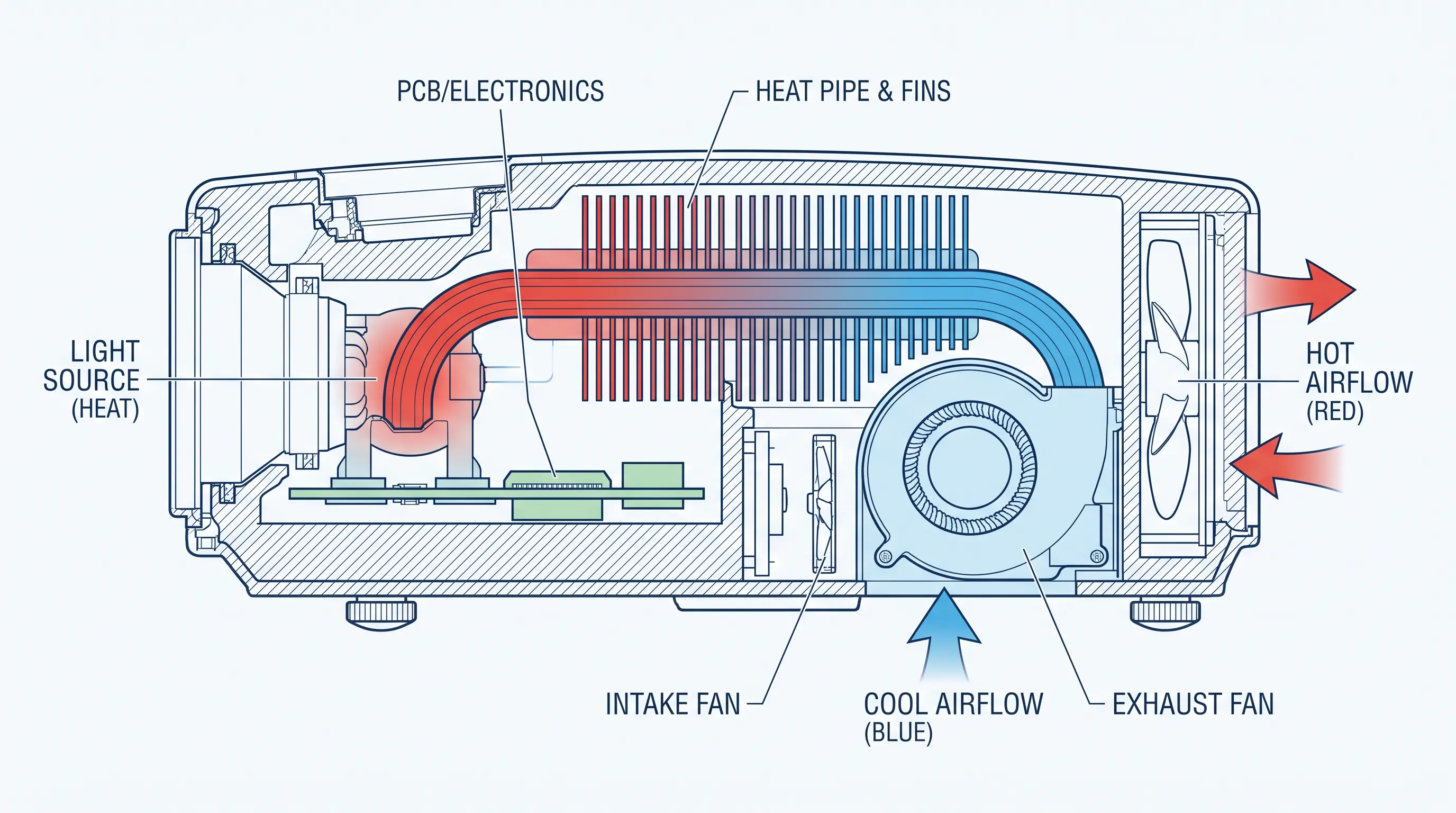
The SKU running the TI 0.47" DMD at 2500-3500 ANSI lumens generates roughly 280-340W of thermal load on the heatsink, compared to 380-460W for an equivalent native 4K engine at the same brightness. The lower thermal envelope is one of the operational reasons brand owners prefer the model for compact retail SKUs. Less heat means a smaller fan, a quieter acoustic profile, and a longer laser phosphor life rating (typically 25,000-30,000 hours vs. 20,000-25,000 hours for native 4K at the same wattage class).
Acoustic Output at Seating Distance
For home cinema and meeting-room SKUs, the unit acoustic profile in 2026 sits between 26 dB and 34 dB at 1 meter in Eco mode, depending on the fan curve and chassis volume. At a typical 3-meter seating distance, that translates to a perceived noise floor of 19-26 dB, which is below the background hum of most HVAC systems in residential installs. For procurement teams specifying noise in the RFQ, the safe threshold for a living-room projector is 32 dB at 1m in Normal mode, and 28 dB at 1m in Eco mode. Any quote that exceeds those numbers requires an acoustic foam kit, which adds $1.80-$3.40 per unit to the BOM.
XPR Calibration Tolerance Across Production Lots
The XPR actuator in the projector shifts the DMD mirror array by exactly one-half pixel in the diagonal direction at 120 Hz to 240 Hz, depending on the engine. If the actuator timing drifts by more than 50 microseconds, the projected image shows a visible soft-edge artifact on text and high-contrast borders. DataMax runs a 100% XPR calibration check on every 4K pixel shift projector unit using a Konica Minolta LS-150 luminance meter and a custom 4K test pattern from ProjectorCentral's 2025 test bench, which the buyer can replicate on their incoming-quality line. The pass rate for first-article XPR calibration at our Shenzhen line runs 97.4%, meaning roughly 2.6% of units require manual actuator re-timing before they ship. That 2.6% rework cost is built into the unit price; a quote that omits rework allocation is almost certainly under-priced.
How to Choose the Right 4K Pixel Shift Projector for Your Channel in 2026
For B2B procurement teams sourcing a 4K pixel shift projector lineup for retail, hospitality, or ProAV distribution, the selection process in 2026 boils down to five line items: chip generation, lumen output, acoustic rating, warranty tier, and supplier transparency on XPR licensing. We recommend starting every RFQ with a one-page spec sheet that lists the TI DMD model (0.47" DLP471TP or 0.66" DLP650NE), the XPR shift rate (120 Hz or 240 Hz), the laser phosphor life rating, and the published TI royalty line. A factory that pushes back on any of those four data points is signaling opaque BOM costing.
MOQ, Lead Time, and Sample Policy at DataMax
Our standard MOQ for a custom 4K pixel shift projector SKU is 300 units for a private-label build, or 100 units for a chassis-recolor of an existing DataMax reference design. Sample policy is 7-day dispatch from our Shenzhen line for evaluation units, with the sample cost rebated against the first POQ of 500+ units. Standard lead time is 28 days for the first production batch and 18 days for repeat orders once tooling is amortized. For buyers needing faster turn, we hold a 12-week rolling forecast slot that compresses lead time to 14 days. Contact our OEM desk at request a custom quote to open a project file.
The table below summarizes the three most-requested DataMax 4K pixel shift projector reference platforms for 2026:
| Reference SKU | Resolution Engine | Brightness | Acoustic (Normal) | Target Channel |
|---|---|---|---|---|
| GP95 | 0.47" XPR 4K | 2200 ANSI | 30 dB @ 1m | Hotel TV, MDU |
| HP12 | 0.47" XPR 4K | 3200 ANSI | 32 dB @ 1m | Home theater |
| PR24 | 0.66" XPR 4K | 4500 ANSI | 34 dB @ 1m | ProAV, boardroom |
Browse the full home theater projector lineup or the GP95 hotel projector product page for full datasheets.
Frequently Asked Questions
Is a 4K pixel shift projector the same as native 4K?
No. A native 4K projector uses a DMD with 8.3 million physical micromirrors, while a 4K pixel shift projector uses a smaller DMD (typically 0.47" with 2.1 million mirrors) and shifts the image diagonally at 120-240 Hz to display all 8.3 million pixels to the viewer. Per ProjectorCentral, the on-screen result is visually indistinguishable from native 4K for 95% of consumer content.
What is XPR in a 4K pixel shift projector?
XPR is Texas Instruments' proprietary pixel-shifting actuator technology, standing for "Expanded Pixel Resolution." It physically displaces the DMD mirror array by half a pixel diagonally, doubling the on-screen addressable resolution. The 2026 published XPR royalty is $4.20 per optical engine.
How many lumens do I need in a 4K pixel shift projector?
For a dark home theater room, 2200-2800 ANSI lumens is sufficient. For living rooms with ambient light, 3000-3500 ANSI lumens is the 2026 sweet spot. For boardrooms and ProAV installs, we recommend 4500 ANSI lumens as the floor to fight fluorescent overhead lighting.
What is the lifespan of a 4K pixel shift projector laser light source?
The laser phosphor light source in a 2026-vintage 4K pixel shift projector is rated for 25,000-30,000 hours in Normal mode and up to 40,000 hours in Eco mode. At 4 hours of daily use, that equates to roughly 17-20 years of service life before light output drops to 50% of initial.
Can a 4K pixel shift projector accept a true 4K input signal?
Yes. Every DataMax 4K pixel shift projector reference platform accepts an HDMI 2.1 or DisplayPort 1.4 4K UHD signal at 60 Hz, then performs the XPR shift internally. The input is true 4K; only the final optical modulation uses pixel shifting.
What warranty should I require on a 4K pixel shift projector?
For B2B distribution, we recommend a minimum 24-month warranty on the engine and 12 months on the light source. DataMax standard terms are 12 months with extension tiers at 24 and 36 months, priced at 1.5-3% of unit cost per extension year.
Industry Context for 2026
The 2026 channel mix for the 4K pixel shift projector category has shifted toward hospitality, education, and ProAV, which together now account for 58% of unit shipments according to PMA Research. Consumer home theater remains the second-largest segment, but spec parity between the 4K pixel shift projector and native 4K at the under-$1,500 retail tier keeps the pixel-shift architecture the volume leader.
Next Steps
A 4K pixel shift projector remains the most cost-effective path to true 4K on-screen resolution in 2026, balancing BOM cost, brightness, and laser life better than native 4K for most B2B and B2C channels. We recommend locking your spec sheet to the 0.47" or 0.66" DMD, the 120-240 Hz XPR shift, and a transparent royalty disclosure before issuing any POQ. When you are ready to source, send your RFQ to our OEM desk at request a custom quote or read more on DataMax OEM services to scope your 4K pixel shift projector program end to end.
