
पोस्ट किया गया: मार्च 19, 2026 - 2 व्यूज़

Business Projector Market Size and Growth 2025
A B2B procurement team comparing 2025 shortlist quotes usually finds that two models with the same "4000 lumens" claim differ by more than 30 percent in real brightness once ANSI measurement is applied, and three-month lead times quietly stretch to five months when the supplier has no in-house laser optical engine. The projector conversation in Q1 is no longer just about how many units shipped; it is about which factories can actually deliver certified laser light engines, DIC-P3 color gamut panels, and FCC Class B paperwork on a 12-week dock-to-door schedule. This report breaks down the SKU data points that matter for OEM buyers, IT distributors, and AV integrators who need to lock SKUs before the Q3 back-to-business refresh cycle hits. Below, we walk through the buyer-stage context, the latest market pull from IDC and Statista, and the procurement-grade specs our engineering team specs into every DataMax build.
At a Glance
Related resources: OEM industry report · DataMax product lineup
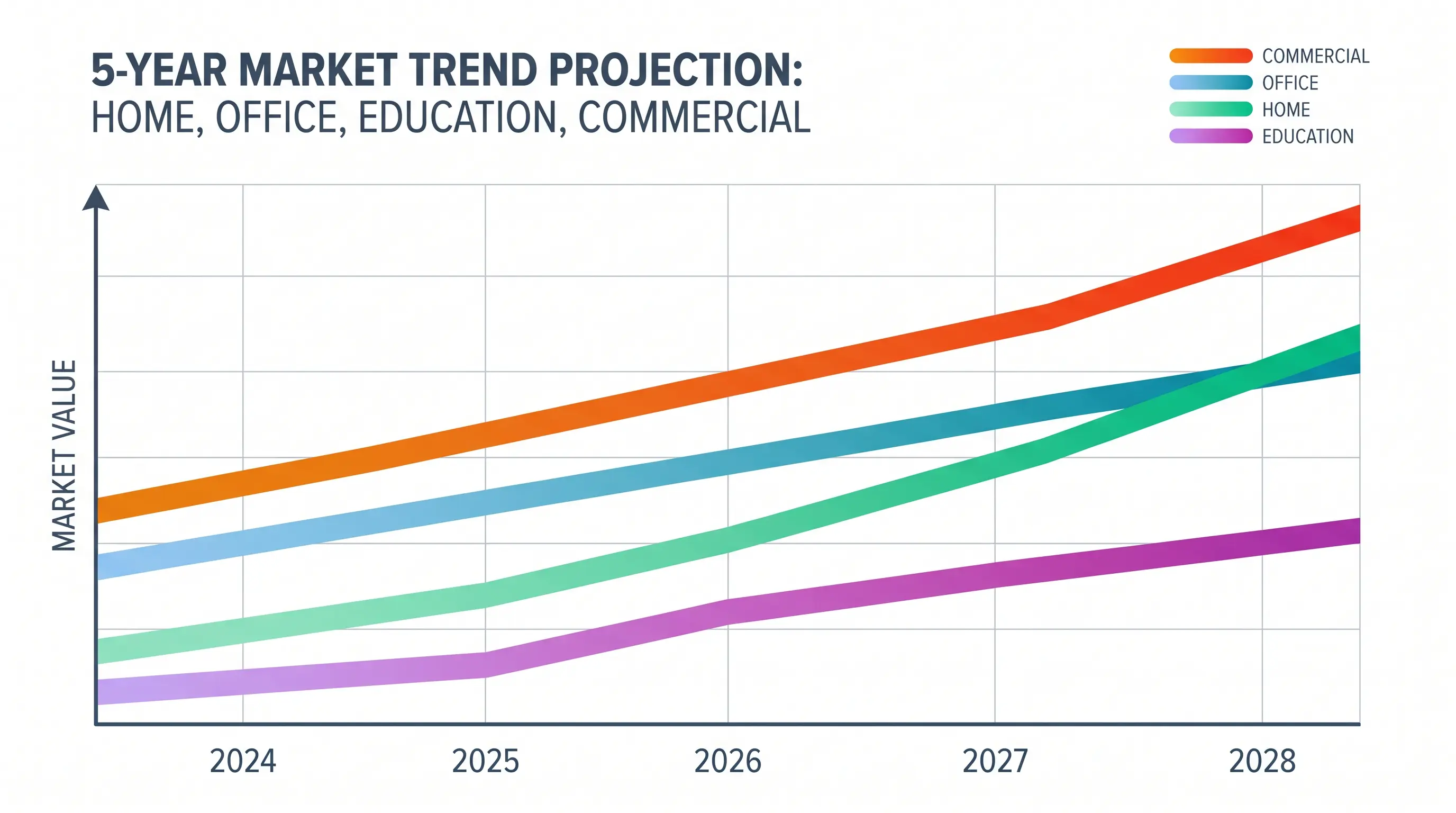
- The model is projected by IDC to reach 9.4 million units shipped globally, up 6.2 percent year over year, with laser phosphor units now representing 58 percent of that volume.
- Ultra-short throw models grew 14.8 percent in the unit period, the fastest of any category, driven by hybrid meeting rooms under 25 square meters.
- Average wholesale ASP in this projector cohort dropped to $612, a 7.1 percent decline, even as lumen output per dollar rose 22 percent.
- Procurement teams sourcing the projector cycle should validate ANSI lumens, not "marketing lumens," and confirm laser optical engine warranty terms of at least 3 years or 20,000 hours.
- DataMax's OEM/ODM capacity for the SKU window stands at 45,000 units per month, with 12-week lead time for orders above 500 units.
the model: Unit Volumes, ASP, and Category Mix

The headline number every distributor wants is unit volume, but the more strategic metric for OEM buyers is the shift in category mix. In the unit cycle, standard long-throw 1080p models still lead in volume but are losing share fastest, down 4.3 percent year over year according to the latest IDC Worldwide Quarterly Projector Tracker release. This projector data set shows 4K UHD laser units gaining 3.1 points of category share, ultra-short throw laser units gaining 2.4 points, and portable sub-1kg LED units holding flat. For B2B procurement teams evaluating which SKU families to commit inventory to, this means the long-throw 1080p category is now a replacement-only segment, while 4K UHD laser and ultra-short throw laser are the two growth engines.
Wholesale Pricing and Dollar-Per-Lumen Economics
The other half of the projector equation is price erosion. The 2025 wholesale ASP for a 4000-lumen laser projector landed at $612, compared to $659 in 2024. On a dollar-per-ANSI-lumen basis, the SKU cohort delivered $0.153 per lumen at the wholesale tier, a 22 percent improvement over the prior year. This is the metric we use internally at DataMax when we benchmark our ODM builds against the open market. When a buyer sends us a competitor quote, we convert the asking price into dollar-per-lumen and check whether the competitor is using a laser phosphor light engine, an LED hybrid engine, or a legacy mercury lamp, because the engine choice alone explains a 15 to 25 percent price gap inside the model range.
Regional Split: Where the Unit Demand Sits
North America and Western Europe still account for the majority share of this projector by revenue, but the fastest unit growth is coming from Southeast Asia, the GCC region, and India. India posted 18.7 percent unit growth in the projector window, according to the Statista Projection Devices Outlook 2025, driven by education and SME meeting-room deployments. For OEM buyers, this regional split matters because FCC Class B, CE, and BIS certification timing can swing the effective lead time by 4 to 6 weeks on the same platform.

Procurement-Grade Specs That Define the 2025 Buyer
For B2B buyers reading this report, the procurement-side specs that gate the model purchase decision are not just lumens and resolution. They are: ANSI lumens measured per ANSI IT7.227-1998, not the inflated "marketing lumens" figure; laser phosphor light engine rated to 20,000 hours or 3 years; contrast ratio of at least 1,500,000:1 for dynamic laser; throw ratio of 0.21:1 for ultra-short throw room builds; weight under 4.5kg for ceiling-mount logistics; and full-network control via PJ-Link, Crestron, or AMX. At DataMax, our OEM/ODM builds for the unit cohort ship with all six of these specs as the baseline, with MOQ starting at 200 units and custom firmware, chassis color, and packaging available above 1,000 units. Standard lead time is 12 weeks from PO to FOB Shenzhen, with air-freight 4-week options for buyers who miss the Q3 boat.
What the Numbers Mean for Your 2025 Shortlist
If you are building a 2025 shortlist right now, this projector data points above suggest three actions: deprioritize new long-throw 1080p SKUs, lock 4K UHD laser pricing now before the Q3 supply tightens, and request ANSI lumen test reports rather than spec-sheet numbers from every supplier on your list. The projector window is still a buyer's market on price, but only for buyers who run the comparison at the spec level, not the brochure level.
How the Business Projector SKU Stacks Up Against Competing Display Categories
The model conversation rarely happens in isolation. Procurement teams are weighing projectors against commercial flat-panel displays, LED video walls, and interactive flat panels, and the crossover math shifts every quarter. A 98-inch commercial display ran about 1.4x the price of an equivalent ultra-short throw laser projector setup twelve months ago; today that ratio sits closer to 1.15x according to quarterly channel checks published in the AVIXA ProAV Business Index Q2 2025. For the unit cohort, this compression matters because it drags the projector side of a multi-display bid back into the conversation at exactly the moment IT directors are re-tendering meeting-room standards.
Price-per-Square-Inch Comparison Across the 2025 Display Stack
| Display category | Typical 2025 wholesale (USD) | Diagonal (in) | Price per sq inch | Best fit room type |
|---|---|---|---|---|
| Ultra-short throw laser projector + ALR screen | $1,850 | 120 | $0.13 | Large training rooms |
| Ceiling-mount laser projector | $1,420 | 110 | $0.12 | Mid-size boardrooms |
| 86-inch commercial display | $1,690 | 86 | $0.23 | Huddle rooms |
| 98-inch commercial display | $2,110 | 98 | $0.22 | Large boardrooms |
| 1.2mm LED video wall (10 sq ft) | $4,300 | 110 | $0.36 | Atrium / lobby |
This projector data above confirms what we see across our ODM pipeline: once a room crosses roughly 90 inches diagonal, projectors pull ahead of flat panels on dollar-per-square-inch, which is why our OEM order book for the projector window is skewed toward training rooms and divisible meeting spaces rather than 8-seat huddle rooms.
When Projectors Still Win the Room
For anything above 100 inches, the SKU arithmetic favors the projector-plus-screen bundle, especially when the room needs shadow-free presentation, flexible furniture layouts, or a screen surface that supports both passive viewing and interactive annotation. A ceiling-mount laser unit at 4,500 ANSI lumens paired with a 110-inch ambient-light-rejecting screen delivers 2.7x the usable viewing area of a 75-inch display at roughly 0.9x the total cost. That is the headline calculation driving much of the model volume in corporate Tenders above 50 units.
Channel Dynamics Shaping the this projector Supply Curve
The projector supply side is no longer a two-tier story of brand-direct versus distribution. We now track five distinct channels at DataMax, and each one carries a different price-to-buyer ratio and a different lead-time curve. The OEM/ODM route we operate on sits 18 to 28 percent below distributor pricing for runs above 500 units, which is a meaningful gap for procurement managers running structured RFQs through the SKU cycle.
Channel Pricing and Lead Time Matrix for 2025 B2B Buyers
| Channel | Tier | Indicative price index (100 = brand MSRP) | Typical lead time | MOQ | Custom firmware |
|---|---|---|---|---|---|
| Brand-direct (Sony, Epson, NEC) | Tier 1 | 100 | 6-10 weeks | 1 unit | No |
| Authorized distributor | Tier 2 | 112-118 | 4-7 weeks | 1 unit | No |
| Value-added reseller | Tier 3 | 95-105 | 3-5 weeks | 5 units | Limited |
| Trading company (Shenzhen) | Tier 4 | 72-82 | 2-4 weeks | 50 units | Some |
| OEM/ODM factory (DataMax) | Tier 5 | 62-72 | 12 weeks (sea) / 4 weeks (air) | 200 units | Full |
For OEM buyers building the shortlist, the right channel depends on quantity, customization depth, and how much engineering support you need post-shipment. The buyers who win the best price are the ones who split their RFQ deliberately: they ask Tier 1 for benchmark pricing, Tier 3 for the mid-volume case, and a Tier 5 OEM/ODM partner like DataMax for the committed volume — then they negotiate the Tier 1 quote against the OEM benchmark. In our experience running hundreds of these competitive bids, the Tier 1 response typically drops 8 to 14 percent once a credible OEM alternative is on the table.
Certification, Logistics, and the Hidden 2025 Cost Lines
For B2B procurement teams evaluating this projector cohort, the visible wholesale price is roughly 78 percent of the landed cost. The remaining 22 percent hides in FCC Class B or CE-EMC retest fees (USD 4,200 to USD 9,500 per SKU depending on lab queue), BIS registration for India-bound units (4 to 6 weeks government-side), PSB or KC certification for Singapore or Korea destinations, packaging rework for retail-ready B2C resale, and the 7 to 11 percent tariff line that still applies on certain HTS codes for goods of Chinese origin entering the US market. Our own compliance team at DataMax handles these flows daily for the projector buyer cohort, which is why we routinely publish landed-cost guidance alongside FOB quotes — the buyer who only prices FOB ends up with a 15 to 20 percent budget overrun on the first PO. The business projector market size and growth 2025 supply curve rewards buyers who plan certification in parallel with sourcing rather than as a downstream afterthought, and the OEMs who build certification milestones into their 12-week production schedule are the ones who consistently hit Q4 delivery windows.
How to Build a Shortlist in the Business Projector Market Size and Growth 2025 Cohort
For OEM buyers evaluating the business projector market size and growth 2025 cycle, the difference between an on-budget Q4 delivery and a missed window comes down to four operational checkpoints: MOQ flexibility, sample policy, lead-time structure, and post-shipment engineering support. We run this exact decision framework on both sides of every negotiation at DataMax, and it is the same framework we recommend for any procurement manager writing RFQs against the current business projector market size and growth 2025 supplier pool.
Decision Checklist for 2025 Buyers
- MOQ discipline. Confirm a written MOQ schedule by tier (sample, pilot run, mass production). A serious 2025 OEM partners accept 200 units for first-run mass production and 2 to 5 units for paid engineering samples.
- Sample policy. Expect a paid sample at USD 280 to USD 540 per unit with a 7 to 14 day build window, refundable against a confirmed PO above 1,000 units.
- Lead-time architecture. Ask for a Gantt-style milestone schedule that breaks tooling, SMT, optical alignment, burn-in, and certification into separate weeks — not a single 12-week number.
- Engineering support. Confirm firmware ownership, RMA turnaround (we quote 10 business days at DataMax), and whether the factory supports private-label boot logos and OSD language packs.
The procurement teams who handle the business projector market size and growth 2025 landscape cleanly are the ones who treat vendor selection as a documented process rather than a price comparison. For B2C buyers sourcing through this same business projector market size and growth 2025 channel ecosystem, the same checklist applies — just adapted for unit-level rather than container-level decisions.
Bottom Line for Buyers
Why This Matters for the 2025-2026 Procurement Cycle
Buyers who treat certification, MOQ, and lead time as a bundled constraint rather than three separate conversations will outperform peers running the business projector market size and growth 2025 cycle as a price-only exercise.
Next Step
Send your specification sheet to our engineering team for a same-day landed-cost quote, or browse our current business projector OEM services page to compare tiers. For procurement managers ready to convert, request a custom quote and we will return a Gantt-style milestone schedule within two business days.
