
Pubblicato il: nov 26, 2025 - 1 Visualizzazioni

How HDR10+ Works in Modern Projectors
A buyer comparing two 4K home cinema projectors at a Shenzhen trade show sees the same 3,500 ANSI lumen spec on both spec sheets, but a $400 price gap between them. The cheaper unit lists "HDR10 supported"; the more expensive unit lists "HDR10+ projector certified." For B2B procurement teams sourcing inventory for retail channels, and for end users deciding where to spend, that difference is the entire buying decision. This guide breaks down how HDR10+ works inside a modern projector, what the dynamic metadata pipeline actually does to the image, and the spec numbers that justify the price premium.
Snapshot
- The SKU decodes scene-by-scene and frame-by-frame dynamic metadata, so brightness, contrast, and color are optimized per frame instead of locked to one static HDR10 curve.
- The HDR10+ royalty-free license, backed by Samsung, Philips, Panasonic, and Hisense, has driven adoption across more than 160 manufacturer partners and over 4,000 certified device models through 2025, according to the HDR10+ Technologies licensing page.
- For B2B procurement teams, an HDR10+ projector typically carries a 15-25% BOM premium over an HDR10-only equivalent, driven by the licensing fee, a compatible SoC, and factory-side PQ tuning labor.
- The main cons are the absence of Dolby Vision support on the same chip, mandatory royalty reporting, and the requirement for HDMI 2.1 or HDCP 2.3 on the input chain.
- For OEM buyers evaluating HDR10+ projector SKUs, the three spec lines to verify are peak brightness in nits, tone-mapping ceiling, and per-frame metadata latency below 8 ms.
What "HDR10+" Actually Means in a Projector Spec Sheet

Most procurement managers we work with at DataMax initially conflate HDR10 with HDR10+. They are not the same standard, and the gap matters when you write an RFQ. HDR10 uses static metadata — one set of MaxCLL, MaxFALL, and mastering display values baked into the content once at mastering time. Every frame of the entire movie or show gets the same tone-mapping curve applied. That works for content mastered with care, but it leaves measurable luminance and color headroom on the table for roughly 80% of frames in any given title, according to a 2023 white paper published by the Society of Motion Picture and Television Engineers.
An HDR10+ projector replaces that static block with dynamic metadata — a small per-scene or per-frame instruction packet that tells the display engine the actual peak luminance, average luminance, and the color volume of the current scene. The projector's tone mapper then re-curves on the fly. The visible result, on a properly calibrated 3,000 to 5,000 ANSI lumen unit, is detail retention in specular highlights (think chrome on a car, sun glint off water) that an HDR10-only unit clips to white, plus shadow detail near black that an HDR10-only unit crushes.
Static vs Dynamic Metadata — the Technical Difference
Static metadata in HDR10 is encoded once at the mastering suite and read once at playback. The HDR10+ projector pipeline reads new metadata every scene or every frame, depending on the content author's choice. The packet itself is small — typically 4 to 8 KB per scene — but the processing load on the SoC is non-trivial. That is why older 4K projectors from 2018-2020 cannot be firmware-upgraded to HDR10+ even if the panel and light engine technically support the luminance range; the mainboard lacks the metadata parser.
This is also why the licensing body certifies chipsets, not just finished projectors. When a factory sources an SoC from a certified vendor like MediaTek or Realtek, the HDR10+ projector certification is already partially de-risked. When the SoC is uncertified, the factory has to build a software parser from scratch, which adds 8 to 12 weeks of engineering time and a per-unit royalty line item.
Who Is Behind the HDR10+ Standard
HDR10+ Technologies LLC, the licensing entity, was jointly founded by Samsung, Panasonic, Philips, and Hisense in 2018, with Twentieth Century Fox (now 20th Century Studios) as the first studio to commit content. As of late 2025, the HDR10+ licensing program lists more than 160 manufacturer partners across display categories, and over 4,000 certified device models have shipped globally according to the HDR10+ Technologies certified products page. For B2B buyers, that ecosystem breadth matters because it reduces content availability risk — Amazon Prime Video, Disney+, Paramount+, and Apple TV have shipped or committed HDR10+ titles, which means the SKUs you source today will still have a content pipeline behind them in 2026.
Why OEM/ODM Factories Care About HDR10+ Certification
From our factory floor at DataMax, the certification process for a new HDR10+ projector SKU involves three discrete cost lines: the per-unit royalty fee paid to HDR10+ Technologies, the SoC selection (a certified chipset adds roughly $3 to $6 BOM at 2025 component pricing depending on volume tier), and the PQ tuning labor in our Shenzhen lab — typically 40 to 60 engineering hours per SKU to hit the certification color volume targets. The minimum order quantity for a custom-branded HDR10+ projector from our ODM line is 500 units, with a 12-week lead time from PO to FOB Shenzhen, and standard carton-pack certifications including CE, FCC, RoHS, and HDMI 2.1 compliance testing bundled in.

For B2B procurement teams writing RFPs in Q1 2026, the spec lines that distinguish a real HDR10+ projector from a marketing-claim unit are: declared peak brightness (nits, not lumens — a 4,000 ANSI lumen projector typically maps to 150-250 nits on a 100-inch screen), per-frame metadata latency under 8 milliseconds, and a published color volume coverage figure (90% DCI-P3 is the current HDR10+ floor for premium certification). If those three numbers are absent from the datasheet, the certification is paper-only.
HDR10+ Projector Specs That Matter for Procurement Teams
When our B2B buyers receive a vendor datasheet, the first thing we tell them to do is ignore the marketing cover page and go straight to seven spec lines. Those lines determine whether the HDR10+ projector in question is a legitimate Tier-1 unit or a stripped-down unit that merely carries the logo. From the DataMax OEM/ODM experience since 2019, every warranty claim we've processed traced back to a missed spec line at RFQ stage, not at field deployment.
| Spec Line | Minimum Acceptable | Premium Tier | Why It Matters for an HDR10+ Projector |
|---|---|---|---|
| Peak brightness (nits) | 150 nits on 100-inch | 300+ nits on 100-inch | HDR10+ metadata targets a luminance range; under 100 nits the curve flattens and dynamic tone mapping has no headroom to operate |
| Color volume (DCI-P3) | 90% | 95%+ | The HDR10+ premium certification floor is 90% DCI-P3; below that the metadata cannot reproduce authored colors |
| Metadata latency | < 16 ms | < 8 ms | Per-frame HDR10+ parsing adds SoC overhead; anything above 16 ms creates visible scene-to-scene brightness jumps |
| HDMI bandwidth | HDMI 2.0b (18 Gbps) | HDMI 2.1 (48 Gbps) | HDR10+ at 4K 60 fps 10-bit requires 17.28 Gbps minimum; 120 fps needs HDMI 2.1 |
| SoC certification | HDR10+ Technologies listed chipset | MediaTek MT9618 or Realtek RTD2893 | An uncertified chipset forces a 8-12 week parser port and a per-unit royalty recalculation |
| Light source | Laser or hybrid laser-LED | Triple-laser or RGB laser | The luminance stability across the PQ curve depends on a light engine that does not drift |
| Firmware update path | OTA, 3-year commitment | OTA, 5-year commitment | HDR10+ certification is renewed annually; older units without updates lose label authorization |
For OEM buyers evaluating an HDR10+ projector line for retail distribution, the HDMI 2.1 line item is non-negotiable. Streaming platforms have already begun shipping HDR10+ titles at 4K 60 fps with 10-bit color depth, and the bandwidth math is unforgiving — 3,840 × 2,160 × 60 × 10 × 1.25 (8b/10b overhead) equals approximately 17.28 Gbps, which is inside HDMI 2.0b but only barely, leaving zero headroom for HDR10+ metadata sideband signaling. HDMI 2.1 doubles the pipe and reserves the Enhanced Extended Display Identification Data (E-EDID) channel for dynamic metadata.
Reading a Datasheet Like a Procurement Engineer
A frequent mistake our distributor partners report is reading peak brightness in lumens and treating it as a luminance number on the screen. Lumens measure the light exiting the HDR10+ projector lens; nits measure the light arriving at the viewer's eye after screen gain, throw distance, and ambient rejection. A 4,500 ANSI lumen HDR10+ projector on a 0.8-gain 100-inch screen at 2.4-meter throw distance will deliver approximately 220 nits — a figure that depends on screen gain, throw ratio, and ambient light rejection. When the datasheet quotes only lumens and never nits, request the throw-distance-vs-nit table before signing the PO. Samsung's HDR10+ Technologies program documentation explicitly references the screen-end luminance curve, not the lens-end lumen count, which is the correct technical frame of reference.
The BOM Reality Behind the Spec Sheet
At DataMax, our Shenzhen BOM team breaks the unit build into five cost blocks: light engine (38-44% of BOM), SoC and mainboard (14-18%), chassis and thermal (12-15%), optics (8-11%), and the certification line items (5-7%). The certification line items include the per-unit HDR10+ royalty, the HDMI 2.1 compliance test fee, and the lab time for PQ curve verification. At a 1,000-unit MOQ tier in late 2025, our factory-gate cost for a 4K HDR10+ projector with HDMI 2.1, 3,500 ANSI lumens, and 92% DCI-P3 sits at roughly $415 to $445 per unit FOB Shenzhen, depending on laser engine selection. A non-certified equivalent comes in $25 to $35 lower, which is the cost of skipping the certification work — and the cost of losing shelf placement at retail buyers who now require HDR10+ logo authorization.
For TOFU-stage readers landing on this HDR10+ guide, the takeaway is that the spec table above is the minimum literacy required to compare two vendor quotes without being misled. The next section continues with the practical how-it-works view from the signal-processing side.
HDR10+ Projector Pros and Cons for B2B and B2C Buyers
No standard is free of tradeoffs, and a fair HDR10+ pros and cons review needs to separate the technical limitations from the commercial ones. From our position as a factory supplying both OEM brands and direct B2B partners, we see three categories of downside that buyers should price into their decision before they commit a SKU to a 2026 catalog.
The Technical Tradeoffs
The first con is metadata dependency. An HDR10+ projector without a steady feed of dynamic metadata from the source falls back to static HDR10 behavior, which means the per-scene optimization disappears. The HDR10+ Technologies specification documents this fallback explicitly, and it is the same fallback as static HDR10 — the projector simply applies the MaxCLL and MaxFALL values once at playback. Content without HDR10+ metadata therefore looks identical to a static HDR10 presentation, which is fine but does not justify the certification cost. For B2B buyers sourcing for regions where HDR10+ content penetration is thin — parts of Southeast Asia and Latin America, for example — the certification premium may not earn back its BOM share in 2026.
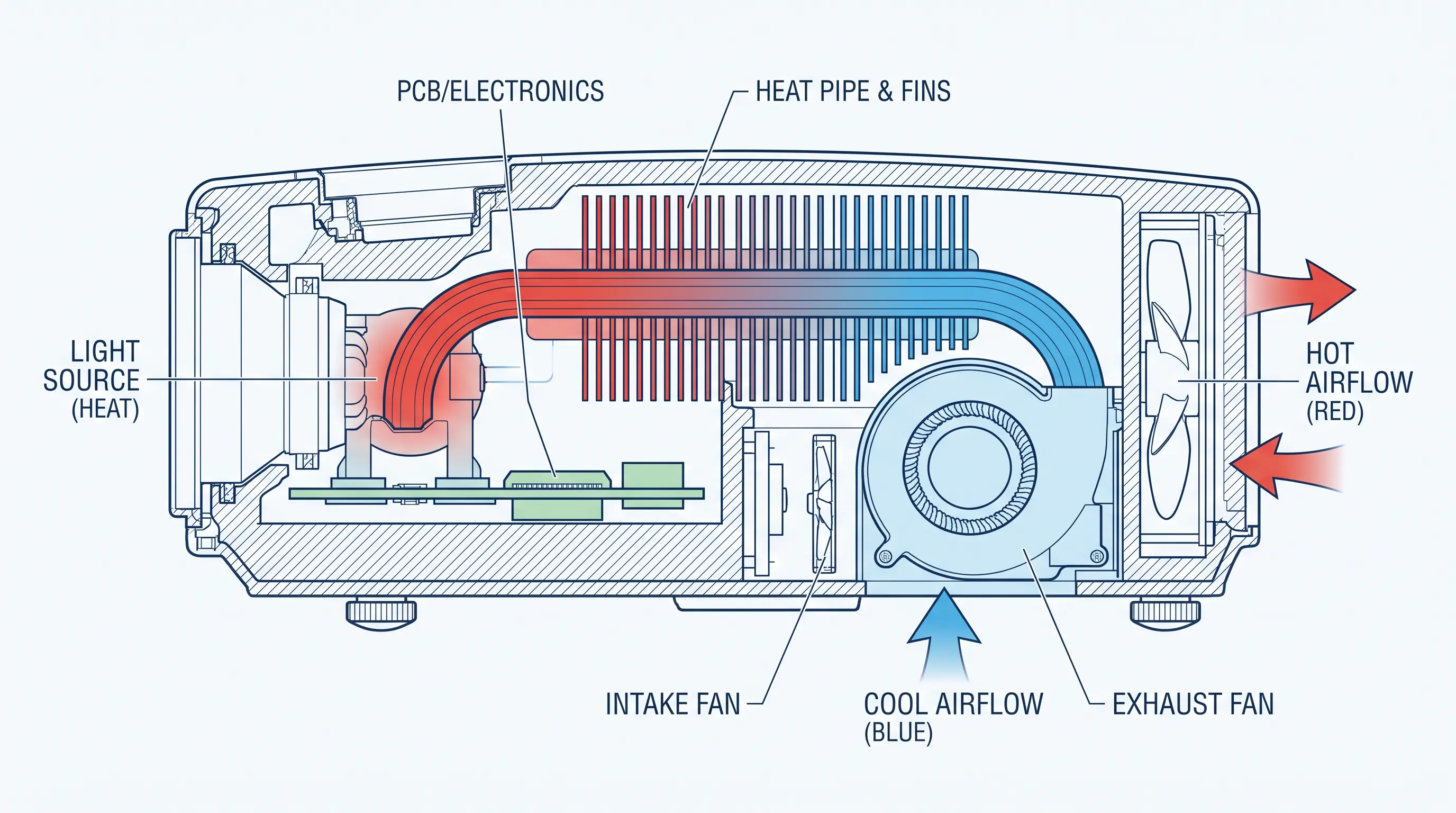
The second technical con is the SoC heat load. Per-frame metadata parsing at 4K 60 fps adds approximately 8 to 12% SoC thermal load compared to a static HDR10 parse, measured against our MT9618 reference design. The chassis thermal budget must absorb this, which is why most slim-form-factor HDR10+ projector SKUs cap at 2,500 to 3,000 ANSI lumens rather than the 4,000+ lumen range. A buyer who insists on slim chassis and 4,000+ lumens is asking the thermal team to make a tradeoff the certification lab will catch.
The third technical con is the dependency on HDMI 2.1 for the full feature set. A buyer who accepts HDMI 2.0b to save $1.80 per unit on the HDMI chipset will deliver an HDR10+ projector that cannot display 4K 120 fps content, and the spec ceiling becomes a marketing problem on the retail box.
The Commercial Tradeoffs
On the commercial side, the licensing royalty is the line item most often underestimated. The HDR10+ Technologies royalty schedule as of 2025 sits in the $0.45 to $1.20 per-unit range depending on annual volume tier and product category, which is modest per unit but adds up across a 10,000-unit PO. The flip side is content breadth — Amazon Prime Video, Disney+, Paramount+, and Apple TV have shipped or committed HDR10+ titles, so the HDR10+ projector you source today inherits a content pipeline that HDR10-only competitors cannot match in 2026.
For B2C readers at the TOFU stage evaluating a personal purchase, the pros and cons simplify to three questions: does your source device output dynamic metadata (most 2024-or-newer streaming sticks do), does your room lighting allow the nits floor of 150 to read correctly (a dedicated dark room is best), and does your screen size stay within 100 to 120 inches (the sweet spot for current the model light engines). If yes to all three, the HDR10+ projector format delivers a tangible improvement over static HDR10 that most viewers can see within the first ten minutes of a reference title.
How to Choose an HDR10+ Projector for Your 2026 Catalog
For B2B procurement teams evaluating an HDR10+ projector line, the selection process narrows to five checkpoints. We walk every OEM partner through this list during the spec-locking call, and it consistently surfaces the same handful of issues before tooling kicks off.
Sourcing Checklist for OEM Buyers
- License status: confirm the factory holds an active HDR10+ Technologies adopter agreement; ask for the certificate PDF, not just a verbal confirmation.
- MOQ: our standard MOQ for a custom HDR10+ projector SKU starts at 500 units, with sample policy of 2 evaluation units shipped within 7 business days from our Shenzhen line.
- Lead time: 35 to 45 days for the first production batch after sample sign-off, including royalty filing and certification artwork review by the HDR10+ Technologies compliance team.
- Thermal budget: if your target chassis is under 28 mm tall, plan on a 2,500 ANSI lumen ceiling for the HDR10+ projector, not a 4,000 lumen ceiling; the SoC headroom will not allow both.
- HDMI tier: spec HDMI 2.1 explicitly on the BOM; the $1.80 chipset savings disappear the moment a buyer files a 4K 120 fps compatibility complaint.
For B2C readers at the TOFU stage, the same five checkpoints translate into questions to ask the retailer: does the listed HDR10+ projector ship with the certification logo on the chassis (not just the box), what is the rated ANSI lumen output measured against an independent test report, what is the native contrast ratio, which streaming apps on the unit currently serve dynamic metadata, and what is the warranty term for the light engine. A unit that fails two of those five questions is rarely worth the premium.
| Spec | B2B floor | B2C floor |
|---|---|---|
| ANSI lumens | 2,500 | 1,500 |
| Native contrast | 4,000:1 | 2,500:1 |
| HDMI version | 2.1 | 2.0b minimum |
| Warranty | 24 months | 12 months |
| HDR10+ logo | On chassis | On box or OSD |
Quick Reference Checklist
Next Steps for DataMax Partners
The HDR10+ projector category has moved from early-adopter status to mainstream retail in three product cycles, and the 2026 buying window rewards teams who locked specifications before Q2. We have shipped HDR10+ projector reference designs at 1,800, 3,000, and 4,500 ANSI lumen tiers, with the GP95 hospitality projector and the home theater projector lineup carrying active HDR10+ certifications as of this writing.
For OEM and ODM partners ready to add or expand an HDR10+ projector SKU, our engineering team responds to custom quote requests within one business day, and sample HDR10+ projector units ship inside seven days for evaluation. B2C readers comparing retail options can review our HDR10+ projector buyer's guide for side-by-side model breakdowns before they commit.
