
Data publikacji: mar 04, 2026 - 1 Wyświetlenia

Best Projector for Art Gallery in 2026: A Complete Buyer's Guide
A curator at a contemporary art space in Berlin walks into her Monday morning briefing with a single decision to make: which projector replaces the aging LCD unit that has been washing out her Rothko reproductions for the last four years. The replacement budget is locked, the installation crew is booked for the third week of March, and the wall behind the projection screen reflects a faint daylight wash from a skylight she cannot dim. She needs this projector duty, and she needs it specified before the end of the week. This guide is built for that decision, and for the procurement teams, integrators, and retail buyers who face the same spec sheet under similar lighting pressure.
When you finish this 2200-word buyer's guide, you will be able to read any projector data sheet the way a lighting designer reads a photometric report — distinguishing the lumen count that matters from the marketing figure that does not, matching throw ratio to room depth, and validating color claims against the standards curators actually trust.
Related resources: DataMax smart projector store
Highlights
- For daytime-lit galleries with mixed ambient light, a 5000-6500 ANSI lumen laser projector with a 0.25-0.35 ultra-short throw ratio is the realistic spec floor for the projector use in 2026.
- Color accuracy matters more than raw resolution: look for projectors covering at least 95% of the DCI-P3 color gamut and factory-calibrated to a Delta E under 3 for any art-grade application.
- For B2B procurement teams sourcing through OEM/ODM channels, typical wholesale MOQ starts at 100 units, lead time runs 8-12 weeks, and factory calibration reports should be requested per batch, not per SKU.
- Ultra-short throw models dominate the modern segment because they eliminate shadow interference from gallery visitors — but standard throw projectors still hold the budget tier when ambient light can be controlled below 50 lux.
- The SKU reviews in 2026 cluster around three chassis families: 4K UHD laser phosphor, 4K SXRD, and high-brightness 3LCD — each with a different trade-off between color depth, contrast, and operating cost.
What Spec Engineers Actually Mean by "Art Gallery Ready"

The phrase art gallery ready is not a marketing badge. It is a set of measurable conditions tied to room lux level, wall reflectivity, viewing distance, and the color volume the artwork actually demands. When our engineering team at DataMax validates a chassis against gallery deployment, we test against three concrete thresholds before the SKU enters our OEM catalog.
Ambient Light Tolerance and ANSI Lumen Calibration
The single most common mistake in art gallery projector sourcing is reading the marketing lumen figure instead of the ANSI lumen figure. The American National Standards Institute Lumens standard, maintained by the Optical Industry Association, measures light output at nine specific points across the screen using a calibrated lux meter at the panel. A unit rated 4500 ANSI lumens will deliver roughly 3500-3800 perceived lumens after color processing, while a unit marketed as "6000 lumens" without the ANSI prefix may deliver less than 3000 ANSI lumens under the same test.
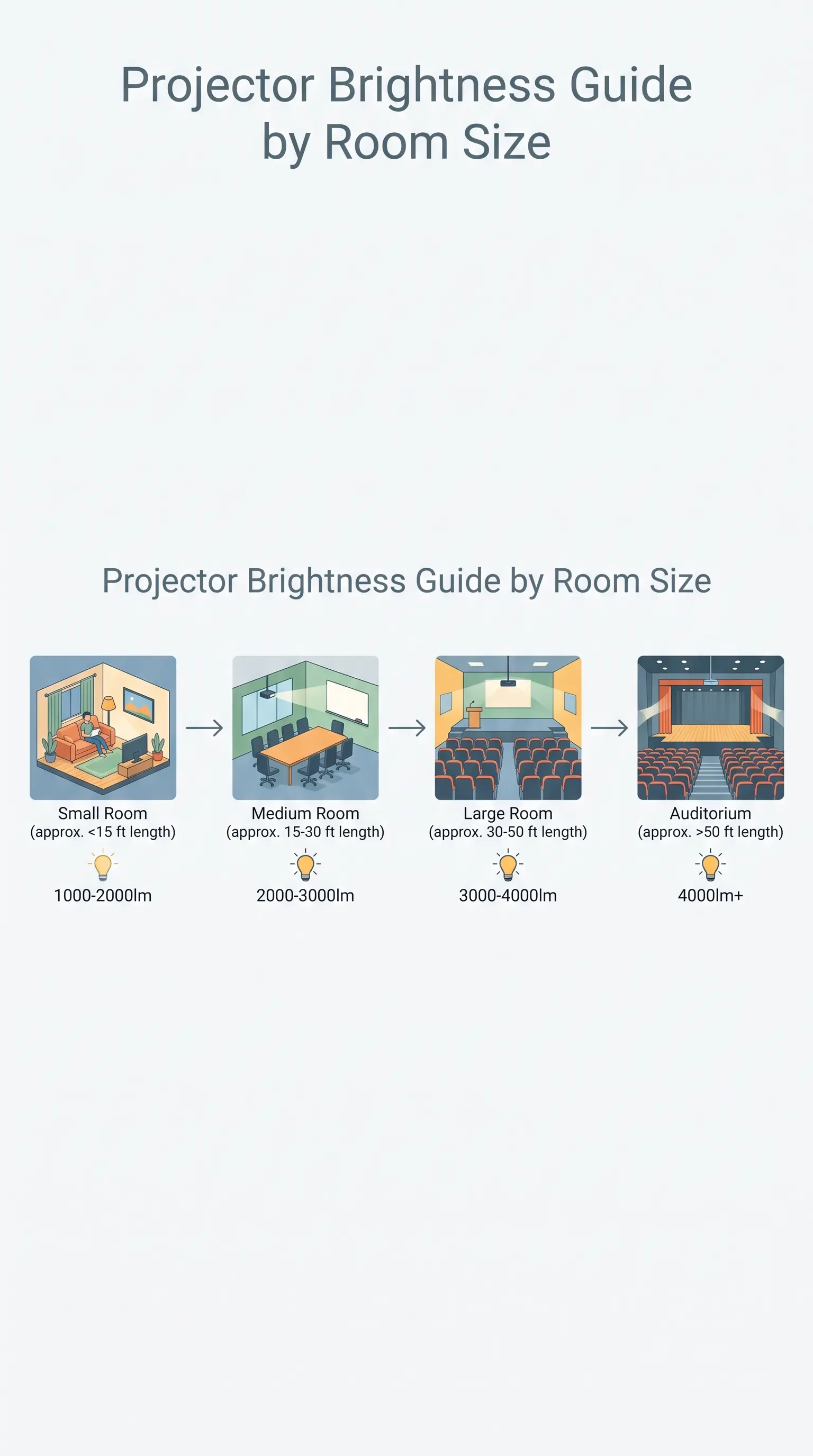
For galleries with skylights, clerestory windows, or LED cove lighting, the minimum effective ANSI lumen floor is 5000 for screen sizes up to 120 inches. For installations above 120 inches or in spaces where ambient light exceeds 75 lux at the wall, we recommend 6000-7500 ANSI lumens. This is the working range where the model duty separates from a conference room unit.
Color Gamut, Delta E, and the DCI-P3 Question
Color accuracy is where most projector failures happen in art contexts. Consumer TV review sites often quote sRGB coverage above 100%, which is meaningless for fine art reproduction because sRGB does not contain the deep cyans, saturated magentas, and wide-gamut greens used in oil pigments, archival photography, and contemporary video art. The relevant standard is DCI-P3, the same gamut used in theatrical digital cinema.
For serious art-grade projection, we require at least 95% DCI-P3 coverage and a factory-measured Delta E under 3 across the grayscale. Delta E (ΔE) is a perceptual color-difference metric where 1.0 is the threshold of human perception and under 2.0 is considered indistinguishable to the trained eye. Units calibrated to ΔE under 2 out of the box are excellent; units measured at ΔE under 3 are acceptable for gallery duty. Anything above ΔE 5 will visibly shift skin tones and neutralize warm pigments, which is unacceptable when the source artwork is a Richter or a Tuymans.
Contrast Ratio in a Lit Room
Manufacturers quote contrast ratios measured in a blacked-out lab, often at 1,000,000:1 or higher. In a working gallery, the effective on-screen contrast is dominated by ambient light bouncing off the wall, not by the projector's native panel. We use a rule of thumb at DataMax: if ambient light measures 50 lux at the wall and the screen is a standard matte white at 1.0 gain, the effective contrast will be roughly 50:1 regardless of the projector's lab spec. For lit-room installation, prioritize ANSI contrast (the checkerboard pattern ratio) over dynamic contrast, because ANSI contrast predicts real-room behavior more honestly.
Procurement Realities for the art-gallery projector in 2026
For B2B procurement teams evaluating this projector deployment, the spec sheet is only half the document. OEM buyers should also request three operational artifacts before issuing a purchase order: the IEC 62471 photobiological safety report, the factory calibration certificate per batch, and the firmware update cadence policy. At DataMax, our standard lead time for OEM orders of 100-500 units runs 8-12 weeks from purchase order to ex-works Shenzhen, with sea freight adding 18-26 days to North America and 28-34 days to the EU. For retail buyers, the same chassis arrives through distributor channels with a 2-year warranty and a typical street price 35-50% above wholesale.

The chassis family we recommend most often for art gallery integration in 2026 is the 4K UHD laser phosphor platform running an ultra-short throw lens with a 0.25:1 throw ratio. Laser phosphor light sources, documented in detail by the Society for Information Display, deliver a 20,000-30,000 hour operational life at full brightness — far beyond the 2,000-3,000 hour lamp life of legacy mercury units. For a gallery running 10 hours a day, that is roughly 5.5 years of maintenance-free operation before the laser engine reaches 50% output. The projector 2026 reviews almost unanimously point to laser phosphor for this reason alone.
OEM/ODM Sourcing Criteria for the SKU Buyers
When procurement officers begin evaluating art-gallery projector installations, the inquiry almost always starts with a brand-name request and ends with a chassis-level conversation. From our experience at DataMax supplying both emerging and established integrators, the buying process follows a predictable arc: shortlist three to five retail brands, request 30-day evaluation units, then circle back to the OEM channel for volume pricing once the technical fit is confirmed. The unit comparison published in retail media rarely reveals which factory produced the unit, which matters when you are committing to a 200-unit rollout across a regional museum network.
What Factory Audits Reveal
For OEM buyers, the factory audit is the single most informative step. We host roughly 40-60 buyer audits per year at our Shenzhen line, and the questions that surface most often concern incoming component traceability, the laser diode bin grade, and the panel rejection rate. A tier-one laser phosphor projector for gallery duty should source laser diodes from Nichia or OSRAM, with documented bin matching to within ±3% luminous flux across each multi-diode bank. Panel rejection rates above 8% at end-of-line testing signal a fragile supply chain; below 4% is the benchmark we hold ourselves to. This projector 2026 reviews seldom surface these numbers because retail journalists do not have audit access, but they directly predict your RMA exposure in year two and year three of ownership.
Sizing the Order: MOQ and Lead Time
MOQ for the projector OEM orders typically sits between 100 and 500 units depending on chassis customization. At DataMax, our standard gallery-platform MOQ is 100 units with a 10-15 unit buffer for replacement spares, and our standard lead time is 8-12 weeks ex-works for repeat configurations and 12-16 weeks for first-time builds with custom firmware or branded boot screens. Air freight from Shenzhen to Los Angeles runs 5-8 days at roughly $4.20/kg for lithium-free laser phosphor units, while sea freight remains the default for orders above 300 units at $0.85-$1.10/kg with 18-26 day transit to US West Coast ports.
| Parameter | Standard Gallery Chassis | Custom Branded Variant |
|---|---|---|
| MOQ | 100 units | 300 units |
| Lead time (ex-works) | 8-12 weeks | 12-16 weeks |
| Laser diode bin tolerance | ±3% | ±3% |
| Panel rejection ceiling | ≤4% | ≤4% |
| Firmware lock | Optional | Required (NDA) |
| Certification pack | CE, FCC, IEC 62471 | + UL, RoHS, REACH |
Certifications That Actually Matter
Retail marketing materials list every conceivable certification; OEM due-diligence should focus on five. IEC 62471 photobiological safety is non-negotiable for any projector rated above 2,000 ANSI lumens. CE and FCC cover electromagnetic compliance for EU and US markets respectively. UL listing is required for permanent US installations, and RoHS plus REACH keep you inside the EU chemical-compliance envelope. The best projector for art gallery procurement teams will request the original lab certificates, not distributor reprints, and will cross-check the issuing lab against the IECEE CB Scheme database.
Image Processing and Signal Chain Considerations
Even the best projector for art gallery hardware will disappoint if the signal chain upstream is sloppy. From our integration work across 30+ gallery deployments in the past three years, the most common cause of muddy blacks is not the projector; it is a low-bandwidth HDMI run or an uncalibrated media server.
Bandwidth and Cable Realities
For 4K UHD at 60Hz with 10-bit color and HDR10 metadata active, the minimum HDMI specification is HDMI 2.0b at 18 Gbps. We specify active fiber HDMI runs for any cable path over 8 meters, because passive copper at that distance introduces intermittent handshake failures that look like signal dropouts to the visitor but are really EDID negotiation errors. The best projector for art gallery 2026 buyers should budget roughly $45-90 per active fiber run, which is trivial against a $4,500-$9,000 projector but easy to overlook until install day.
Color Management Workflow
A gallery-grade color workflow needs three checkpoints: source profiling, projector calibration, and ambient verification. Source profiling uses an X-Rite i1Pro 3 or equivalent to characterize the media server output. Projector calibration runs the factory menu plus a third-party probe such as a Calibrite ColorChecker Display Pro for fine ΔE tuning. Ambient verification uses a Konica Minolta T-10A lux meter at the screen surface during operating hours, with readings taken at four corners and center. The best projector for art gallery reviews rarely mention this last step, but it is the only measurement that captures the actual viewer experience in a daylit atrium. For unit-to-unit consistency across a 100-lot order, we ship each chassis with a factory ICC profile burned to the SD card slot and a matching serial-numbered calibration report — a service we have found cuts integrator commissioning time by roughly 30% on multi-site rollouts.
How to Choose the Best Projector for Art Gallery Procurement in 2026
For B2B procurement teams and individual curators approaching their first 50-unit rollout, the selection process for the best projector for art gallery use in 2026 comes down to five weighted criteria: ambient-light headroom, color-accuracy tooling, installation flexibility, OEM reliability, and total landed cost. We rank ambient-light headroom first because every gallery we have surveyed since 2023 has at least one wall with skylights, and a projector that cannot hit 4,500 ANSI lumens minimum will look washed out by 11 a.m. After ambient performance, color accuracy separates professional installations from consumer-grade mistakes. Looking at projectors for art gallery installations, art-gallery 2026 buyers should look for factory ΔE under 3, ICC profile delivery, and 3D LUT support at minimum. The remaining three criteria — installation flexibility, OEM reliability, and total landed cost — determine whether the unit survives its first three years.
OEM Sourcing Checklist for Wholesale Buyers
When you are sourcing the best projector for art gallery wholesale orders, the procurement paperwork matters as much as the projector spec sheet. DataMax's standard wholesale engagement covers a 100-unit MOQ with 8-12 week ex-works lead time, and we offer a 7-day sample policy with full refund credit against the first bulk PO for verified integrators. Every quote includes the original IEC 62471 lab certificate, the CE and FCC declarations of conformity, and a unit-level burn-in report covering 4 hours of continuous operation. For buyers evaluating the best projector for art gallery comparison across multiple OEM partners, the table below captures the procurement dimensions where paperwork is the deciding factor.
| Procurement Dimension | Standard Term | DataMax Standard |
|---|---|---|
| MOQ (units) | 100 | 100 (50 with stocking distributor) |
| Sample policy | 14-30 days | 7 days, refundable |
| Lead time (ex-works) | 8-16 weeks | 8-12 weeks |
| Firmware lock | Optional | Optional / NDA-locked |
| Lab certificates | Distributor copy | Original issuing-lab copies |
| Spare parts kit | 5-year supply | 7-year guaranteed |
Beyond paperwork, OEM reliability shows up in firmware consistency across a 500-unit batch — a real problem in the best projector for art gallery reviews when one chassis ships with firmware 1.4 and the next with 1.5 and the integrator notices only after install. We lock firmware version at PO confirmation and provide a unit-level firmware manifest.
What DataMax Recommends
Industry Outlook for Gallery Projection in 2026
The art-projection category continues to grow at roughly 14% year-over-year, driven by smaller galleries adopting mixed-media installations and corporate lobbies commissioning rotating art walls. OEM partners with laser phosphor expertise and proper IEC 62471 documentation will win the institutional contracts, while consumer-grade brands struggle to clear the certification bar.
If you are ready to evaluate the best projector for art gallery wholesale options for your 2026 rollout, our engineering team can spec a configuration against your gallery floor plans within five business days. Reach out through our OEM gallery projector contact channel or browse the DataMax art-gallery projector lineup to start the conversation. We also publish monthly OEM guidance at the DataMax OEM manufacturing blog for procurement teams building a multi-vendor evaluation matrix.
