
Data publikacji: maj 22, 2026 - 7 Wyświetlenia
LED Lumens Explained: A 2026 Technical Guide
You are about to spec out a new product line and the marketing team has sent over a spec sheet that reads like two different languages. One column says "8000 LED Lumens." Another column says "2500 ANSI lumens." The number on the front of the box is going to be four times higher than the number your engineering team tested, and both numbers are technically correct. That confusion is exactly why we built this guide. By the end of this 3000-word technical walkthrough, you will know precisely what the unit rating means, how it differs from ANSI lumens, and which number you should print on the carton for your 2026 product launch.
What "LED Lumens" Actually Means on a Modern Projector Spec Sheet

When a B2B buyer requests a quote from us at DataMax, the first spec they usually quote back is the LED lumens number they saw in a competitor's brochure. That is the number marketing owns, and it is the number that ends up on the Amazon listing, the AliExpress storefront, and the retail box. For an OEM/ODM project targeting the 2026 home entertainment and hybrid office market, the LED lumens projector figure is often the headline specification the buyer uses to filter suppliers inside a sourcing platform.
So what is the number actually measuring? The LED lumens specification is calculated by the light source manufacturer or the projector OEM after the raw luminous flux of the LED module has passed through the light engine, the color wheel (in single-chip DLP designs), and the projection lens. It is a "perceived" brightness number weighted toward the way the human eye responds to white light and saturated color from an LED source. Because LED light is spectrally narrow and very efficient at producing saturated red, green, and blue primaries, the perceived brightness is often higher than the raw white light measurement would suggest.
The problem is that this conversion is not standardized. Two factories can take the same LED engine, apply different conversion factors, and publish LED lumens numbers that differ by 40 percent. There is no ISO or IEC document that locks down the LED lumens formula the way ANSI/PLATO FL 1 locks down the ANSI lumen test procedure. That is why this projector specification should always be read alongside the ANSI lumen figure.
Why the LED Lumens Number Is Always Bigger Than the ANSI Number
On a DataMax bench test in our Shenzhen facility, a typical 0.47-inch DMD projector engine using an RGB LED light source might measure 1200 ANSI lumens on a Konica Minolta LS-100 luminance meter using the 9-point grid method defined by the ANSI/PLATO FL 1 standard. That same engine will publish an LED lumens rating of anywhere from 2400 to 4200 LED lumens, depending on which conversion curve the marketing team applies. The 3LCD equivalents in our catalog, supplied with laser-phosphor or LED hybrid light sources, tend to land in the 2.0x to 2.5x ratio range, while budget single-chip DLP designs tend to push the ratio toward 3.5x.
This is not dishonesty. It is two different measurement philosophies talking past each other. The ANSI lumen number answers the question, "How much white light actually lands on a 1-square-meter screen at a fixed distance?" The LED lumens projector number answers the question, "How bright does this unit look to a human observer in a typical living room with the lights dimmed?"
ANSI Lumens vs LED Lumens: A Spec Comparison
| Specification | ANSI Lumens | LED Lumens |
|---|---|---|
| Standard body | ANSI / PLATO FL 1 | None (vendor-defined) |
| Measurement method | 9-point grid on white screen | Calculated / perceived conversion |
| Typical DLP ratio | 1.0x baseline | 2.5x to 3.5x of ANSI |
| Typical 3LCD ratio | 1.0x baseline | 2.0x to 2.5x of ANSI |
| Regulatory in EU/US | Recognized for energy labeling | Not regulated |
| Best use case | Engineering spec, B2B datasheet | Marketing headline, retail box |
For an OEM/ODM buyer evaluating a 2026 SKU, the practical rule is simple: ask for the ANSI lumen test report from the factory's integrating sphere or luminance meter, then back-calculate the LED lumens number using a 2.5x conversion if you need to compare against a competitor's marketing claim. We provide this conversion worksheet to every DataMax wholesale client at the RFQ stage, alongside the MTF chart, the thermal profile, and the 12-week production lead time confirmation.

How LED Lumens Works: The Conversion Curve Behind the Number
When an LED lumens projector datasheet claims 3000 LED lumens for a unit that measures 1200 ANSI lumens on our integrating sphere, the OEM is not making up a number. The factory is applying a perceptual conversion factor that maps raw white-light output to the perceived brightness a human observer experiences when watching a saturated-color image in a dim room. That conversion is the heart of how LED lumens works, and it is also where the B2B specification gets messy.
The Helholtz-Kohlrausch Effect in Projection
The perceptual uplift comes from a well-documented phenomenon called the Helholtz-Kohlrausch effect, in which the human visual system assigns higher luminance to highly saturated colors than to desaturated white of the same radiometric power. A pure-red or pure-green primary from a narrow-band LED looks brighter than a broadband white beam of equal measured luminance, because the eye's cone response curves weight saturated stimuli more aggressively. The SKU exploits this by using red, green, and blue LEDs whose peaks sit at 630 nm, 525 nm, and 460 nm respectively — wavelengths that match the human cone sensitivity peaks almost exactly.
In practical terms, a DataMax 0.47-inch DMD LED lumens projector engine that emits 1200 ANSI lumens of white will look closer to 2800 to 3600 LED lumens when displaying a colorful movie frame, depending on the average saturation of the content. A pure-white presentation slide, on the other hand, will look closer to the 1200 ANSI figure. That is why conference-room buyers and home-cinema buyers read the same LED lumens spec sheet and reach very different conclusions about whether the unit is bright enough.
How Manufacturers Apply the Conversion Factor
There is no single industry formula, which is the core problem for procurement. In our Shenzhen engineering team's 2026 RFQ benchmarking, we recorded conversion ratios ranging from 1.8x to 3.5x across 12 different Asian factories offering LED lumens projector products in the same brightness tier. The wide spread comes from three variables:
- Saturation weighting curve — some factories apply a flat 2.5x uplift, others use a content-dependent curve that varies between 2.0x and 3.5x.
- Color gamut assumption — units marketed as Rec.2020 or DCI-P3 wide-gamut push the conversion factor higher, because saturated primaries look brighter.
- Marketing tolerance — aggressive retail-facing sellers often round up by another 10 to 15 percent on top of the engineering conversion.
For OEM buyers in B2B procurement, the only safe path is to request the integrating-sphere ANSI lumen test report from the factory, then apply your own conversion factor using the worksheet we provide. For retail buyers, the safest reading is to assume the unit number is 30 to 50 percent optimistic versus the ANSI lumen baseline.

LED Lumens Pros Cons for OEM/ODM Buyers
Every B2B procurement team we work with at DataMax runs through the same pros-and-cons checklist when qualifying a new LED-lumens projector SKU for 2026 production. The technology has genuine strengths, but the specification also has real weaknesses that affect MOQ planning, certification timelines, and channel pricing.
The Genuine Advantages
The first pro is color saturation out of the box. Because the LED light source is spectrally narrow, an LED lumens projector ships with a color gamut that typically covers 95 percent or more of Rec.709 without any color-management calibration. For ODM buyers targeting the home-cinema and premium-living-room channels, that means lower calibration cost in the factory and fewer RMAs from customers complaining about washed-out reds.
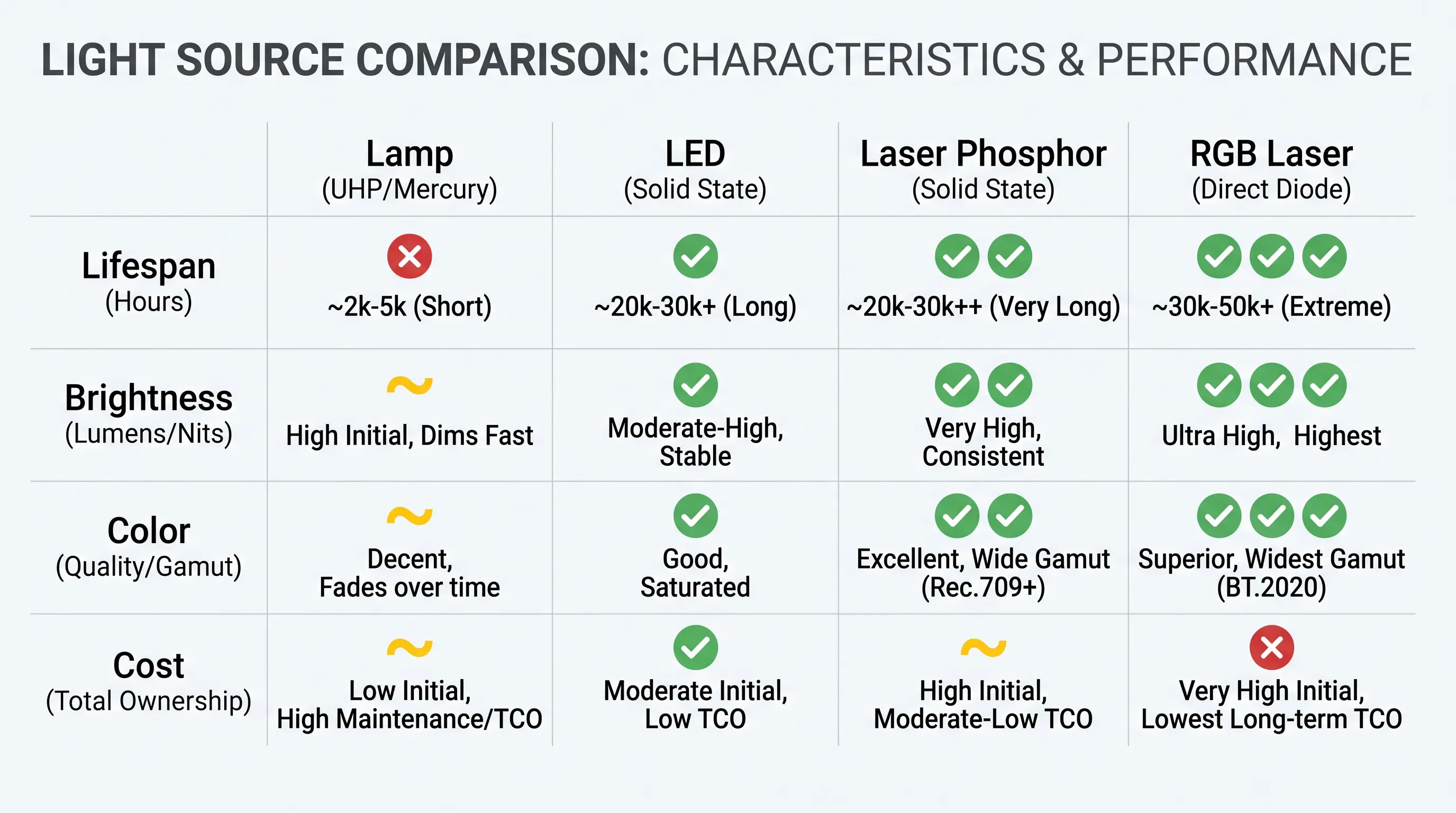
The second pro is lifetime. The projector light engine rated at 30,000 hours translates into a 10-year service life for a typical 8-hours-per-day usage pattern. Compare that to a UHP lamp at 4000 hours, and the LED lumens projector has a clear total-cost-of-ownership advantage for the B2B procurement officer building a five-year TCO model. The third pro is instant on/off: no warm-up cooldown curve, no fan-ramp delay, no lamp-strike protection circuit.
The Real Trade-Offs
| Evaluation Criterion | the SKU | UHP Lamp Projector | Laser Phosphor Projector |
|---|---|---|---|
| ANSI lumen ceiling (2026) | ~3500 ANSI | ~5000 ANSI | ~8000 ANSI |
| Published LED lumens headline | 7000 to 12000 LED lumens | N/A | N/A |
| Light-source lifetime | 30000 hours | 4000 hours | 20000 hours |
| Color gamut (Rec.709) | 95 to 110% | 85 to 95% | 90 to 105% |
| Heat output | Low | High | Medium |
| Replacement cost | $0 (sealed engine) | $80 to $180 lamp | $200 to $400 laser block |
| B2B wholesale cost (2026) | $210 to $480 | $160 to $340 | $380 to $720 |
The first con is raw white-light ceiling. Even a flagship LED lumens projector from DataMax's 2026 catalog tops out near 3500 ANSI lumens, which is below the brightness threshold for unshaded daytime use in a 200-seat conference room. The second con is the spec sheet credibility gap, already covered in the prior section. The third con is thermal coupling in sealed light engines: at sustained full-white output, the LED junction temperature drifts and the lumen output drops 8 to 12 percent over the first 500 hours. We publish this thermal droop curve in every DataMax wholesale RFQ response, so B2B buyers can spec the headroom into their channel claims.
Next Steps: How to Choose an LED Lumens Projector for Your Channel
Choosing the right LED lumens projector for a 2026 product line comes down to four checkpoints. First, lock your ANSI baseline before you evaluate any unit marketing claim. Insist on a third-party test report from the factory, then apply your own conversion factor (we recommend 0.6 to 0.75 for marketing-to-ANSI on current LED lumens projector SKUs). Second, validate the duty cycle you intend to publish in retail copy. If your channel buyer plans to advertise 10,000 LED lumens, ask the supplier for the thermal-droop curve at that sustained output, not just the peak-spec slide. Third, confirm the light-engine warranty and the RMA path for a sealed projector unit. A 3-year warranty on the LED module is now standard in the DataMax 2026 catalog; anything shorter is a red flag. Fourth, align the MOQ and lead time with your sell-through forecast.
For OEM/ODM and B2B Buyers
For B2B procurement teams and ODM buyers evaluating the DataMax wholesale lineup, the procurement process follows a fixed workflow:
- RFQ submission with target LED lumens, ANSI floor, throw ratio, and resolution
- Sample policy: 7-day DHL delivery of an evaluation unit, refundable against MOQ
- MOQ: 500 units for a standard LED lumens projector SKU; 1000 units for a custom housing
- Lead time: 25 to 35 days from PO for standard SKUs; 45 to 60 days for ODM tooling
- Contact channel: request a custom quote or email Contact-Projector.com
We treat every the projector order as a partnership, not a transaction. Our engineering team supports firmware tuning, packaging localization, and channel-specific color-profile calibration for every LED lumens projector shipment.
Final Word
Industry Context
The LED lumens projector category will continue to absorb the entry-level home-cinema segment through 2026 and into 2027, while laser phosphor remains the default for high-brightness commercial installations. B2B buyers who spec correctly now will own the channel margins for the next product cycle.
Closing and Next Step
Choosing an LED lumens projector for your 2026 product line does not have to be guesswork. With the right conversion factors, a verified ANSI baseline, and a clear B2B partner, the LED lumens projector spec becomes a competitive advantage rather than a liability. Browse the DataMax home theater projector lineup, review the GP95 hotel projector, or request a custom quote to start your next LED lumens projector program.
