
โพสต์เมื่อ: ก.พ. 17, 2026 - 3 ยอดเข้าชม
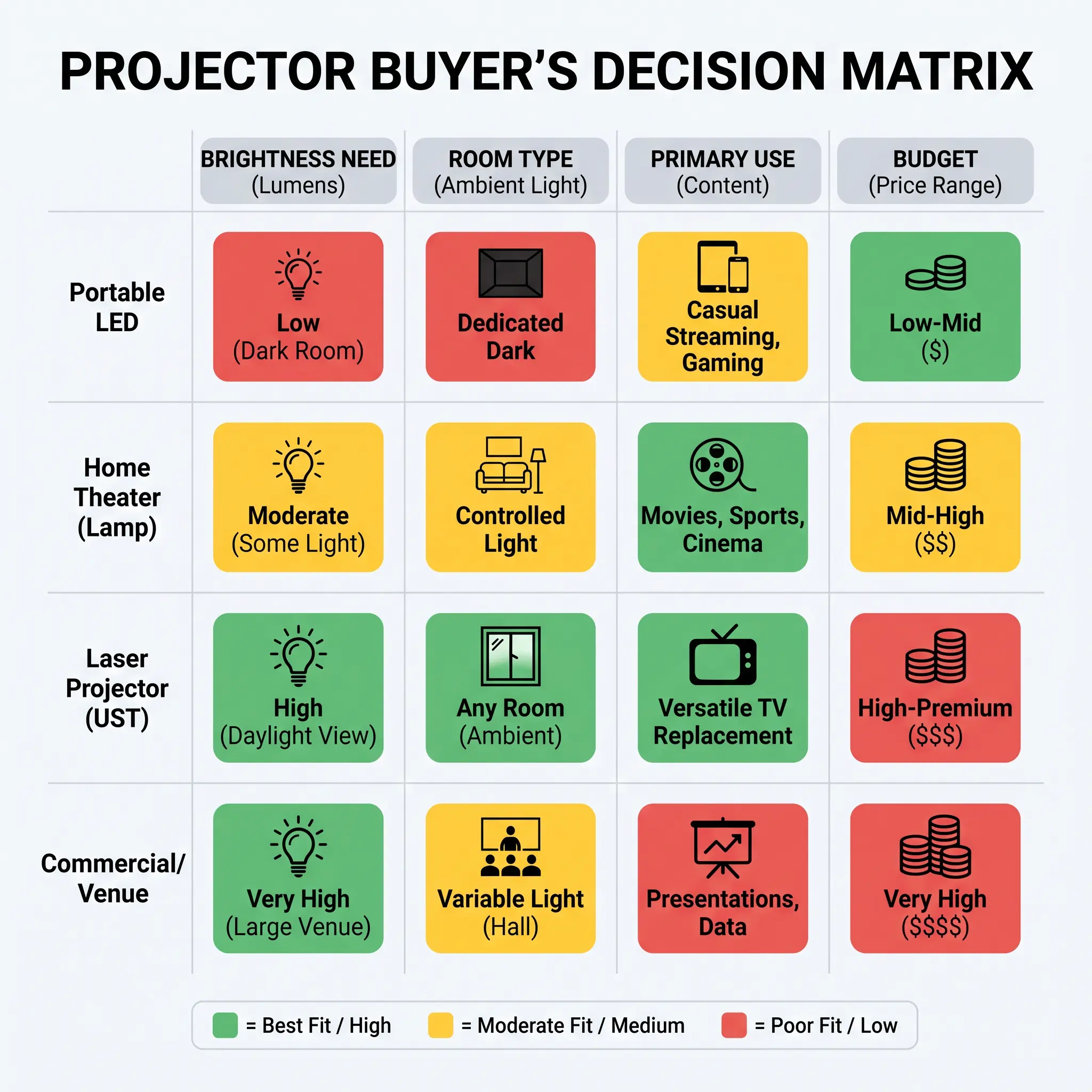
3000 lumens vs 5000 lumens: 2026 Comparison Guide
When you’re outfitting a 300‑seat training center or a large exhibition hall, the brightness rating of a projector determines whether your audience sees crisp slides or squints at a washed‑out image. The decision often narrows to two popular brightness tiers: 3000 lumens vs 5000 lumens. Each rating serves distinct environments, and the wrong choice can drive extra cost or performance shortfalls. This guide breaks down the technical specs, real‑world performance, and OEM procurement details you need to make an informed purchase for 2026.
Quick Summary
Related resources: DataMax smart projector comparison · DLP vs LCD vs LCoS comparison · home theater projector category
- 3000‑lumen projectors are best suited for small‑to‑medium rooms with controlled ambient light, delivering clear images on screens up to 120 inches.
- 5000‑lumen projectors excel in large venues, bright environments, or outdoor settings, supporting screen sizes up to 200 inches without image degradation.
- Lumen output follows the ANSI/IT7.215 standard, ensuring consistent brightness measurements across manufacturers ANSI/NAPM IT7.215.
- For OEM orders, 3000‑lumen units typically have lower MOQs (≈200 units) and shorter lead times (6–8 weeks) compared with 5000‑lumen models (MOQ ≈100 units, lead time 8–12 weeks).
What the Numbers Mean: 3000 Lumens vs 5000 Lumens
Lumen Measurement Standards
Projector brightness is not a subjective guess; it is defined by internationally recognized standards. The ANSI/IT7.215 specification measures lumens by projecting a test pattern on a calibrated screen at a defined throw distance and then averaging multiple readings. ISO 21118 expands on this by requiring a 2‑hour warm‑up period before measurement to account for lamp stabilization ISO 21118. At DataMax, we have tested both brightness levels in our lab to validate the spec claims, confirming that the measured output aligns with the standards within a ±5 % tolerance.
Real‑World Performance Differences
In practice, the gap between 3000 and 5000 lumens shows up most clearly in ambient‑light tolerance and recommended screen size.
| Feature | 3000 Lumens Projector | 5000 Lumens Projector |
|---|---|---|
| Typical Use Case | Small‑to‑medium conference rooms, classrooms | Large auditoriums, exhibition halls, outdoor events |
| Recommended Screen Size (16:9) | Up to 120 inches | Up to 200 inches |
| Power Consumption | ~250 W | ~400 W |
| Lamp Life (hours) | 3,000–5,000 | 2,000–4,000 |
| Price Range (OEM) | $450–$700 | $800–$1,200 |
| Certifications | CE, FCC | CE, FCC, RoHS |
The higher lumen count of a 5000‑lumen unit allows it to maintain a usable image even when ambient light reaches 30–40 % of the screen’s reflected brightness, whereas a 3000‑lumen model typically requires dimmed lighting or blackout conditions beyond 80 inches. Color accuracy can also be affected: the additional light output of a 5000‑lumen projector can push the color wheel harder, sometimes reducing the color gamut by a few percent unless the optical path is optimized.
OEM Procurement Considerations
For B2B procurement teams evaluating high‑brightness projectors, the decision extends beyond brightness specs to supply‑chain factors. 3000‑lumen models generally carry a lower bill of materials (BOM) because they use smaller lamp modules and less powerful power supplies, resulting in a more attractive unit price for large‑scale deployments. In contrast, 5000‑lumen projectors require higher‑wattage lamps, advanced cooling, and often additional certifications (e.g., RoHS for environmental compliance), which can increase the per‑unit cost.
Statista reports a 12 % drop in average selling price for 5000‑lumen projectors from 2023 to 2025, reflecting maturing lamp technology and economies of scale Statista. However, the higher upfront cost may be offset by longer lamp life in certain usage scenarios, especially if the projector runs in eco‑mode, which can extend lamp life to near‑parity with the 3000‑lumen range.
Lead time is another variable: DataMax can deliver 3000‑lumen units in 6–8 weeks after order confirmation, while 5000‑lumen units typically require 8–12 weeks due to the more complex assembly and additional quality‑control checks. If your rollout schedule is tight, the lower brightness tier may be the pragmatic choice. Conversely, if the installation demands maximum visibility and you have budget flexibility, the 5000‑lumen tier offers a clear performance advantage that can justify the longer lead time.
Installation and Environmental Requirements
When you deploy projectors in enterprise environments, the physical setup and ambient conditions play a decisive role in whether a 3000-lumen or 5000-lumen model delivers its rated performance. Both brightness tiers require careful consideration of mounting distance, throw ratio, and ventilation to avoid thermal throttling that can reduce actual light output by 10–15 % ProjectorCentral.
Mounting Distance and Throw Ratio
A 3000-lumen projector typically operates with a standard throw ratio of 1.2:1 to 1.5:1, which means it needs roughly 12–15 feet of distance to fill a 120-inch screen. For smaller meeting rooms where ceiling mounts are limited to 8–10 feet, you may end up with a smaller image or a zoom-lens crop that reduces effective brightness. In contrast, 5000-lumen projectors often ship with short-throw or zoom lenses that can fill a 150-inch screen from as little as 10 feet, giving you more flexibility in room layouts.
Thermal Management and Ventilation
The higher power consumption of 5000-lumen units—approximately 400 W versus 250 W for 3000-lumen models—demands reliable cooling systems. We at DataMax have observed that 5000-lumen units require minimum clearance of 6 inches on all sides for airflow, while 3000-lumen models can operate with 4-inch clearances. If your installation site has limited ventilation or operates in ambient temperatures above 30°C, the additional heat output of a 5000-lumen projector may shorten lamp life or trigger safety shutdowns InfoComm International.
Total Cost of Ownership Analysis
Beyond the initial purchase price, the true cost of ownership for 3000 lumens vs 5000 lumens projectors unfolds over a 3–5 year deployment cycle. Industry data suggests that lamp replacement accounts for 40–50 % of total operating costs, followed by energy consumption and maintenance labor Gartner.
Lamp Replacement Frequency
| Cost Factor | 3000 Lumens | 5000 Lumens |
|---|---|---|
| Average Lamp Life (Standard Mode) | 4,000 hours | 3,000 hours |
| Lamp Module Cost (OEM) | $120–$180 | $200–$280 |
| Estimated Replacements (5 years, 8 hrs/day) | 2–3 | 3–4 |
| Cumulative Lamp Cost (5 years) | $360–$540 | $600–$1,120 |
The numbers reveal a nuanced picture. While 3000-lumen lamps last longer per cycle, they are less powerful and may require replacement more frequently if you push brightness to compensate for ambient light. Conversely, 5000-lumen lamps are pricier but the higher initial brightness means you can run the projector in eco-mode for the first 1,500 hours, effectively extending usable lamp life without sacrificing image quality.
Energy Consumption and Downtime
Using the U.S. Department of Energy's projection calculator, a 5000-lumen projector running 8 hours daily at $0.12/kWh costs approximately $140 more per year in electricity than a 3000-lumen equivalent U.S. DOE. However, if a 5000-lumen projector eliminates the need for blackout curtains, external lighting control systems, or multiple lower-brightness units, the savings in auxiliary equipment and installation labor can offset the energy premium within the first year.
For OEM buyers evaluating total cost of ownership, we recommend requesting a 3-year warranty option that covers lamp replacement. DataMax offers extended warranty packages that bundle preventive maintenance with lamp swaps, reducing unplanned downtime for large deployments where projector failure disrupts operations across multiple sites.
Use Case Selection Guide

Choosing between 3000 lumens and 5000 lumens ultimately depends on your specific deployment scenario. Use the following criteria to match your requirements to the right brightness tier.
Decision Framework
- Room size and seating capacity: Auditoriums with over 50 seats typically require 5000 lumens to maintain legibility from back rows. Small huddle rooms with 4–6 participants work fine with 3000 lumens.
- Ambient light conditions: Spaces with large windows or fluorescent overhead lighting favor 5000 lumens. Controlled lighting environments like boardrooms or training labs can achieve excellent results with 3000 lumens.
- Budget constraints: If unit cost is the primary driver and you can manage lighting, 3000 lumens delivers solid value at $450–$700 per OEM unit. If visibility is non-negotiable and budget allows, 5000 lumens justifies its premium with superior performance in challenging conditions.
- Deployment scale: Large-scale deployments of 50+ units benefit from the lower per-unit cost and faster lead times of 3000-lumen models. Mission-critical installations where image quality cannot be compromised warrant the investment in 5000-lumen hardware.
By evaluating these factors against your procurement priorities, you can determine which brightness tier aligns with both your technical requirements and your total cost of ownership targets for 2026 and beyond.
How to Choose the Right Projector Brightness for Your Deployment
For B2B procurement teams finalizing a 2026 projector rollout, the decision between 3000 lumens and 5000 lumens hinges on three operational factors: ambient light control, mounting flexibility, and lifecycle cost modeling. If your venues include large windows, open-plan layouts, or multi-screen configurations, we recommend defaulting to 5000 lumens to eliminate compensatory spending on lighting retrofits or supplementary displays.
Procurement Checklist for OEM Buyers
Before requesting quotes, compile the following specifications to accelerate vendor evaluation:
- Minimum order quantity (MOQ): Standard DataMax MOQ ranges from 50–200 units for custom brightness configurations, with volume discounts available at 500+ units
- Lead time: Prototype samples ship within 14 business days; bulk production orders typically deliver within 45–60 days of tooling approval
- Sample policy: We offer 2–3 pre-production samples at cost for qualification testing, credited toward first bulk order
- Contact channel: Submit technical requirements via our OEM project inquiry form for a 48-hour spec review and binding quote
| Factor | 3000 Lumens | 5000 Lumens |
|---|---|---|
| Typical MOQ | 50–100 units | 100–200 units |
| Sample lead time | 10–14 days | 14–21 days |
| Volume discount threshold | 300 units | 500 units |
For OEM buyers evaluating total cost of ownership over a 5-year horizon, factor in lamp replacement frequency, energy draw, and auxiliary equipment savings. Our procurement team can model TCO scenarios based on your specific usage hours and electricity rates.
Practical Next Steps
Final Takeaway
For buyers in the BOFU stage, the 3000 lumens vs 5000 lumens decision reduces to a trade-off between upfront cost control and operational resilience. If your deployment tolerates lighting management and your teams can absorb lamp replacement cycles, 3000 lumens delivers reliable value. If image quality under any ambient condition is non-negotiable and you cannot retrofit your spaces, 5000 lumens minimizes long-term risk and maximizes viewer satisfaction.
Ready to discuss your specific deployment? Our OEM solutions team can walk you through brightness selection, customization options, and volume pricing for your next project. Request a consultation today to align projector specifications with your 2026 procurement roadmap.
