
Posted At: Apr 13, 2026 - 88 Views
DLP vs LCD vs LCoS Projectors: A B2B Buyer's Guide to Display Technology
For B2B buyers sourcing DLP vs LCD vs LCoS projector platforms, the choice between these three display technologies shapes product positioning, retail price band, target customer, and even certification cost. Each technology has structural advantages and disadvantages that no amount of factory tuning can fully erase. This guide explains how they work, where each excels, what they cost at the OEM level, and which scenarios favor which technology.
How Each Technology Works
DLP (Digital Light Processing)
DLP uses a Digital Micromirror Device (DMD) chip — millions of microscopic mirrors on a single silicon die. Each mirror represents one pixel and tilts thousands of times per second to direct light either toward or away from the projection lens. Color is typically generated by a spinning color wheel (single-chip DLP) or by splitting white light through a prism onto three DMDs (three-chip DLP, far rarer in mid-range projectors).
DLP is the dominant technology in compact and portable projectors. Texas Instruments is the sole DMD supplier, which has implications for pricing and lead times.
LCD (Liquid Crystal Display)
LCD projectors (technically HTPS — High Temperature Poly-Silicon LCD) use three small LCD panels — one each for red, green, and blue. Light from a single source passes through all three panels; the modulated beams are recombined and projected through a single lens. 3LCD (Epson's branding) is the most common architecture.
LCD is the dominant technology in education and entry-level business projectors, where brightness and color brightness matter more than absolute black levels.
LCoS (Liquid Crystal on Silicon)
LCoS combines elements of both — liquid crystal layers on a reflective silicon backplane. Light reflects off the silicon surface, passes through the liquid crystal, and is projected. Sony calls it SXRD; JVC calls it D-ILA.
LCoS delivers the highest native contrast and resolution of the three, but at a higher cost and with a more limited supply base. LCoS projectors are typically positioned at the premium home theater and pro-AV end of the market.
Image Quality Comparison

Buyers looking for a turnkey smart OS reference should evaluate the GP95-GTV 400 ANSI Full-Sealed Smart Projector with Google TV Built-In. Google TV is licensed and pre-integrated, eliminating months of middleware work for ODM projects.
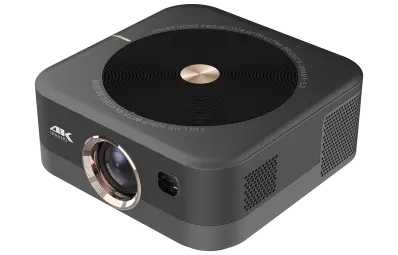
Distributors evaluating the B2B projector market can reference our GP94C Android Smart Projector for Home Theater—a production-validated platform covering Android 9 · 500 ANSI · Built-in Speakers, suitable as an OEM/ODM starting point.
| Attribute | DLP | LCD (3LCD) | LCoS |
|---|---|---|---|
| Native contrast | 1,500:1 to 5,000:1 | 1,000:1 to 3,000:1 | 5,000:1 to 30,000:1 |
| Color brightness | ~80% of white (color wheel dependent) | 100% (three-panel) | 95–100% |
| Color gamut | Good with laser phosphor | Good with laser | Excellent (BT.2020 capable) |
| Motion handling | Excellent (microsecond response) | Good (some smearing possible) | Very good |
| Pixel structure | Visible at very close range | Visible screen door effect | Minimal (smallest pixel gaps) |
| Black levels | Good (laser dimming helps) | Fair (light leakage) | Excellent (deepest blacks) |
| Rainbow effect | Possible (single-chip DLP) | Not present | Not present |
Cost Implications at the OEM Level
Component cost is the largest variable across the three technologies:
| Component | DLP | LCD | LCoS |
|---|---|---|---|
| Imaging chip | DMD ($5–$60 per chip depending on size) | 3× HTPS panels ($15–$50 total) | LCoS panel ($40–$200) |
| Light source | LED or laser (similar across techs) | LED or laser | Laser (almost universally) |
| Prism / light engine | Color wheel + integrator | Dichroic prism | Polarization beam splitter |
| OEM factory base | Wide (50+ DLP projector factories) | Narrow (10–20 factories) | Very narrow (5–10 factories) |
| Tier | DLP | LCD (3LCD) | LCoS |
|---|---|---|---|
| 1080p portable, 500 ANSI | $48–$72 | $42–$65 | — |
| 1080p home theater, 1,500 ANSI | $115–$165 | $105–$150 | $180–$260 |
| 4K HDR, 2,500 ANSI | $320–$480 | — | $520–$780 |
| 4K HDR, 4,000+ ANSI | $580–$850 | $480–$720 | $900–$1,400 |
Lifespan and Maintenance
| Metric | DLP (LED) | DLP (Laser) | LCD (Laser) | LCoS (Laser) |
|---|---|---|---|---|
| Light source life | 20,000–30,000 hr | 20,000–30,000 hr | 20,000–25,000 hr | 20,000–30,000 hr |
| Color wheel life | 20,000–50,000 hr | N/A | N/A | N/A |
| Panel degradation | None (solid-state DMD) | None | Possible after 15,000 hr | Possible after 15,000 hr |
| Dust sensitivity | Low (sealed engine common) | Low | Moderate (open panel design) | Low |
| Filter cleaning | Often unnecessary | None | Every 500–1,000 hr | None |
Manufacturing and Supply Chain Considerations
- DLP: Texas Instruments is the sole DMD supplier. Lead times for popular DMD chips (0.33" 1080p, 0.47" 4K) range from 4–14 weeks depending on backlog. The DLP ecosystem is mature, with mature color wheels, light engines, and reference designs.
- LCD: Epson and Sony are the dominant panel suppliers. The supplier base is narrower than DLP. Lead times are typically 6–12 weeks.
- LCoS: Sony and JVC are the primary panel makers. The supplier base is narrowest. Lead times can stretch to 12–20 weeks for popular LCoS panels.
Use Case Recommendations
| Scenario | Recommended Technology | Rationale |
|---|---|---|
| Portable business projector | DLP | Compact size, fast startup, robust supply |
| Classroom projector (K-12) | LCD (3LCD) | High color brightness for lit rooms, low cost |
| Higher-ed / lecture hall | DLP laser | Long life, low maintenance, sealed optics |
| Premium home theater | LCoS or DLP laser | Best black levels and motion |
| Conference room (mid-size) | DLP laser | Brightness, low maintenance, smart features |
| Large venue / event | 3LCD laser | High brightness, color fidelity |
| Outdoor portable | DLP LED | Sealed engine, impact resistance |
| Gaming projector | DLP | Fast response, low input lag |
What We Recommend at Smart-Projector.com
Our catalog reflects industry demand patterns:
- ~70% of our OEM/ODM production is DLP (LED or laser), spanning portable, home theater, education, and conference room classes
- ~25% is 3LCD, primarily for education and entry-level business projectors where color brightness matters
- ~5% is LCoS or premium DLP laser for high-end home theater and pro-AV clients
Conclusion and Next Step
The DLP vs LCD vs LCoS projector decision is not about "best technology" — it is about matching technology to your retail price band, target customer, and operational model. DLP is the safe default for most B2B buyers. LCD wins on cost and color brightness for education. LCoS wins on image quality for premium positioning.
💼 Need a technology recommendation for your projector line?
Request a Free Quote | View Product Catalog
Tell us your target specs, retail price, and use case. We will recommend the right display technology and ship a working sample within 14 days. MOQ starts at 500 units for catalog SKUs, with full ODM available for clients seeking exclusive platforms.
