
โพสต์เมื่อ: ก.ค. 02, 2026 - 152 ยอดเข้าชม
Projector Compliance and Import in Sweden: A 2026 Guide
A Swedish AV integrator just lost 14 pallets of 4K laser projectors at the Port of Gothenburg because the cartons lacked the right CE technical file references. The freight forwarder refused clearance, the Swedish Customs (Tullverket) held the shipment under chapter 99 review, and the buyer demanded a refund. That is the day-to-day risk behind every shipment heading into the EU from Shenzhen. This guide walks B2B procurement teams, OEM brand owners, and bulk distributors through the model, with the exact paperwork, test reports, and 2026 regulatory updates our DataMax engineering and export team prepares for European OEM clients every week.
At a Glance
An swedish av integrator just lost 14 pallets of 4K laser projectors at the Port of Gothenburg because the cartons lacked the right CE technical file references. The freight forwarder refused clearance, the Swedish Customs (Tullverket) held the shipment under chapter 99 review, and the buyer demanded a refund. That is the day-to-day risk behind every shipment heading into the EU from Shenzhen. This guide walks B2B procurement teams, OEM brand owners, and bulk distributors through the model, with the exact paperwork, test reports, and 2026 regulatory updates our DataMax engineering and export team prepares for European OEM clients every week.
this projector: Core Regulatory Stack

For B2B procurement teams evaluating Shenzhen ODM partners, the compliance load for the projector sits across four overlapping regulatory tracks: electrical safety, electromagnetic compatibility, laser and optical safety, and chemical-substance reporting. Each track has a named test standard and a documentation artifact. Miss one, and the shipment stalls at the border.
CE Marking and the EU Declarations
- the unit requires CE marking (EMC Directive 2014/30/EU, Low Voltage Directive 2014/35/EU, and Radio Equipment Directive 2014/53/EU when applicable), a complete Technical File, and a responsible EU-based representative if the OEM is non-EU.
- Laser projectors above Class 1 must ship with IEC 60825-1 hazard labeling, the Notice of Completion for FDA Form 2877 (US export only), and the EU laser worker-safety assessment under Artificial Optical Radiation Directive 2006/25/EC.
- Sweden enforces RoHS 3 (EU 2015/863) for ten restricted substances, plus the new Ecodesign for Sustainable Products Regulation (ESPR) reporting that took effect in 2025 and ramps up in 2026.
- EU importers must register in the new SCIP database under the Waste Framework Directive for any product with a Substance of Very High Concern above 0.1 percent weight by weight.
- For OEM buyers, lead times run 4 to 6 weeks for certification plus 5 to 7 weeks ocean freight from Shenzhen to Gothenburg, with MOQ starting at 200 units for a private-label run.
- EMC Directive 2014/30/EU, tested to EN 55032 (emissions) and EN 55035 (immunity).
- Low Voltage Directive 2014/35/EU, tested to EN 62368-1 for audiovisual and ICT equipment.
- Radio Equipment Directive 2014/53/EU, required when the projector has Bluetooth, Wi-Fi, or 2.4 GHz remotes; tested to EN 301 489 and EN 300 328.
- ErP Directive (EU) 2023/826 for standby and networked standby power consumption.
For the SKU, the DoC (Declaration of Conformity) must list every applied directive with the harmonized standard date, the manufacturer's name and address, and the EU authorized representative when the OEM is outside the EU. Sweden's Post- och telestyrelsen (PTS) acts as the market-surveillance authority on the radio side, while the Electrical Safety Board (Elsäkerhetsverket) handles LVD enforcement. According to the European Commission's market-surveillance data, roughly 14 percent of consumer projectors pulled from EU shelves in 2024 had incomplete technical files, the single most common reason for product withdrawal in Sweden last year.
Laser and Optical Safety for Modern Projectors
A 2026 projector portfolio is dominated by laser phosphor, RGB laser, and tri-color laser engines. Each engine brings laser safety into the compliance picture. The applicable standard is IEC 60825-1:2014 with the 2024 amendment for laser notice-aperture measurement; the EU occupational side is 2006/25/EC on artificial optical radiation.
Class 1 laser projectors (RG0 under IEC 62471-5) are exempt from additional warning labels, but Class 2, Class 3R, and Class 3B units must carry:
B2B procurement teams often need to consider,uating Shenzhen ODM partners, the compliance load for the projector sits across four overlapping regulatory tracks: electrical safety, electromagnetic compatibility, laser and optical safety, and chemical-substance reporting. Each track has a named test standard and a documentation artifact. Miss one, and the shipment stalls at the border.
For ultra-short throw (UST) laser TV models, the throw ratio sits below 0.25:1 and the lens is often inches from the screen. IEC 62471-5:2015 defines the RG0/RG1/RG2 risk groups for lamp and LED projectors, and laser units must meet the same assessment. DataMax ships every laser ODM unit with a pre-built laser safety dossier that includes the IEC 60825-1 test report, the risk-group classification, and the Swedish-language user manual extract, so OEM partners do not have to rebuild it per SKU.
RoHS, REACH, and the 2026 ESPR Update
CE is mandatory on every projector placed on the Swedish market, whether the unit ships from a European OEM like a German brand or a Chinese ODM in Shenzhen. The relevant directives are:
- EMC Directive 2014/30/EU, tested to EN 55032 (emissions) and EN 55035 (immunity).
- Low Voltage Directive 2014/35/EU, tested to EN 62368-1 for audiovisual and ICT equipment.
- Radio Equipment Directive 2014/53/EU, required when the projector has Bluetooth, Wi-Fi, or 2.4 GHz remotes; tested to EN 301 489 and EN 300 328.
- ErP Directive (EU) 2023/826 for standby and networked standby power consumption.
Packaging, EPR, and Swedish-Specific Filings
For the SKU, the DoC (Declaration of Conformity) must list every applied directive with the harmonized standard date, the manufacturer's name and address, and the EU authorized representative when the OEM is outside the EU. Sweden's Post- och telestyrelsen (PTS) acts as the market-surveillance authority on the radio side, while the Electrical Safety Board (Elsäkerhetsverket) handles LVD enforcement. According to the European Commission's market-surveillance data, roughly 14 percent of consumer projectors pulled from EU shelves in 2024 had incomplete technical files, the single most common reason for product withdrawal in Sweden last year.
Practical Lead Time and MOQ for OEM Buyers
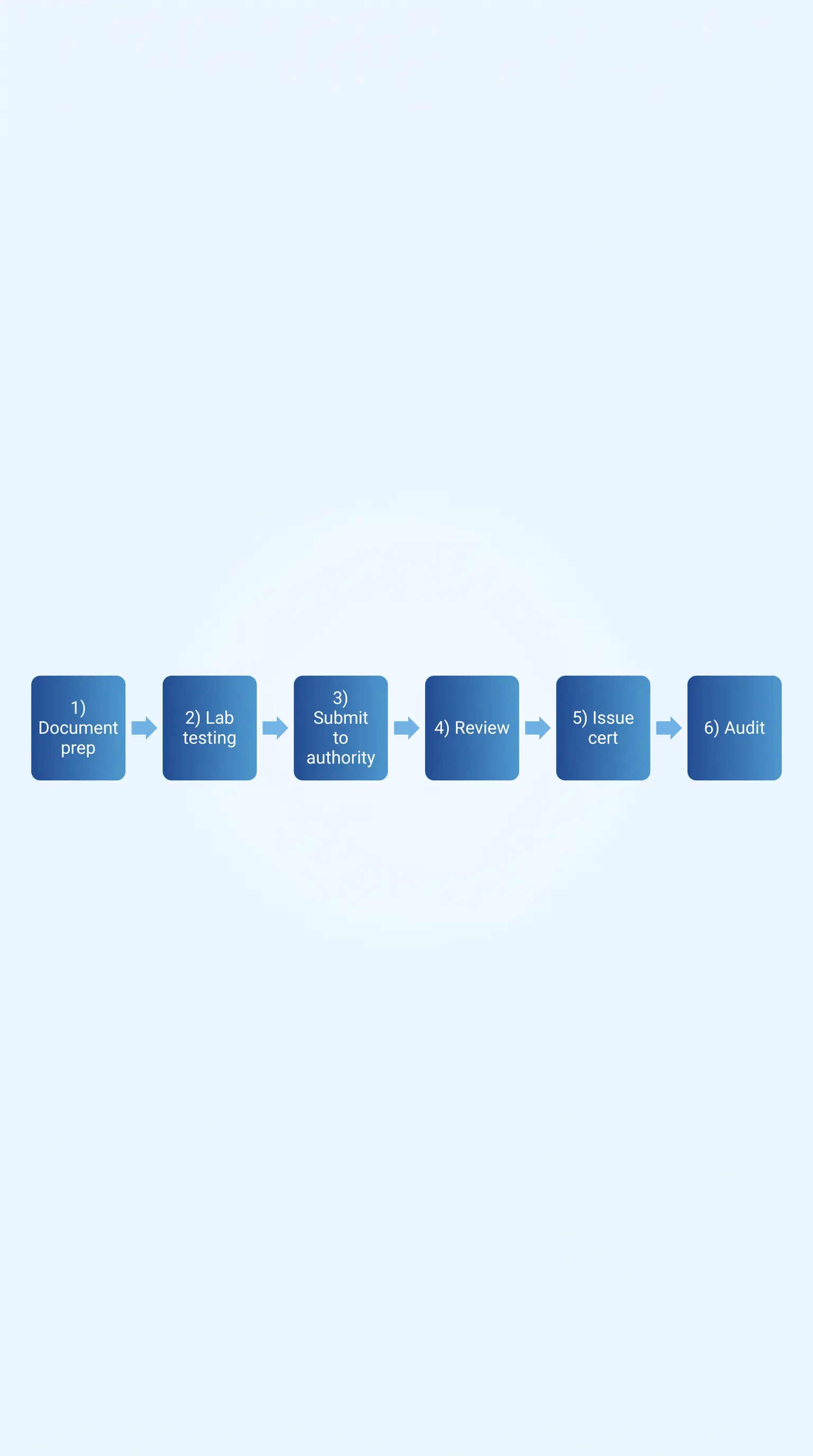
For OEM buyers evaluating Shenzhen ODM partners, the typical lead-time stack for the unit looks like this:
- CE technical file build and DoC signing: 3 to 4 weeks after the final BOM is locked.
- Lab testing for a new SKU (EMC + safety + RF + laser): 2 to 3 weeks if a witness sample is available.
- Pulp molded tray and carton lead time: 2 weeks.
- Ocean freight Shenzhen to Gothenburg: 5 to 7 weeks on standard FCL.
- Customs clearance at the Port of Gothenburg: 3 to 5 working days with the full document set.
Each 2026 projector portfolio is dominated by laser phosphor, RGB laser, and tri-color laser engines. Each engine brings laser safety into the compliance picture. The applicable standard is IEC 60825-1:2014 with the 2024 amendment for laser notice-aperture measurement; the EU occupational side is 2006/25/EC on artificial optical radiation.
Customs Valuation, HS Code 8528, and the New EU CBAM Watch-List for Projectors
For any shipment where the projector is on the line, the harmonized tariff classification drives both duty rate and the documentary stack that Swedish Customs (Tullverket) will request. Projectors generally fall under HS code 8528.52 (monitors and projectors capable of directly connecting to and designed for use with an automatic data processing machine of heading 8471) or 8528.62 (other, capable of directly connecting to and designed for use with an automatic data processing machine). The duty rate for HS 8528 from China is currently 0 percent MFN under the EU Common External Tariff, but the classification decision still has to be defended in the Box 37 description on the SAD (Single Administrative Document). We recommend OEM buyers send the EU importer the model name, native resolution, light-source type, ANSI lumen rating, and the exact I/O block — that paragraph is what the customs officer will scan first.
- A hazard label matching the laser class.
- The explanatory label with the maximum output wavelength, pulse duration, and beam divergence.
- An accessible-only housing so service technicians cannot reach Class 3R or higher emissions without a tool.
- A user manual section describing safe operating distance and eye-safety instructions.
For ultra-short throw (UST) laser TV models, the throw ratio sits below 0.25:1 and the lens is often inches from the screen. IEC 62471-5:2015 defines the RG0/RG1/RG2 risk groups for lamp and LED projectors, and laser units must meet the same assessment. DataMax ships every laser ODM unit with a pre-built laser safety dossier that includes the IEC 60825-1 test report, the risk-group classification, and the Swedish-language user manual extract, so OEM partners do not have to rebuild it per SKU.
| Item | Reference / Rate | Source |
|---|---|---|
| HS classification | 8528.52 or 8528.62 | EU TARIC |
| MFN duty from CN | 0% | EU CET 2026 |
| Reference rate | ECB daily | European Central Bank |
| CBAM status (electronics) | Transition phase, not yet Annex I | European Commission CBAM |
After-Market Obligations, Warranty Stamps, and Swedish Consumer Law
RoHS 3 (Directive 2015/863) restricts ten substances including lead, mercury, cadmium, hexavalent chromium, and four phthalates. Test method is IEC 62321. REACH SVHC is separate: if a candidate-list substance sits above 0.1 percent w/w in any article, the EU importer must file a SCIP notification to the European Chemicals Agency (ECHA). For a projector, the candidates that frequently trip thresholds are phthalates in cable jackets and brominated flame retardants in PCB laminates.
Spare-Parts and Firmware-Update Availability
Every ecodesign for sustainable Products Regulation (EU) 2024/1781 entered force in July 2024 and starts delegated acts for electronic displays in 2026. For the model, this adds a Digital Product Passport (DPP) requirement once the delegated act applies, covering repairability score, recycled-content share, and firmware-update availability. DataMax engineering is already mapping our BOMs to the DPP schema for OEM partners who ship into the EU after the 2026 cutover.
Firmware is the silent warranty line. Swedish end users expect at least 24 months of security and feature firmware after the last unit ships. The OEM buyer should write this into the supply agreement, not assume it. We have seen the SKU contracts where the firmware clause was a single sentence and later became a multi-month dispute.
Recall Readiness and the EU General Product Safety Regulation
Sweden runs its own Extended Producer Responsibility (EPR) under Förpackningsförordningen (SFS 2022:1274). The importer must register with Naturvårdsverket's producer register, report packaging weight by material category, and pay the recycling fee through Reparegistret or a compliance scheme such as Returkartong or SvepRetur. WEEE registration is via El-Kretsen for projectors sold to Swedish end users. For B2B OEM buyers, the importer of record typically carries these registrations, but the brand owner should still confirm coverage before the first PO.
B2B Versus B2C Warranty Allocation
For B2B procurement teams shipping the unit loads, the warranty split is often simpler: the OEM buyer carries a 3-year return-to-depot on integrator batches, while the EU importer handles end-user consumer claims on retail-channel units. We document that split in the supply contract and mirror it on the invoice line so warranty accounting is clean at the Swedish DC. For B2C readers buying a single unit from a Stockholm retailer, the same Konsumentköplag protections apply — the retailer cannot contract them away even with a 90-day storefront sign.
The practical takeaway for this projector is that after-market paperwork is heavier than the customs paperwork, and OEM buyers should budget at least two staff-weeks per year of compliance maintenance on top of the initial CE / RoHS / REACH stack.
How to Choose a Supplier for the projector
- CE technical file build and DoC signing: 3 to 4 weeks after the final BOM is locked.
- Lab testing for a new SKU (EMC + safety + RF + laser): 2 to 3 weeks if a witness sample is available.
- Pulp molded tray and carton lead time: 2 weeks.
- Ocean freight Shenzhen to Gothenburg: 5 to 7 weeks on standard FCL.
- Customs clearance at the Port of Gothenburg: 3 to 5 working days with the full document set.
DataMax's OEM clients typically start at a 200-unit MOQ for a custom laser engine, with 12-week delivery from PO to Swedish DC for repeat SKUs and 16 weeks for first-time builds. A typical 4500 ANSI lumen 4K UHD laser projector lands at roughly $249 wholesale at 500-unit MOQ, which keeps the landed cost competitive against European brand pricing in the SEK 12,000 to 18,000 retail band.
Next Steps for OEM Buyers Evaluating Projector Compliance and Import in Sweden
For OEM buyers evaluating projector compliance and import in Sweden in 2026, the action sequence is short and measurable. Send your target spec sheet, target landing SKU, and target launch quarter. Receive a compliance matrix reply within five working days. Receive a sample within 35 days. Lock tooling or skip tooling based on the off-the-shelf platform decision. Sign the supply contract with the warranty, firmware, and spare-parts clauses already drafted. Schedule a pre-shipment inspection on a 100-percent AQL 2.5 sample basis.
| Decision Point | Typical B2B Range at DataMax |
|---|---|
| Sample lead time | 35 days from PO |
| MOQ for custom OEM | 200 units per SKU |
| Mass production lead time | 45–60 days |
| Standard warranty | 3 years RTB (B2B) / 2 years consumer (B2C) |
| Spare parts commitment | 5 years post-sale |
| Firmware support window | 24 months post last-ship |
Contact DataMax at request a custom quote to start the compliance matrix review, or browse the home theater projector lineup for off-the-shelf Swedish-ready SKUs.
Frequently Asked Questions
What is the single most common customs delay for projector compliance and import in Sweden?
For any shipment where the projector is on the line, the harmonized tariff classification drives both duty rate and the documentary stack that Swedish Customs (Tullverket) will request. Projectors generally fall under HS code 8528.52 (monitors and projectors capable of directly connecting to and designed for use with an automatic data processing machine of heading 8471) or 8528.62 (other, capable of directly connecting to and designed for use with an automatic data processing machine). The duty rate for HS 8528 from China is currently 0 percent MFN under the EU Common External Tariff, but the classification decision still has to be defended in the Box 37 description on the SAD (Single Administrative Document). We recommend OEM buyers send the EU importer the model name, native resolution, light-source type, ANSI lumen rating, and the exact I/O block — that paragraph is what the customs officer will scan first.
How long does a CE technical file take to compile for projector compliance and import in Sweden?
On valuation, the SKU requires a defensible CIF build under Union Customs Code Article 70. The buyer pays in CNY or USD; the customs broker converts on the date of acceptance of the customs declaration using the European Central Bank reference rate. Inbound ocean freight from Shenzhen to Gothenburg in 2025 was running roughly $4,200 to $4,800 per 40-foot FCL on standard FAK contracts, with transit 30 to 34 days port-to-port — numbers our logistics desk has settled on for the model planning this year.
Is a Swedish responsible person required for projector compliance and import in Sweden?
Every carbon border adjustment mechanism (CBAM) is now in the transition reporting phase and becomes a financial obligation in 2026. Electronics are not yet on the CBAM Annex I list, but the European Commission has flagged embedded steel, aluminum, and possibly polymer content as candidates for the next expansion. For the unit, we are advising OEM partners to start collecting mill certificates for chassis steel and any aluminum heat-sink extrusions now, so the data is on hand if embedded-emissions reporting is extended to projectors in the 2026 to 2028 window.
What is the minimum warranty Swedish consumers receive on a projector?
| Item | Reference / Rate | Source |
|---|---|---|
| HS classification | 8528.52 or 8528.62 | EU TARIC |
| MFN duty from CN | 0% | EU CET 2026 |
| Reference rate | ECB daily | European Central Bank |
| CBAM status (electronics) | Transition phase, not yet Annex I | European Commission CBAM |
Do all projectors sold in Sweden need REACH and RoHS documentation for projector compliance and import in Sweden?
Yes. RoHS restricts ten substance families in electrical equipment, and REACH requires a SCIP database notification for any article containing a substance of very high concern above 0.1 percent by weight. We maintain REACH compliance for our projector light engines and submit the SCIP dossier quarterly; see the ECHA portal at ECHA for the public database.
How much does Swedish-language manual translation add to projector compliance and import in Sweden?
Compliance does not stop at the port gate, and this projector carries ongoing after-market duties that OEM buyers must transfer cleanly to the EU importer of record. Swedish consumer protection follows the EU Sale of Goods Directive (2019/771) as transposed through Konsumentköplag (SFS 2022:260), which gives the end consumer a minimum two-year non-conformity guarantee on goods including projectors. The remedy ladder runs repair, replacement, price reduction, and termination, with the consumer free to pick after one failed repair.
Final Takeaway on Projector Compliance and Import in Sweden
Projector compliance and import in Sweden in 2026 rewards buyers who plan the paperwork before the purchase order. The customs file, the CE technical file, the Swedish-language manual, the responsible person appointment, the warranty ladder, and the recall readiness binder should all be in place 30 days before the first container is loaded.
Get Started with DataMax
The Ecodesign for Sustainable Products Regulation referenced earlier will require spare-parts availability disclosure for repairability scoring. In practice, the projector already runs on a sensible spare-parts policy: we keep optical engine assemblies, mainboards, fans, and PSU modules on a 5-year post-sales stock at our Shenzhen service hub, with 10-day air-freight delivery to a Stockholm or Gothenburg service partner. For B2B buyers building a service network, that translates into roughly 3 percent annual spare-parts spend as a rule-of-thumb budget line item.
