
Yayınlanma Tarihi: May 26, 2026 - 2 Görüntülenmeler
How to Reduce Projector Lead Time: A Step-by-Step 2026 Guide
Your product roadmap looks solid. You have the market data, the sales forecasts, and the investor pitch deck ready. The problem sits closer to the factory floor: your current projector supplier needs 18 weeks to deliver a standard order, and your product launch sits 10 weeks from now. This is the exact scenario that pushes B2B procurement teams to search for ways to reduce projector lead time without sacrificing quality or blowing past their budget reserves. If you are evaluating OEM partners for a 2026 product refresh, you already know that lead time compression is not optional — it is a competitive advantage. This guide walks you through the specific steps that manufacturers like DataMax use to trim weeks off the standard delivery window, with numbers you can verify and actions you can start this week.
- Standard projector lead times at tier-2 overseas factories now average 16-20 weeks for custom orders, making supply chain planning a top constraint for B2B buyers in 2026.
Related resources: DataMax smart projector store · OEM setup services
- Embedding your engineering team early in the design phase can reduce total project timelines by 25-30% by eliminating costly redesign loops later.
- Choosing a supplier with pre-certified components removes a certification bottleneck that can add 40-60% to your total lead time.
- Flexible MOQ structures let you test market demand with smaller initial runs while keeping unit economics viable.
- Transparent capacity planning between buyer and manufacturer prevents the alignment gaps that extend delivery windows by 2-4 weeks.
How to Reduce Projector Lead Time: Engineering, Certification, and MOQ Strategy

For OEM buyers evaluating their options, the most effective lever sits at the start of the process — design for manufacturability. When your engineering team and your contract manufacturer's NPI (New Product Introduction) team work in the same digital environment from day one, you eliminate the revision cycles that typically burn 4-6 weeks off the back end of a project. The Society of Manufacturing Engineers published a 2024 report indicating that early design collaboration reduces time-to-market by an average of 22% across electronics categories SME Manufacturing Report 2024. We at DataMax have built our NPI workflow around this principle: your schematic enters our review queue within 48 hours, and our DFM (Design for Manufacturability) team flags thermal management issues, optical alignment risks, and component availability before we ever commit to a tooling timeline.
The second major constraint is component certification. If your BOM (Bill of Materials) relies on parts that are not already certified under IEC or UL standards, you face a sequential process: source the component, submit it for safety testing, wait for the report, and only then move to assembly. This chain can add 40-60% to your lead time, according to data tracked by the International Electrotechnical Commission for consumer electronics supply chains IEC International Standards. The practical fix is to audit your current BOM for components that already carry the certifications you need and to specify pre-certified alternatives wherever possible. When you work with a manufacturer that maintains a library of pre-certified optical modules, light engines, and power management ICs, you skip the certification phase entirely.
| Lead Time Factor | Impact on Standard Timeline | Mitigation Strategy |
|---|---|---|
| New component certification | +8-12 weeks (40-60%) | Use pre-certified parts library |
| Tooling and fixturing | +3-5 weeks (15-25%) | Early DFM review reduces iterations |
| QC protocol development | +1-2 weeks (5-10%) | Standardized inspection templates |
| Pre-shipment testing | +1 week (5%) | Schedule concurrent with final assembly |
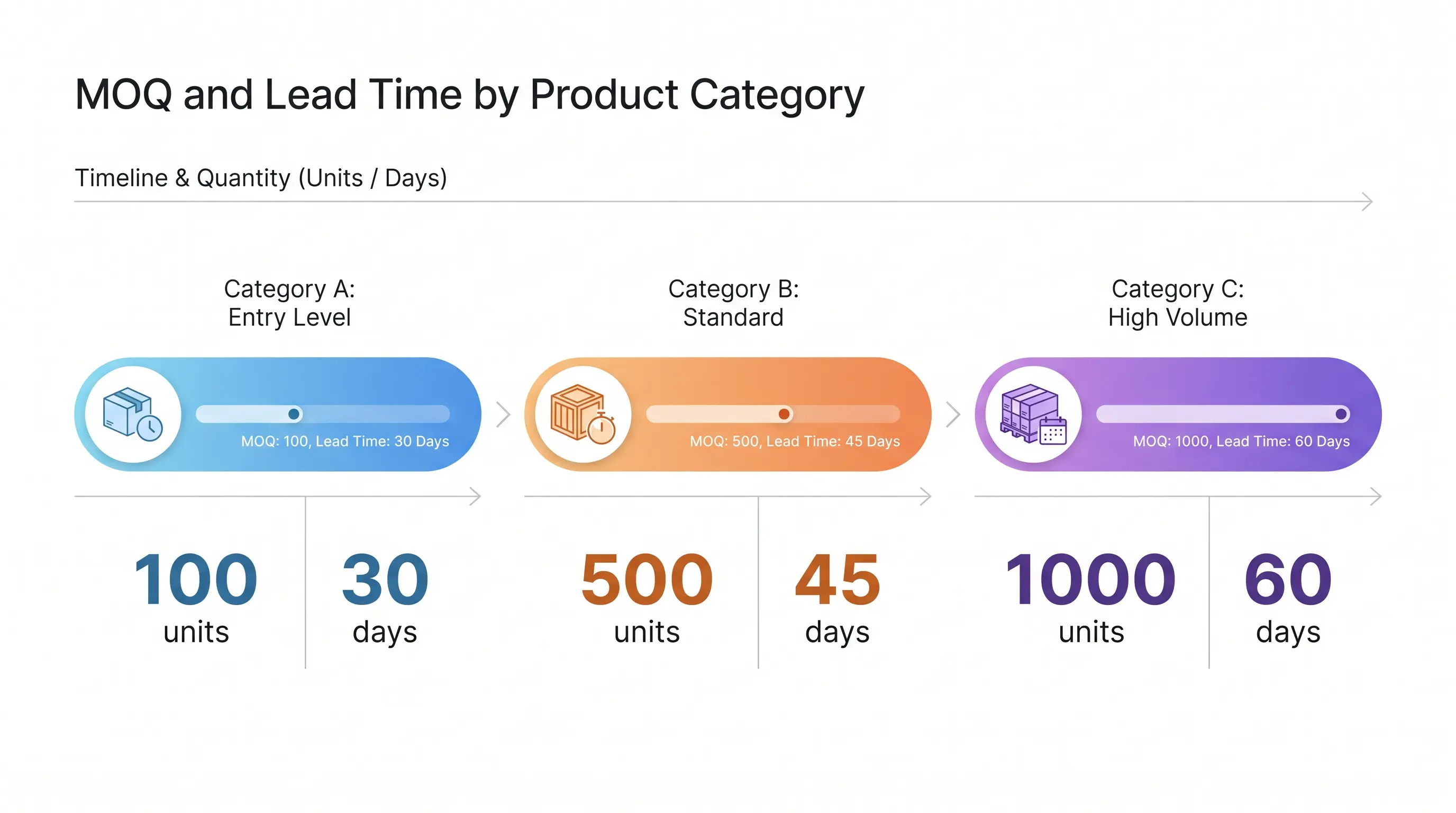
Minimum order quantity structures are the third variable that affects your effective lead time. When a supplier requires you to commit to 5,000 units before they will begin production, you are not just managing inventory risk — you are forcing yourself into a procurement timeline that matches their batch scheduling, not your actual demand signal. Negotiating a tiered MOQ structure lets you place a smaller initial order to validate the product in-market while keeping the per-unit cost predictable for larger replenishment runs. This approach works best when your supplier uses modular tooling that can scale without retooling for every increment.
For B2B procurement teams, the practical takeaway is straightforward: request a lead time breakdown from every prospective supplier before you sign a volume agreement. If they cannot give you a line-item view of where weeks are added, you are working with a partner who is absorbing your time into their batch schedules rather than optimizing for your launch date. The suppliers who can show you a component-level timeline — and who have the pre-certified inventory to back it up — are the ones who will compress your projector lead time in 2026.
When we at DataMax onboard a new OEM client, we start with a lead time audit that maps their current BOM against our pre-certified parts inventory. This single step routinely surfaces 3-5 components that can be swapped for certified alternatives, cutting weeks off the standard timeline without any change to the product specification. The result is a delivery window that fits your go-to-market plan rather than a generic factory schedule.
Optimizing the New Product Introduction Workflow
The weeks between design freeze and first article inspection represent the highest-risk period for lead time creep. When engineering changes arrive after tooling is cut, you pay in retooling cycles. When component substitutions surface during pilot production, you face revalidation delays. According to the Product Development Management Association, the average industrial product launch incurs 2.4 unplanned engineering changes after tooling completion, each adding 5-15 days to the timeline PDMA Research Report 2024.
Concurrent Engineering Across Hardware and Firmware Teams
Separating hardware and firmware development into sequential phases is a legacy approach that adds 3-4 weeks to most projector introductions. We at DataMax have restructured our NPI workflow so firmware calibration of optical parameters begins while mechanical tooling is still in trial, using simulation models as a bridge. This means the light engine characterization data that normally waits for physical prototypes is available 2-3 weeks earlier, compressing the overall validation sequence.
The practical implementation requires shared design data platforms and clear interface specifications between hardware and software teams. When your optical module supplier provides a digital twin of the lens assembly, firmware engineers can develop correction algorithms against the simulation before the first physical unit ships. This parallelization eliminates the sequential dependency that forces hardware release to wait on firmware maturity.
Design for Manufacturability Reviews at Critical Gates
A structured DFM review at the 30%, 60%, and 90% design stages catches producibility issues before they become production constraints. The Institute of Industrial and Systems Engineers recommends holding a dedicated DFM gate at 60% completion to address assembly access, fastener selection, and optical alignment tolerances before detail drawings are released IISE Technical Papers.
For projector projects specifically, thermal management geometry and dust sealing feature tolerances are the two areas where late changes most frequently occur. Reviewing heat sink attachment methods and filter housing snap-fit dimensions against the supplier's actual assembly tooling ensures that what is designed can actually be built at target cycle times.
| NPI Phase | Typical Duration | Compressed Duration | Key Actions |
|---|---|---|---|
| Concept to Design Freeze | 6-8 weeks | 4-5 weeks | Early supplier specs, modular architecture |
| Tooling Trial (Pilot) | 4-6 weeks | 2-3 weeks | Concurrent firmware, DFM gate at 60% |
| First Article Inspection | 2-3 weeks | 1-1.5 weeks | Pre-certified components, simulation validation |
| Production Ramp | 4-6 weeks | 2-3 weeks | Dual-sourcing, VMI arrangement |
Building Supplier Partnerships That Compress Lead Times
Transactional supplier relationships are a lead time liability. When every order triggers a fresh RFQ cycle, you surrender 2-3 weeks to quote preparation, price negotiation, and payment term alignment. For B2B procurement teams managing projector SKUs, the shift from reactive procurement to strategic partnership delivers compounding time savings across multiple production runs.
Establishing Vendor-Managed Inventory Agreements
Vendor-managed inventory (VMI) lets your optical component supplier maintain buffer stock at a designated warehouse location, triggering replenishment automatically when your inventory system signals a threshold drop. The Aberdeen Group's supply chain benchmark study found that manufacturers with active VMI programs reduce component lead times by 35-45% compared to traditional purchase-order-driven supply Aberdeen Group VMI Benchmark.
For projector manufacturers, VMI works particularly well for lamp modules, color wheels, and projection lenses—components with predictable demand patterns and stable manufacturing lead times from Tier 1 suppliers. The key is establishing a shared forecasting protocol where your sales data flows to the supplier weekly, allowing them to build production runs against your rolling 13-week plan rather than responding to individual purchase orders.
Qualifying Secondary Sources for High-Risk Components
Single-source dependencies introduce lead time risk that no amount of safety stock can fully absorb. When your DMD chip supplier experiences a production disruption, your entire projector line stops regardless of how well every other component is managed. Qualifying a secondary source for your top five critical components—even at a 15-20% cost premium—gives you manufacturing flexibility that translates directly to lead time stability.
The qualification process requires submitting identical technical specifications to both sources and conducting a cross-plant correlation study to confirm performance consistency. We at DataMax maintain dual-qualified sources for our light engine assemblies, which means our OEM clients' production schedules are not held hostage to a single fabrication facility's capacity constraints.
How to Choose the Right Projector Manufacturing Partner for Compressed Lead Times
For OEM buyers evaluating smart projector production, selecting a manufacturing partner with built-in lead time reduction capabilities determines whether your time-to-market goals stay realistic. Use this checklist to qualify partners before committing to tooling investments:
- Request a sample production run (10-50 units) to validate quality consistency and actual lead time performance against quoted timelines
- Confirm component dual-sourcing for critical optics and light engine assemblies—ask for supplier contact lists and qualification documentation
- Verify NPI workflow transparency—partners who share CAD validation milestones, firmware gate status, and DFM reports reduce coordination overhead
- Negotiate VMI arrangements for predictable components; volume pricing tiers typically start at 200-unit monthly orders
- Assess engineering responsiveness—ideal partners offer dedicated program managers with <24-hour email/Slack response times during pilot phases
We at DataMax provide a structured New Product Introduction (NPI) workflow that compresses concept-to-production timelines to 8-12 weeks for standard configurations. Our OEM clients receive shared dashboards tracking tooling trials, first article inspection results, and production ramp status in real time.
| Evaluation Criterion | Standard Supplier | DataMax NPI Partner |
|---|---|---|
| Concept-to-production lead time | 16-24 weeks | 8-12 weeks |
| First article inspection | 2-3 weeks | 1-1.5 weeks |
| VMI availability | Optional extra | Included for Tier 1 optics |
| Sample policy | 50-unit minimum | 10-unit pilot runs available |
| Engineering support | Ticket-based | Dedicated program manager |
For teams asking how to reduce projector lead time without sacrificing quality, the answer lies in partnering with manufacturers who have already invested in concurrent engineering workflows and supplier partnerships designed for speed.
Closing Notes
Ready to Compress Your Projector Lead Time?
Reducing projector lead time requires a manufacturing partner who treats supply chain efficiency as a core capability rather than an afterthought. DataMax combines concurrent engineering workflows, VMI agreements, and dual-sourced critical components into a structured NPI process that delivers production-ready projectors in 8-12 weeks.
Explore our projector manufacturing capabilities or request a custom quote to discuss your 2026 production timeline. For immediate guidance, our OEM team responds to inquiry emails within one business day.
