
Đăng lúc: Th06 26, 2026 - 95 Lượt xem

How to Manage Projector OEM Project: A Step-by-Step 2026 Guide
You've been assigned to launch a new smart projector line, but you don't have in-house manufacturing capabilities. The OEM route seems like the logical path—until you start comparing specifications, vetting suppliers, and coordinating timelines across continents. According to IDC, the global smart projector market will grow 12% annually through 2026, which means more companies are competing for qualified manufacturing partners IDC. Managing a projector OEM project requires a structured approach that balances technical requirements, budget constraints, and supply chain realities. This guide walks you through each phase, from initial specification to final delivery, using the same framework that we at DataMax have refined with hundreds of OEM clients.
How to Manage Projector OEM Project: Planning and Specification Phase

Related resources: DataMax smart projector store · OEM setup services
Define Core Technical Requirements
Before you contact any projector OEM manufacturer, document your product's technical DNA. The core specifications include brightness (measured in ANSI lumens), resolution, throw ratio, connectivity ports, and smart platform integration. For B2B procurement teams evaluating OEM options, these parameters directly impact the unit cost and minimum order quantity (MOQ). A standard 1080p projector for corporate environments typically starts at 3,000 ANSI lumens, while home entertainment models may prioritize resolution and HDR support over raw brightness. We recommend creating a three-tier specification document: "must-have" features, "should-have" enhancements, and "nice-to-have" differentiators. This tiered approach helps you negotiate scope with manufacturers and identify cost-saving opportunities.
Establish Budget and Timeline Parameters
OEM projects operate on strict financial and temporal boundaries. Your budget determines which features are feasible, while your launch window dictates production schedules. Lead times for custom projector tooling typically range from 30 to 60 days, with full production runs requiring 45 to 90 days depending on complexity. Factor in an additional 2-4 weeks for shipping and customs clearance if you're importing from Shenzhen or other manufacturing hubs. For OEM buyers evaluating multiple vendors, request detailed production timelines and verify they align with your product launch calendar. Building buffer time into your schedule protects against common delays in component sourcing, firmware development, and quality certification.
Create Detailed RFQ Documentation
A Request for Quotation (RFQ) is only as good as the information you provide. Include complete technical specifications, expected order volumes, packaging requirements, and compliance standards. Specify your target retail price point so the manufacturer can recommend appropriate component tiers. We at DataMax have processed thousands of RFQs, and the most successful projects start with exhaustive documentation that leaves no room for interpretation. Ambiguous specifications lead to sample discrepancies, retooling costs, and delayed timelines—all of which erode your project margins.
How to Manage Projector OEM Project: Vendor Selection and Negotiation
Evaluate Manufacturing Capabilities
Not all projector manufacturers offer the same services. Some specialize in consumer-grade DLP technology, while others focus on laser phosphor or LCOS systems. Verify that your shortlisted partners have experience producing projectors that match your technical requirements. Request facility audits, inspect production lines, and review their quality control processes. A manufacturer with ISO 9001 certification demonstrates commitment to consistent processes, but you should also confirm they have specific experience with projector optical systems and lamp/laser modules. The average projector OEM factory in Shenzhen operates with 200-500 workers, but larger facilities can handle higher volumes with faster turnaround.
Negotiate MOQ and Pricing Structures
Minimum order quantities represent A common critical negotiation points for OEM buyers. Standard projector MOQs typically range from 500 to 2,000 units per SKU, though some manufacturers accept lower quantities for premium pricing. Your per-unit cost decreases significantly as order volume increases—expect 15-30% cost reduction when doubling your initial order size. Request itemized pricing breakdowns that separate tooling costs, unit costs, and packaging expenses. This transparency helps you identify areas for optimization and compare offers across vendors accurately.
Review Certification and Compliance Requirements
Projectors sold in different markets must meet specific safety, electromagnetic, and environmental standards. The EU requires CE marking and RoHS compliance, while the US mandates FCC certification for devices emitting radio frequencies. If your projector includes smart functionality or wireless connectivity, additional testing may be necessary. Factor certification costs into your initial budget—typical projector compliance testing ranges from $5,000 to $15,000 depending on target markets. We recommend selecting manufacturers who have existing certifications for your target regions, as this reduces both cost and timeline for market entry.
Prototyping and Sample Approval Process
Requesting Initial Prototypes
After you sign the agreement with your chosen projector OEM manufacturer, the next phase involves obtaining functional prototypes for validation. Most manufacturers offer 2-4 prototype samples for testing, though you should negotiate for at least 3 units to conduct parallel evaluations. Prototype development typically takes 4-6 weeks, with costs ranging from $3,000 to $10,000 depending on complexity. This investment is minor compared to the retooling expenses you avoid by identifying design flaws early.
We at DataMax have seen numerous projects delayed because buyers accepted a single prototype without conducting rigorous testing. The sample approval stage is your last opportunity to request design modifications without incurring mass production retooling costs. Prepare detailed feedback documentation that specifies exact measurements, performance metrics, and cosmetic requirements. Generic feedback such as "the image looks off" wastes time—provide luminance readings, color temperature data, and contrast ratio measurements instead.
Sample Evaluation and Feedback Loop
Establish a structured evaluation protocol before prototypes arrive. Create a checklist covering optical performance, thermal management, acoustic levels, connectivity functionality, and physical fit. The Illuminating Engineering Society (IES) publishes standardized measurement procedures for projector performance testing that you can reference for consistency IES RP-30-13. Document every test with photographs and video recordings to support your feedback to the manufacturer.
Respond to prototype submissions within 10 business days to maintain project momentum. Excessive revision cycles extend your timeline and increase costs. Most OEM agreements limit free revision rounds to 2-3 iterations before additional fees apply. Aim to consolidate all feedback into a single comprehensive revision request rather than sending incremental changes.
Production Planning and Timeline Management
Setting Realistic Lead Times
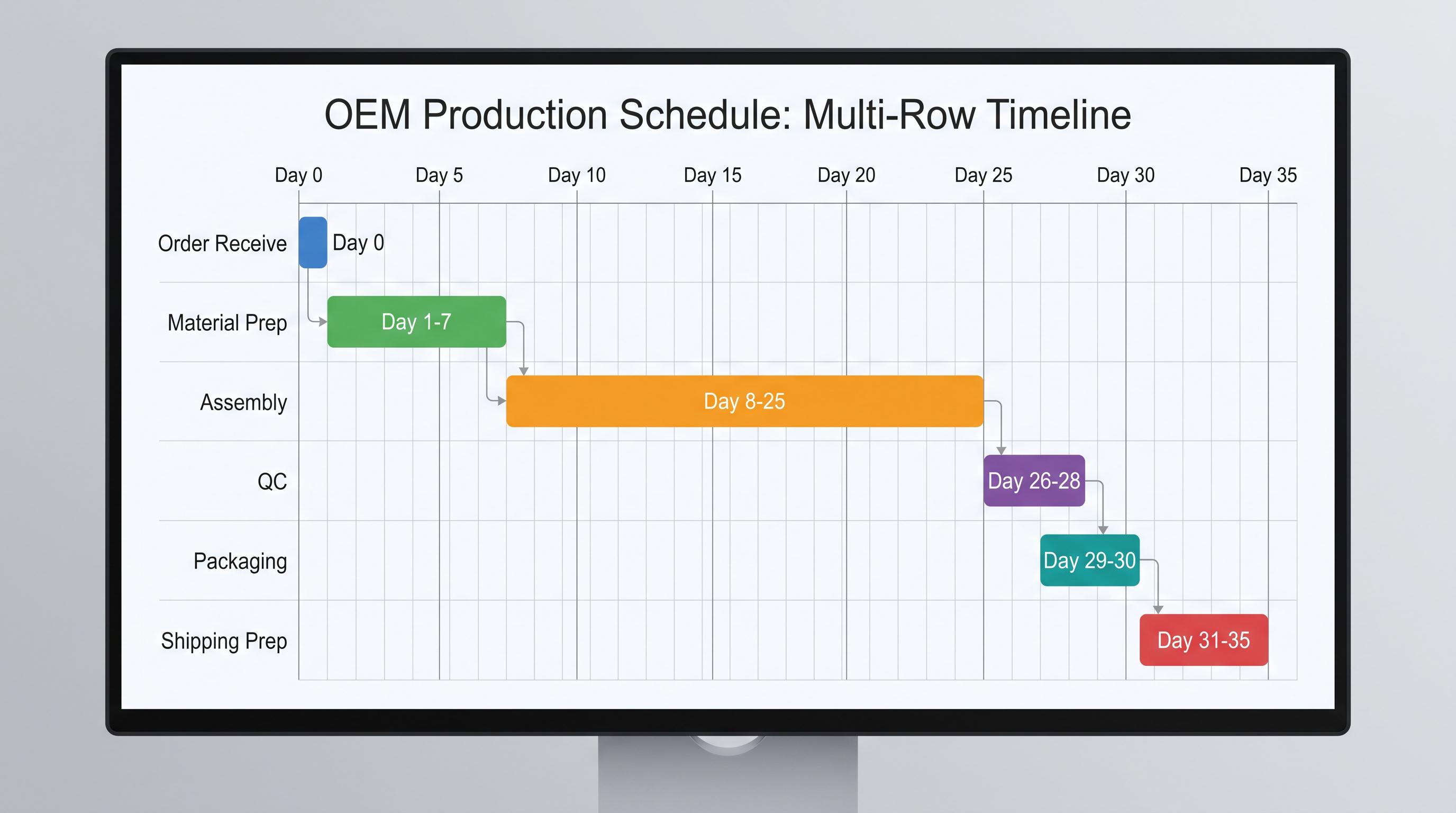
Understanding the production timeline prevents costly rushed orders and inventory shortfalls. Standard projector manufacturing requires 6-10 weeks after sample approval, not including component sourcing time. Component procurement for specialized items like DMD chipsets or laser diodes adds another 4-8 weeks, as these parts often come from single-source suppliers. According to the Consumer Technology Association, consumer electronics products typically face 15-20% timeline extensions due to supply chain variability CTA Supply Chain Report 2025.
Build 3-4 weeks of buffer time into your launch schedule for pre-shipment inspections, port congestion, and inland transit. For B2B procurement teams managing retail commitments, a realistic total timeline from contract signing to warehouse delivery often spans 5-7 months.
Managing Component Sourcing and Inventory
Coordinate with your OEM partner on critical component allocation. Projectors contain 150-300 individual components sourced from multiple suppliers, creating inherent vulnerability to shortages. Confirm that your manufacturer has secured allocations for key optical and electronic parts before confirming your production slot. Some buyers negotiate component escrow arrangements where they purchase long-lead items directly and ship to the factory, guaranteeing availability.
| Component Category | Typical Lead Time | Risk Level |
|---|---|---|
| Optical engine | 6-10 weeks | High |
| Light source (lamp/laser) | 4-8 weeks | Medium |
| DMD/imager chips | 8-12 weeks | Critical |
| Power supplies | 2-4 weeks | Low |
| Casings/housings | 3-5 weeks | Medium |
Maintain 48-hour communication windows with your manufacturer during peak production periods. Weekly status reports should include unit completion counts, current quality metrics, and any emerging issues. For OEM buyers evaluating multiple vendors, prioritize those offering real-time production tracking dashboards.
Logistics and Delivery Coordination
Shipping Options and Costs
Select shipping methods that balance cost efficiency against inventory carrying risk. Sea freight remains the most economical choice at $0.05-$0.15 per kilogram for containerized projector shipments, though transit times range from 25-35 days to major U.S. ports. Air freight costs 5-8 times more but reduces transit to 5-7 days—appropriate for urgent replenishment orders but unsustainable for regular inventory builds.
Negotiate freight forwarding agreements that include customs brokerage services, especially if you're entering multiple markets. Consolidated shipping through established logistics partners typically yields 10-20% cost reductions compared to individual shipments.
Customs and Import Considerations
Import documentation accuracy directly impacts your clearance timeline and landed costs. Incomplete Harmonized System (HS) codes for projector assemblies versus components can trigger audits and storage fees. The U.S. International Trade Commission maintains updated classification guidance for electronic products USITC HTS Database.
Factor import duties into your total cost model early—projectors typically face 3-7% ad valorem tariffs depending on origin country and product classification. For OEM buyers entering the European market, Brexit has introduced additional complexity for UK-bound shipments, requiring separate customs clearance and compliance verification.
How to Choose Your Projector OEM Partner
Selecting the right manufacturer determines your project's ultimate success. For B2B procurement teams managing projector oem project timelines, the evaluation criteria extend beyond unit pricing to encompass quality assurance capabilities, communication infrastructure, and production flexibility.
Key Evaluation Criteria
We recommend requesting quotations from at least three manufacturers before committing. Request samples from each finalist—reputable partners provide 2-5 units for evaluation without requiring large deposits. Evaluate optical performance using standardized brightness (ANSI lumens) and contrast ratio measurements.
| Evaluation Factor | Minimum Acceptable Standard | Preferred Standard |
|---|---|---|
| Minimum Order Quantity (MOQ) | 200 units | 50-100 units |
| Sample Policy | 2 units available | Free samples with freight collect |
| Lead Time (production) | 8-12 weeks | 4-6 weeks |
| Quality Certification | ISO 9001 | ISO 9001 + ISO 14001 |
| Communication Response | 24 hours | Real-time dedicated account manager |
Request detailed component specifications and verify supply chain redundancy for critical parts like DMD chips. Ask potential partners about their defect rate benchmarks—top-tier manufacturers maintain below 1% outgoing quality failure rates according to industry standards IPC Electronics Quality Standards.
Confirm the manufacturer's tooling amortization policy. Some partners charge setup fees that decrease per-unit cost at higher volumes, while others incorporate these costs into unit pricing. Clarify whether tooling ownership transfers to you after certain volume thresholds.
For OEM buyers evaluating partnerships, we suggest establishing a 90-day pilot order representing 10-15% of your anticipated annual volume. This approach validates the partner's capabilities before committing to larger production runs while limiting initial exposure.
