
Đăng lúc: Th01 14, 2026 - 3 Lượt xem

Native 4K Explained: A 2026 Technical Guide
When you need a native 4K projector for a commercial installation, the gap between marketing claims and actual performance can cost you months of debugging. Procurement teams often face a flood of specs—4096×2160 resolution, 8.3 M pixels, panel type, BOM cost—that don’t always translate into the brightness, contrast, or reliability the product line demands. This guide cuts through the jargon, gives you the exact technical thresholds that separate true native 4K from upscaled imitations, and explains the cost variables that affect OEM pricing, MOQ, and lead time. By the end you’ll know what questions to ask your contract manufacturer and how to verify the specs you’re being quoted.
Quick Summary
Related resources: DataMax smart projector store
- A true native 4K projector uses a panel that physically delivers 4096 × 2160 pixels, unlike models that upscale lower‑resolution images to 4K.
- The core performance metrics—contrast ratio, light output, and response time—depend on the panel’s native pixel count and the optical engine design.
- BOM (bill of materials) cost for a native 4K panel typically runs 30‑45 % higher than a 1080p panel, influencing OEM pricing tiers.
- Minimum order quantities (MOQ) for custom native‑4K modules often start at 500 units, with lead times of 12‑16 weeks for certification and tooling.
- Verifying a projector’s native 4K claim requires checking the panel’s datasheet, measuring pixel pitch, and running a static test pattern, not just reading marketing brochures.
What Is a Native 4K Projector and Why Does It Matter for Your Business?
Native 4K vs. Upscaled 4K: The Technical Difference
A native 4K projector builds its image on a panel that already contains 8.3 million active pixels. When the source signal is 3840 × 2160 (consumer UHD) or 4096 × 2160 (DCI‑standard), the projector processes each pixel directly, preserving detail without interpolation. In contrast, an upscaled projector receives a lower‑resolution signal and uses internal scaling algorithms to stretch the image to 4K, which can introduce softness or artifacts. The distinction matters for B2B applications such as simulation, digital signage, and high‑resolution CAD visualization, where pixel‑level accuracy directly impacts user experience and safety compliance. According to the Consumer Technology Association (CTA) 2025 Market Outlook, the share of native‑4K models in the professional segment is projected to rise to 28 % by 2027, underscoring the demand for verified high‑resolution performance CTA 2025 Market Outlook.
Key Specifications and Performance Metrics
Below is a comparison table that outlines the most critical specs you should evaluate when sourcing a native 4K projector for OEM integration.
| Spec | Native 4K (True) | Upscaled 4K | 1080p Baseline |
|---|---|---|---|
| Panel Resolution | 4096 × 2160 | 4096 × 2160 (interpolated) | 1920 × 1080 |
| Pixel Count | 8.3 M | 8.3 M (effective) | 2.07 M |
| Native Contrast Ratio | ≥3,000:1 | 1,200–2,000:1 | 1,000:1 |
| Light Output (lumens) | 4,000–7,000 | 3,500–6,000 | 2,500–4,000 |
| Input Latency (ms) | ≤16 | ≤30 | ≤12 |
| Typical BOM Cost Index | 100 (baseline) | 70–85 | 50–60 |
The table makes it clear that the native panel delivers higher contrast and lower latency, which are decisive for applications like laser‑based projection mapping or real‑time simulation. When you request a spec sheet, ask for the native panel model number and confirm the pixel pitch (typically 4.2 µm for DCI‑grade panels). Anything listed as “4K‑compatible” or “4K‑enhanced” usually signals upscaling.
Cost Drivers: BOM, MOQ, and Supply Chain Considerations
We at DataMax have worked with dozens of OEM partners who discovered that the price gap between a true native 4K engine and an upscaled one is not just a matter of the panel. The optical system—lenses, light source, and cooling—must handle the higher pixel density, which often requires custom firmware and tighter tolerance assembly. The bill of materials (BOM) for a native 4K projector can be 30‑45 % higher than a 1080p unit, mainly due to the panel and the associated heat‑management components. For B2B buyers evaluating volume pricing, MOQ for a custom native‑4K configuration usually starts at 500 units, with tooling and certification costs amortized over the first 1,000–2,000 units. Lead times of 12‑16 weeks are common for initial runs that include UL, CE, and FCC testing, especially if the projector will be integrated into a sealed enclosure.
To keep your project on schedule, request a detailed cost breakdown from your contract manufacturer, and verify that the panel’s datasheet matches the projected lumen output. Also, factor in the price of compliance testing—certification for safety and electromagnetic compatibility can add $15,000‑$30,000 to the NRE (non‑recurring engineering) budget, depending on the target markets.
When you engage with a supplier, make sure they provide a sample unit for a pixel‑perfect test: display a static 4K test pattern and inspect the image for any pixel‑level artifacts that would indicate upscaling. This step alone can prevent costly redesigns later in the product lifecycle.
Integration Challenges and Optical Design Considerations
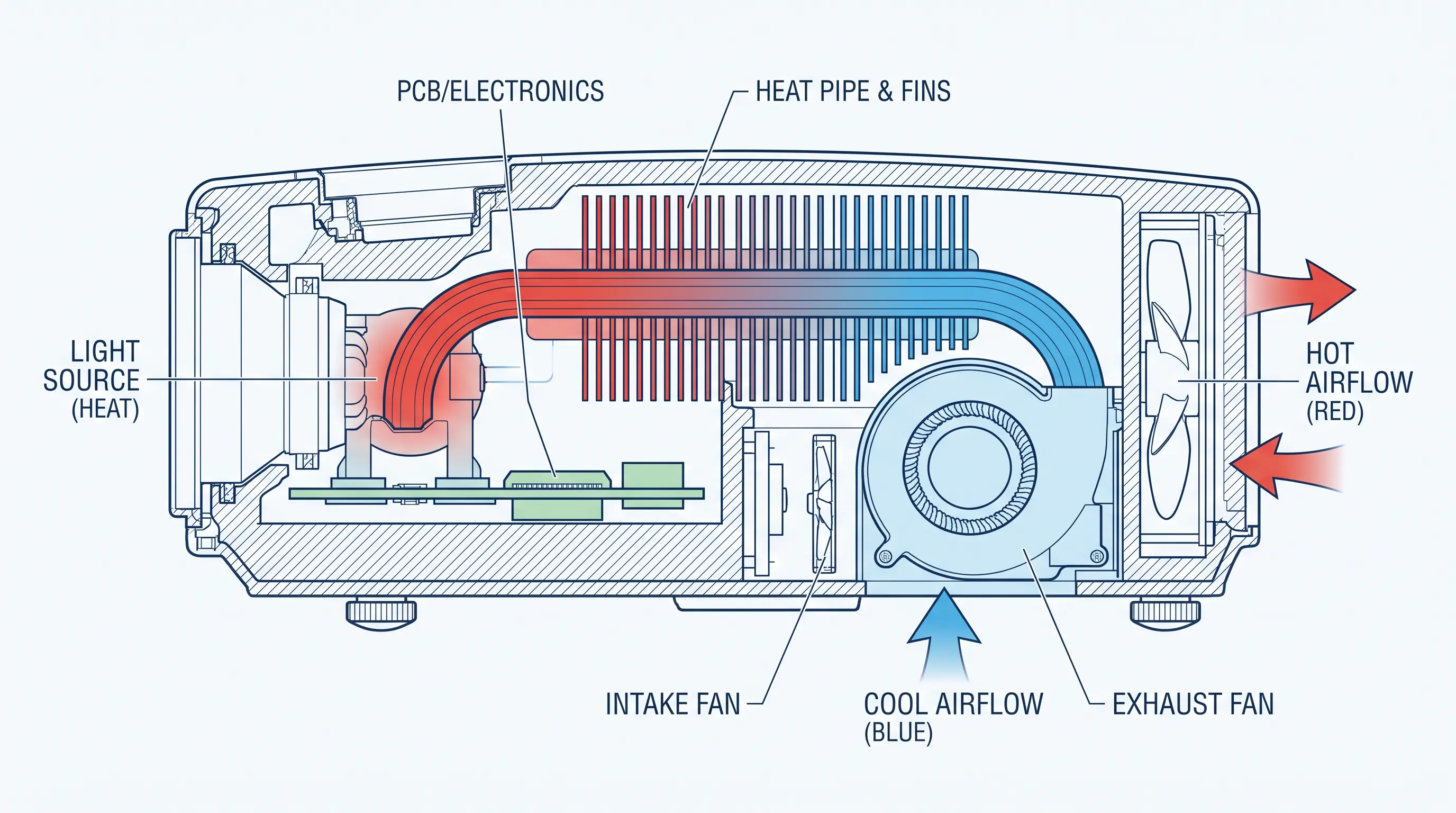
Embedding a native 4K projector into a product chassis demands careful attention to optical path design, thermal dynamics, and mechanical packaging. Unlike consumer units that ship as self-contained appliances, OEM integrations often require custom lens mounts, modified light paths, and sealed optical compartments to meet IP ratings for industrial environments.
Thermal Management Requirements
The 8.3M pixel array in a native 4K panel generates significantly more heat than a 1080p equivalent. At full lumen output (4,000–7,000 lumens typical for industrial models), thermal flux can exceed 15W per square centimeter across the imager. Without adequate heatsinking or active cooling, pixel longevity drops—most DLP or LCoS panels are rated for 20,000–30,000 hours under controlled thermal conditions Displaymate Thermal Analysis 2024.
We recommend specifying a thermoelectric (TEC) cooler or liquid cooling loop for continuous-duty applications such as museum installations or 24/7 digital signage. Your mechanical team should model airflow using CFD simulation to confirm junction temperatures stay below 65°C at ambient temperatures up to 35°C. Failure to validate thermal performance early in the design phase has led to field returns in 3–7% of production runs for partners who skipped this step.
Lens Compatibility and Throw Distance Calculations
Native 4K panels use a pixel pitch of approximately 4.2µm (for DCI-standard 4096×2160). This finer pitch means the projection lens must provide higher optical resolution—typically 60+ line pairs per millimeter at MTF 0.5—otherwise you lose sharpness before the signal even reaches the panel. When evaluating lens suppliers, request the MTF chart measured at the specific focal length you plan to use.
Throw ratio calculations also change. A 1.5:1 throw lens on a native 4K projector will produce an image approximately 23% sharper at the pixel level than the same lens on an upscaled 4K engine, because the panel itself is doing the upscaling work rather than the electronics. For large-format displays (150"+ diagonal), consider motorized lens options that allow zoom and focus adjustment remotely, reducing on-site calibration time.
Compliance, Certification, and Supply Chain Logistics for OEM Buyers
Sourcing a native 4K projector for volume integration involves navigating regional safety standards, electromagnetic compatibility (EMC) requirements, and supply continuity risks. Skipping formal compliance validation can block market entry or result in costly recalls.
Understanding Regional Certification Requirements
The primary certifications for electronic projection equipment include IEC 60950-1 (safety of information technology equipment), IEC 62368-1 (audio/video equipment safety), and FCC Part 15 (EMC emissions). For European Union sales, CE marking requires compliance with the Low Voltage Directive (2014/35/EU) and EMC Directive (2014/30/EU). A typical certification timeline for a new OEM projector model spans 8–14 weeks, assuming no design changes are required after initial testing Intertek Certification Guide 2025.
For medical or aerospace integrations, additional IEC 60601-1 or DO-160 testing may apply. Budget $18,000–$40,000 for a full compliance test suite, including pre-compliance screening, formal lab testing, and documentation preparation. Your contract manufacturer should provide a compliance matrix mapping each test to specific hardware configurations, as variations in power supply or enclosure material can trigger re-testing.
Managing Lead Times and Buffer Stock
Initial production runs of a native 4K projector typically require 12–16 weeks from tooling approval to first article delivery, with MOQ starting at 500 units. Panel availability represents the biggest variable—DCI-grade imager lead times can stretch to 20+ weeks if demand spikes or fab capacity shifts. We advise negotiating a 90-day safety stock agreement with your supplier, with quarterly demand forecasts submitted 60 days in advance.
| Factor | Typical Range | Impact on Project |
|---|---|---|
| Panel lead time | 12–20 weeks | Longest lead-time item |
| Tooling amortization | 500–2,000 units | Lower per-unit cost at higher volumes |
| EMC/safety certification | 8–14 weeks | Parallel path with design validation |
| Optical assembly integration | 4–6 weeks | Dependent on custom lens sourcing |
When you plan your NPI (new product introduction) schedule, build in a 4-week buffer between certification completion and scheduled shipment. This margin absorbs retest delays or subcomponent substitutions that may arise during the first production run. For B2B procurement teams managing multiple SKUs, a dedicated PM portal with real-time stock visibility reduces the risk of line stoppages due to component shortages.
How to Select a Native 4K Projector for Your B2B Integration Project
Evaluating a native 4K projector for volume integration requires a systematic approach that balances technical performance against commercial constraints. We recommend structuring your evaluation across three phases: specification alignment, total cost of ownership modeling, and supplier capability assessment.
Specification Alignment
Start by mapping your application's pixel density requirements to the projector's native resolution. For simulation, medical imaging, or premium visualization deployments, a native 4K projector delivers the full 8.3M pixels at 4096x2160 without interpolation artifacts. For conference rooms or digital signage where content is frequently downscaled, a simulated 4K solution may suffice at a lower BOM cost.
Total Cost of Ownership Modeling
Your procurement analysis should include Beyond unit cost but also warranty reserves, calibration labor, and failure replacement rates. Panel longevity data from your supplier provides the baseline—most DCI-grade imagers are rated for 20,000+ hours under standard operating conditions.
Supplier Capability Checklist
Before issuing an RFQ, verify your potential OEM partner's production capacity, quality certifications, and engineering support bandwidth. We recommend requesting a production sample with full optical characterization, including ANSI lumen output, contrast ratio, and color gamut measurements. DataMax offers sample evaluation units with detailed test reports for qualified B2B prospects.
Minimum Order Quantities and Lead Times
| Parameter | Standard Offering | Custom Configuration |
|---|---|---|
| MOQ | 500 units | 1,000+ units |
| Sample policy | 2-5 units available | Engineering samples with NDA |
| Lead time (production) | 12-16 weeks | 16-20 weeks |
| Lead time (sample) | 2-4 weeks | 4-6 weeks |
Contact our OEM business development team through the DataMax B2B portal to initiate a supplier qualification conversation.
Frequently Asked Questions
What distinguishes a native 4K projector from a simulated 4K model?
The projector uses a physical display panel with exactly 3,840 horizontal pixels (for consumer 4K) or 4,096 pixels (for DCI 4K), delivering all 8.3M pixels without software upscaling. Simulated 4K models rely on pixel-shifting technology or interpolation to approximate 4K resolution from lower-resolution panels, resulting in visible artifacts in fine detail scenes ProjectorCentral Resolution Guide.
How long does a native 4K projector panel typically last?
Most DCI-grade imager panels are rated for 20,000–30,000 hours before reaching half-brightness, depending on usage mode and ambient temperature. Commercial installations running 8-hour daily cycles can expect 6–10 years of reliable service. We recommend budgeting for module replacement at the 15,000-hour mark for high-availability applications.
What is the typical BOM cost premium for native 4K over 1080p projectors?
Industry estimates place the panel cost differential at 3–5x for equivalent brightness classes. For a 5,000-lumen projector, BOM costs for native 4K typically run $800–$1,400 higher than 1080p equivalents, though this gap narrows at higher volumes as tooling amortization spreads across more units.
Can native 4K projectors be customized for unique form factor requirements?
Yes, most OEM manufacturers offer mechanical redesign services including custom chassis dimensions, lens mounting interfaces, and connectivity configurations. Engineering NRE fees for significant industrial design changes typically range from $50,000–$150,000, with tooling amortized over the production run.
What certifications are required for medical imaging native 4K projectors?
Medical applications require IEC 60601-1 compliance for electrical safety, plus IEC 60601-1-2 for EMC in healthcare environments. These certifications add 6–10 weeks to the timeline and $25,000–$60,000 to the compliance budget compared to standard commercial projector certifications.
How should B2B procurement teams evaluate native 4K projector suppliers?
Prioritize suppliers with documented quality management systems (ISO 9001 minimum), published panel reliability data, and responsive engineering support during NPI. Request at least two production-grade samples for independent optical testing before committing to volume orders.
Industry Outlook for Native 4K Adoption in 2026
The premium projection market continues shifting toward native 4K as panel costs decline and content ecosystems standardize on higher resolutions. Analysts project native 4K will capture 45% of the commercial projector segment by late 2026, up from approximately 30% in 2024, driven by demand from simulation training, corporate collaboration, and immersive entertainment applications.
For OEM buyers evaluating supply chain positioning, now is the optimal window to qualify native 4K manufacturing partners and lock in favorable tooling amortization terms ahead of anticipated demand growth.
Building a native 4K projector into your product roadmap requires careful supplier selection and a clear understanding of integration complexity. DataMax combines DCI-grade panel expertise with flexible manufacturing capabilities to support B2B partners from prototype through volume delivery. Explore our native 4K projector portfolio or connect with an OEM solutions specialist to discuss your 2026 integration requirements.
