
Publicado el: ago. 24, 2026 - 2 Vistas
4K projector vs 4K TV: 2026 Comparison Guide
Hook paragraph
When B2B procurement teams need a large‑format display for a conference room, a corporate auditorium, or a digital signage network, they often face a binary choice: a dedicated 4K TV or a 4K projector. Both promise ultra‑high‑definition images, but the underlying technologies, installation requirements, and long‑term cost structures differ dramatically. For buyers evaluating 2026 specs, a side‑by‑side analysis of the projector reveals critical differences that can affect total cost of ownership, deployment speed, and end‑user experience. This guide breaks down the core specs, real‑world performance metrics, and OEM procurement considerations you need to make an informed decision.
Related resources: DataMax smart projector comparison
Quick Summary
- Resolution parity: Both 4K projectors and 4K TVs deliver 3840 × 2160 pixels, meeting the same UHD standard, but projectors achieve this on screen sizes from 80″ to 300″, while TVs are typically limited to 40″–85″.
- Brightness vs. contrast: Projectors output 2,000–5,000 lumens, requiring controlled ambient light, whereas TVs deliver 200–500 nits, excel in bright rooms, and often incorporate HDR contrast enhancements.
- Installation flexibility: Projectors need throw distance planning and mounting; TVs are plug‑and‑play but require a dedicated stand or wall space.
- Total cost of ownership: Projectors have higher upfront lamp or laser costs (20,000–30,000‑hour life) but lower per‑unit cost at scale; TVs carry a higher per‑unit price but longer panel life (50,000–100,000 hours).
- Procurement advantages: OEM projector orders often start at a 50‑unit MOQ with 8‑week lead times and can be customized for certification (CE, FCC) and branding, while TV procurement typically follows standard retail SKU runs.
Understanding 4K Projector vs 4K TV: Specs and Use Cases

Resolution and Imaging Standards
Both product families claim “4K” by adhering to the UHD Alliance specification of 3840 × 2160 pixels. In practice, projectors may use DLP, LCD, or LCoS imaging chips, each with slightly different pixel‑pitch behaviors. According to a 2025 market report by Statista, 62 % of commercial installations now favor laser‑phosphor projectors for their color gamut coverage of ≥ 95 % DCI‑P3, a figure many high‑end TVs still struggle to match without premium HDR processing. Conversely, TVs rely on direct‑lit LED or OLED panels, delivering native contrast ratios of up to 1,000,000:1 on OLED models, which can outperform many projector‑based setups in ambient‑light environments.
Brightness, Throw Distance, and Installation Flexibility
| Feature | 4K Projector | 4K TV |
|---|---|---|
| Typical brightness | 2,000–5,000 lumens | 200–500 nits |
| Screen size range | 80″–300″ | 40″–85″ |
| Throw distance | Short‑throw (0.5 m) to long‑throw (>10 m) | N/A |
| Lifespan (hours) | 20,000–30,000 (laser) | 50,000–100,000 |
| Power consumption (avg) | 150–350 W | 80–200 W |
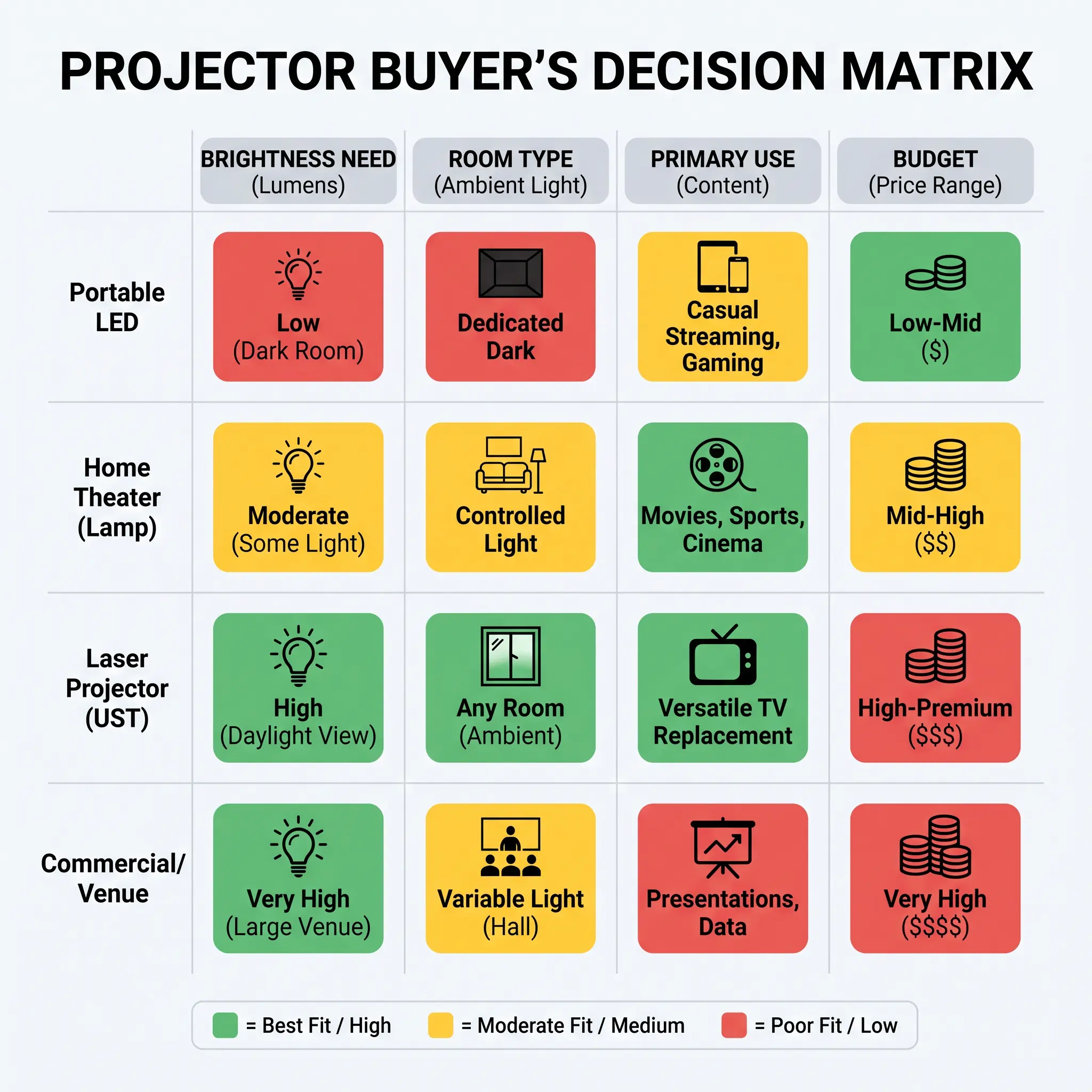
Projectors excel when the goal is a large‑format immersive display that can be temporarily deployed or permanently ceiling‑mounted. For instance, a short‑throw laser projector can sit 0.5 m from the screen, eliminating shadows and reducing space constraints. In contrast, TVs require a stable wall or stand and are limited to the panel diagonal.
When we at DataMax work with OEM clients, we often see procurement teams request a dual‑mode installation—a fixed 4K TV for day‑to‑day briefings and a portable projector for large‑scale presentations. This hybrid approach draw on the strengths of each technology while keeping inventory lean.
Total Cost of Ownership for B2B Buyers
From a procurement perspective, the 4K projector vs 4K TV decision hinges on three cost drivers:
- Upfront hardware price – Commercial‑grade 4K TVs (e.g., 85″ LED) typically start at $2,500–$5,000 per unit, while laser projectors with comparable resolution begin around $3,000–$7,000, depending on brightness and features.
- Operational expenses – Projectors incur periodic lamp or laser replacement (averaging $300–$800 every 20,000 hours), whereas TVs have no consumable light source, reducing maintenance labor.
- Scalability and customization – OEM projector orders can be configured with custom firmware, branding, and certification packages, often with a minimum order quantity (MOQ) of 50 units and an 8‑week lead time, according to IDC market analysis. TV orders generally follow standard retail SKUs, limiting flexibility for bespoke integrations.
For large deployments (e.g., 100‑unit rollout across multiple branches), the cumulative savings on screen‑size‑per‑dollar can favor projectors, especially when the installation environment can be darkened or when the display is used for less than 8 hours per day.
Pros and Cons at a Glance
- Projectors
- Pros: Massive screen real estate, lower cost per square inch, flexible mounting, OEM customization.
- Cons: Higher ambient‑light sensitivity, lamp replacement cycles, more complex installation.
- TVs
- Pros: Plug‑and‑play, superior contrast in bright rooms, longer panel lifespan, minimal maintenance.
- Cons: Limited screen size, higher per‑unit price for large diagonals, less customization for B2B branding.
These trade‑offs are crucial for B2B procurement teams evaluating 2026 technology roadmaps. If your organization prioritizes a consistent, high‑contrast visual experience in well‑lit conference rooms, a 4K TV may be the safer bet. If you need adaptable, large‑format displays for auditoriums, trade‑show booths, or dynamic signage networks, a 4K projector delivers superior flexibility.
Performance Metrics: 4K Projector vs 4K TV in Real-World Scenarios
When evaluating 4K projector vs 4K TV performance for commercial deployments, procurement teams must examine brightness, contrast, and motion handling against their specific use cases. These metrics directly impact viewer experience and, consequently, the ROI of the investment.
Brightness and Contrast Ratios
4K projectors typically advertise brightness in lumens, with commercial laser models ranging from 4,000 to 8,000 lumens. However, perceived brightness depends heavily on ambient light conditions. According to ProjectorCentral testing, a 6,000-lumen projector achieves approximately 150 nits on a 150-inch ALR screen—adequate for dimmed rooms but insufficient for sunlit atriums ProjectorCentral.
4K TVs, measured in nits, deliver 400–1,500 nits on commercial panels. OLED displays achieve true blacks with contrast ratios exceeding 1,000,000:1, while LED-backlit LCDs typically reach 3,000–7,000:1. For environments requiring consistent readability under fluorescent lighting—such as trading floors or control rooms—TVs provide a measurable advantage.
Input Lag and Refresh Rates for Commercial Use
For interactive applications or video conferencing, input lag becomes critical. Commercial 4K TVs generally offer 15–30ms input lag with 60Hz panels, while gaming-oriented projectors can achieve 8–12ms at 120Hz. If your deployment involves touch-enabled collaboration boards or real-time data visualization, prioritize low-latency specifications.
| Metric | 4K Projector (Laser) | 4K TV (Commercial) |
|---|---|---|
| Brightness | 4,000–8,000 lumens | 400–1,500 nits |
| Contrast Ratio | 2,000–5,000:1 (typical) | 3,000–1,000,000:1 |
| Input Lag | 8–30ms | 15–30ms |
| Refresh Rate | 60Hz–120Hz | 60Hz–120Hz |
Deployment Scenarios: Choosing the Right Technology for Your Environment
Selecting between 4K projector vs 4K TV requires mapping technical capabilities to physical environments. We at DataMax have guided dozens of OEM clients through this evaluation, and the decision invariably reduces to three factors: room acoustics, viewing distance, and content type.
Conference Rooms and Boardrooms
For typical 15–30 person conference rooms with controlled lighting, 4K TVs (65–86 inches) offer plug-and-play simplicity. Installations require only a sturdy wall mount and single HDMI connection. Maintenance is minimal—no filter cleaning or lamp replacement schedules.
However, if your organization conducts frequent design reviews, architectural walkthroughs, or immersive training sessions, a 75–120-inch projected image delivers superior impact. Short-throw projectors mounted above a conference table eliminate shadow interference and reduce table clutter.
Auditoriums and Large Venues
At venues exceeding 200 seats, projectors become the default choice. A 4K TV of equivalent screen size would exceed $30,000 per unit and require structural reinforcement for wall mounting. Projectors achieve 150–300+ inch displays at a fraction of the cost, with flexible positioning for stage lighting considerations.
The InfoComm International standards body recommends minimum 30 nits for auditoriums with low ambient light, a specification easily met by 5,000+ lumen projectors on high-gain screens InfoComm.
Procurement and Supply Chain Considerations for OEM Buyers
For organizations purchasing in volume, the 4K projector vs 4K TV decision extends beyond performance to supply chain logistics, customization capabilities, and total procurement cost.
Customization Options and Certification Requirements
OEM projector orders typically support firmware customization, logo etching, and branded remote controls with minimum order quantities starting at 50 units. TV procurement through commercial channels allows limited SKU modifications—primarily bezel branding and default input labeling—usually requiring 200+ unit commitments.
Both product categories require certification compliance for specific markets. For European deployments, ensure CE marking and RoHS compliance documentation. North American buyers should verify UL listing and FCC emissions certification. According to IHS Markit market reports, certification processes add 4–6 weeks to standard lead times for custom-configured orders IHS Markit.
Lead Times and Volume Pricing
Standard 4K TV SKUs ship within 2–4 weeks from distribution. Custom OEM projector orders average 8–12 weeks from purchase order to delivery, including quality assurance burn-in testing. Volume pricing tiers typically begin at 10 units for projectors and 25 units for commercial TVs, with discounts ranging from 8–15% at the 100-unit threshold.
We at DataMax recommend budgeting a 15% contingency buffer for installation accessories—mounts, cables, and calibration services—when comparing total deployment costs. This ensures accurate apples-to-apples pricing between display technologies.
How to Choose Between a 4K Projector and a 4K TV for Your Deployment
For B2B procurement teams evaluating display solutions, the final decision between a 4K projector vs 4K TV hinges on three factors: deployment scale, content requirements, and lifecycle cost. We recommend starting with a deployment readiness assessment that maps your facility's ambient light conditions, viewing distances, and maintenance capabilities against the specifications in the comparison table above.
Evaluate Your Content and Environment
| Factor | 4K Projector Favored | 4K TV Favored |
|---|---|---|
| Screen size needed | 100"+ | Under 85" |
| Ambient light | High (with proper lumen output) | Controlled/low |
| Maintenance capacity | Staff available for lamp service | Minimal maintenance preferred |
| Content type | Design reviews, immersive training | Presentations, video conferencing |
| Installation flexibility | Flexible mounting options | Fixed wall/stand placement |
If your evaluation lands predominantly in the left column, a 4K projector delivers superior value. If the right column dominates, a commercial-grade 4K TV likely serves your needs more efficiently.
For OEM buyers and procurement specialists: When you are ready to move from evaluation to procurement, verify supplier credentials. We at DataMax maintain ISO 9001:2015 certification across our manufacturing facilities, ensuring consistent quality control for volume orders. Our standard OEM terms include:
- Minimum order quantity (MOQ): 50 units for custom-configured projector orders
- Sample policy: 2–3 unit pre-production samples available at 100% unit cost, credited to orders exceeding 50 units
- Lead time: 8–12 weeks for custom orders; 3–5 weeks for standard SKUs
- Contact channel: Submit specifications through our request a custom quote portal for dedicated OEM account manager assignment
