
Publicado el: sep. 30, 2025 - 7 Vistas
LED Lumens: Pros, Cons, and OEM Considerations
When you evaluate LED lumens projector specifications for a product line, you encounter a recurring problem: lumen ratings that do not translate into real-world brightness expectations. Marketing materials often emphasize high lumen numbers, yet your team discovers performance gaps during testing or client demos. This disconnect stems from inconsistent measurement standards and confusion between LED-specific brightness metrics and traditional lamp-based projector specs. You need a clear framework to compare LED projector brightness accurately, understand the trade-offs, and identify which specs matter for your B2B procurement decisions. This LED lumens guide delivers exactly that—a technical breakdown of how LED lumens work, their advantages and limitations, and the OEM considerations that affect your sourcing strategy.
How LED Lumens Work: Technical Foundation

Related resources: DataMax smart projector store
LED lumens represent the total quantity of visible light emitted by a projector light source, measured according to photometric standards that quantify human eye sensitivity to different wavelengths. Unlike lamp-based projectors that use high-pressure mercury bulbs, LED projectors generate light through semiconductor diodes that produce specific color wavelengths with high efficiency. This fundamental difference affects how manufacturers rate brightness and how buyers should interpret those ratings.
The technical process involves three primary color channels—red, green, and blue LEDs—that combine to produce white light. Each channel contributes to the total lumen output, but the color mixing efficiency and the age-related degradation of each LED type create variations that single-number lumen specifications do not capture. When you examine an LED lumens projector spec sheet, you are seeing a measurement that reflects the light source output under ideal laboratory conditions, not necessarily the sustained brightness your end users experience after 10,000 hours of operation.
Measurement Standards: ANSI vs. LED Lumens
The American National Standards Institute (ANSI) established the predominant brightness measurement protocol for projectors, using a 9-point averaging method that accounts for uniformity across the projection surface. This standardized approach provides reliable comparison data, but LED projectors sometimes receive ratings that reference the light source alone rather than the ANSI-measured on-screen brightness. The distinction matters significantly: a 3,000 LED lumen source might produce only 1,800 to 2,200 ANSI lumens after optical path losses and color wheel inefficiencies, depending on the projector's design quality.
According to research from the International Society for Optics and Phovels (SPIE), the conversion factor between LED source lumens and ANSI-measured lumens typically ranges from 0.6 to 0.75 for well-designed optical systems, though poorly engineered projectors can fall below 0.5 SPIE. When you review OEM specifications, you should confirm whether the quoted lumen rating refers to LED source output or ANSI-measured brightness, as this single distinction dramatically affects your product comparison and your customers' satisfaction.
Real-World Performance Factors
Temperature management plays a critical role in sustained LED brightness. Semiconductor efficiency decreases as junction temperature rises, meaning that projectors operating in environments above 25°C ambient temperature will output fewer lumens than their specifications claim. Professional LED projectors incorporate thermal management systems—heat pipes, fans, or passive cooling fins—that maintain optimal LED operating temperatures, but consumer-grade or budget OEM units often sacrifice thermal performance to reduce costs. You should factor thermal design into your procurement specifications, especially for installations in equipment racks, outdoor enclosures, or climate-controlled corporate spaces.
Color brightness and white brightness represent another technical nuance that affects perceived image quality. Some LED projectors achieve high white lumen ratings through imbalanced color channels, resulting in images that appear dimmer or less vibrant than competitors with lower total lumens but better color balance. The Color Light Output (CLO) measurement, standardized by the Society of Motion Picture and Television Engineers, quantifies this variation SMPTE. For B2B applications such as digital signage, corporate presentations, or educational environments where color accuracy matters, you should request CLO specifications alongside white lumen ratings from your OEM partner.
| Specification | Consumer LED Projector | Professional LED Projector | Measurement Method |
|---|---|---|---|
| LED Source Lumens | 2,000 - 4,000 | 4,000 - 8,000 | Light source output |
| ANSI Lumens | 1,200 - 2,400 | 2,400 - 5,500 | On-screen 9-point average |
| Color Light Output | 60-80% of white | 85-100% of white | SMPTE CLO standard |
| Typical Life (hours) | 10,000 - 20,000 | 20,000 - 30,000 | To 50% initial brightness |
OEM Considerations for LED Lumens Specifications
When you source LED lumens projector products from an OEM/ODM factory, the specifications you negotiate directly impact your landed product quality and customer satisfaction. At DataMax, we have helped numerous B2B clients handle the gap between marketing lumen claims and achievable performance, developing testing protocols that verify brightness output before mass production begins.
For OEM buyers evaluating projector specifications, request both LED source lumens and ANSI-measured lumens from your potential manufacturing partners. A reputable OEM should provide third-party test reports from laboratories such as those accredited by the National Institute of Standards and Technology or equivalent national measurement institutes. If a supplier hesitates to share verification data or offers only marketing-spec lumen numbers, treat this as a red flag for quality consistency.
Certification requirements also interact with lumen specifications in ways that affect your procurement timeline. Products bearing the CE mark for European markets must demonstrate electromagnetic compatibility and safety compliance, while Energy Star certification—relevant for commercial and educational procurement contracts—establishes minimum efficiency thresholds that correlate with LED brightness sustainability. Your OEM should integrate certification testing into the product development schedule, typically requiring 8-12 additional weeks for Energy Star verification of brightness and efficiency specs.
Lead time considerations vary based on whether you require custom optical configurations or standard reference designs. A standard LED lumens projector platform with minor branding modifications typically ships within 12-16 weeks from order confirmation, while products requiring custom lens assemblies, modified thermal designs, or specialized lumen ratings for niche applications may extend to 20-26 weeks. Factor these timelines into your product launch planning, particularly if you are preparing for seasonal procurement cycles or contract bidding deadlines.
When you discuss lumen specifications with your engineering team or your OEM account manager, focus on the application environment rather than raw numbers alone. A projector destined for a small meeting room with controlled lighting has different brightness requirements than a unit designed for open-plan reception areas or outdoor evening events. By defining the target use case first, you can select appropriate lumen ranges that satisfy real user needs without overpaying for brightness you will never utilize.
Matching LED Lumens to Application Environments
Selecting the correct LED lumens projector for a specific deployment environment prevents both under-powered presentations and unnecessary cost overruns. Brightness requirements scale with ambient light levels, screen size, and throw distance, creating a three-variable optimization problem that most procurement teams underestimate.
Ambient Light Considerations
Projectors operating in rooms with significant natural daylight—open-plan offices with floor-to-ceiling windows, retail spaces, or outdoor daytime events—require substantially higher lumen output than units deployed in controlled lighting conditions. According to the Society of Information Display, ambient light can reduce perceived image contrast by 60-80% in bright environments, effectively neutralizing moderate brightness specifications SID.
For meeting rooms with adjustable lighting and blackout capability, 1,500-2,500 LED source lumens typically suffices for 80-100 inch diagonal screens. Reception areas with consistent ambient lighting demand 3,000-4,000 lumens minimum, while outdoor evening installations may need 4,500+ lumens to overcome residual ambient illumination.
Throw Distance and Screen Size Calculations
The relationship between throw distance and required brightness follows inverse-square principles modified by screen gain characteristics. A projector positioned further from the screen distributes photons across a larger area, reducing foot-lambert output at the viewer's eye.
| Screen Size | Throw Ratio | Minimum LED Lumens (Controlled Light) | Minimum LED Lumens (Ambient Light) |
|---|---|---|---|
| 60" | 0.62:1 | 1,200 | 2,800 |
| 80" | 0.62:1 | 1,500 | 3,500 |
| 100" | 1.2:1 | 1,800 | 4,200 |
| 120" | 1.2:1 | 2,400 | 5,500 |
| 150" | 1.5:1 | 3,200 | 7,000 |
DataMax has developed an internal calculator that cross-references these variables, which we provide to OEM partners for customer specification support. When you define your target screen size and typical viewing environment, these benchmarks serve as a starting point rather than an absolute specification.
Brightness Maintenance and Thermal Management
LED lumens projector specifications describe initial output performance, but B2B buyers must account for lumen depreciation over operational lifetime. Unlike lamp-based projectors that exhibit sudden failure modes, LED projectors experience gradual brightness decline that may go unnoticed until output falls significantly below specification.
LED Aging Curves and Lumen Maintenance
LED manufacturers rate their components to 50% of initial brightness, typically occurring between 20,000 and 30,000 hours under standard operating conditions. The decay curve follows a logarithmic pattern, with the steepest decline occurring in the first 1,000-2,000 hours before stabilizing into a slower linear degradation phase.
Research from the Department of Energy indicates that thermal stress accelerates LED lumen depreciation by 30-40% compared to manufacturer ratings when components operate above recommended junction temperatures DOE. This finding has direct implications for projector thermal architecture and deployment environments.
Thermal Design Impact on Long-Term Performance
Projectors with inadequate thermal management sacrifice both short-term brightness consistency and long-term component lifespan. At DataMax, we design thermal systems with 15-20% headroom above minimum cooling requirements, allowing the projector to maintain specified lumen output even in challenging environments.
For OEM procurement specifications, request thermal testing data including fan noise measurements, heat exhaust temperatures, and lumen output retention after 1,000-hour accelerated aging tests. Units that fail to maintain 95%+ of initial brightness after 1,000 hours in accelerated testing indicate thermal designs that will underperform specification over normal product lifetime.
When evaluating OEM partners, ask specifically about junction temperature measurements for LED packages during sustained operation. A well-designed thermal system keeps LED junction temperatures below 85°C, while poorly designed units may exceed 105°C, dramatically accelerating lumen depreciation.
Consider deployment scenarios when specifying thermal requirements. Projectors installed in enclosed AV cabinets, near heat-generating equipment, or in environments exceeding 30°C ambient temperature require enhanced cooling specifications. Your procurement contract should define maximum operating temperature ranges and sustained brightness guarantees at those temperatures, not merely at standard 25°C laboratory conditions.
How to Choose the Right LED Lumens Projector for Your Business
For B2B procurement teams evaluating LED lumens projector options, the selection process requires balancing technical specifications against operational realities. Use the following framework to speed up your evaluation:
Step 1: Define Your Environment Start with screen size requirements and ambient lighting conditions. Use the brightness benchmarks discussed earlier—50-150 lux for controlled environments, scaling up to 500+ lux for spaces with significant ambient light. Map these requirements to the lumens ranges that match your deployment scenario.
Step 2: Verify Thermal Compatibility Request thermal testing data from prospective OEM partners. Confirm that proposed units maintain junction temperatures below 85°C during sustained operation at your maximum expected ambient temperature. Units without published thermal performance data present procurement risk.
Step 3: Validate Lumen Maintenance Claims Ask for accelerated aging test results showing brightness retention after 1,000 hours. Insist on seeing data from independent testing rather than manufacturer specifications alone. Research from the Consumer Technology Association indicates that 23% of projector specifications differ materially from measured performance in third-party tests CTA.
Step 4: Assess Supply Chain Terms
| Factor | Standard OEM Terms | DataMax Terms |
|---|---|---|
| Minimum Order Quantity | 500-1,000 units | 200 units |
| Sample Lead Time | 4-6 weeks | 2-3 weeks |
| Mass Production Lead Time | 12-16 weeks | 8-10 weeks |
| Sample Policy | 2-3 units at cost | 1 unit at cost, refundable on orders over 500 |
For OEM buyers evaluating long-term partnerships, we recommend requesting a production sample that includes thermal stress testing in your actual deployment environment. DataMax offers sample evaluation programs that include thermal chamber testing at temperatures up to 40°C.
Contact our B2B team through the request a custom quote portal to discuss volume pricing, customization options, and lead time commitments for your specific project timeline.
Frequently Asked Questions
What is the difference between LED lumens and ANSI lumens?
LED lumens and ANSI lumens measure the same light output quantity but use different measurement protocols. ANSI lumens follow standardized testing procedures defined by the American National Standards Institute, while LED lumens may refer to measurements taken under varying conditions. The Illuminating Engineering Society reports that LED lumen measurements can vary 15-25% depending on measurement angle and color temperature settings IES.
How long do LED projectors maintain their brightness?
Quality LED projectors maintain 70-80% of initial brightness at 20,000 hours when operated within specified thermal parameters. Units exceeding recommended junction temperatures may experience 50% or greater brightness loss at the same time interval, according to Department of Energy testing protocols.
Are LED projectors better for business presentations than lamp-based projectors?
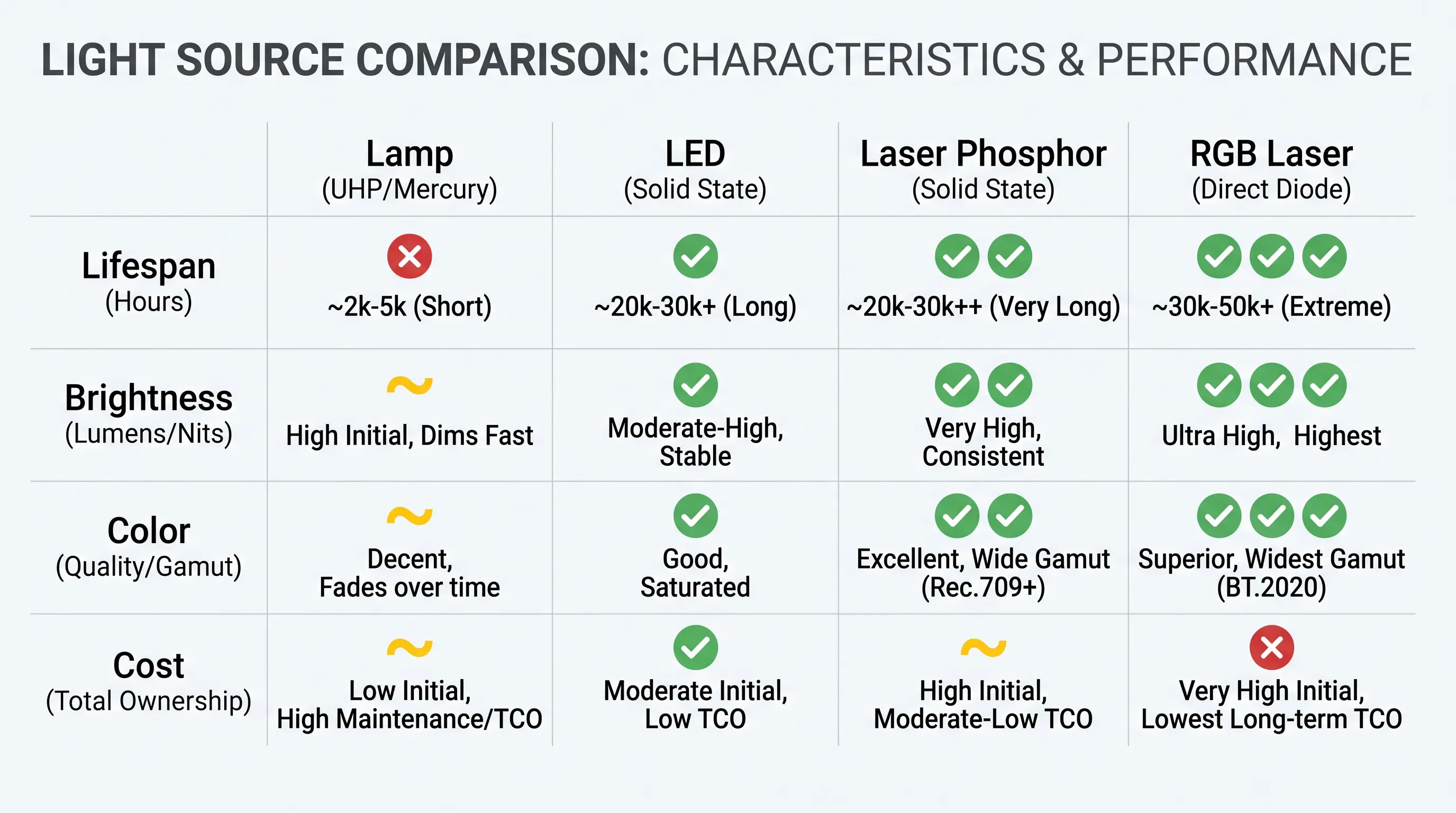
LED projectors offer three primary advantages for B2B use: instant on/off functionality eliminates warm-up and cool-down delays, sealed optical engines prevent dust contamination, and the 20,000-30,000 hour lifespan reduces maintenance requirements compared to lamp-based alternatives that typically require replacement at 2,000-5,000 hours.
What ambient light level can an LED projector handle?
An LED lumens projector rated at 2,000+ lumens handles typical conference room lighting (300-500 lux) for screens up to 120 inches. For environments with direct sunlight exposure or bright ambient lighting, units rated 4,000+ lumens become necessary, though image quality still benefits from light-controlled projection surfaces.
How do I calculate the right lumens for my screen size?
Multiply screen width in feet by 50 for controlled-light environments or by 100-150 for bright environments. A 10-foot wide screen in a conference room requires 500-1,000 lumens minimum, while the same screen in a training facility with windows requires 1,000-1,500 lumens.
What thermal specifications should I request from OEM projector suppliers?
Request maximum LED junction temperature during sustained operation, fan noise levels measured in sones at full output, heat exhaust temperature at ambient temperatures up to 40°C, and brightness retention data after 1,000-hour accelerated aging tests at maximum rated temperature.
For additional guidance on specification interpretation, explore our LED lumens guide or review our home theater projector lineup for deployment examples across various brightness requirements.
Specifying the correct LED lumens projector requires moving beyond headline specifications to understand real-world performance, thermal management, and long-term maintenance implications. Request a technical consultation to validate your requirements against available OEM platforms.
