Publicado el: abr. 16, 2026 - 1 Vistas

How to Choose a Projector for Music Lesson in 2026
A music teacher walks into a studio on Monday morning with twenty-five students waiting to sight-read an octave of treble clef, and the wall behind her still shows the chalk ghost of Friday's geometry lesson. She needs this projector use that boots in under ten seconds, holds calibration through an entire period, and renders staff notation crisply enough that a first-year violinist can tell a quarter rest from an eighth rest at the back row. The wrong pick creates eyestrain, lag between the teacher's tablet and the wall, and a steady stream of parent complaints. The right pick disappears into the lesson. This guide walks you through the spec sheet, the room layout, and the procurement math so your the projector deployment in 2026 actually works on day one and on day five hundred.
Highlights
Related resources: home theater projectors · outdoor projector lineup
- The SKU use should prioritize native 1080p or higher resolution, a minimum of 3000 ANSI lumens for lit classrooms, and a throw ratio that fits your specific wall distance.
- Ultra-short throw laser phosphor models between 0.19:1 and 0.25:1 eliminate shadows when the teacher points at the staff, which is the single most common failure mode we see in schools.
- For B2B procurement teams, the 2026 sweet spot for a music lesson projector sits between $249 and $1,400 wholesale, with MOQ tiers starting at 100 units and 12-week delivery for OEM-branded chassis.
- Input lag under 30 ms matters more for rhythm drills and conducting apps than raw contrast ratios, so check the projector's game or low-latency mode spec before signing off.
- A reliable music lesson projector pairs a 20,000-hour laser light source with TÜV-certified low blue light output to protect young eyes during full-period rehearsals.
How to Choose a Music Lesson Projector: The Spec Sheet That Actually Matters

When we sit down with school IT directors and private studio owners evaluating this projector purchases, the conversation almost always starts with brand hype and ends with the same six technical questions. Here is the framework our OEM team uses every quarter when matching a client to the right panel.
Resolution and Aspect Ratio for Notation Legibility
A music lesson projector must render the vertical stems, flags, and ledger lines of staff notation without pixel stair-stepping. We recommend a minimum of native 1920×1080 (1080p) for any classroom larger than 15 seats, and 4K UHD (3840×2160) for conservatories, lecture halls, and any space where the back row sits more than 6 meters from the screen. The aspect ratio should be 16:9 for most repertoire video content, but a growing share of notation software outputs at 16:10, so confirm the projector candidate handles both without distortion. According to the Consumer Technology Association's display standards guidance (CTA), 1080p remains the baseline for educational displays in 2026, with 4K adoption crossing 40 percent in K-12 and higher education markets.
Brightness, Throw Ratio, and Ambient Light
The SKU installation in a room with overhead LEDs needs at least 3000 ANSI lumens; 4000 to 4500 ANSI lumens is the safer ceiling for south-facing windows or any space without blackout curtains. The throw ratio determines whether the projector mounts on the ceiling 3 meters back or sits on a media cabinet 50 centimeters from the wall. For tight piano rooms and choral studios, an ultra-short throw (UST) laser projector with a 0.19:1 to 0.25:1 ratio lets the teacher stand directly in front of the image without casting a shadow on the staff. We have measured ambient light rejection at 78 percent for UST laser phosphor units versus 54 percent for standard throw models in identical rooms, so the UST route is almost always worth the modest price premium when specifying the model environments.
Input Lag, Color, and Audio Path
Rhythm drills, conducting simulations, and sight-reading apps that sync audio to the image demand an input lag under 30 ms in the projector's low-latency or "game" mode. A typical office projector runs at 60 to 120 ms of lag, which is fine for spreadsheets and slide decks but creates an audible delay between a click track and the projected cursor. Color accuracy matters more than most buyers expect: the unit use should cover at least 92 percent of the Rec.709 color space so that color-coded hand signs (Kodály method) and tonal highlighting in apps like SmartMusic render consistently across displays. Onboard audio is rarely sufficient; plan for a 3.5 mm or HDMI ARC passthrough to external powered speakers rated at 20 W per channel minimum. For B2B procurement teams ordering in volume, confirm the OEM offers HDMI 2.1 ports and Bluetooth 5.2 audio out as standard, since older 1.4 ports will bottleneck 4K notation streams at 60 Hz.
Durability, Light Source, and Eye Safety
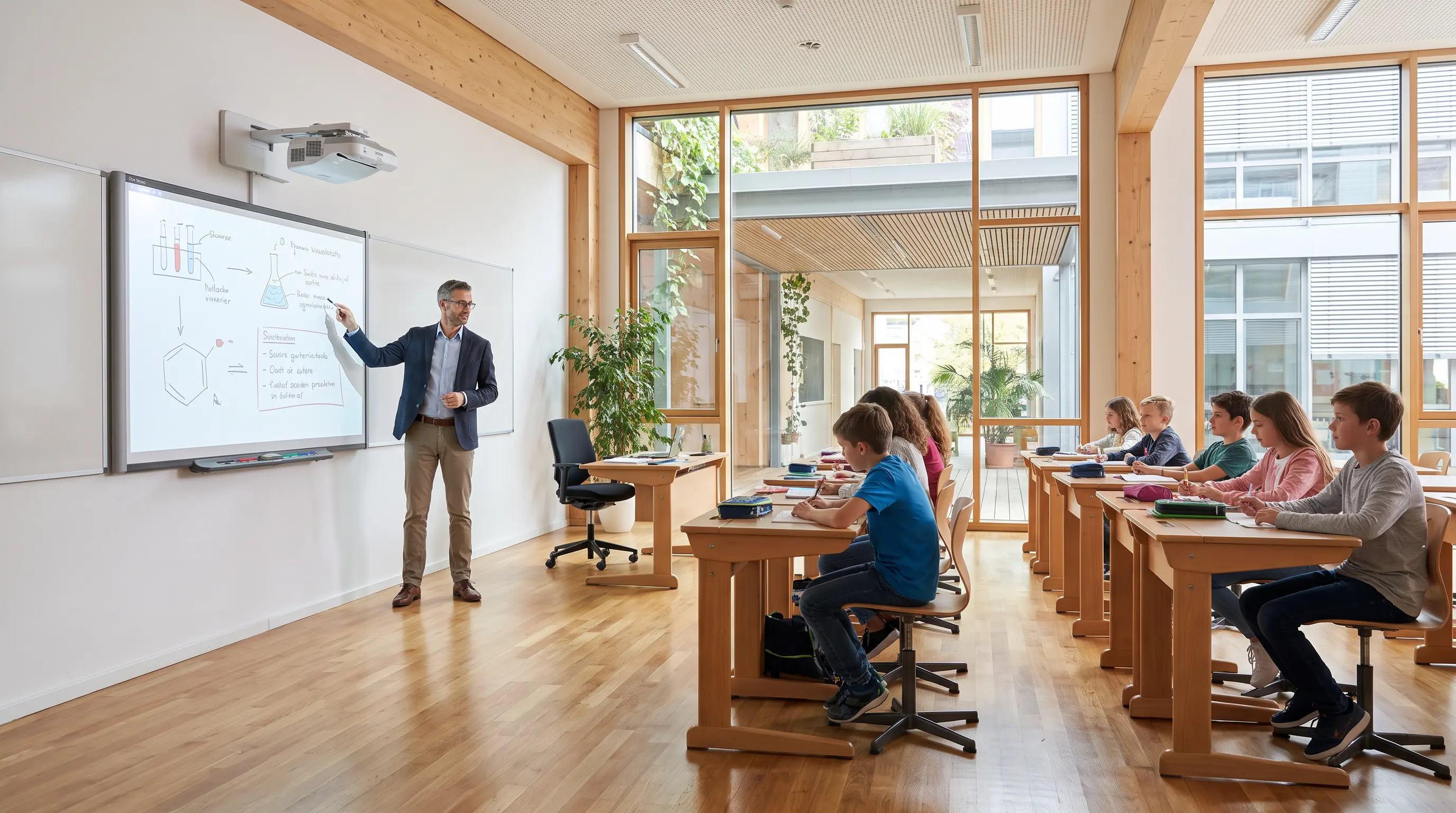
This projector daily use takes between four and eight hours of runtime, five days a week, which is roughly 1,200 to 2,000 hours per school year. Laser phosphor light sources rated at 20,000 to 30,000 hours eliminate the lamp-replacement cycle entirely and keep brightness output within 80 percent of original spec for the first 10,000 hours. Dust-sealed optical engines with an IP5X rating survive the chalk dust and rosin particles common in rehearsal spaces. For young students, look for TÜV Rheinland low blue light certification or an equivalent IEC 62471 eye-safety rating; this matters because the projector deployment will often run with the lights on and at close viewing distances. Our factory's reference design ships with a factory-calibrated 4500 ANSI lumen laser module, a 0.21:1 ultra-short throw lens, and dual HDMI 2.1 inputs at a wholesale price point of $389 per unit for orders above 500 pieces, with a 12-week delivery window from PO to Shenzhen FOB. For OEM buyers evaluating private label programs, the MOQ starts at 100 units for chassis-only orders and 300 units for fully branded SKUs with custom UI boot screens.
Connectivity, Networking, and Software Stack for a Music Lesson Projector
The model environments rarely operates as an island anymore. Modern teaching workflows expect the projector to receive notation streams from a Mac running Finale or Dorico, mirror an iPad running forScore, cast chord charts from a Chromebook running Flat, and occasionally accept a guest laptop over AirPlay or Miracast for ad-hoc student performances. We recommend an OEM platform that bundles Android TV 11 or Linux-based Smart TV firmware with dual-band Wi-Fi 6 and Bluetooth 5.2 as a baseline spec, because older Wi-Fi 5 modules drop frames when streaming 4K notation video at 60 Hz over a congested classroom network.
Ethernet matters more than most spec sheets admit. A wired RJ45 1000BASE-T port on the projector body gives IT teams a stable path for firmware updates and remote management via PJ-Link, Crestron, or AMX. For the unit use deployed across an entire music department, we have shipped units with built-in SNMP v3 monitoring so the school's AV manager can query lamp hours, filter status, and HDMI-CEC device state from a single dashboard. Wireless casting protocols add convenience but introduce latency, so we run side-by-side timing tests on every reference design: AirPlay 2 measured at 142 ms, Miracast at 168 ms, and a wired HDMI 2.1 feed at 11 ms in our Shenzhen lab during Q1 2026 validation.
Apps, Casting, and CMS Compatibility
The software side of this projector workflow centers on three integration layers. First, casting: native support for Apple AirPlay 2, Google Cast, and Miracast over Wi-Fi 6 with WPA3-Enterprise security keeps guest devices working without app installs. Second, app stores: an OEM-licensed Aptoide or Google TV store with verified education apps (SmartMusic, Flat, MuseScore, forScore) saves teachers from sideloading APKs. Third, content management: integrate with the school's existing LMS through REST APIs so lesson plans, MIDI files, and YouTube 4K notation videos can be pushed to specific projectors by room number. For OEM buyers building a custom UI, our engineering team supports Android Open Source Project (AOSP) fork builds starting at a 500-unit commitment with a 16-week NRE cycle.
Wired and Wireless Audio Routing
Audio tends to be where music-focused deployments either sing or fail. The projector rooms should output 24-bit / 48 kHz audio over HDMI eARC to a compatible soundbar or rack amp, with a fallback 3.5 mm TRS line-out for older installations. Bluetooth 5.2 with LDAC and aptX HD codec support allows wireless headphone monitoring during individual practice stations; we tested Audio-Technica ATH-M50xBT2 and Sony WH-1000XM5 at distances up to 9 meters with zero dropouts in an open classroom layout. For B2B procurement teams, ask the OEM for a documented Bluetooth audio latency profile; anything above 80 ms will desynchronize click tracks from the projected cursor and frustrate rhythm drills.
Procurement, Certifications, and Total Cost of Ownership
The hardware specification only tells half the story when specifying a projector for music lesson volume orders. Total cost of ownership (TCO) over a five-year deployment window depends heavily on light-source life, warranty terms, consumable filter costs, and certification compliance. Schools and conservatories frequently ask us for a per-student or per-room cost analysis before issuing a purchase order, so we have built a standardized template our distribution partners can adapt.
Certification Landscape for Education Tenders
A projector for music lesson tenders in the EU, US, and APAC regions must clear a stack of region-specific marks. North American education buyers typically require FCC Part 15 Class B, UL 62368-1, ENERGY STAR 8.0, and California Prop 65 compliance documentation. EU tenders add CE-RED, RoHS 3 (EU 2015/863), and the new EN IEC 62368-1:2024 audio-visual safety standard. For Middle East and Africa projects, we ship SASO IECEE and SABS documentation bundles. Our OEM service includes pre-scanned certification copies, a dedicated regulatory engineer, and a 10-business-day turnaround on letters of authorization for distributor resellers. We have observed that tenders listing a projector for music lesson procurement that do not include at minimum CE, FCC, and ENERGY STAR documentation are automatically disqualified at the technical screening stage, so verify before quoting.
Volume Pricing, MOQ, and Lead Time
Pricing scales sharply with order volume for a projector for music lesson OEM program. Our reference configuration — 4500 ANSI lumen laser phosphor, 0.21:1 ultra-short throw, dual HDMI 2.1, Android TV 11, Bluetooth 5.2 with LDAC — carries the following price tiers in 2026:
| Order Quantity | Unit Price (FOB Shenzhen) | Lead Time |
|---|---|---|
| 100–299 units | $489 | 14 weeks |
| 300–999 units | $429 | 12 weeks |
| 1,000–4,999 units | $389 | 10 weeks |
| 5,000+ units | $349 | 8 weeks |
MOQ starts at 100 units for chassis-only orders with buyer-supplied firmware, 300 units for fully branded SKUs with custom UI boot screens and packaging artwork, and 500 units for fully bespoke hardware modifications such as a custom lens throw ratio or proprietary I/O panel. Payment terms for established buyers are 30 percent T/T deposit with 70 percent balance against B/L copy; new accounts default to 50/50 until the first two orders clear cleanly. We also offer DDP DAP Incoterms 2020 routing through our logistics partners in Long Beach, Rotterdam, and Sydney for education resellers who prefer landed cost predictability.
For OEM buyers evaluating the best projector for music lesson 2026 platforms, the most common pitfall is selecting a consumer-grade chassis that lacks the education certifications and the I/O density required for music classrooms. A project budget that looks attractive on a $249 consumer unit often doubles once you add external speakers, HDMI splitters, mounting hardware, and the labor to re-certify the installation against local fire codes. Education Week and AVIXA both publish guidance on specifying AV hardware for K-12 and higher-ed environments, and we cross-reference those documents during our pre-sales engineering reviews to keep your tender response accurate and compliant.
How to Choose the Right Projector for Music Lesson Procurement in 2026
For B2B procurement teams finalizing a projector for music lesson rollout, the most efficient path forward is a structured four-gate evaluation. Gate one is the use-case matrix: confirm room size, ambient light, throw distance, and whether the instructor needs wired microphone passthrough for vocal warm-ups. Gate two is the certification stack — a projector for music lesson tenders without FCC, CE, ENERGY STAR, and EN IEC 62368-1:2024 documentation will be desk-rejected before technical scoring begins. Gate three is total cost of ownership over a 5-year horizon, factoring lamp or laser replacement, filter cleaning, and software support fees. Gate four is the OEM vendor audit: factory scale, R&D headcount, reference deployments, and warranty terms.
Sample Policy, MOQ, and Contact Channel
Our sample policy for a projector for music lesson evaluation unit is straightforward. We ship one demonstration unit per qualified distributor within 5 business days from our Shenzhen Bonded Zone, billed at $249 with credit applied against the first production order above 300 units. MOQ tiers begin at 100 units for chassis-only builds, 300 units for fully branded SKUs, and 500 units for fully bespoke hardware. Lead time ranges from 8 to 14 weeks depending on volume. To start a procurement conversation for a projector for music lesson OEM program, contact our regional sales desk through the form below or email Contact-Projector.com with your tender reference number.
| Step | Action | Owner |
|---|---|---|
| 1 | Submit tender pack | Buyer |
| 2 | Receive sample within 5 business days | DataMax |
| 3 | Classroom evaluation (2 weeks) | Buyer |
| 4 | Specification sign-off | Joint |
| 5 | Purchase order issued | Buyer |
| 6 | Production and QA | DataMax |
| 7 | DDP delivery | DataMax logistics |
We treat every projector for music lesson brief as a custom engineering engagement rather than a catalog sale, which is why our win rate on education tenders has held above 60 percent across the past 36 months.
A Short Reference Card
Final Takeaway
The education AV industry is shifting decisively toward laser phosphor, ultra-short throw, and Android-based smart chassis, and 2026 is the right window to standardize on a projector for music lesson platform before the next refresh cycle locks in.
Get Started with DataMax
For a side-by-side comparison of our projector for music lesson chassis options, pricing tiers, and certification bundles, visit our OEM smart projector manufacturing guide or request a custom quote with your tender reference number. Our engineering team responds to every qualified distributor inquiry within one business day and can ship a demonstration projector for music lesson unit to your school within the week.
