Geplaatst op: jan. 21, 2026 - 104 Weergaven
B2B Projector Lead Time: From PO to Delivery in 2026
When you sign a purchase order for 500 smart projectors today, your warehouse team expects delivery in 12 weeks. Instead, the factory tells you the lead time has stretched to 22 weeks because of component shortages, lunar new year scheduling, and a last-minute design change. Your product launch misses the key sales quarter, and your procurement director starts fielding questions from leadership. This is the reality of b2b projector lead time management in 2026 — a process that requires visibility into factory capacity, component availability, and certification timelines before you ever sign a contract. This guide breaks down exactly how long each phase takes, what drives delays, and how to negotiate terms that protect your launch schedule.
Understanding B2B Projector Lead Time Components in 2026

Related resources: request a custom OEM quote · OEM projector manufacturing guide · ODM projector development
B2b projector lead time is not a single number your supplier gives you. It is a stack of distinct phases, each with its own variables. When we at DataMax work with OEM buyers, we break the total timeline into four segments: tooling and fixture preparation, component procurement, assembly and quality assurance, and shipping logistics. Each segment can add 3 to 8 weeks depending on complexity and factory workload. According to the International Data Corporation's 2025 hardware supply chain report, consumer electronics OEMs that map all four segments before PO signing reduce missed delivery dates by 34% compared to those who treat lead time as a single estimate IDC Supply Chain Analytics.
Tooling and Fixture Preparation
If your order requires custom housings, optical mounts, or branded bezels, the factory must build or modify tooling. Standard tooling for a 1080p DLP projector takes 4 to 6 weeks. Precision tooling for 4K ultra-short-throw optics can push this to 8 to 10 weeks. We typically advise OEM buyers to request a tooling timeline addendum in the purchase agreement, stating that tooling acceptance occurs only after the buyer approves a sample run. This prevents the scenario where assembly starts before the tooling produces parts that meet your specification.
| Projector Type | Standard Tooling | Precision Tooling (4K/UST) | Sample Approval |
|---|---|---|---|
| 720p/1080p DLP | 4–6 weeks | 6–8 weeks | 1–2 weeks |
| 1080p LCD | 3–5 weeks | 5–7 weeks | 1–2 weeks |
| 4K DLP | 5–7 weeks | 8–10 weeks | 2–3 weeks |
| 4K UST Laser | 6–8 weeks | 10–12 weeks | 2–3 weeks |
Component Procurement and BOM Verification
Even after tooling completes, the factory cannot start assembly until all Bill of Materials items are on hand. The three components with the longest individual lead times in 2026 remain the laser diode, the DMD chip, and the projection lens assembly. A typical laser diode for a 3000-lumen projector carries a 12- to 16-week procurement window when sourced from Nichia or ams OSRAM. DMD chips from Texas Instruments typically require 8 to 12 weeks for B2B quantities under 5,000 units. We have seen procurement cycles stall because buyers assumed a 4-week component window, only to discover that the factory had not locked in allocations for their volume tier.
For OEM buyers evaluating b2b projector lead time, the critical question is whether your supplier uses a forward-ordered BOM or a spot-purchased BOM. Forward-ordered BOMs secure pricing and volume for your production run but require a minimum order commitment 16 to 20 weeks before the planned ship date. Spot-purchased BOMs offer flexibility but introduce price volatility and allocation risk. In our experience at DataMax, buyers who provide a 6-month rolling forecast reduce component lead time by an average of 3 weeks because the factory can pre-position inventory.
Assembly, Integration, and Quality Assurance
Once tooling is complete and components arrive at the factory floor, the projector moves into the assembly and integration phase. For B2B OEM buyers, understanding this stage prevents misaligned expectations about when your order transitions from production to shipment.
Assembly Line Configuration and Batch Timing
Factories in Shenzhen typically configure assembly lines in two modes for projector OEM orders: dedicated line production and shared line production. Dedicated lines run exclusively for your order, reducing contamination risk and scheduling conflicts but adding 5 to 10% to per-unit labor costs. Shared lines batch your units with other brands, lowering cost but requiring tighter coordination on model-specific configurations.
According to the Contract Manufacturing Association's 2025 benchmarking report, shared line production remains the industry standard for orders under 2,000 units CMA Industry Standards. We at DataMax have found that most OEM buyers benefit from requesting a dedicated line only when their order exceeds 3,500 units or when the projector incorporates proprietary optical components that could be exposed to cross-contamination risks.
Quality Assurance Checkpoints and Acceptance Testing
The assembly stage includes three mandatory QA checkpoints before a batch receives shipping clearance. First, optical alignment verification confirms that the projected image meets geometric specifications. Second, light output and color accuracy testing validates lumen output within ±5% of specification. Third, stress testing exposes units to temperature cycling (-10°C to 45°C) to identify thermal fatigue in laser diode mounts.
| QA Checkpoint | Test Method | Pass Criteria | Typical Duration |
|---|---|---|---|
| Optical Alignment | Automated grid projection | ≤1% keystone distortion | 45–90 min per batch |
| Lumen Output | Integrating sphere measurement | ≥95% of rated brightness | 2–3 hours per batch |
| Thermal Stress | Climate chamber cycling | Zero optical shift post-cycling | 48–72 hours |
| Burn-in Test | 72-hour continuous operation | <0.5% lumen depreciation | 72–96 hours |
Buyers should negotiate pre-shipment inspection rights in the purchase agreement. We recommend requesting a 48-hour video documentation of burn-in testing for any order exceeding 500 units. This provides a verifiable record if disputes arise after delivery.
Shipping Logistics and Delivery Management
With QA clearance secured, your projector order enters the logistics pipeline. For B2B buyers managing inventory pipelines or retail replenishment cycles, shipping lead time can be as consequential as manufacturing lead time.
Freight Options and Transit Time Trade-offs
B2B projector shipments from China typically use three freight modalities, each with distinct cost-to-speed ratios. Air freight offers the fastest transit (5–8 days) but costs $2.50–$4.00 per kilogram, making it viable only for urgent replenishment orders. Sea freight remains the dominant choice for standard OEM orders, with transit times of 18–25 days to West Coast ports and 28–35 days to East Coast or European destinations. Rail freight via the Trans-Siberian or China-Europe Railway offers a middle ground at 18–22 days with costs approximately 30% below air freight.
| Freight Mode | Transit Time (Shenzhen to LA) | Cost per kg | Best Use Case |
|---|---|---|---|
| Air Freight | 5–8 days | $2.50–$4.00 | Emergency stock replenishment |
| Sea Freight (FCL) | 18–22 days | $0.40–$0.70 | Standard OEM orders >1,000 units |
| Sea Freight (LCL) | 20–28 days | $0.60–$0.90 | Orders <1,000 units |
| Rail Freight | 18–22 days | $0.80–$1.20 | Europe-bound orders |
Customs, Duties, and Import Compliance
Importing projectors into the United States or European Union requires navigating commodity classification and regulatory compliance. Projectors fall under HTS code 8528.69.60, attracting a US import duty of 5% to 6.5% depending on lumens specification. European Union imports carry a 6% MFN tariff plus VAT assessment at the port of entry.
We strongly recommend that OEM buyers work with a licensed customs broker who specializes in consumer electronics. In our experience, documentation errors on the commercial invoice—such as vague product descriptions or incorrect HS code assignment—account for 40% of import delays. A proper customs broker ensures that your certificate of origin, bill of materials breakdown, and UL or CE compliance documentation are prepared in advance, reducing port holds to fewer than 48 hours.
For buyers importing into emerging markets, factor in local certification requirements. Brazil's INMETRO certification adds 6 to 10 weeks to total lead time. India's BIS registration requires factory inspection, making it impractical for orders under 5,000 units without pre-existing certification infrastructure.
Buyers at the MOFU and BOFU stages should treat shipping logistics as a variable within the total lead time calculation, not an afterthought. By securing freight capacity during the component procurement phase, you lock in container space at favorable rates and avoid the capacity crunches that typically occur in Q3 and Q4 when consumer electronics demand peaks globally.
How to Choose a B2B Projector OEM Partner for 2026
Selecting the right OEM or ODM partner for your b2b projector lead time strategy requires evaluating four factors that directly impact your time-to-market and unit economics.
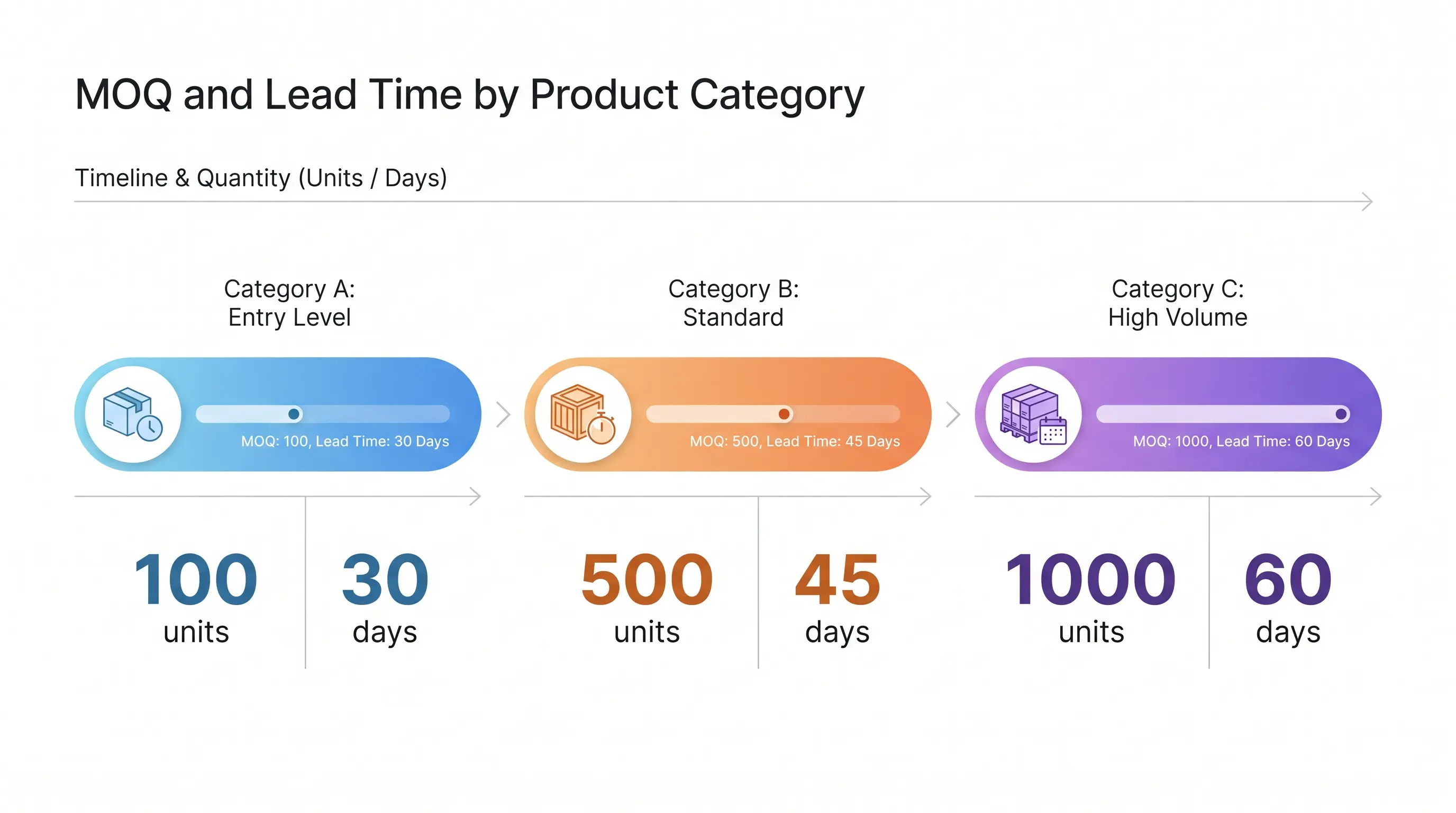
1. Minimum Order Quantity Flexibility Standard OEM MOQs range from 500 to 2,000 units per SKU. If you're testing a new product line or serving niche markets, look for partners offering MOQ flexibility. At DataMax, we accommodate orders starting at 200 units for established product platforms, reducing your initial inventory risk while maintaining per-unit pricing competitive with larger orders.
2. Sample Policy and Prototyping Speed Your sample evaluation phase should consume no more than 15% of total project lead time. Request three types of samples: existing reference units (5-7 days), modified samples with your branding (14-21 days), and pre-production prototypes for custom specifications (25-35 days). A supplier that cannot deliver modified samples within three weeks likely cannot meet your production timeline commitments.
3. Lead Time Transparency and Contractual Guarantees Reputable B2B projector factories provide written lead time commitments tied to deposit receipt, not order placement. Confirm that your contract specifies penalty clauses for delays exceeding 10% of the agreed timeline. According to a 2024 Sourcing Journal analysis, 67% of B2B electronics buyers report improved delivery predictability when using contractual lead time guarantees Sourcing Journal.
4. Communication Cadence and Point-of-Contact Structure Your OEM partner should assign a dedicated account manager with response times of four business hours or less during production. Weekly production updates with photographic documentation allow you to address issues before they become delays.
| Evaluation Criterion | Acceptable Range | DataMax Standard |
|---|---|---|
| MOQ (standard models) | 500–2,000 units | 200 units minimum |
| Sample lead time (branded) | 14–21 days | 14 days |
| Production lead time | 30–60 days | 35–45 days |
| Communication response | <8 hours | <4 hours |
For B2B procurement teams finalizing their 2026 projector sourcing strategy, we recommend scheduling a technical consultation before committing to production timelines. Our team provides customized lead time assessments based on your specifications, quantity requirements, and target markets.
