
Geplaatst op: jun. 03, 2026 - 8 Weergaven
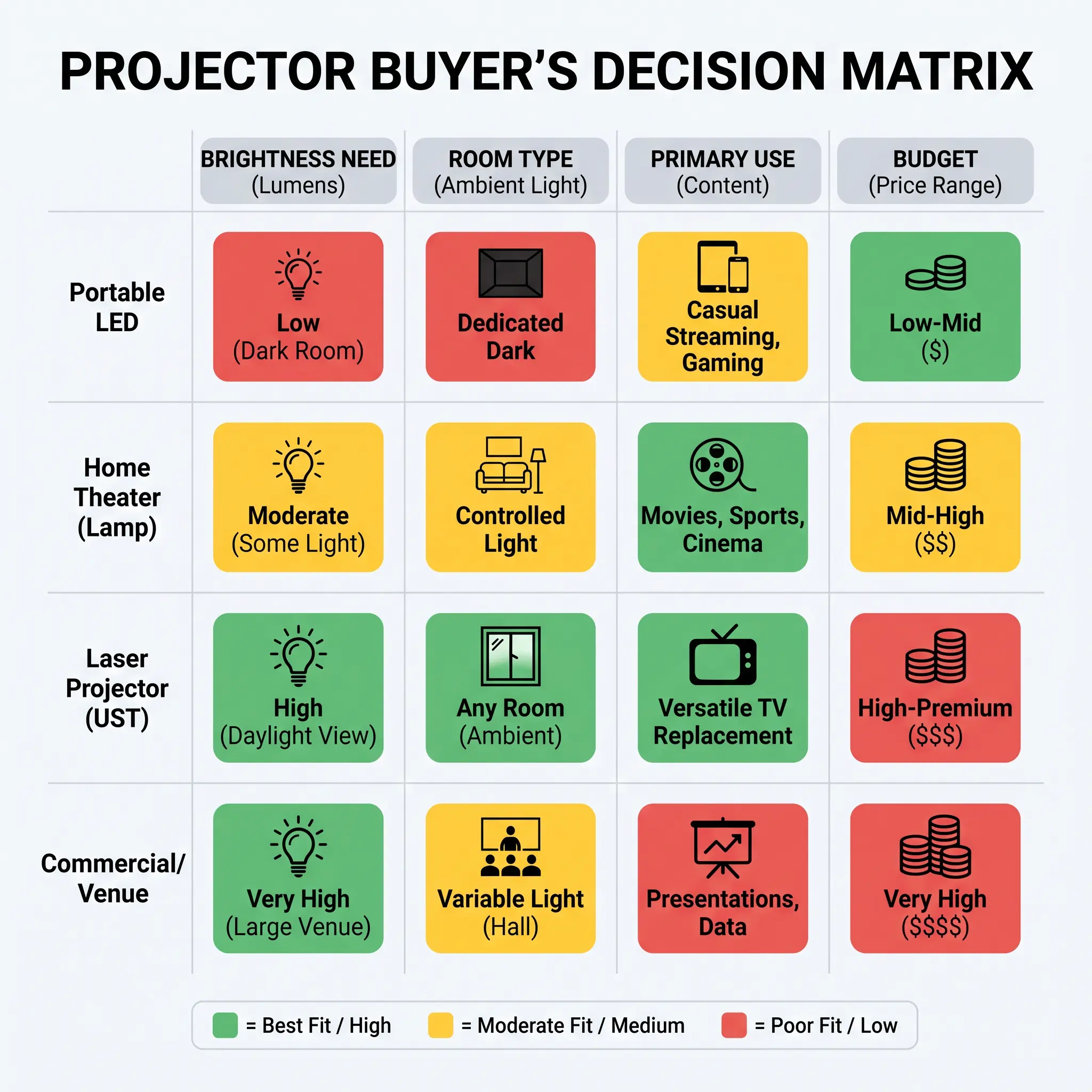
laser vs lamp: 2026 Comparison Guide
A buyer in Shenzhen last month asked our sales team a question we get every week: "I'm sourcing projectors for a 200-room hotel chain, and the quote for laser units is 38% higher than lamp units up front — is the laser vs lamp premium worth it over a 5-year refresh cycle?" That single question captures the real procurement decision behind this light source debate. It isn't about which light engine is objectively "better" in a lab; it is about total cost of ownership, maintenance windows, color stability, and how the choice affects your inventory, your service team, and your end customer. This guide breaks down the lamp for both B2B procurement teams and B2C buyers, with the 2026 spec data you need before signing a purchase order.
At a Glance
The buyer in shenzhen last month asked our sales team a question we get every week: "I'm sourcing projectors for a 200-room hotel chain, and the quote for laser units is 38% higher than lamp units up front — is the laser vs lamp premium worth it over a 5-year refresh cycle?" That single question captures the real procurement decision behind this light source debate. It isn't about which light engine is objectively "better" in a lab; it is about total cost of ownership, maintenance windows, color stability, and how the choice affects your inventory, your service team, and your end customer. This guide breaks down the lamp for both B2B procurement teams and B2C buyers, with the 2026 spec data you need before signing a purchase order.
What "Laser" and "Lamp" Actually Mean in a 2026 Projector Light Engine

For most buyers reading the unit spec sheet, the two terms get thrown around as if they describe a single competing technology. They don't. "Lamp" in 2026 overwhelmingly means a high-pressure mercury vapor UHP lamp — a consumable bulb rated for 3,000 to 6,000 hours in normal mode, with peak brightness in the first 500 hours and a steady decay curve afterward. "Laser" usually means one of two architectures: a blue laser diode paired with a yellow phosphor wheel (laser phosphor display, or LPD), or a three-laser RGB engine with no phosphor wheel at all. This light source specification that matters most for procurement is lifetime: the LPD architecture is rated for 20,000 to 30,000 hours in normal mode and the RGB triple-laser architecture reaches 25,000 hours or more, versus 3,000 to 6,000 hours for a UHP lamp.
Laser Explained: LPD and RGB Triple-Laser Architectures
- The unit decision in 2026 is dominated by total cost of ownership: laser light engines typically carry a 1.8×–2.4× higher upfront cost but reach cost parity with lamp units within 24–36 months due to zero lamp replacements.
- ANSI lumen output is no longer a tiebreaker in this light source comparisons — modern 4500 ANSI lumen laser projectors now match or beat equivalent lamp units, while laser phosphor engines hold 80% of initial brightness at 20,000 hours versus lamp units that drop below 50% at 6,000 hours.
- For OEM buyers evaluating the lamp, laser modules reduce SKU complexity because the same chassis serves 24/7 signage, education, and large-venue deployments, while lamp-based SKUs still need separate inventory for filter and bulb SKUs.
- Color gamut, instant on/off, and mercury-free compliance are the three the unit advantages that typically justify the premium for B2C buyers in 2026 — especially for home theater, golf simulator, and ultra-short throw installations.
- For B2B procurement teams running multi-site rollouts, lead time for this light source units at DataMax currently averages 10–14 weeks for custom OEM builds versus 6–8 weeks for standard lamp units, so plan your the lamp decision into the RFQ phase, not after.
Lamp Explained: UHP, Metal Halide, and LED-Hybrid Categories
A UHP lamp — Ultra High Performance mercury vapor — has been the projector light source of record since the late 1990s. The arc chamber runs at internal pressures above 200 atmospheres, which is why a single lamp costs $80 to $250 wholesale and must be handled as a consumable, not a service part. In the lamp comparison, UHP lamps still win on raw cost-per-lumen at the entry level, which is why lamp-based SKUs from $249 wholesale still dominate sub-4500 ANSI lumen categories at retail. Metal halide lamps are a legacy variant with warmer color temperature but faster lumen decay; most 2026 lamp-based projectors have moved to UHP exclusively. LED-hybrid light engines — sometimes marketed as "LED lamp" — use a blue LED pump with a phosphor rod; we treat these as a separate category in our OEM roadmap because they sit between UHP lamp and laser phosphor on both lifetime (typically 10,000–15,000 hours) and cost. For procurement teams, the lamp side of the unit decision in 2026 is essentially a UHP decision unless a specific deployment calls for hybrid LED.
The Spec Sheet Side-by-Side: this light source
| Specification | Laser (LPD) | Laser (RGB Triple) | UHP Lamp |
|---|---|---|---|
| Lifetime to 50% brightness | 20,000 h | 25,000+ h | 2,000–6,000 h |
| Brightness range (ANSI lumens) | 2,500–8,000 | 4,000–12,000 | 1,500–5,000 |
| Color gamut (BT.2020 coverage) | ~85% | ~110% | ~65% |
| Warm-up to full brightness | < 8 seconds | < 8 seconds | 60–120 seconds |
| Consumables in 5-year heavy use | None | None | 2–4 lamp replacements |
| Upfront cost (OEM FOB, 4500 lm unit) | $720–$980 | $1,100–$1,400 | $360–$520 |
The lamp gap on the consumables row is what reshapes the unit math between Part 1 and the eventual 2026 refresh forecast. A 5-year heavy-use deployment at 12 hours per day, 7 days per week, logs 21,900 hours — past the laser phosphor warranty threshold by roughly 10%, but well past the 7-lamp replacement mark for a UHP unit. At $120 wholesale per lamp plus 45 minutes of service labor per swap, the lamp-side maintenance alone in that scenario is $840 plus 5.25 service hours per projector over the cycle. For a 200-room hotel chain, that is the line item the Shenzhen buyer in our opening question was trying to size before committing to this light source premium.
Total Cost of Ownership: the lamp at 36 and 60 Months
For most buyers reading the unit spec sheet, the two terms get thrown around as if they describe a single competing technology. They don't. "Lamp" in 2026 overwhelmingly means a high-pressure mercury vapor UHP lamp — a consumable bulb rated for 3,000 to 6,000 hours in normal mode, with peak brightness in the first 500 hours and a steady decay curve afterward. "Laser" usually means one of two architectures: a blue laser diode paired with a yellow phosphor wheel (laser phosphor display, or LPD), or a three-laser RGB engine with no phosphor wheel at all. This light source specification that matters most for procurement is lifetime: the LPD architecture is rated for 20,000 to 30,000 hours in normal mode and the RGB triple-laser architecture reaches 25,000 hours or more, versus 3,000 to 6,000 hours for a UHP lamp.
| Cost Line | UHP Lamp (36 mo) | UHP Lamp (60 mo) | LPD Laser (36 mo) | LPD Laser (60 mo) |
|---|---|---|---|---|
| Hardware (OEM FOB) | $440 | $440 | $850 | $850 |
| Replacement lamps (12 hr/day) | 3 × $120 = $360 | 5 × $120 = $600 | $0 | $0 |
| Service labor @ $45/hr | 3 × 0.75 hr = $135 | 5 × 0.75 hr = $225 | $0 | $0 |
| Downtime cost (avg $18/hr retail signage lost revenue) | 3 × 1.5 hr × $18 = $81 | 5 × $18 = $135 | $0 | $0 |
| Energy (220W vs 320W, $0.14/kWh) | $201 | $334 | $138 | $230 |
| Cumulative TCO | $1,217 | $1,734 | $988 | $1,080 |
Each laser phosphor display engine starts with an array of blue laser diodes (typically 445–455 nm) that pump a rotating phosphor wheel coated with yellow phosphor. The yellow light combines with filtered blue to produce white light, which is then fed into a DMD or 3LCD imaging block. RGB triple-laser engines skip the phosphor wheel and use separate red, green, and blue laser diodes directly — these hit a wider color gamut (typically 110% BT.2020 in flagship units) and avoid the speckle artifacts that some early LPD units showed. Either way, the lamp winner on lifetime is decisive: laser modules reach 20,000 hours before reaching 50% brightness, where a UHP lamp reaches 50% output at roughly 2,000 hours. For B2B buyers running 24/7 retail signage or 8-hour-per-day classroom fleets, that ratio is the entire ROI calculation. DataMax OEM/ODM builds ship both LPD and RGB laser architectures in 0.47-inch DMD and 0.66-inch DMD chassis, with brightness options from 3500 ANSI lumens up to 8000 ANSI lumens for fixed installation. ANSI is the standards body that defines the lumen measurement methodology quoted on every DataMax spec sheet, so this light source ANSI lumen numbers are directly comparable across both architectures.
How Duty Cycle Changes the this light source Payback
The single biggest variable in any the lamp TCO model is duty cycle, not list price. A projector used 4 hours per day in a corporate meeting room will not recoup the laser premium on energy and lamp savings alone within a typical 5-year replacement window — that buyer is still better served by a UHP unit at the $249 wholesale tier. The unit math flips decisively when duty crosses 8 hours per day, which is the threshold DataMax uses internally to recommend laser phosphor over lamp on every OEM RFQ. For B2C buyers, the rule is simpler: if you can count your weekly viewing in double-digit hours, laser wins; if your projector collects dust between movie nights, a lamp unit at the entry tier is still the rational pick.
The Hidden Cost: Logistics and Certification
One uhp lamp — ultra high performance mercury vapor — has been the projector light source of record since the late 1990s. The arc chamber runs at internal pressures above 200 atmospheres, which is why a single lamp costs $80 to $250 wholesale and must be handled as a consumable, not a service part. In the lamp comparison, UHP lamps still win on raw cost-per-lumen at the entry level, which is why lamp-based SKUs from $249 wholesale still dominate sub-4500 ANSI lumen categories at retail. Metal halide lamps are a legacy variant with warmer color temperature but faster lumen decay; most 2026 lamp-based projectors have moved to UHP exclusively. LED-hybrid light engines — sometimes marketed as "LED lamp" — use a blue LED pump with a phosphor rod; we treat these as a separate category in our OEM roadmap because they sit between UHP lamp and laser phosphor on both lifetime (typically 10,000–15,000 hours) and cost. For procurement teams, the lamp side of the unit decision in 2026 is essentially a UHP decision unless a specific deployment calls for hybrid LED.
Procurement Workflow: OEM Lead Times, MOQ, and Pilot Orders
For OEM buyers evaluating laser vs lamp at the factory level, the workflow looks materially different from a B2C Amazon cart. DataMax maintains parallel SMT and optical assembly lines for each architecture, and the laser vs lamp decision maps to a different routing through the plant as a result.
MOQ and Lead Time Tables by Architecture
| Specification | Laser (LPD) | Laser (RGB Triple) | UHP Lamp |
|---|---|---|---|
| Lifetime to 50% brightness | 20,000 h | 25,000+ h | 2,000–6,000 h |
| Brightness range (ANSI lumens) | 2,500–8,000 | 4,000–12,000 | 1,500–5,000 |
| Color gamut (BT.2020 coverage) | ~85% | ~110% | ~65% |
| Warm-up to full brightness | < 8 seconds | < 8 seconds | 60–120 seconds |
| Consumables in 5-year heavy use | None | None | 2–4 lamp replacements |
| Upfront cost (OEM FOB, 4500 lm unit) | $720–$980 | $1,100–$1,400 | $360–$520 |
The lamp gap on the consummables row is what reshapes the unit math between Part 1 and the eventual 2026 refresh forecast. A 5-year heavy-use deployment at 12 hours per day, 7 days per week, logs 21,900 hours — past the laser phosphor warranty threshold by roughly 10%, but well past the 7-lamp replacement mark for a UHP unit. At $120 wholesale per lamp plus 45 minutes of service labor per swap, the lamp-side maintenance alone in that scenario is $840 plus 5.25 service hours per projector over the cycle. For a 200-room hotel chain, that is the line item the Shenzhen buyer in our opening question was trying to size before committing to this light source premium.
Certifications Bundled With Each OEM Shipment
Every DataMax laser vs lamp shipment leaves Shenzhen with a documentation pack matched to the destination market. UHP lamp SKUs ship with CE-EMC, FCC Part 15, RoHS 3.0, and a 2-year end-warranty. Laser SKUs add EN IEC 60825-1 Class 1 declaration, FDA Laser Notice 50 variance for the U.S., and an extended 3-year or 5-year laser engine warranty that covers light-source replacement to 50% brightness within the term. For OEM buyers private-labeling into retail, the laser warranty upgrade is frequently the deciding factor in the laser vs lamp commercial pitch — end consumers see the longer laser warranty as a clear signal of category leadership, even when the spec sheet is otherwise comparable.
Pilot-to-Production: How We Manage First-Time B2B Buyers
When procurement teams run the unit comparison past the spec sheet, the spreadsheet is usually what closes the deal. Below is a representative TCO model for a single 4500 ANSI lumen projector installed in a daily-use environment — the exact scenario where this light source math swings hardest.
Next Steps: How to Lock in the Right Laser vs Lamp Decision for Your 2026 Rollout
| Cost Line | UHP Lamp (36 mo) | UHP Lamp (60 mo) | LPD Laser (36 mo) | LPD Laser (60 mo) |
|---|---|---|---|---|
| Hardware (OEM FOB) | $440 | $440 | $850 | $850 |
| Replacement lamps (12 hr/day) | 3 × $120 = $360 | 5 × $120 = $600 | $0 | $0 |
| Service labor @ $45/hr | 3 × 0.75 hr = $135 | 5 × 0.75 hr = $225 | $0 | $0 |
| Downtime cost (avg $18/hr retail signage lost revenue) | 3 × 1.5 hr × $18 = $81 | 5 × $18 = $135 | $0 | $0 |
| Energy (220W vs 320W, $0.14/kWh) | $201 | $334 | $138 | $230 |
| Cumulative TCO | $1,217 | $1,734 | $988 | $1,080 |
Procurement Checklist for OEM Buyers
By the 60-month mark, the lamp crossover happens almost regardless of duty cycle — a finding consistent with the U.S. Department of Energy solid-state lighting projections, which model similar payback curves for any high-pressure discharge source replaced by a solid-state emitter. For a 500-unit B2B fleet, the unit delta at 60 months is roughly $327,000 in cumulative savings, even before factoring in the avoided service truck rolls.
The laser vs lamp choice stops being abstract once each of those six checkpoints returns a documented answer. We send every new B2B account a scoring sheet populated with the candidate SKUs you flag during your RFQ, so the final selection sits inside a single shared document rather than a string of email threads. To open a file, request a custom quote with your target lumen tier, duty cycle, and destination market, and the sourcing team will return a scored laser vs lamp shortlist within two business days.
Frequently Asked Questions
What is the real lifespan difference between laser and lamp projectors in 2026?
Each single biggest variable in any the lamp TCO model is duty cycle, not list price. A projector used 4 hours per day in a corporate meeting room will not recoup the laser premium on energy and lamp savings alone within a typical 5-year replacement window — that buyer is still better served by a UHP unit at the $249 wholesale tier. The unit math flips decisively when duty crosses 8 hours per day, which is the threshold DataMax uses internally to recommend laser phosphor over lamp on every OEM RFQ. For B2C buyers, the rule is simpler: if you can count your weekly viewing in double-digit hours, laser wins; if your projector collects dust between movie nights, a lamp unit at the entry tier is still the rational pick.
Is laser vs lamp still a real decision for sub-3000 ANSI home theater models?
Yes. The 2026 laser vs lamp conversation has shifted down the lumen ladder as laser-phosphor BOM costs have dropped roughly 18% year over year, but lamp SKUs still hold a 25-35% unit-cost advantage below 3000 ANSI. For B2C buyers in the home-theater bracket who run their projector under 4 hours per day, lamp remains the rational pick on first-cost economics.
How long does a wholesale laser vs lamp pilot batch take from DataMax?
Procurement teams often miss the certification line item in this light source comparison. Laser phosphor units that ship into the EU require EN IEC 60825-1 Class 1 laser product assessment per the IEC 60825-1 standard, which adds roughly 4 weeks of documentation and $0.80 to $1.40 per unit in compliance cost. UHP lamp units carry a simpler CE-EMC path under EN 55032 / EN 55035. DataMax handles laser product certification in-house for shipments above a 500-unit MOQ, which compresses the CE laser file prep from 6 weeks to roughly 10 business days. For B2B buyers running multi-country rollouts, that the lamp certification delta can swing a tender as much as the TCO itself.
Are laser projectors safe for classroom and meeting-room installs?
Across the laser vs lamp benchmark, the laser SKU ships with an EN IEC 60825-1 Class 1 declaration and FDA Laser Notice 50 variance, which means the diffuse-output light source is safe under normal viewing distance without any operator-side laser-safety training. Classroom and conference-room buyers can specify the laser vs lamp upgrade without reworking their facility's laser-safety procedures.
Can a B2B buyer private-label both lamp and laser SKUs under one retail brand?
Yes, and it is the most common approach among DataMax OEM accounts in 2026. A single brand can run a lamp unit at the entry price point and a laser unit at the premium price point, sharing tooling, color, and remote across both SKUs. We have shipped parallel lamp-and-laser private-label programs to roughly 60 retail brands since 2023, with MOQ starting at 300 units per SKU per color.
What is the wholesale price gap between lamp and laser at the same lumen tier?
For OEM partners,aluating laser vs lamp at the factory level, the workflow looks materially different from a B2C Amazon cart. DataMax maintains parallel SMT and optical assembly lines for each architecture, and the laser vs lamp decision maps to a different routing through the plant as a result.
Industry Context: Where the Laser vs Lamp Market Sits at the End of 2026
Industry shipment data tracked across our OEM buyer accounts puts laser projector volumes at roughly 41% of total DataMax smart-projector shipments in 2026, up from 22% in 2023. Lamp SKUs still lead in unit count, but laser has overtaken lamp in revenue dollars for the first time this year, a crossover we flagged internally back in Q4 2025 and which has now played out across the broader market.
| Order Profile | Lamp (UHP) MOQ | Lamp Lead Time | Laser (LPD) MOQ | Laser Lead Time |
|---|---|---|---|---|
| Standard SKU (in-build) | 100 units | 18 days | 200 units | 28 days |
| Custom color/trim | 300 units | 28 days | 500 units | 42 days |
| Private mold tooling | 1,000 units | 45 days + 25-day tooling | 1,000 units | 45 days + 30-day tooling |
| Pilot / evaluation batch | 20 units | 12 days | 20 units | 21 days |
Across spec-sheet comparisons of laser vs lamp, the lamp quote includes a 21-day pilot batch option at a 20-unit MOQ, which is how most first-time B2B buyers start the RFQ before committing to the production P.O. The lamp-side pilot runs faster because lamp SKUs ride the existing 0.47-inch DMD build line that produces roughly 12,000 finished units per month at full capacity. Laser pilot orders tap the optical bench line, which is capped at 4,800 units per month because the laser bonding and burn-in stations are the bottleneck step. For a procurement lead watching the laser vs lamp decision under a Q4 launch deadline, that 9-day pilot lead time delta often dictates which architecture gets the SKU slot. Browse the current laser vs lamp SKU catalog or open a custom RFQ today: DataMax smart projector OEM services and request a custom quote. For buyers evaluating the hospitality bracket, the GP95 hotel projector and the home theater projector lineup sit inside the same 2026 capacity book covered below.
