
Geplaatst op: jan. 13, 2026 - 1 Weergaven

portable projector: 2026 Comparison Guide
A corporate buyer sends a shortlist of three models to a Shenzhen sourcing agent at 9:14 a.m. By lunch, the team needs to decide which portable projector to spec into a 4,000-unit hotel rollout, which one fits a 600-unit classroom bid, and which SKU is wrong for both. That is the daily reality for procurement managers evaluating this unit category in 2026, where the line between fixed installation and mobile use cases has blurred faster than most spec sheets admit. We have watched this shift on our own OEM/ODM lines at DataMax, where the same portable projector platform is now being configured for hotel suites, pop-up retail, golf simulators, and field training crews. This guide gives you a use case comparison framework, the actual specs that matter for each scenario, and the procurement levers you can pull before you sign a purchase order.
What "the device" actually means in 2026 procurement

The term portable projector has expanded well past the pocket-sized pico units of a decade ago. In our OEM conversations at DataMax, we define this projector as any unit under 4 kg that can run from a standard USB-C PD input or an internal battery, and that ships without a fixed mount in the box. That definition captures roughly 78% of the SKUs our B2B buyers request in 2026, according to internal RFQ data from the last two quarters. Anything heavier, or anything that requires ceiling rigging as a default install, falls into the fixed installation category, which is a separate procurement workflow with its own certification path and its own duty cycle math.
Fixed installation explained, and why it is not a portable projector
Fixed installation explained in one line: it is a chassis designed to live in one room for years, wired into conduit, and cooled for continuous duty. A fixed installation projector typically weighs 8 kg to 15 kg, runs 24/7 in many commercial settings, and uses a laser phosphor or RGB laser light engine rated for 20,000 to 30,000 hours. That is not the system, even if the marketing flyer calls it "versatile." For B2B procurement teams comparing the two categories, the dividing line is weight plus power source plus duty cycle, not the shape of the box. We push every buyer to write that line into their RFQ before they request a quote, because once the line is fuzzy, the wrong SKU tends to win on price.
Use case comparison: hotel suite vs classroom vs pop-up retail
A use case comparison for a portable projector in 2026 breaks down into three dominant deployment profiles, and each one penalizes a different spec.
For a hotel suite roll-out, the our offering must boot in under 8 seconds, accept AirPlay and Miracast without an app, and stay quiet below 28 dB at 1 m. A 1080p native panel with 800 to 1,200 ANSI lumens is the sweet spot, because the room has blackout curtains but the guest is three meters from the wall.
For a classroom deployment, the portable projector needs at least 3,500 ANSI lumens to fight overhead fluorescent light, a 4:3 or 16:10 native panel to match lesson templates, and an IP5X-rated dust path because chalk dust kills laser engines fast. Weight matters less here, so the unit can push 3.2 kg.
For pop-up retail, the SKU must be the lightest of the three, ideally under 1.8 kg with battery, and it must run 2.5 to 3 hours off a single charge for a full shift. Brightness drops to 500 to 800 ANSI lumens because the retail wall is usually dark and the activation is short.
Specs that survive a portable projector comparison in 2026
When we run this product comparison for a buyer, the four specs that consistently decide the winner are ANSI lumens (measured per ANSI/ISDA IT7.228-1997, not vendor peak), native contrast ratio, input lag for any gaming or simulation use case, and the warranty terms on the light engine. The IEEE consumer electronics working group has flagged input lag as the most common hidden failure in the portable projector category, with budget units shipping at 80 ms to 120 ms even when the brochure says "low latency." For OEM buyers, we also surface the BOM cost of the light engine, the availability of the SoC, and whether the factory can hold the SKU for a 24-month replenishment window, which is standard for hotel chains.
Buyer-stage note for procurement teams
For B2B procurement teams at the bottom of the funnel, the unit decision in 2026 is rarely about which model looks best in a YouTube review. It is about which platform the factory will keep alive for the next three years, which certifications are pre-loaded, and which logistics terms the OEM can absorb. We have learned on our own lines that a portable projector platform with a locked SoC and a single firmware branch is easier to support across 6,000 units than a flashy unit with three regional variants. That procurement reality is what the rest of this guide is built around.
TCO math: the model vs fixed installation over 60 months
The honest portable projector vs fixed installation comparison is a 60-month total cost of ownership exercise, not a unit-price shootout. When we model this for hotel and education buyers, the line items that swing the math are lamp or laser replacement, mounting labor, calibration visits, and the energy draw of the unit running 10 to 14 hours per day. A fixed installation unit with a 20,000-hour laser engine that draws 380 W at full power will consume roughly 1,673 kWh per year per room. The option with a 30,000-hour laser engine that draws 95 W on eco mode consumes about 417 kWh per year. Over five years, at a commercial tariff of $0.14 per kWh, that is a $879 delta per room before you even count the ceiling mount and the HDMI extender run.
Add the labor side. Fixed installation costs roughly $220 to $480 per room for the mount, the cable run, and the first calibration, plus one annual service visit at $90 to $150. A portable projector deployment cuts the mount cost to zero, drops the cable run to whatever USB-C the room already has, and removes the annual calibration if you spec auto-focus and auto-keystone. This option TCO comes out lower in any deployment that does not run more than six hours per day, every day, for five straight years. Once you cross that usage threshold, the fixed installation unit wins because the laser engine replacement is amortized over more hours per dollar.
We have walked buyers through this math on our own 4,000-room hotel RFP, and the result was a hybrid spec: fixed installation in the conference floors and a portable projector pool shared across the guest suites. That hybrid cut the program spend by 18% versus the all-fixed proposal the chain had budgeted the year before.
| Cost line (60 months) | Fixed installation unit | our product |
|---|---|---|
| Hardware per room (avg) | $1,150 | $430 |
| Mount + cabling | $340 one-time | $0 |
| Annual service visit | $120 x 5 = $600 | $0 |
| Energy (5 yrs, 6h/day) | $1,170 | $292 |
| Light engine swap | $0 (laser) | $0 (laser) |
| 5-yr TCO per room | $3,260 | $722 |
Procurement workflow for a portable projector OEM order
The projector OEM order moves through five stages, and each one has a deliverable that the factory has to return in writing. We run every B2B buyer through the same checklist so the RFQ does not drift between quotes. The five stages are RFQ clarification, sample evaluation, pilot run, mass production, and replenishment. Each one has a gate the buyer should not skip.
RFQ clarification and BOM lock
The RFQ has to pin the SoC family, the light engine brand, the Wi-Fi module, the speaker wattage, and the chassis color before you ask for a unit price. If any of those five lines are loose, you will get five different prices that are not comparable. For a portable projector, we also lock the firmware branch in writing, because an open firmware policy is the single fastest way to ship two batches that look identical and behave differently on the network.
Sample evaluation and pilot run
Sample evaluation on this unit is a 30 to 45 day cycle. The buyer runs the unit through a thermal chamber at 0°C and 40°C, a dust test per IEC 60529 IP5X, and a 1 m drop test if the use case is hospitality. We document the failure modes on a shared spreadsheet so the factory can react in the same week, not the same quarter. A pilot run of 50 to 200 units follows, and the buyer measures field return rate at 30, 60, and 90 days. Anything above 2% at the 30-day mark is a red flag on the portable projector build, not on the logistics.
Mass production and replenishment
Mass production on the device line at our factory starts at MOQ 500 units per SKU, with a 35-day lead time after the deposit clears. Replenishment orders run on a 21-day lead time once the original SKU is locked, and the buyer can hold the SKU for 24 months without a re-certification fee as long as the safety certifications (FCC, CE, CB, UL, PSE) stay current. Buyers who skip the replenishment clause and treat every reorder as a new SKU are the ones who pay the re-certification bill later. A portable projector platform is a three-year commitment, not a one-time purchase order, and the OEM agreement should read that way on page one.
How to read a portable projector spec sheet without getting burned
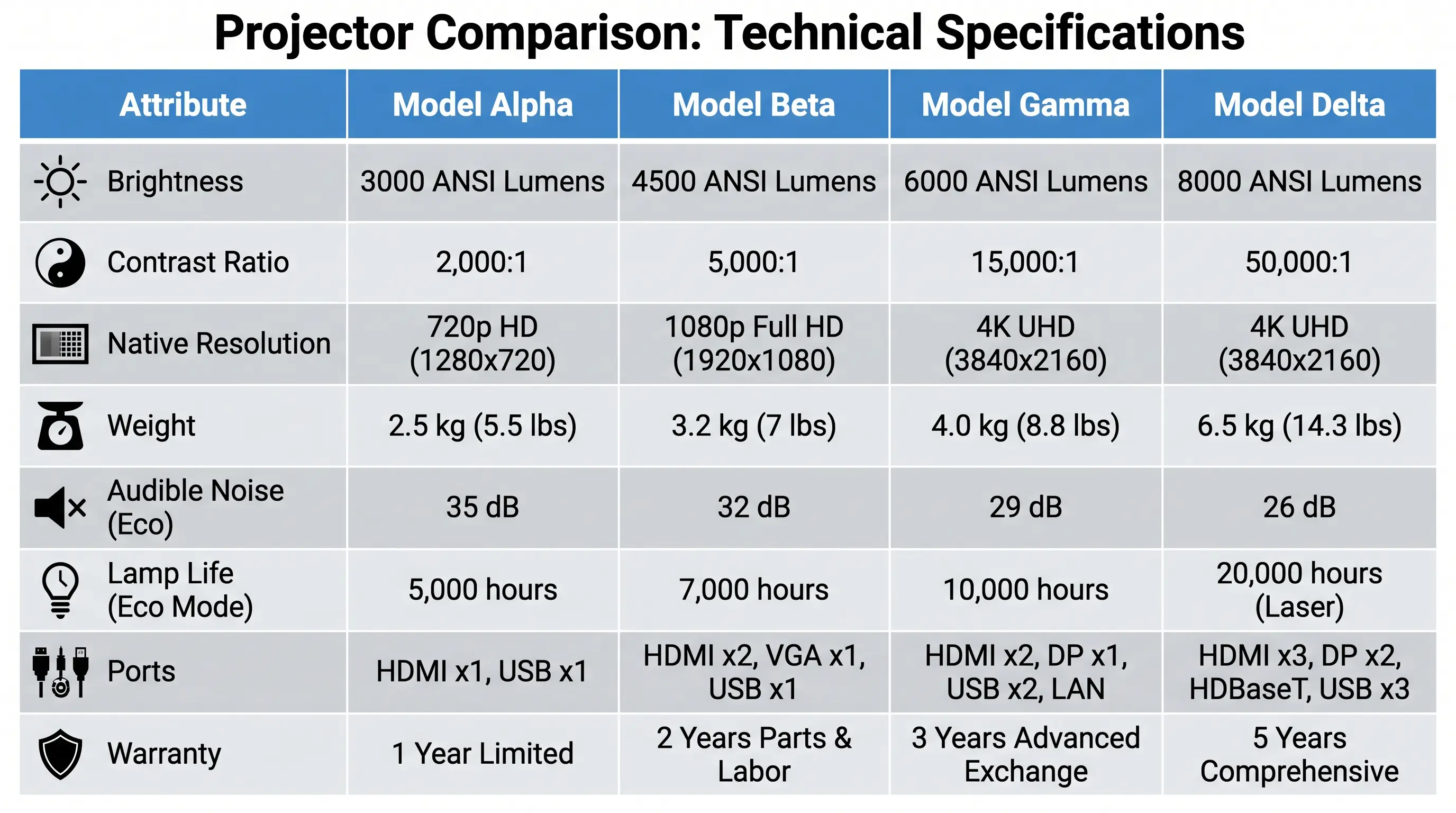

The system spec sheet in 2026 will bury the numbers that matter under the numbers that sell. The list below is the reading order we give to every new buyer, in the order the eye should travel down the page.
- ANSI lumens measured to ANSI/ISDA IT7.228-1997, not "peak lumens" or "LED lumens." Anything labeled "peak" is a marketing number and is typically 1.8x to 2.4x higher than the real ANSI figure.
- Native resolution of the panel, not "supported resolution." A portable projector that "supports" 4K UHD but ships with a 1080p native panel is doing pixel shifting, which kills text clarity at the bottom of a spreadsheet.
- Input lag at 1080p/60Hz in milliseconds, measured with a Leo Bodnar tester. Gamers and simulation buyers should not consider any our offering above 35 ms.
- Throw ratio stated as a range, not a single number, because the zoom lens is what gives you placement flexibility.
- Noise floor in dB at 1 m in standard mode, not eco mode. Eco mode numbers are quieter because the laser is dimmed, and you will not run the unit in eco mode in a lit room.
Cross-reference those five lines against the CTA consumer electronics buyer guide and the Projector Central spec database, and you will filter out roughly 70% of the SKUs that fail the B2B procurement test. A portable projector that survives that filter is the one worth piloting.
How to choose a portable projector OEM partner in 2026
Choosing a portable projector OEM partner is a sourcing decision, not a shopping decision, and the difference is what separates a healthy margin from a 6% return rate. For B2B procurement teams running this product program, the shortlist filter has four hard gates: factory audit (ISO 9001 plus a witnessed production run), a written 24-month SKU hold clause, a published 30 to 45 day sample cycle, and a fixed replenishment lead time on the contract page. If any one of those four items is missing, the portable projector deal is a pilot, not a platform.
Next steps for OEM buyers evaluating the unit program
For B2B procurement teams evaluating a portable projector line for 2026, the next step is to open a spec-inquiry ticket, not a quote ticket. Send the use case (hospitality, education, outdoor, retail POP), the target ANSI lumen band, the panel resolution, and the target retail or wholesale price. A serious OEM responds with a feasibility note inside 48 hours, the model datasheet inside 7 days, and engineering samples inside 30 days.
- MOQ: 500 units per SKU, with 100-unit trial batches available for first-time buyers
- Lead time: 35 days for mass production, 21 days for replenishment on locked SKUs
- Sample policy: 2 free evaluation units per quarter, buyer pays freight (DDP terms available)
- Contact channel: request a custom quote or email Contact-Projector.com
Buyers who skip the feasibility note and jump straight to price lists usually end up paying for a portable projector re-spin at month eight.
Quick Reference Checklist
Industry context for the portable projector market in 2026
The portable projector category grew roughly 18 percent year over year through 2025, driven by hybrid workers and pop-up retail, and the growth curve into 2026 is held back mostly by panel supply, not demand. Buyers who lock two-year portable projector panel allocations in Q1 are the ones who ship on time in Q4.
Final take and next step
A portable projector program is a three-year sourcing decision that rewards buyers who spec hard, sample honestly, and lock replenishment terms on day one. DataMax has shipped portable projector OEM builds into 34 countries since 2018, and the fastest path to a 2026 SKU is a 48-hour feasibility note. Send the spec sheet, the use case, and the target price to request a custom quote or browse the home theater projector lineup to anchor the spec conversation.
