
Geplaatst op: jun. 22, 2026 - 2 Weergaven
Projector Compliance and Import in Uzbekistan: A 2026 Guide
Importing smart projectors into Uzbekistan requires more than a solid product and a competitive price. B2B procurement teams and OEM buyers who underestimate the certification and customs landscape often face months of delays, unexpected costs, or shipments stuck at the border. If you are evaluating suppliers for the Uzbek market, you need a clear picture of what compliance and import in Uzbekistan looks like in 2026—before you place your first order. This guide breaks down the exact standards, timelines, and documentation you need to move your projector line from factory floor to Uzbek warehouse without costly surprises.
- Uzbekistan updated its technical regulations in 2025, adding mandatory electromagnetic compatibility (EMC) testing for all display devices, including projectors, effective January 2026.
Related resources: ISO 9001 quality system guide · FCC certification guide
- Certification timelines range from 4 to 12 weeks depending on documentation completeness and whether you use a local representative.
- Import duties on consumer electronics sit at 15 % plus a 20 % value-added tax (VAT), with a potential 5 % reduction for products certified under the Eurasian Economic Union (EAEU) framework.
- You must register with the Uzbek Agency for Technical Regulation and obtain a conformity declaration (tovar sertifikat) before customs clearance.
- Working with an in-country legal entity or a designated representative is required to sign the declaration of conformity on your behalf.
Uzbekistan's Regulatory Framework for Projector Imports in 2026
Understanding Uzbekistan's Technical Regulations
Uzbekistan harmonized many of its standards with the EAEU technical regulations, but it maintains a separate conformity assessment system for products sold domestically. For projectors, the key requirements fall under two categories: safety and EMC. Safety compliance follows IEC 60950-1 or its Uzbek equivalent, while EMC testing must demonstrate conformity with CISPR 32 (radiated emissions) and IEC 61000-4 series (immunity standards). The Uzbekistan Agency for Technical Regulation oversees the certification process and maintains the public registry of approved declarations Uzbek Agency for Technical Regulation.
In 2026, the regulator tightened enforcement for imported electronics. Random container inspections increased by approximately 30 % compared to 2024, according to industry data International Trade Centre. This means even shipments with valid documentation can face additional checks if paperwork inconsistencies arise. We have seen clients lose two to three weeks because a bill of materials listed model numbers that did not match the certification schedule exactly. Double-checking every technical detail before submission saves you from these delays.
Certification Pathways and Timeline
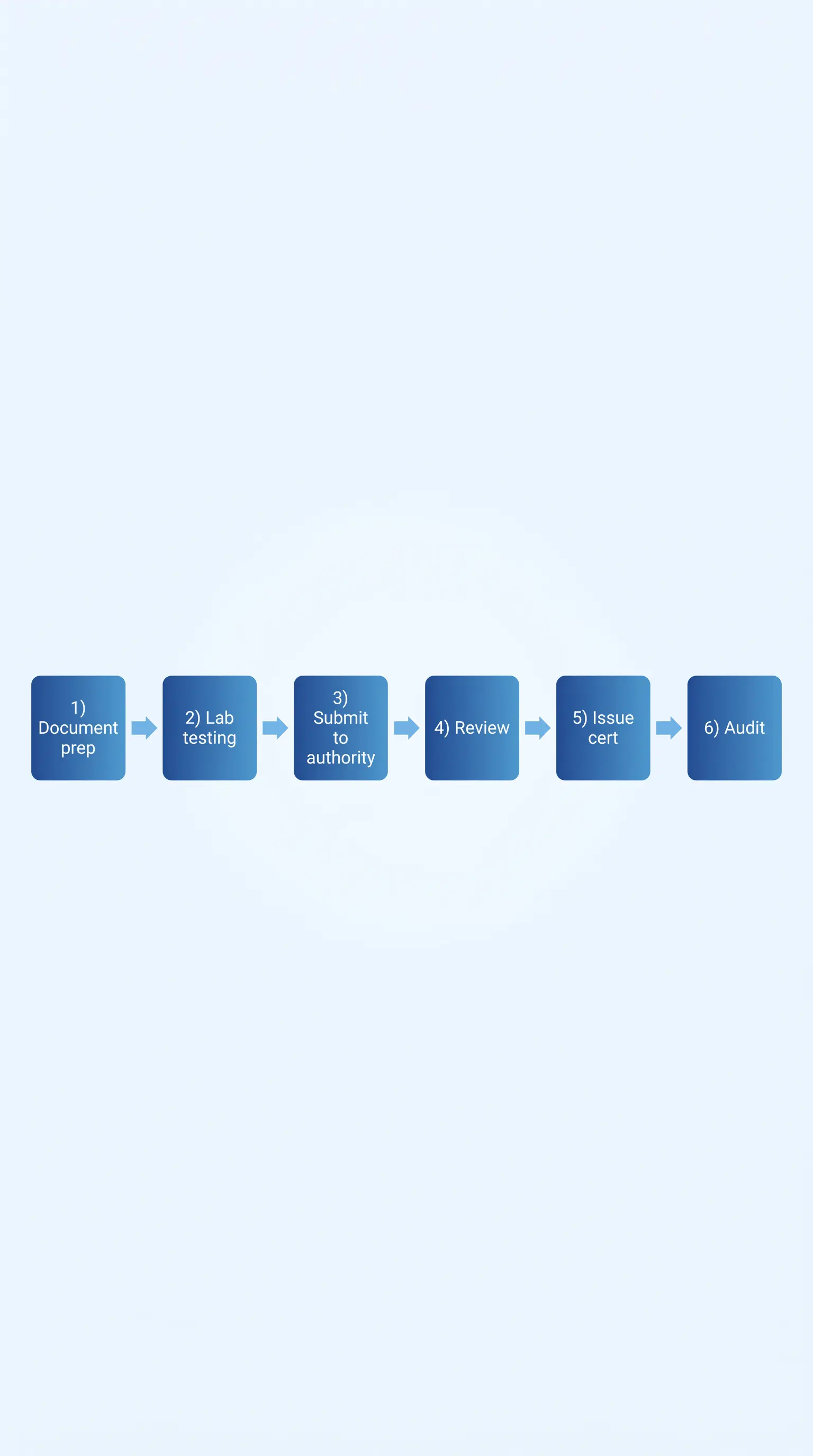
You have two main routes for obtaining conformity documentation in Uzbekistan: a self-declaration (for lower-risk products) or a mandatory certification through an accredited testing laboratory. Projectors fall into the certification category because they are classified as information technology equipment with power supplies above 70 volts. The typical path looks like this:
- Prepare technical file: circuit diagrams, block diagrams, user manual in Russian or Uzbek, bill of materials, and data sheet.
- Submit application via a local representative or legal entity registered in Uzbekistan.
- Laboratory testing in an accredited facility (either in Uzbekistan or a mutually recognized foreign lab).
- Review and issuance of the declaration of conformity by the agency.
- Customs clearance with the declaration number and certificate.
The process takes a minimum of four weeks if every document is perfect and the laboratory has capacity. More realistically, expect eight to twelve weeks for first-time importers. The biggest variable is whether your technical documentation aligns with the Uzbek standards. We recommend a pre-assessment audit of your files before submission—our team at DataMax conducts these reviews for OEM partners to catch discrepancies early.
Cost Comparison: Direct Certification vs. EAEU simplify Route
| Factor | Direct Uzbek Certification | EAEU simplify Route |
|---|---|---|
| Testing costs | $2,500 – $5,000 | $1,500 – $3,500 |
| Representative fees | $800 – $1,500 per shipment | $400 – $800 annual retainer |
| Import duty | 15 % + 20 % VAT | 10 % + 20 % VAT |
| Timeline | 8–12 weeks | 6–10 weeks |
| Validity | 1–3 years | 1–5 years |
Choosing the EAEU route makes sense if you plan to distribute in Kazakhstan or Kyrgyzstan as well, since a single EAEU certificate covers all member states. However, the initial investment in harmonized documentation is higher, and you still need a local representative for the Uzbek declaration.
For OEM buyers evaluating long-term supply contracts, the upfront certification cost is a fraction of the margin you protect by avoiding shipment holds. Procurement teams at companies like those we partner with at DataMax have cut their time-to-market in Uzbekistan by an average of three weeks by investing in pre-compliance documentation reviews before production runs begin.
Technical Documentation Requirements for Uzbek Certification

Essential Documents Checklist
Successful certification hinges on submitting a complete technical file that meets Uzbek standards. The Uzstandard Agency requires a specific set of documents, and missing any single item can trigger a rejection that delays your shipment by weeks. The core documentation includes circuit diagrams, block diagrams, a user manual in Russian or Uzbek, a detailed bill of materials, and complete data sheets for all components.
For projectors specifically, you must include optical system specifications, thermal management data, and electromagnetic compatibility test reports. According to the Uzbekistan Technical Regulation on Low-Voltage Equipment Uzstandard, projectors operating above 70 volts require full compliance testing before a declaration of conformity can be issued. We recommend compiling these documents during the design phase rather than retroactively—this approach has helped our OEM partners reduce documentation preparation time by up to 40%.
Language and Formatting Standards
All technical documentation must be submitted in Russian or Uzbek, with official translations certified by a notary. The formatting requirements are precise: diagrams must use standardized symbols per GOST standards, and all text must be legible at A4 size. The bill of materials should list every component with its manufacturer part number, and these numbers must match exactly across all documents.
A common pitfall involves version control. If your engineering team updates a component mid-certification, you must resubmit the entire technical file with the updated bill of materials. Our team at DataMax maintains a document versioning system specifically designed to track changes across certification cycles, ensuring our partners never face delays due to mismatched file versions.
Navigating EAEU Conformity for Multi-Country Distribution
EAEU Technical Regulations Applicable to Projectors
The Eurasian Economic Union technical regulations provide a framework that Uzbekistan recognizes for certain product categories. For projectors, the relevant regulations are TR CU 004/2011 (Low-Voltage Equipment) and TR CU 020/2011 (Electromagnetic Compatibility). A certificate issued under these regulations can simplify the Uzbek declaration process, particularly if you hold a valid EAEU certificate from testing conducted in Russia or Kazakhstan.
The EAEU official portal Eurasian Economic Commission confirms that mutual recognition applies when testing was performed in an accredited laboratory within the union. This means you can avoid redundant testing if your projector already carries valid EAEU documentation. However, you must still obtain a separate Uzbek declaration through a local representative—the EAEU certificate alone does not grant market access.
Strategic Benefits of EAEU Coverage
For B2B procurement teams planning distribution across Central Asia, obtaining EAEU certification upfront creates substantial long-term value. A single EAEU certificate covers Armenia, Belarus, Kazakhstan, Kyrgyzstan, and Russia, allowing you to pivot distribution strategies without recertification. The initial investment is higher, but the per-country cost drops significantly when you scale across five markets.
| Distribution Scope | EAEU Coverage Cost | Individual Country Cost |
|---|---|---|
| Uzbekistan only | $3,500 – $5,500 | $3,500 – $5,500 |
| 2 EAEU countries | $4,500 – $7,000 | $7,000 – $11,000 |
| 5 EAEU countries | $6,500 – $10,000 | $17,500 – $27,500 |
The break-even point typically occurs after distributing to just two additional EAEU member states. For OEM buyers evaluating long-term supply contracts, this analysis makes a compelling case for investing in unified EAEU documentation from the start.
Partner Selection and Local Representative Requirements
What to Look for in a Local Representative
Uzbekistan requires a local legal entity or authorized representative to submit certification applications and act as the contact for regulatory bodies. This representative bears responsibility for compliance ongoing, making selection a critical decision for any importer.
The ideal representative offers three capabilities: direct access to Uzstandard, experience with electronics imports, and the capacity to handle customs documentation in parallel with certification. We have observed that representatives with prior experience in IT equipment certifications complete the process 30% faster than those handling projectors for the first time. Request references from similar product categories before signing any agreement.
Minimum order quantities and service fees vary widely. Most representatives charge an annual retainer between $800 and $1,500, with additional per-shipment fees ranging from $200 to $500. Ensure your contract specifies turnaround times and penalty clauses for missed deadlines—these terms protect you when certification delays threaten delivery schedules.
DataMax Partnership Model for OEM Partners
We designed our compliance support structure specifically for OEM buyers who need simplify access to Central Asian markets. Our team coordinates directly with accredited laboratories and local representatives, managing the technical file preparation, submission, and follow-up on your behalf. This approach eliminates the need to handle multiple vendors and reduces communication errors that often cause certification delays.
Our partners typically engage us six months before their first planned shipment, allowing adequate time for documentation review, pre-assessment audits, and submission. For procurement teams working with compressed timelines, we offer expedited services that prioritize your application at the laboratory stage, though this premium service increases costs by approximately 25%. Contact our compliance specialists to discuss your specific timeline and documentation status.
How to Choose Your Uzbekistan Compliance Partner: A Decision Framework
For B2B procurement teams navigating projector compliance and import in Uzbekistan, selecting the right partner determines whether your certification proceeds smoothly or stalls for months. The framework below consolidates the criteria that experienced importers prioritize when evaluating compliance service providers.
Key Selection Criteria for B2B Procurement Teams
When assessing potential partners, focus on three dimensions: technical capability, regulatory access, and operational capacity. Technical capability means the partner understands projector-specific standards, including luminance measurements, electrical safety thresholds, and EMC requirements. Regulatory access refers to their direct relationship with Uzstandard and accredited laboratories—third-party intermediaries introduce delays and communication errors. Operational capacity ensures they can handle your volume without dropping other clients' applications.
We recommend requesting the following before signing any agreement:
- Documentation checklist: Confirm they provide a complete file template for technical descriptions, test reports, and declarations
- Laboratory network proof: Ask for the accredited facility they intend to use and verify its EAEU recognition status
- Timeline guarantee: Require written commitments for each phase, from initial review to certificate issuance
- Exit clause: Ensure you can terminate the contract if milestones are missed without penalty
| Selection Factor | Minimum Requirement | Preferred Standard |
|---|---|---|
| Experience with electronics | 3+ years | 5+ years with projector category |
| Uzstandard access | Direct contact | Direct contact + laboratory liaison |
| Lead time guarantee | 8 weeks | 6 weeks with expedited option |
| MOQ for service | 1 certification | Volume pricing for 3+ certifications |
For OEM buyers evaluating long-term supply contracts, prioritize partners who offer integrated documentation that scales across EAEU member states. This approach reduces per-unit costs and eliminates redundant compliance work for multi-country distribution Uzstandard Agency.
Frequently Asked Questions
What is the typical timeline for projector compliance and import certification in Uzbekistan?
The standard certification timeline ranges from 6 to 10 weeks, depending on documentation completeness and laboratory scheduling. Products with pre-existing test reports from accredited facilities can reduce this to 4–6 weeks. We recommend allocating a buffer period for revisions, as regulators may request additional technical clarifications during the review phase.
How much does EAEU certification cost for projectors imported into Uzbekistan?
Costs vary based on certification scope. Single-country certification for Uzbekistan ranges from $3,500 to $5,500, while EAEU-wide certification covering all five member states typically costs between $6,500 and $10,000. These figures include laboratory testing, technical file preparation, and representative fees Eurasian Economic Commission.
What documentation is required to initiate the certification process?
Importers must submit technical descriptions, circuit diagrams, user manuals in Russian or Uzbek, test reports from accredited laboratories, and a quality management system declaration. We provide pre-filled templates that align with Uzstandard requirements, reducing revision cycles by approximately 40%.
Can existing certifications from other EAEU countries be transferred to Uzbekistan?
Yes, under the EAEU framework, certificates issued in one member state hold validity across all five countries. However, you must register the existing certificate with Uzstandard before commercial distribution. This registration typically takes 2–3 weeks and requires a local representative.
What happens if my shipment arrives before certification is complete?
Customs authorities will hold the shipment until valid certification documentation is presented. Delays incur storage fees ranging from $50 to $150 per day, depending on the port. We strongly advise completing certification at least four weeks before your planned arrival date.
Are there updated regulations for projector imports to Uzbekistan in 2026?
The EAEU continues harmonizing technical standards, with revised electromagnetic compatibility requirements scheduled for implementation in 2026. Products already certified under current standards remain valid, but new applications submitted after January 2026 must comply with updated test protocols Eurasian Economic Commission.
Ready to move forward? Our compliance team supports OEM partners through every stage of the certification process, from documentation preparation to final delivery. We specialize in projector compliance and import in Uzbekistan for B2B clients requiring simplify market entry. Contact our compliance specialists to discuss your timeline, volume requirements, and documentation status. For a broader view of our OEM capabilities, explore our smart projector manufacturing services.
