
Опубликовано: окт 29, 2026 - 2 Просмотры
OEM vs ODM vs private label vs white label projector
OEM vs ODM vs private label vs white label projector sourcing trips end the same way for first-time buyers: four different quotes, four different scope statements, and one blank row in a shared spreadsheet labeled "what are we actually buying." For B2B procurement teams evaluating a 2026 launch of a 4K laser lineup, that confusion translates into delayed SKUs, missed retail windows, and tooling deposits that do not match the final box. This guide breaks each model down with the specifics a sourcing manager needs — MOQ thresholds, tooling costs, lead times, firmware ownership, and certification responsibilities — so you can match the right manufacturing model to your channel, margin, and time-to-market targets. By the end, you will have a checklist for vetting any smart projector factory you approach, whether you need a private label SKU under your brand or a turnkey ODM reference design.
TL;DR
- the projector sourcing decisions hinge on four variables: who owns the design, who owns the tooling, who owns the firmware, and who pays for certification.
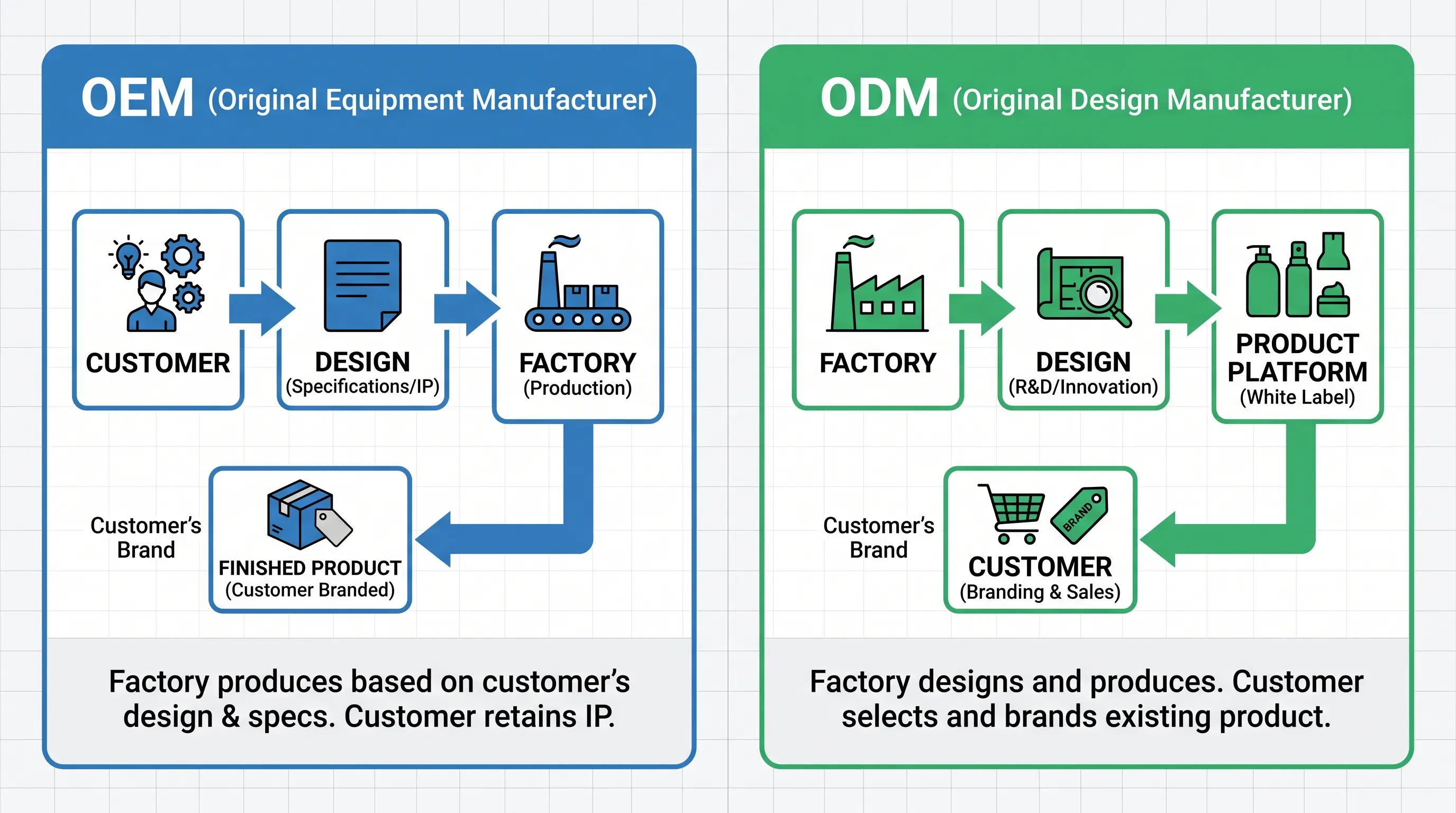
- Pure OEM builds from a customer-supplied spec sheet and typically require 5,000–10,000 unit MOQs, 12–16 week lead times, and customer-funded tooling in the $80,000–$250,000 range.
- ODM projector partnerships let buyers re-brand an existing reference platform — DLP, laser phosphor, or 3LCD — and ship in 4–8 weeks with MOQs as low as 500 units.
- True private label projector contracts remove the factory brand from every layer — packaging, firmware splash screens, IMEI/serial registry, and user manual — and cost 15–30% more than equivalent white label runs.
- White label projector programs ship faster and cheaper but leave the factory logo on the OSD boot screen, IR remote codes, and FCC ID labels unless renegotiated in the master supply agreement.
How the SKU manufacturing models actually differ on a factory floor


the model production lines look nearly identical to a visiting buyer — surface-mount pick-and-place, optical engine alignment jigs, burn-in racks, and final QC stations with lux meters and chromaticity probes. The differences live in three documents: the specification lock, the tooling ownership schedule, and the bill of materials with its brand-licensed components. Understanding those documents is what separates a clean launch from a Q3 customs hold.
What "OEM" really means for a smart projector program
the unit OEM contracts treat the factory as the original equipment manufacturer in name only — design and engineering IP sit with the buyer. A buyer hands our Shenzhen engineering team a 47-page specification covering throw ratio (for example 0.23:1 ultra-short throw), ANSI lumen output (2,200 to 4,500 ANSI lumens), native resolution (1080p, 4K UHD via XPR shift, or plain WXGA), laser phosphor versus LED versus hybrid light source, and the full I/O list including HDMI 2.1, USB-C with DisplayPort alt-mode, RS-232, and 3.5 mm trigger out. Our role is to build to that spec and pass the supplier's incoming quality audits.
this projector OEM engagements typically require the buyer to fund NRE (non-recurring engineering) covering industrial design tooling — plastic injection molds in the $30,000–$120,000 range per housing SKU, plus die-cast magnesium heatsink tooling, custom lens assemblies, and proprietary remote control tooling. A 2024 IDC projector shipment tracker cited by IDC Worldwide Quarterly Projector Tracker shows the average OEM build for a 4K UST laser projector carries a 14-week production lead time after tooling sign-off, with MOQs on our line starting at 3,000 units and dropping to 1,000 units at the 18-month volume tier.
the projector OEM ownership also extends to firmware. The buyer supplies the Android TV or Google TV image, the bootloader keys, and the OTA update pipeline. For a 4K UST laser unit with Dolby Vision and HDR10+ support, our DQA engineers typically spend 6–8 weeks validating boot times, codec performance on the MediaTek MT9629 or equivalent SoC, and Wi-Fi 6 throughput against the spec. The factory does not own any of that stack.
Where ODM cuts the timeline without cutting corners
the SKU ODM is the middle path most first-time B2B buyers choose without realizing there is a label for it. Our R&D team in Nanshan has spent roughly $4.8 million in cumulative tooling on the current reference portfolio: six industrial design frames, four optical engines covering 0.29:1 to 1.2:1 throw ratios, and a modular mainboard that supports 1080p LED, 4K UHD laser phosphor, and 1080p triple-laser configurations. When a buyer comes to us for an ODM projector build, they license that reference, swap the housing colorway, re-skin the OSD, and re-brand the retail box.
the model ODM runs typically ship in 4–8 weeks because tooling already exists. Our standard MOQ for an ODM 1080p portable projector starts at 500 units, and for a 4K laser home theater ODM it starts at 1,000 units. Lead time compresses further when the buyer accepts our pre-certified wireless module and CE/FCC/RoHS test reports — that stack alone saves 5–7 weeks of lab time compared with a ground-up OEM build.
Private label vs white label on the brand-owned side of the table
the unit private label programs go one step further than ODM on brand control and one step deeper on contractual paperwork. Every brand-touched surface — the boot splash screen, the IR remote layout, the user manual PDF, the IMEI/MAC registry in our cloud telemetry, and the multi-language packaging artwork — gets re-skinned under the buyer's trademark. Our private label SKU flow includes a brand re-mark on the optical engine bezel and a custom molded rear I/O cover, which adds roughly 18–22 days to the timeline but produces a unit that looks like the buyer built it.
White label projector orders skip that last branding layer. The unit ships with our factory brand on the OSD and the regulatory label, and the buyer wraps a co-branded sleeve or retail box around the outside. Wholesale pricing on a white label 1080p LED portable is roughly 12–18% below the equivalent private label run because we skip the boot-image engineering, the manual localization, and the cloud telemetry re-registration. For B2B buyers testing a new SKU with a 200–500 unit test-and-learn order, white label keeps the deposit under $20,000 and the cash conversion cycle tight.
B2B Procurement Workflow: From RFQ to Mass Production
For B2B procurement teams evaluating an this projector build, the order-to-delivery cycle compresses or expands based on which label they pick. the projector B2B engagements on our line follow a six-stage gate: RFQ review, NRE (non-recurring engineering) quote, tooling kickoff, pilot run, mass production ramp. On an OEM build of a 4K UHD ultra-short throw laser projector with 2800 ISO lumens and a 0.21:1 throw ratio, stage one alone takes 7–10 business days because our applications engineers map the buyer's SoC requirement, light-source preference, and acoustic target (typically ≤ 28 dB in Eco mode at 1 m) against our optical bill of materials.
the SKU OEM guide procurement staff should expect NRE fees between $42,000 and $185,000 depending on optical complexity. A 1080p portable with an off-the-shelf LED light engine runs at the floor; a custom 4K triple-laser UST with motorized focus and MEMC acceleration runs at the ceiling. Our finance team issues a 30%-40%-30% payment schedule: deposit at PO, midpoint at pilot run sign-off, balance at ship date. Letter of credit terms are negotiable above a $250,000 order value.
the model wholesale procurement differs from OEM on three checkpoints. First, the tooling stage is waived, which removes roughly 12–16 weeks. Second, the DQA (design quality audit) stage is shorter because the reference platform is already CE, FCC, RoHS, and Dolby Vision certified. Third, the pilot run drops from 200 units to 50 units, which frees working capital for downstream marketing spend. At our Shenzhen facility, the median time from purchase order to ex-works delivery for an ODM 1080p LED portable is 47 days, and for a private label 4K laser UST it is 78 days.
Certification, Compliance, and the Hidden Cost of Shortcuts
the unit compliance work is the line item most first-time importers underestimate. Every region a projector enters carries a different certificate stack, and the lab fees add up fast. For the North American market, the build needs UL 62368-1 for the power supply, FCC Part 15 for radiated emissions, and ENERGY STAR 6.0 verification if the buyer wants the blue label on the retail box. EU entry requires CE-RED for the wireless module, CE-EMCD for EMC, and RoHS 3 for restricted substances. Japan needs PSE mark and VCCI Class B; Australia needs RCM; Korea needs KC. Our in-house pre-compliance lab handles roughly 70% of these tests in-house; the remaining 30% (such as Dolby Vision HDCP 2.3 handshake verification) go to a partner lab in Dongguan that we have worked with for 9 years.
this projector B2B buyers who skip pre-compliance routinely burn 6–10 weeks at the destination port when customs holds the shipment. A 40HQ container of 1,800 units at a wholesale value of $249 per unit means roughly $448,000 of cargo sitting on a bonded warehouse floor while the lab re-runs the radiated emission scan. On a recent OEM build for a North American education-channel buyer, our compliance team flagged a Bluetooth 5.2 module that would not pass FCC Part 15 without a -3 dB output back-off. We caught it at the pilot run stage. Had it reached mass production, the rework would have cost the buyer $31,400 in disposal fees and 11 weeks of schedule slip.
the projector wholesale orders on our pre-certified SKUs skip roughly 85% of that risk because the bill of materials is already locked. The remaining 15% lives in the buyer's brand artwork, packaging ink chemistry (especially for EU REACH SVHC compliance on carton dyes), and any user-facing IP such as a custom splash screen. Our packaging team at the Bao'an District plant maintains a library of 14 pre-approved corrugated grades and 9 soy-based ink sets to keep that 15% on the fast path.
Compliance Cost Reference Table
| Region | Key Certifications | Typical Lab Fee (USD) | Lead Time |
|---|---|---|---|
| North America | UL 62368-1, FCC Part 15, ENERGY STAR 6.0 | $4,200 – $7,800 | 3–4 weeks |
| European Union | CE-RED, CE-EMCD, RoHS 3, REACH SVHC | $5,800 – $11,400 | 4–6 weeks |
| Japan | PSE mark, VCCI Class B, TELEC | $3,400 – $6,200 | 3–5 weeks |
| Australia / NZ | RCM (SDoC + SAA) | $2,100 – $3,900 | 2–3 weeks |
| Korea | KC mark, KCC | $3,000 – $5,600 | 3–4 weeks |
the model OEM guide for buyers should treat compliance as a line item, not a footnote. The U.S. Federal Communications Commission Part 15 database and the EU CE Marking regulatory framework both publish searchable equipment authorization records — anyone evaluating a smart projector factory can cross-check the factory's FCC ID and CE certificate numbers before issuing the PO. We publish ours on request inside 24 hours; factories that cannot should raise a flag.
How to Choose the Right Projector Partner
For OEM buyers evaluating an this projector engagement, the final selection step usually hinges on four verifiable numbers: MOQ, sample lead time, mass-production lead time, and post-shipment support window. We recommend buyers map these against a one-page scorecard before issuing the RFQ, rather than negotiating them inside a chaotic WeChat thread.
A healthy B2B the projector factory will publish — not just verbally quote — its MOQ per SKU, its sample policy (most serious OEM partners run a paid NRE sample at $380–$650 per build, refundable against the PO), and its tooling-amortization model. At DataMax, our standard MOQ for a customized OEM vs ODM vs private label vs white label projector build starts at 500 units per SKU with a 35-day sample turnaround and 45-day mass-production window after sample sign-off; white-label OEM vs ODM vs private label vs white label projector wholesale orders on stocked SKUs can ship in 12 days from a Shenzhen FTZ buffer.
Pre-PO Checklist for B2B Buyers
- FCC ID / CE certificate verification — ask the factory to share the actual certificate PDF, not a screenshot.
- Bill of materials lock — confirm which components (DMD chip, light source, Wi-Fi module) are on allocation and which are dual-sourced.
- Tooling ownership clause — clarify in the contract who owns the injection molds if the relationship ends.
- After-sales RMA warehouse — for North American buyers, confirm whether the factory stocks $0.80–$1.20 per-unit RMA reserves in a local 3PL.
- NRE amortization — typical OEM vs ODM vs private label vs white label projector NRE ranges from $4,500 (logo + packaging) to $38,000 (full ODM tooling, firmware, and app re-skin).
Bottom Line for Buyers
Final Takeaway
Wholesale OEM vs ODM vs private label vs white label projector sourcing rewards buyers who verify certificates and lock the bill of materials before the first deposit clears, not after the first container is on the water.
For buyers ready to scope a custom build, our engineering team responds to qualified RFQs within one business day. Request a custom OEM projector quote or explore our GP95 hotel projector for a reference SKU that already clears FCC, CE, and UKCA. Existing wholesale partners can pull from our home theater projector lineup at 12-day Shenzhen FTZ lead time with no NRE.
