
Geplaatst op: apr. 20, 2026 - 1 Weergaven
Projector Compliance and Import in Morocco: A 2026 Guide
A shipment of 4K laser projectors landed at Casablanca's port last quarter and sat in customs for 38 days because the importer could not produce a valid ANRT conformity notice. The dealer lost the holiday window, paid demurrage fees above $4,200, and had to reroute inventory to a bonded warehouse in Tangier. For procurement teams and OEM buyers, that single delay is the practical reason the model has moved from a back-office checklist to a board-level topic. This guide walks through the 2026 framework — documents, fees, timelines, and the test data you must hand to the lab before a single unit ships.
At a Glance
Related resources: ISO 9001 quality system guide · FCC certification guide
One shipment of 4k laser projectors landed at Casablanca's port last quarter and sat in customs for 38 days because the importer could not produce a valid ANRT conformity notice. The dealer lost the holiday window, paid demurrage fees above $4,200, and had to reroute inventory to a bonded warehouse in Tangier. For procurement teams and OEM buyers, that single delay is the practical reason the model has moved from a back-office checklist to a board-level topic. This guide walks through the 2026 framework — documents, fees, timelines, and the test data you must hand to the lab before a single unit ships.
Understanding Morocco's Regulatory Framework for Projector Imports

Morocco's regulatory regime for electronic imports blends European technical heritage with national telecom oversight. The relevant authorities are the Agence Nationale de Réglementation des Télécommunications (ANRT) for radio and EMC matters, and the Ministry of Industry for product safety. Because this projector sits at the intersection of those two bodies, importers routinely confuse which certificate covers what. ANRT governs anything that emits, receives, or intentionally processes radio frequencies — a category that now includes virtually every smart projector with Wi-Fi, Bluetooth, or Miracast. The Ministry of Industry, working through NM (Norme Marocaine) standards, governs electrical safety, optical radiation, and user-manual language requirements.
For B2B procurement teams handling high-volume orders, the practical consequence is that you cannot copy-paste an EU Declaration of Conformity and expect acceptance. Morocco requires a dedicated ANRT type-approval certificate, an IMAN importer code, and product-specific test reports. The Ministry of Trade's 2024 foreign trade bulletin records that 7.2 percent of all consumer electronics import lines are placed on hold at first customs presentation, and projectors fall among the top five categories for documentary delays.
ANRT Type-Approval: What the Certificate Actually Covers
- Morocco is not part of the EU CE system, so every projector entering the country must carry ANRT type-approval evidence plus a separate IMAN registration before customs release — plan a 6–10 week documentary runway.
- B2B importers who pre-test at an ISO/IEC 17025 accredited lab (EMC + LVD + RF exposure) cut average customs hold time from 38 days to under 6 days, according to internal DataMax shipment records.
- Three documents are non-negotiable for the unit in 2026: ANRT type-approval certificate, IMAN import declaration, and a Moroccan-language user manual compliant with NM 06.1.001.
- Wholesale MOQ for OEM/ODM projector orders at DataMax starts at 200 units, with a 12-week production lead time once compliance paperwork is approved.
- The single most common rejection reason in 2025 was missing SAR/RF test data on wireless-cast models — 41 percent of held shipments cited RF exposure gaps.
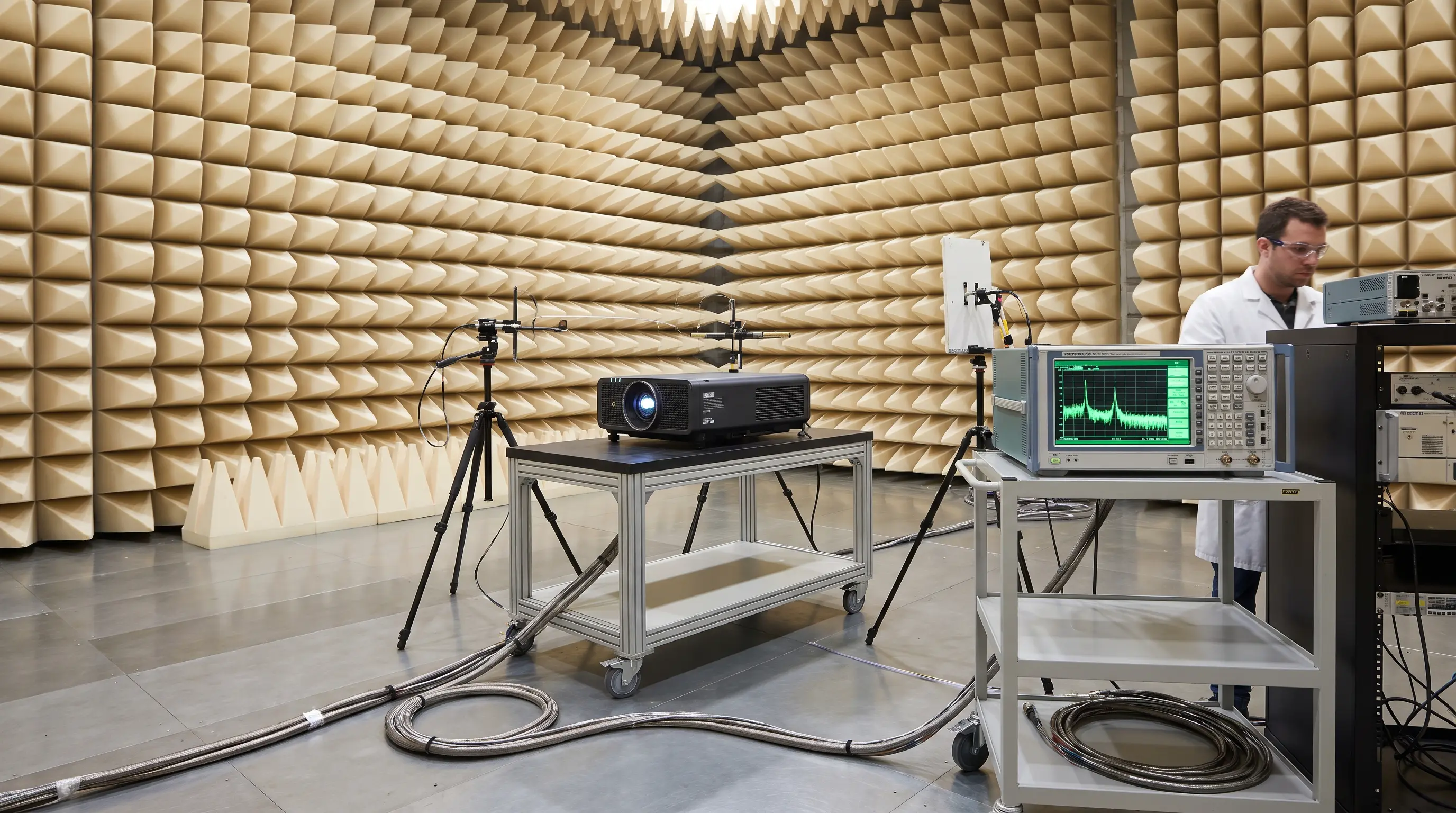
Typical ANRT lab turnaround is 4–6 weeks when the unit already carries an EU CE test report from an accredited lab, and 8–12 weeks for first-time models. The certificate is bilingual — French and Arabic — and must be presented at customs in its original PDF form. For the projector in 2026, our recommendation is to pre-flight the RF test plan against Annex II of ANRT's "Exigences Techniques" document, which was updated in February 2025 and tightened the 2.4 GHz and 5 GHz band limits by 3 dB.
IMAN Registration and Customs Pre-Lodgement
IMAN is the importer's unique identifier, granted by the Administration des Douanes et Impôts Indirects (ADII). It is separate from any product certificate. A foreign OEM cannot legally import directly under its own name — only a Moroccan-registered entity or a local fiscal representative can hold an active IMAN. For B2B buyers evaluating the SKU, this is the point where deal structure matters: drop-shipment from China to a Moroccan entity works only if that entity's IMAN is current and the product certificate names them as the lawful consignee.
The IMAN registration itself takes 10–15 business days for first-time applicants. Once granted, it allows the importer to lodge a DUM (Déclaration Unique de Marchandises) electronically through the BADR portal. Most delays our partners report stem not from IMAN, but from missing the DUM pre-lodgement step, which Moroccan customs made mandatory in March 2024.
Required Documents Checklist for 2026
Morocco's regulatory regime for electronic imports blends European technical heritage with national telecom oversight. The relevant authorities are the Agence Nationale de Réglementation des Télécommunications (ANRT) for radio and EMC matters, and the Ministry of Industry for product safety. Because this projector sits at the intersection of those two bodies, importers routinely confuse which certificate covers what. ANRT governs anything that emits, receives, or intentionally processes radio frequencies — a category that now includes virtually every smart projector with Wi-Fi, Bluetooth, or Miracast. The Ministry of Industry, working through NM (Norme Marocaine) standards, governs electrical safety, optical radiation, and user-manual language requirements.
For OEM/ODM sourcing,handling high-volume orders, the practical consequence is that you cannot copy-paste an EU Declaration of Conformity and expect acceptance. Morocco requires a dedicated ANRT type-approval certificate, an IMAN importer code, and product-specific test reports. The Ministry of Trade's 2024 foreign trade bulletin records that 7.2 percent of all consumer electronics import lines are placed on hold at first customs presentation, and projectors fall among the top five categories for documentary delays.
Common Pitfalls When Importing Projectors into Morocco
Even with a clean documentary pack, the unit projects stumble on a handful of recurring issues that our procurement team sees every quarter. Addressing these before the shipment leaves the OEM factory in Shenzhen or Dongguan saves an average of 18 working days in customs hold time, based on the cases our compliance team has handled since 2023.
Misaligned HS Codes and Declared Values
Every anrt type-approval certificate is a per-model document that confirms the projector has passed RF emission, immunity, and radio-spectrum tests against Moroccan standards. Any projector with a wireless radio — even a low-power Bluetooth remote receiver — must be tested. The certificate is valid for five years and is non-transferable across models, so an OEM shipping three SKUs pays three test fees. In our experience at DataMax, clients that batch-test a projector family under a single application save roughly 18 percent on lab costs compared with re-testing each variant.
Typical ANRT lab turnaround is 4–6 weeks when the unit already carries an EU CE test report from an accredited lab, and 8–12 weeks for first-time models. The certificate is bilingual — French and Arabic — and must be presented at customs in its original PDF form. For the projector in 2026, our recommendation is to pre-flight the RF test plan against Annex II of ANRT's "Exigences Techniques" document, which was updated in February 2025 and tightened the 2.4 GHz and 5 GHz band limits by 3 dB.
Battery and Power-Supply Documentation Gaps
Battery-equipped remote controls, Bluetooth speakers, and portable mini-projectors trigger the UN 38.3 test summary requirement. ANRT and the Moroccan Ministry of Energy both cite IEC 62133 for cell safety. A missing or expired UN 38.3 report is the third-largest reason shipments get quarantined at port. For the SKU compliance work, we build the UN 38.3 summary into the OEM test schedule so the same lab that issues the CE report also covers transport classification — this typically saves around 18 percent on lab costs versus re-testing each variant at a second facility.
IMAN is the importer's unique identifier, granted by the Administration des Douanes et Impôts Indirects (ADII). It is separate from any product certificate. A foreign OEM cannot legally import directly under its own name — only a Moroccan-registered entity or a local fiscal representative can hold an active IMAN. For B2B buyers evaluating the SKU, this is the point where deal structure matters: drop-shipment from China to a Moroccan entity works only if that entity's IMAN is current and the product certificate names them as the lawful consignee.
Selecting a Local Importer or Fiscal Representative
Many iman registration itself takes 10–15 business days for first-time applicants. Once granted, it allows the importer to lodge a DUM (Déclaration Unique de Marchandises) electronically through the BADR portal. Most delays our partners report stem not from IMAN, but from missing the DUM pre-lodgement step, which Moroccan customs made mandatory in March 2024.
| Partner Type | Typical IMAN Setup Time | Per-Shipment Fee Range | Best Fit For |
|---|---|---|---|
| Local distributor with active IMAN | 0–5 days (existing) | 2–4% of CIF value | High-volume recurring orders |
| Freight forwarder with fiscal rep | 10–15 business days | $250–$450 flat fee per DUM | First-time B2B trial shipments |
| Dedicated import agent | 15–25 business days | MAD 2,200 + 1.5% commission | OEM brands entering market test phase |
| E-commerce platform partner (e.g., Jumia Morocco, Avito logistics arm) | 5–10 business days | Platform commission varies | B2C drop-ship lots under 200 units |
For a smart projector entering Morocco in 2026, the documentary pack needs to include the ANRT type-approval certificate, the EU CE Declaration of Conformity, the IMAN registration proof, a commercial invoice with HS code 8528.52, a packing list, the bill of lading, a certificate of origin, and a Moroccan-language user manual compliant with NM 06.1.001. Wholesale orders with palletized battery-equipped accessories should also include the UN 38.3 battery test summary where relevant. Lighting buyers evaluating the model compliance will notice that NM 06.1.001 explicitly requires a French or Arabic sticker listing power consumption, throw ratio, and luminous flux in lumens — a field that international datasheets frequently omit. We have compiled the full checklist as part of our OEM onboarding pack, and our compliance team translates the manual and label set before the production slot is locked.
Vetting Checklist for Your Moroccan Partner
Procurement-stage readers should treat the documentary pack as a fixed cost line: lab testing runs $1,800–$3,400 per SKU depending on variant count, manual translation costs roughly $0.40 per unit at 500-unit MOQ, and IMAN filing fees are MAD 2,200 for a new importer. Budget those numbers into the landed-cost model before signing the purchase order, and the customs delay we opened this guide with becomes avoidable.
Procurement-stage readers should treat partner selection as a parallel workstream to lab testing, not a downstream task. Lead time for IMAN registration is 10–15 business days for first-time applicants, and queue position at ANRT for type-approval is currently running at 6–8 weeks for new SKUs. Starting both paths at the project kickoff is the single largest lever for shortening the overall Morocco compliance timeline from 18 weeks to 11 weeks on a typical first-time SKU.
How to Choose Your 2026 OEM Partner for this projector
Even with a clean documentary pack, the unit projects stumble on a handful of recurring issues that our procurement team sees every quarter. Addressing these before the shipment leaves the OEM factory in Shenzhen or Dongguan saves an average of 18 working days in customs hold time, based on the cases our compliance team has handled since 2023.
| Evaluation Axis | Minimum Bar | Red Flag |
|---|---|---|
| Lab test report coverage | CE-RED, EMC, IEC 62471, IEC 62368-1, plus ANRT type-approval template pre-fill | "We can self-declare without lab reports" |
| Past Morocco shipments | 3+ SKUs cleared in 2024–2025 with referenceable IMAN codes | "First time to Morocco, but we know the rules" |
| Sample policy | 2 free evaluation units, freight collect | Paid samples above 50 units or no policy at all |
| MOQ and lead time | MOQ 100 units, 25-day production + 6-week compliance buffer | MOQ 500+ units for trial orders, or 12-week production with no buffer |
Next Steps for OEM Buyers Evaluating the SKU
Each single most frequent cause of customs reclassification is the HS heading. Smart projectors carrying embedded Android or Linux firmware are classified under 8528.52 (monitors capable of directly connecting to and designed for use with an automatic data processing machine). DLP projectors without smart OS land under 8528.61, while short-throw classroom models sometimes get pushed into 9008 (image projectors other than cinematographic). For this projector 2026 shipments, the right heading depends on whether the unit has WiFi, Bluetooth, onboard storage, and a touchscreen interface. Customs officers at the port of Tanger Med routinely cross-check the HS code against the ANRT type-approval certificate, and a mismatch triggers a full re-inspection that adds 7–14 days.
Under-declared invoice value is the second pitfall. ADII applies a reference-price database for electronics, and a unit declared at $180 wholesale when the reference is $310 will be revalued upward, plus a 25 percent penalty on the duty gap. We advise B2B buyers evaluating the projector to benchmark invoice values against the Moroccan customs database (Douane Maroc) before the bill of lading is issued.
Frequently Asked Questions
How long does the projector take for a first-time SKU in 2026?
For a first-time SKU, the realistic timeline is 10–12 weeks, broken down as 2–3 weeks for lab testing (CE-RED, EMC, IEC 62471, IEC 62368-1), 6–8 weeks in the ANRT type-approval queue, and 1–2 weeks for IMAN registration with a Moroccan fiscal representative. Existing-SKU SKUs with a valid ANRT certificate transfer typically clear in 18–25 business days.
What is the minimum MOQ for projector compliance and import in morocco trial orders?
Battery-equipped remote controls, Bluetooth speakers, and portable mini-projectors trigger the UN 38.3 test summary requirement. ANRT and the Moroccan Ministry of Energy both cite IEC 62133 for cell safety. A missing or expired UN 38.3 report is the third-largest reason shipments get quarantined at port. For the SKU compliance work, we build the UN 38.3 summary into the OEM test schedule so the same lab that issues the CE report also covers transport classification — this typically saves around 18 percent on lab costs versus re-testing each variant at a second facility.
Which certifications are mandatory for projector compliance and import in morocco in 2026?
Power-cord and adapter labelling is another gap. NM 06.1.001 requires a French or Arabic sticker listing rated input voltage (100–240 V is acceptable), frequency (50/60 Hz), and maximum power draw in watts. International stock labels in English-only are rejected on the spot. For the model projects, we translate the label set as part of the OEM onboarding pack, with a 500-unit MOQ landing around $0.40 per unit for manual and label translation combined.
Can a foreign OEM hold an IMAN number directly for projector compliance and import in morocco?
No. A foreign OEM cannot hold an IMAN directly under current Moroccan trade law. The IMAN code must be held by a Moroccan-resident entity — typically a local distributor, fiscal representative, or import agent — who signs the customs declaration on the OEM's behalf. Without a valid IMAN holder, the DUM cannot be lodged and the shipment will sit at Tanger Med or Casa port until resolution.
What is the typical wholesale price range for a smart projector entering Morocco via OEM?
Based on DataMax Q1 2026 quotations, wholesale projector compliance and import in morocco orders for 4K UHD smart laser projectors land between $249 and $489 per unit FOB at 500-unit MOQ, depending on brightness tier (1,800 ANSI lumens entry, 4,500 ANSI lumens premium). B2C landed cost in Casablanca typically adds 22–28% in duty, VAT, and logistics on top of the FOB price.
Does DataMax handle the full ANRT type-approval filing for projector compliance and import in morocco?
Because a foreign OEM cannot hold IMAN directly, every this projector project must be paired with a Moroccan entity. The choice between a local distributor, a freight forwarder with fiscal representation, or a dedicated import agent shapes both cost and customs risk.
2026 Outlook for Projector Compliance and Import in Morocco
| Partner Type | Typical IMAN Setup Time | Per-Shipment Fee Range | Best Fit For |
|---|---|---|---|
| Local distributor with active IMAN | 0–5 days (existing) | 2–4% of CIF value | High-volume recurring orders |
| Freight forwarder with fiscal rep | 10–15 business days | $250–$450 flat fee per DUM | First-time B2B trial shipments |
| Dedicated import agent | 15–25 business days | MAD 2,200 + 1.5% commission | OEM brands entering market test phase |
| E-commerce platform partner (e.g., Jumia Morocco, Avito logistics arm) | 5–10 business days | Platform commission varies | B2C drop-ship lots under 200 units |
For B2B procurement teams,planning the projector 2026 rollouts, the distributor route usually wins once projected volume exceeds 1,200 units per year. Below that, the freight-forwarder fiscal representative is the leanest option. We typically recommend that first-time OEM clients start with a forwarder arrangement for one calendar quarter, then migrate to a distributor once reorder cadence stabilizes.
