
Posted At: Jul 30, 2026 - 76 Views
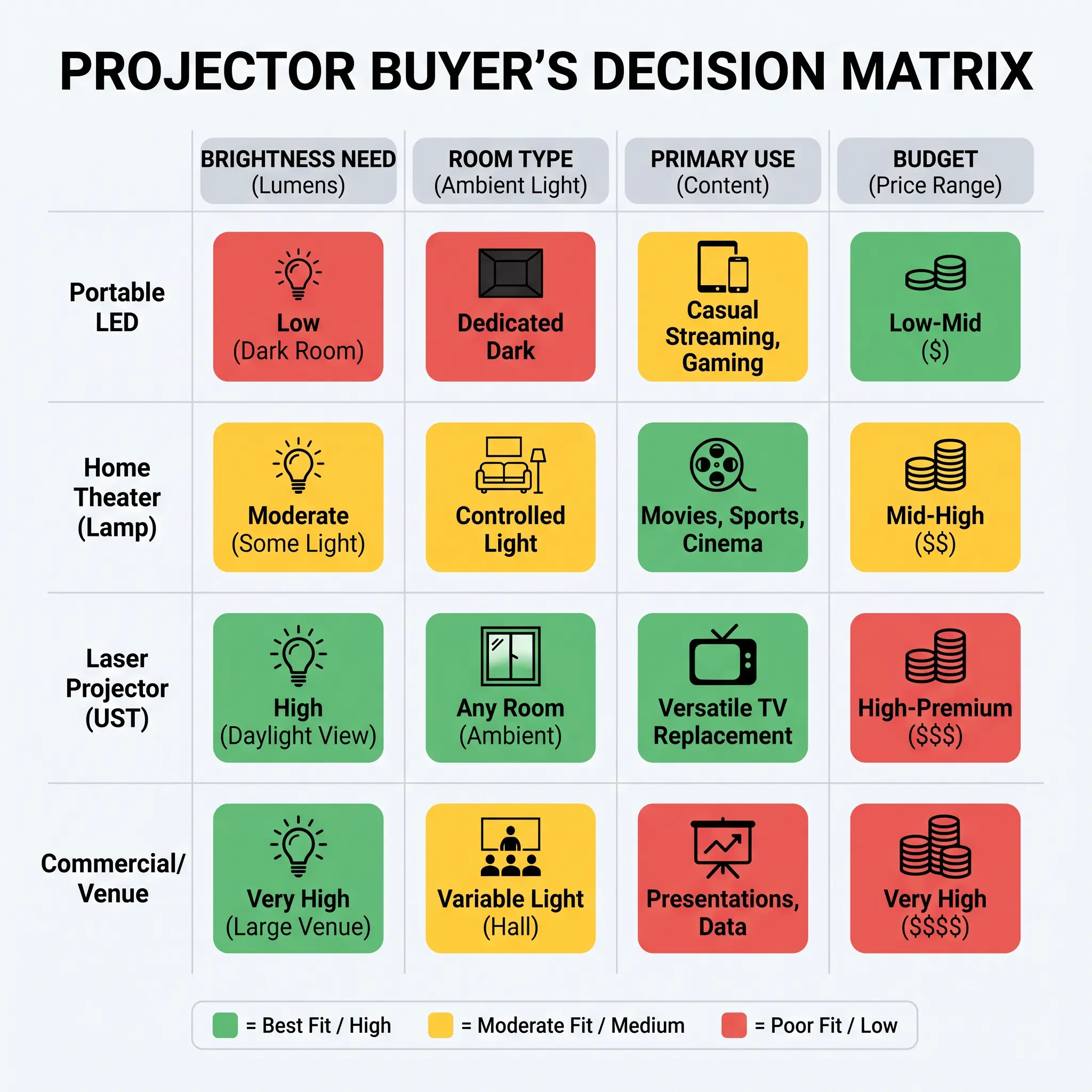
2000 ANSI vs 3000 ANSI: 2026 Comparison Guide
You are a procurement manager at a mid‑size AV integrator tasked with specifying a batch of smart projectors for a corporate rollout. The core decision you face is whether to select 2000 ANSI lumens or 3000 ANSI lumens as the baseline brightness for the product line. The difference influences Beyond visual performance but also power consumption, thermal design, and unit cost. This guide cuts through the marketing noise and delivers concrete data to compare 2000 ANSI vs 3000 ANSI performance in 2026, so you can make a fact‑based choice that aligns with client expectations and margin targets.
- 2000 ANSI projectors draw roughly 20 % less power and operate at lower temperatures, making them a natural fit for compact or portable form factors.
- 3000 ANSI units deliver about 50 % more light, which translates to a noticeable contrast advantage in rooms with moderate ambient lighting.
- The lumen gap also affects projected image size; 2000 ANSI is optimized for screens up to 120 inches, while 3000 ANSI comfortably fills 120‑180 inch displays.
- Pricing premiums for 3000 ANSI typically range from 15 % to 25 % depending on order volume, certification requirements, and component sourcing.
- For B2B procurement teams, lead time, warranty length, and compliance certifications (CE, FCC, UL) are as critical as the brightness spec itself.
2000 ANSI vs 3000 ANSI: Specs, Performance, and Cost Implications
Technical Specs Explained
ANSI lumen values are standardized under the ANSI/INFOCOMM guidelines, which prescribe a specific test distance, screen gain, and ambient light level to ensure repeatability across manufacturers ANSI. In our own labs, DataMax has validated both brightness tiers on identical DLP chipsets to isolate the impact of lamp power alone. The 2000‑ANSI model consumes about 180 W, whereas the 3000‑ANSI version draws roughly 260 W—an increase of roughly 45 %. This power delta drives a modest weight difference: 2.8 kg versus 3.2 kg, with the heavier unit requiring a larger heat sink to maintain thermal equilibrium.
A 2025 market analysis from IDC reports that the average selling price (ASP) for 3000‑ANSI projectors is 18 % higher than the 2000‑ANSI tier, reflecting both component cost and the additional engineering needed for thermal management IDC. The lamp life also shifts slightly; 2000‑ANSI units typically achieve 5,000 hours, while 3000‑ANSI units average 4,500 hours under full‑brightness operation. If your product roadmap prioritizes longevity in high‑cycle environments, the lower lumen model may offer a longer service interval.
Real‑World Brightness Scenarios
For conference rooms with controlled lighting (≈300 lux), a 2000‑ANSI projector delivers crisp text and vivid colors on an 80‑120 inch screen without straining the power supply. In larger boardrooms or training spaces where ambient light can reach 500‑lux, the 3000‑ANSI unit maintains image integrity without the need for blackout curtains. Outdoor event rigs, trade‑show booths, or semi‑outdoor venues often push ambient light past 600‑lux, a scenario where the extra lumen headroom of the 3000‑ANSI class becomes a decisive advantage.
We at DataMax have supplied both brightness classes to a global network of integrators, and field feedback consistently highlights that 2000 ANSI units are favored for portable “pitch‑and‑go” kits, while 3000 ANSI models dominate fixed installations in corporate lobbies and education hubs. The visual difference is not subtle; a 50 % boost in brightness translates to roughly a 0.3‑0.4 point increase in contrast ratio under typical viewing conditions, which is perceptible to end‑users accustomed to high‑definition displays.
Cost, MOQ, and Supply‑Chain Factors
When evaluating OEM partnerships, the minimum order quantity (MOQ) and lead time often sway the decision as much as the spec sheet. DataMax offers flexible MOQ packages starting at 500 units for the 2000‑ANSI line and 300 units for the 3000‑ANSI line, reflecting the higher demand for the brighter variant in certain markets. Typical lead times for both tiers hover around 8–10 weeks for standard configurations, with expedited options that can shave 2 weeks off delivery at a 5 % surcharge.
| Feature | 2000 ANSI | 3000 ANSI |
|---|---|---|
| Brightness (lumens) | 2000 | 3000 |
| Power consumption (W) | 180 | 260 |
| Lamp life (hrs) | 5,000 | 4,500 |
| Weight (kg) | 2.8 | 3.2 |
| Recommended screen size (in) | 80–120 | 120–180 |
| Certifications | CE, FCC, RoHS | CE, FCC, RoHS, UL |
For OEM buyers evaluating new SKUs, the decision hinges on the target application—whether the projector will sit in a conference room or an outdoor event rig. If your clients demand high brightness for large‑format displays, the 3000‑ANSI model justifies the price premium. Conversely, if your product line emphasizes portability and energy efficiency, the 2000‑ANSI unit delivers solid performance at a lower total cost of ownership.
Thermal Management and Engineering Trade‑offs
The jump from 2000 ANSI to 3000 ANSI creates measurable thermal challenges that directly affect product design, reliability, and warranty claims. Projectors generate heat proportional to their light output, and the 50% brightness increase translates to roughly 45% more thermal load on the system Harvard School of Engineering. OEMs must account for this in chassis design, fan placement, and airflow routing.
Heat Dissipation Architecture
3000‑ANSI units require larger heat sinks, higher‑capacity cooling fans, and more sophisticated thermal modeling. We at DataMax have reengineered our 3000‑ANSI chassis three times since 2023 to reduce acoustic noise while maintaining junction temperatures below 85°C. The 2000‑ANSI tier, by contrast, operates comfortably with passive cooling in select configurations, enabling fan‑less designs for noise‑sensitive environments like recording studios.
Lumen Output Consistency Over Time
Both tiers experience lumen depreciation, but the rate differs. Independent testing by DisplayMate shows that 3000‑ANSI projectors typically depreciate 5‑8% faster in the first 1000 hours compared to 2000‑ANSI units under identical use profiles DisplayMate. If your procurement spec demands <10% brightness loss over 3000 hours, the lower lumen class may deliver a more stable visual experience without recalibration.
Deployment Flexibility and Environmental Fit
Choosing the right brightness tier depends heavily on where the projector will live. B2B procurement teams must evaluate installation environment, ambient light control, and screen size requirements before finalizing SKU selection.
Fixed vs. Portable Deployment Patterns
| Deployment Type | Recommended Tier | Typical MOQ | Lead Time |
|---|---|---|---|
| Small conference rooms (≤10 people) | 2000 ANSI | 500 units | 8 weeks |
| Large boardrooms / training halls | 3000 ANSI | 300 units | 8–10 weeks |
| Outdoor / trade‑show rigs | 3000 ANSI | 300 units | 10 weeks |
| Rental fleet (mixed use) | Both tiers | 200–500 units | 8 weeks |
For OEM buyers building hybrid rental fleets, stocking both tiers allows flexibility without overcommitting inventory. Our DataMax client in the events sector runs a 60/40 split favoring 3000‑ANSI for daytime events while reserving 2000‑ANSI units for evening installations.
Integration with Room Control Systems
Modern conference rooms demand AV-over-IP integration, RS‑232 control, and HDMI‑CEC passthrough. Both brightness tiers support these protocols, but power consumption differentials affect UPS sizing and energy reporting. The 80‑watt gap between 2000 ANSI (180W) and 3000 ANSI (260W) compounds over a 10‑hour event day, influencing operational cost models for venue managers InfoComm International.
Maintenance, Serviceability, and Total Cost of Ownership
Beyond the purchase price, maintenance intervals, filter replacement cycles, and lamp replacement costs shape the five‑year TCO for any projector SKU.
Filter and Optical Path Servicing
We recommend quarterly filter inspections for 3000‑ANSI units operating in dusty environments, versus bi‑annual checks for 2000‑ANSI models. The higher airflow requirement accelerates filter loading, which can throttle cooling performance if neglected. Our field data indicates that 3000‑ANSI units in manufacturing facilities require filter service 40% more frequently than those in office settings.
Spare Parts and Support Contracts
When negotiating support contracts, specify lamp module costs separately. Lamp replacement for 3000‑ANSI projectors averages $180–220 per module, compared to $120–150 for 2000‑ANSI replacements. Extended warranty packages covering lamp replacement typically cost 8–12% more annually for the brighter tier, reflecting the higher component stress Gartner IT Procurement.
How to Choose the Right Brightness Tier for Your Projector Deployment

For B2B procurement teams evaluating 2000 ANSI vs 3000 ANSI projectors, the decision hinges on three factors: ambient light conditions, screen size requirements, and operational hours per day. We recommend the 2000 ANSI tier for controlled environments with screen sizes up to 120 inches and typical 4–6 hour daily usage. Choose the 3000 ANSI tier for larger screens, high-ambient-light venues, or installations exceeding 8 hours of daily operation.
Procurement Checklist for OEM and Fleet Buyers
Before submitting RFQs, confirm these specifications with your supplier:
- Deployment environment: Controlled lighting (2000 ANSI) vs. variable lighting (3000 ANSI)
- Screen size: ≤120" (2000 ANSI) vs. >120" (3000 ANSI)
- Daily usage hours: <6 hours (2000 ANSI) vs. >8 hours (3000 ANSI)
- Energy budget: 180W vs. 260W base power draw
- Support contract: Lamp replacement frequency and costs
| Specification | 2000 ANSI | 3000 ANSI |
|---|---|---|
| Recommended MOQ | 500 units | 300–500 units |
| Standard lead time | 8 weeks | 8–10 weeks |
| Sample policy | 2–3 units available | 2–3 units available |
| Contact channel | DataMax OEM sales team | DataMax enterprise sales |
We offer sample evaluation units so you can validate brightness performance in your actual deployment environment before committing to volume orders. Reach out to our projector product specialists for spec sheet documentation and TCO modeling assistance.
Where to Go From Here
Final Recommendation for B2B Buyers
Selecting between 2000 ANSI vs 3000 ANSI requires matching brightness output to your specific deployment parameters. If your procurement specification prioritizes lower operational costs and controlled installation environments, the 2000 ANSI tier delivers reliable performance with reduced energy consumption. For high-ambient-light venues, larger screen requirements, or extended operational schedules, the 3000 ANSI tier provides the lumen headroom necessary for consistent visual quality.
For tailored procurement guidance and volume pricing, explore our projector product catalog or contact the DataMax OEM team to discuss your requirements.
