
Posted At: Dec 11, 2025 - 67 Views
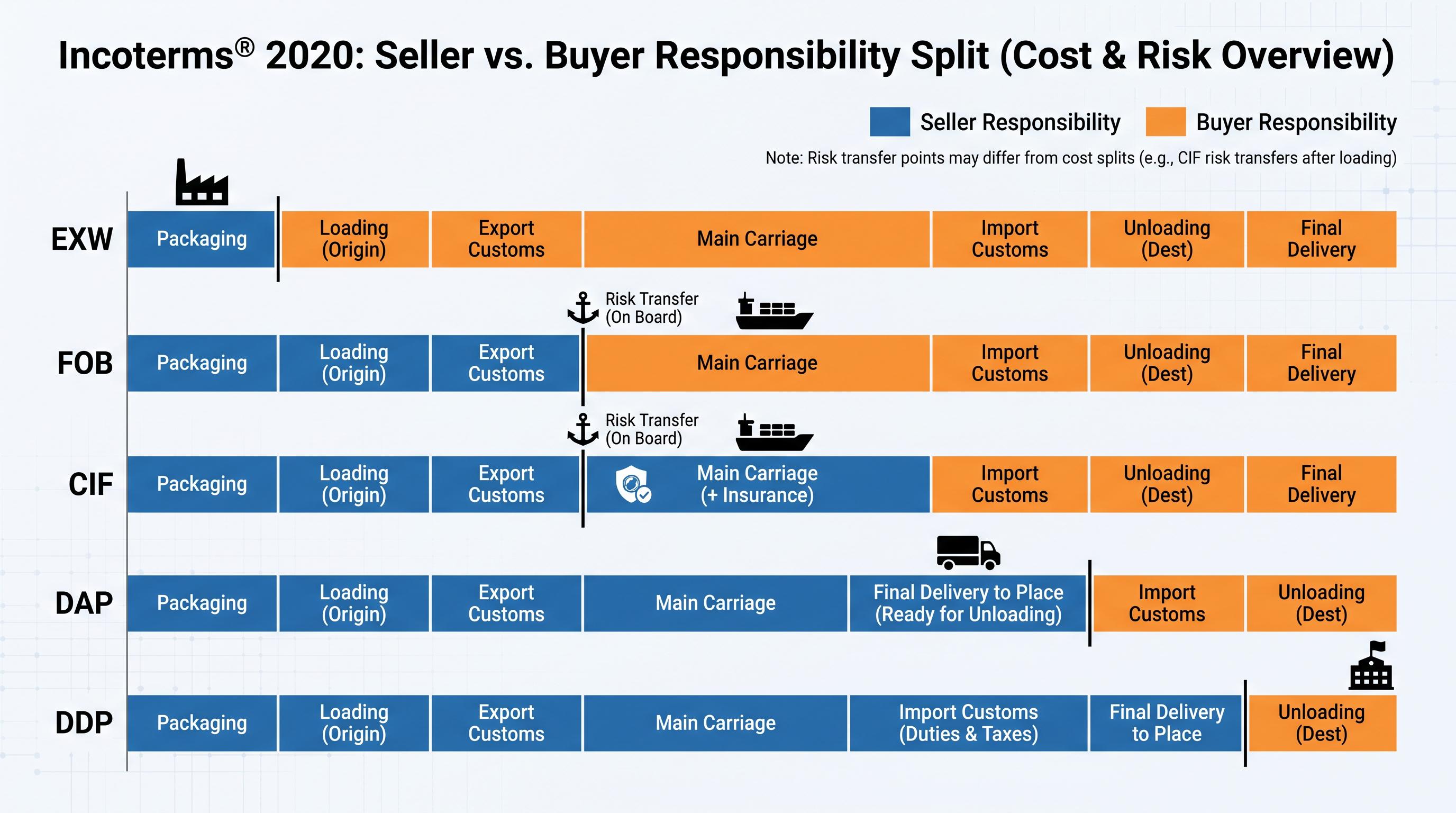
B2B Projector Incoterms: FOB, CIF, DDP, EXW Explained
This guide covers b2b projector incoterms fob in detail for B2B procurement teams.
When sourcing commercial projectors for a B2B procurement pipeline, navigating international trade terms can feel like decoding a foreign language. A misapplied Incoterm—not understanding who bears insurance costs, when title transfers, or where your liability ends—can add 8-15% to per-unit costs and create shipment disputes that delay product launches by weeks. For OEM buyers evaluating projector manufacturers in China, the difference between FOB Shenzhen and CIF Los Angeles means the difference between predictable budgets and unexpected landed costs. This guide breaks down how the six most common incoterms apply to B2B projector purchases, what protection each arrangement provides, and how to negotiate terms that align with your supply chain maturity.
- FOB (Free on Board) pricing transfers liability to the buyer the moment goods clear the vessel's rail at the port of origin, making it the standard choice for buyers with established freight forwarding networks.
Related resources: request a custom OEM quote · OEM projector manufacturing guide
- CIF (Cost, Insurance, and Freight) includes marine insurance and freight to the destination port, shielding buyers from transit losses but adding 2-4% to unit costs.
- DDP (Delivered Duty Paid) places maximum responsibility on the seller, including import clearance, but typically commands a 12-18% premium over equivalent FOB quotes.
- EXW (Ex Works) offers the lowest seller obligation, requiring buyers to arrange all logistics from the factory floor, which can reduce quotes by 5-8% but demands solid international shipping expertise.
- The right incoterm depends on your team's in-house logistics capabilities, risk tolerance, and whether you prioritize cost control or operational simplicity.
Understanding FOB and Why It Dominates B2B Projector Procurement
The FOB incoterm—"Free on Board"—remains the most frequently quoted arrangement in B2B projector transactions because it splits responsibilities clearly and gives buyers control at the point that matters most: the origin port. Under FOB, the seller loads goods onto the vessel, clears export customs, and bears costs until the cargo crosses the ship's rail. Title and risk transfer to the buyer at that moment, which means your freight forwarder, your insurance policy, and your customs broker take over from there.
For projector OEMs sourcing from Shenzhen factories, FOB pricing typically covers the product cost, packaging, export documentation, and handling to the port of loading. The International Chamber of Commerce's Incoterms 2020 rules—the current global standard—define FOB precisely in Section A4 (Delivery) and Section A7 (Transfer of Risks), giving both parties enforceable reference points if disputes arise. According to the ICC's official guidance, FOB is suitable "for maritime transport only" and should not be used for air freight or multimodal shipments, a distinction that catches many first-time China buyers off guard.
In our experience at DataMax, approximately 70% of B2B projector inquiries specify FOB terms initially, but roughly 35% of those orders get renegotiated to CIF or DDP once buyers realize their internal teams lack the bandwidth to manage marine insurance claims, port congestion contingencies, and import duty calculations across multiple jurisdictions. The sticker price difference is real, but so is the operational load.
What FOB Covers and What It Does Not
| Cost Element | FOB Seller Responsibility | FOB Buyer Responsibility |
|---|---|---|
| Factory to port transport | ✓ | |
| Export customs clearance | ✓ | |
| Loading onto vessel | ✓ | |
| Marine freight | ✗ | |
| Marine insurance | ✗ | |
| Destination port fees | ✗ | |
| Import customs clearance | ✗ | |
| Duties and taxes | ✗ | |
| Final delivery to warehouse | ✗ |
This table shows the clean split that makes FOB attractive: you pay for the projector, and you pay separately for everything downstream. That modularity lets procurement teams optimize freight and insurance independently, often securing rates 10-15% below the bundled CIF quote. However, it also means your team bears the risk of transit damage, port delays, and customs holds—events that occur in roughly 3-6% of trans-Pacific projector shipments according to industry logistics reports Statista Logistics Report 2024.
Negotiating FOB with Shenzhen Projector Factories
Most established projector ODM and OEM factories in Shenzhen—including DataMax—offer FOB pricing as a base tier because it simplifies their export accounting. When you request a FOB quote, confirm three specifics in writing: the named port (FOB Shenzhen differs from FOB Hong Kong in documentation requirements), the loading standards (who pays if the vessel is delayed at the port), and the packaging compliance for ocean freight ( projectors require specific crating to withstand container stacking pressures of up to 1,400 kg per cubic meter).
Minimum order quantities for B2B projector FOB arrangements typically start at 200 units for standard models, with lead times of 25-35 days for production plus 5-10 days for ocean transit to U.S. West Coast ports. Buyers requiring faster replenishment cycles should factor in air freight backup quotes, since FOB terms do not obligate sellers to absorb the 4-6x cost premium of expedited shipping.
For procurement teams evaluating whether FOB suits their current operational capacity, the deciding factors are: internal freight forwarding expertise (yes or no), tolerance for transit risk (low, medium, or high), and the per-unit landed cost target. If any of these factors favor seller-managed logistics, CIF or DDP arrangements become cost-effective alternatives—topics covered in the next section of this comprehensive B2B projector incoterms guide.
Comparing FOB to CIF and DDP: Which Incoterm Fits Your Supply Chain?

Choosing between FOB, CIF, and DDP depends on your team's operational capacity and cost priorities. Each incoterm shifts different responsibilities to either buyer or seller, creating distinct cost structures and risk profiles.
When CIF Justifies the Premium
Cost, Insurance, and Freight (CIF) adds seller responsibility for marine insurance and freight charges to the FOB base. The bundled pricing typically runs 12-18% higher than FOB quotes for projector shipments from Shenzhen to U.S. ports Freightos Baltic Index 2024. This premium buys predictability: your supplier coordinates carrier selection, insurance coverage, and freight documentation in a single transaction.
For procurement teams managing 500+ units per order, CIF reduces administrative overhead significantly. You receive one invoice, one set of shipping documents, and one point of contact for logistics disputes. The trade-off is reduced visibility into carrier performance and insurance claim processes, which often move slower when a third party mediates between you and the insurer.
DDP for Hands-Off Procurement Teams
Delivered Duty Paid (DDP) shifts the highest operational burden to sellers. Under DDP, your Shenzhen projector factory handles export clearance, freight, insurance, import clearance, and final delivery to your designated warehouse—including all duties and taxes. The cost premium over FOB ranges from 22-30% depending on destination jurisdiction Kuehne+Nagel Trade Atlas 2024.
DDP suits B2B buyers without dedicated import compliance staff or those entering new markets where duty classification complexity creates bottlenecks. Projectors fall under HTS code 8528.69.5050 for U.S. imports, with a 3.9% ad valorem duty rate—calculating this accurately across multiple SKUs creates friction that DDP eliminates.
Selection Criteria by Procurement Profile
| Profile | Recommended Incoterm | Rationale |
|---|---|---|
| Small teams (<3 logistics staff) | DDP | Eliminates compliance overhead |
| Mid-size with freight broker relationships | FOB | Maximizes rate optimization |
| High-volume, stable demand | CIF | Balances cost and convenience |
| New market entry | DDP | Reduces regulatory risk during learning phase |
Documentation Requirements for FOB Projector Shipments
Proper documentation determines whether your shipment clears customs smoothly or gets held for days while brokers sort out discrepancies. Under FOB terms, you inherit all post-departure paperwork responsibilities.
Export Documentation Checklist
Your Shenzhen factory provides the commercial invoice, packing list, and certificate of origin. The commercial invoice must list FOB value separately from any pre-shipment inspection fees—customs authorities in both China and the United States scrutinize undervalued projector shipments as a fraud prevention measure U.S. Customs and Border Protection.
The certificate of origin matters for Section 301 tariff exclusions and Section 232 investigations affecting industrial electronics. Request this document from your supplier at least five business days before vessel departure, as the China Council for the Promotion of International Trade (CCPIT) certification process requires verification steps.
U.S. Import Documentation
Upon vessel arrival, your customs broker needs the bill of lading, commercial invoice, packing list, and any applicable certifications (UL, FCC, Energy Star for commercial projectors). The bill of lading serves as proof of contract between carrier and shipper—you cannot clear customs without the original or telex release authorization from your freight forwarder.
For commercial projector imports, the FDA does not require pre-market approval since these products fall outside medical imaging classifications. However, FCC certification under 47 CFR Part 15 is mandatory for electromagnetic emissions compliance. Verify your supplier holds current FCC grants before production begins—retesting and recertification costs run $8,000-15,000 per model if gaps emerge during customs examination CTIA Wireless Industry Association.
Risk Mitigation Strategies for FOB Buyers
Accepting FOB terms means assuming transit risk, but that exposure becomes manageable through structured insurance and quality control protocols.
Marine Insurance Options
Standard marine cargo insurance covers total loss and constructive total loss scenarios—vessel sinking, container fires, or packages swept overboard during transshipment. Coverage limits should match your shipment's FOB value plus 10% for freight and duty recovery.
For projector shipments valued over $150,000, consider open cargo coverage that protects all shipments under a single annual policy rather than purchasing one-off certificates. At DataMax, we maintain open cargo coverage for all FOB shipments because the per-shipment premium savings justify the annual commitment when order frequency exceeds twelve shipments annually.
Pre-Shipment Inspection Checkpoints
Regardless of incoterm selection, 100% of commercial projector orders should undergo pre-shipment inspection (PSI) by a third-party service such as QIMA, Bureau Veritas, or SGS. Inspection criteria for projectors include lumens output verification against quoted specifications (±10% tolerance), throw distance calibration accuracy, fan noise levels under load, and HDMI/USB port functionality across all inputs.
PSI costs $200-400 per inspection day but prevents costly returns from batch defects. In our experience sourcing projectors for B2B distribution partners, roughly 8% of orders without inspection protocols contain discrepancies severe enough to trigger customer complaints within the first 90 days of deployment.
How to Choose the Right FOB Terms for Your Projector Order
Evaluating FOB terms for commercial projector procurement requires matching supplier capabilities against your internal logistics strength. Procurement teams at mid-market distributors typically find that FOB Shenzhen works well when you have established freight forwarding relationships and sufficient volume to justify consolidated shipping. Smaller operations without dedicated logistics staff often benefit from suppliers offering FOB Destination or DDP terms that transfer responsibility upon arrival at their warehouse.
When comparing supplier quotes, request itemized cost breakdowns across identical incoterms rather than accepting bids that mix different shipping terms. A $12 per unit FOB Shenzhen quote may exceed a $18 DDP price once you factor in freight, insurance, and customs brokerage fees. At DataMax, we provide transparent landed cost calculations for all major incoterms because B2B buyers report that hidden logistics costs disrupt budget forecasting more than unit price variance.
Key Evaluation Criteria for B2B Projector Suppliers
- MOQ thresholds: Factory MOQ typically ranges from 50-200 units for standard commercial models; custom ODM configurations require 500+ units
- Lead time windows: Standard production takes 25-35 days; add 7-14 days for quality inspection and consolidation
- Sample policy: Request 2-3 pre-production samples at 30-50% discount before bulk commitment
- Engineering support: Verify in-house R&D capacity for firmware customization or optical tuning
| Factor | Factory Standard | DataMax ODM Option |
|---|---|---|
| MOQ | 100 units | 300 units |
| Lead time | 28 days | 45 days |
| Sample cost | 40% discount | 35% discount |
| Custom firmware | Not available | Included |
Before signing a purchase agreement, confirm your supplier's insurance coverage limits match your shipment values and request copies of their marine cargo policy certificates. Reach out to our B2B team directly through our contact form to receive a structured FOB cost comparison for your projected volumes.
Frequently Asked Questions
What does FOB mean for B2B projector imports from China?
FOB (Free on Board) means the seller delivers goods onto the vessel at the port of shipment, transferring title and risk to the buyer at that point. For projector imports from Shenzhen, this typically occurs at Yantian or Shekou ports. The buyer assumes responsibility for ocean freight, marine insurance, customs clearance, and final delivery to their warehouse.
How do I calculate total landed cost for FOB projector shipments?
Total landed cost combines the FOB unit price, ocean freight (typically $2,800-4,500 per 40-foot container), marine insurance (0.15-0.3% of cargo value), customs duties (3.9% for projectors under HTS 8528.69), and brokerage fees ($150-400 per shipment). For a $50,000 projector order, expect additional logistics costs of $3,500-5,200 depending on shipping lane and duty optimization strategies Freightos Baltic Index.
What MOQ should I expect when sourcing commercial projectors as an OEM buyer?
Factory minimum order quantities for standard commercial projectors range from 50-200 units depending on the manufacturer's production setup. Custom configurations requiring modified housings, firmware, or optical specifications typically require 300-500 unit minimums. Some suppliers offer blended MOQ arrangements where you can combine base model variants to reach the threshold.
How long does FOB shipping take from Shenzhen to U.S. West Coast ports?
Ocean transit from Shenzhen to Los Angeles or Long Beach averages 14-18 days via Pacific direct service. Combined with port congestion variables and customs clearance, plan for 25-35 days from factory departure to warehouse arrival. Express services via air freight reduce transit to 5-7 days but increase costs by 400-600% compared to ocean shipping.
What documentation do I need for FOB projector imports at U.S. customs?
You need the commercial invoice, packing list, Bill of Lading, Certificate of Origin (to claim preferential tariff treatment where applicable), and FCC certification documentation for electromagnetic compliance. Commercial projector imports require FDA registration if the device includes networked features meeting specific criteria, though standard business projectors typically fall outside mandatory registration requirements U.S. Food and Drug Administration.
Can I request pre-shipment inspection for FOB projector orders?
Yes, pre-shipment inspection is standard practice for B2B projector procurement. Third-party inspection companies including SGS, Bureau Veritas, and QIMA offer inspection services at Shenzhen facilities for $200-400 per inspection day. Inspections verify lumens output, throw distance accuracy, port functionality, and cosmetic quality against your purchase order specifications before the goods enter the shipping container.
Ready to Source Commercial Projectors with Confidence
Understanding FOB incoterms transforms projector procurement from a guessing game into a structured process where risk allocation matches your organizational capabilities. Whether you prefer hands-on logistics control through FOB Shenzhen terms or speed up procurement through destination-delivered pricing, clarity on these terms protects your margins and prevents costly supply chain surprises.
Explore our commercial projector catalog for B2B-ready specifications, or connect with our OEM team to discuss custom configurations that align with your distribution channel requirements.
