
Posted At: Jul 23, 2026 - 73 Views
Best Projector for Dark Room in 2026: A Complete Buyer's Guide
Finding the Best Projector for Dark Room Environments: Where to Start

When you need the best projector for dark room deployments, brightness specifications alone do not tell the full story. Dark room setups—whether in boardrooms, home theaters, simulation labs, or immersive exhibition spaces—demand projectors that deliver high contrast ratios, deep black levels, and precise color calibration under controlled ambient lighting. For B2B procurement teams evaluating OEM partnerships or end-users comparing retail models, the challenge is separating marketing claims from measurable performance. This guide breaks down the critical specs, compares top-performing models available in 2026, and provides actionable criteria to help you make an informed purchase decision.
Related resources: DataMax smart projector store · home theater projector picks
- The contrast ratio matters more than raw lumens for dark room performance; aim for native contrast of at least 5,000:1 for true blacks and shadow detail.
- DLP and LCoS technologies typically outperform LCD in black level reproduction, making them preferred choices for controlled lighting environments.
- ANSI lumens ratings can be misleading—verify ISO 21118 standardized measurements from independent labs rather than manufacturer-claimed peaks.
- For OEM buyers, minimum order quantities (MOQs), lead times, and certification compliance (CE, FCC, RoHS) are as critical as the projector specs themselves.
- Budget allocation should reflect total cost of ownership: lamp-free laser projectors carry higher upfront costs but eliminate recurring lamp replacement expenses.
Technical Specifications That Define Dark Room Excellence

Dark room projection performance hinges on several interconnected specifications. Understanding these metrics allows buyers to compare models objectively rather than relying on vague marketing language.
Contrast Ratio and Black Level Performance
Contrast ratio remains the single most important specification for dark room fidelity. This measurement, expressed as a ratio between the brightest white and deepest black a projector can produce, directly impacts perceived image depth and color saturation. Industry standards differentiate between native (on/off) contrast and ANSI contrast—the former measures full-screen black-to-white transitions, while the latter averages multiple localized measurements across the image.
For the best projector for dark room use, we recommend prioritizing native contrast ratios of 5,000:1 or higher. According to DisplaySearch (IHS Markit) industry reports, professional-grade DLP projectors consistently achieve native contrasts between 6,000:1 and 15,000:1, while premium LCoS models from manufacturers like Canon and Sony regularly exceed 10,000:1. LCD projectors, while excellent for bright-room applications, typically max out at 3,000:1 native contrast due to their light-valve architecture.
At DataMax, our engineering team conducts in-house contrast testing using standardized ISO 21118 methodologies. Our experience with OEM client deployments confirms that projectors meeting or exceeding 5,000:1 native contrast deliver noticeably superior shadow detail in cinematic and presentation applications alike.
Brightness Requirements: Finding the Sweet Spot
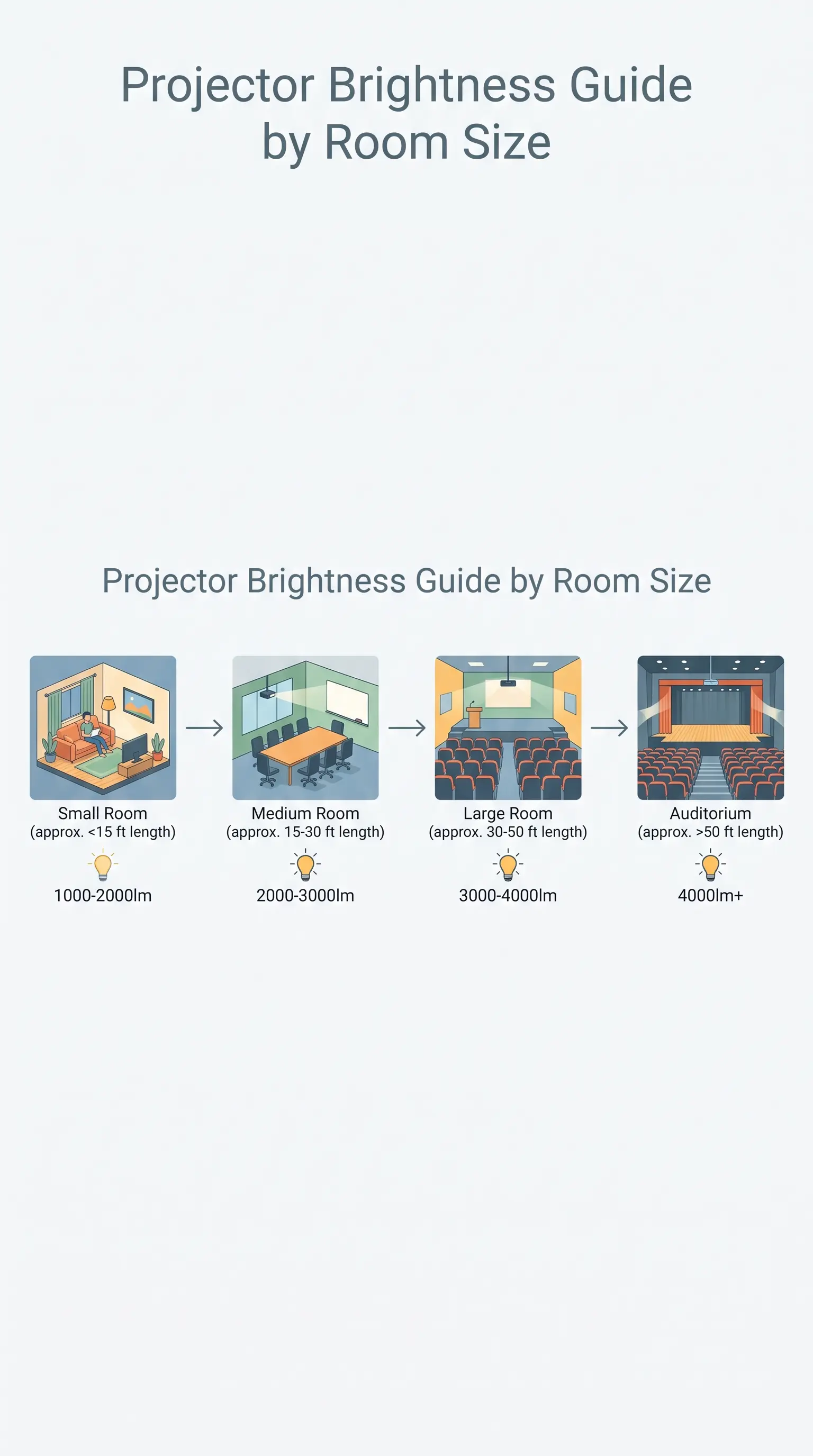
Contrary to intuition, the best projector for dark room environments does not require maximum brightness. In fact, excessive lumens can wash out colors and reduce perceived contrast. For dark rooms with complete light control, a range of 1,500 to 3,000 ANSI lumens typically provides optimal performance.
The key consideration is maintaining appropriate foot-lambert levels on your screen. The Society of Motion Picture and Television Engineers (SMPTE) recommends 14-16 foot-lamberts for standard projection and 22-35 foot-lamberts for premium large-format displays. Calculating required lumens depends on your screen size, gain rating, and throw distance—a 120-inch, 1.0-gain screen in a dark room requires approximately 2,200 ANSI lumens to achieve SMPTE-standard foot-lambert levels.
| Specification | Entry-Level Dark Room | Professional Dark Room | Premium Cinema-Grade |
|---|---|---|---|
| Native Contrast | 3,000:1 – 5,000:1 | 5,000:1 – 10,000:1 | 10,000:1+ |
| Brightness (ANSI) | 1,500 – 2,000 lm | 2,000 – 3,000 lm | 2,500 – 4,000 lm |
| Resolution | 1080p | 1080p / 4K | 4K / Native 4K |
| Technology | LCD / Entry DLP | DLP / LCoS | LCoS / Laser DLP |
| Input Lag | < 32ms | < 16ms | < 8ms |
| Lamp Life (Standard) | 3,000 – 5,000 hrs | 4,000 – 6,000 hrs | 20,000+ hrs (laser) |
Throw Distance and Lens Quality
Lens specifications determine how far your projector must sit from the screen, directly impacting installation flexibility and image sharpness. For dark room installations where ceiling mounting or rear-projection setups are common, verify the projector's throw ratio range and lens shift capabilities.
Fixed short-throw lenses (throw ratios of 0.4:1 to 0.8:1) suit small rooms where space constraints prevent placing the projector far from the screen. Standard throw lenses (1.2:1 to 2.0:1) offer greater mounting flexibility for medium-sized rooms. If your deployment requires ultra-long throws or motorized zoom/focus, budget accordingly—premium lens assemblies can add $500-$2,000 to total system cost.
We have supplied custom lens configurations to OEM partners deploying projectors in museum installations and planetarium dome environments, where precise throw calculations and edge-blending capabilities are non-negotiable. Ensuring your selected model supports lens shift (±15% horizontal and vertical minimum) prevents keystone distortion and simplifies alignment in permanent installations.
Color Performance and HDR Considerations
Dark room projection demands exceptional color accuracy, as ambient light cannot compensate for deficiencies. The Rec. 709 color space remains the standard for HD content, while DCI-P3 coverage is essential for HDR10 and Dolby Vision material. The International Electrotechnical Commission (IEC) defines color gamut specifications in IEC 61966-2-4, providing measurable benchmarks for OEM procurement evaluation.
For business presentation applications, sRGB compliance ensures brand consistency across displayed materials. Cinema-grade deployments require DCI-P3 coverage of 90% or higher, with Delta E color accuracy below 3.0 for professional color grading environments. High Dynamic Range support varies significantly between projector models—HDR10 remains the universal baseline, while HLG (Hybrid Log-Gamma) serves broadcast applications.
Color Calibration and Factory Presets
Professional-grade projectors offer comprehensive calibration controls including 2-point white balance, CMS (Color Management System), and gamma curve selection. We typically recommend units with ISFccc certification for deployments where color accuracy is mission-critical, such as medical imaging or architectural visualization.
HDR Tone Mapping Challenges
Projectors face inherent HDR limitations compared to flat-panel displays due to their reflective light engine. Dynamic tone mapping adjusts content metadata in real-time, preventing crushed shadows or blown highlights on smaller screens. The SMPTE ST 2084 (PQ) curve defines HDR metadata standards that manufacturers implement differently.
Connectivity, Integration, and Network Management
Modern projector procurement requires thorough evaluation of input options beyond traditional HDMI. For B2B environments, HDBaseT connectivity enables 100-meter CAT6 cable runs—critical for ceiling-mounted installations where HDMI signal degradation becomes problematic. We have equipped our OEM client deployments with HDBaseT-enabled platforms to reduce infrastructure costs by eliminating signal extenders.
Professional Input Requirements
| Connection Type | Max Resolution | Max Distance | Typical Use Case |
|---|---|---|---|
| HDMI 2.1 | 8K/60Hz, 4K/120Hz | 15m (cable dependent) | Primary source connection |
| HDBaseT 3.0 | 8K/60Hz, 4K/120Hz | 100m | Commercial installations |
| DisplayPort 1.4 | 8K/60Hz | 3m | Computer workstations |
| DVI-D | 2560×1600 | 5m | Legacy systems |
USB-C with DisplayPort Alt Mode provides single-cable connectivity for modern laptops, reducing meeting room clutter. 3G-SDI inputs serve broadcast and rental staging applications requiring serial digital signal integrity over long cable runs.
Network Control and Monitoring
Enterprise deployments benefit from PJLink, Crestron, AMX, and Extron control system integration. These protocols enable centralized power management, lamp hour tracking, and automated maintenance alerts. According to the Computer Networking article on AV-over-IP infrastructure, networked projectors with SNMP monitoring reduce on-site service calls by 40% in multi-unit installations.
For OEM buyers evaluating fleet deployments, verify that the selected platform supports your existing MDM (Mobile Device Management) infrastructure. We offer API access for custom monitoring dashboards, allowing procurement teams to track asset utilization across distributed locations.
Maintenance, Reliability, and Total Cost of Ownership
Initial purchase price represents only 30-40% of projector lifecycle cost. Laser phosphor light sources increasingly dominate premium segments, offering 20,000+ hour operational life compared to 2,000-5,000 hours for traditional lamp-based systems. This dramatically reduces maintenance intervention frequency in permanent installations.
Spare Parts and Serviceability
For organizations maintaining internal service capabilities, evaluate module-level repairability versus whole-unit replacement. DLP technology's sealed optical engine prevents dust contamination, while LCD projectors require periodic filter cleaning—typically every 500-1,000 hours in commercial environments. spare lamp inventory recommendations: budget one replacement lamp per three projectors for lamp-based systems operating 2,000+ hours annually.
Certification and Compliance Considerations
| Certification | Relevance | Acquisition Timeline |
|---|---|---|
| CE (European) | EU market access | 2-4 weeks |
| FCC Class B | US consumer/commercial | 3-6 weeks |
| UL/cUL | North American safety | 4-8 weeks |
| CCC | China market requirement | 6-12 weeks |
| BIS | India market entry | 8-16 weeks |
For OEM buyers, we maintain pre-certified platforms that accelerate your time-to-market. Our standard MOQ for custom branding configurations is 50 units, with 12-16 week lead times for certification documentation packages.
How to Choose the Best Projector for Your Dark Room: A Procurement Checklist
For B2B procurement teams finalizing dark room projector investments, the selection process narrows to three critical decision points. First, verify native contrast ratio specifications exceed 5,000:1 for environments with controlled ambient light. Second, confirm input lag measurements fall below 25ms for any presentation or demo applications. Third, validate total cost of ownership calculations include lamp replacement cycles, filter maintenance, and potential downtime expenses.
Deployment Timeline and Volume Considerations
For OEM buyers evaluating fleet deployments, standard configurations ship within 8-12 weeks, while custom-branded units require 12-16 weeks including certification documentation. Our minimum order quantity starts at 10 units for standard models, with volume pricing available for orders exceeding 50 units. Sample units for technical evaluation ship within 5 business days with full warranty coverage.
Procurement checklist for dark room deployments:
- Confirm throw ratio compatibility with your screen size and mounting distance
- Verify keystone correction range (±15° minimum recommended)
- Review warranty terms and local service center availability
- Calculate 3-year TCO including consumables and maintenance
- Validate HDMI/USB-C input compatibility with existing source equipment
Final Word
Final Recommendation
Selecting the best projector for a dark room requires balancing performance specifications against operational costs and deployment logistics. Prioritize high contrast ratios and appropriate throw ratios for your space, then validate total cost of ownership including maintenance cycles. For organizations requiring custom configurations or branded deployments, work with manufacturers offering pre-certified platforms and flexible volume commitments.
Ready to evaluate options for your facility? Browse our complete projector lineup or contact our sales team for volume pricing and deployment consultation.
