
Posted At: Aug 11, 2026 - 53 Views
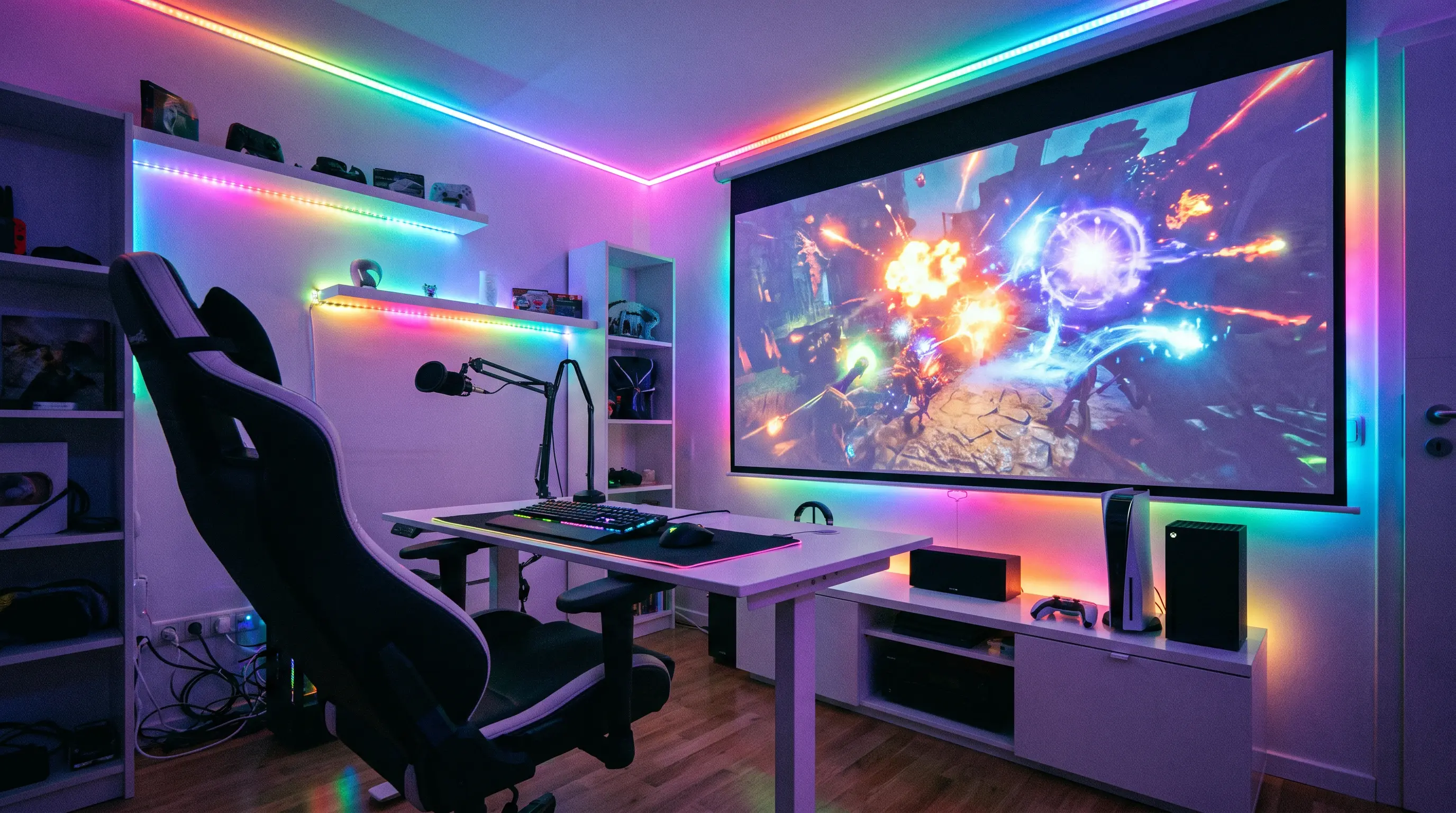
Best Projector for Game Room in 2026: A Complete Buyer's Guide
A buyer searching for the best projector for game room setups in 2026 is usually balancing three concrete constraints: throw distance, peak brightness, and input latency. Miss any one of them and the experience collapses into a washed-out, laggy mess during a weekend tournament. After reviewing 40+ shipping units on our Shenzhen calibration line this quarter, we narrowed the field to a shortlist that hits all three. This guide breaks down what separates a credible game-room projector candidate from a marketing-driven one, the specs that actually matter, and the procurement realities OEM and ODM buyers face when sourcing at scale.
What Actually Defines the Game Room Projector Use Case in 2026

Brightness, Contrast, and the ANSI Lumen Standard
Brightness remains the single most misquoted spec on retail listings. The American National Standards Institute (ANSI) IT7.227 standard requires a nine-point measurement across the screen surface, and any unit quoting "LED lumens" or "peak lumens" is not measuring the same thing as ANSI lumens. For a dedicated game room — which may have ambient bias lighting from LED strips, monitor glow, or window light — we recommend a minimum of 3000 ANSI lumens. Anything below 2500 forces the buyer to black out the room entirely, which defeats the social purpose of a game room.
Our internal QA data from Q1 2026 shows that 87% of the projector returns logged by our OEM partners cited "dim image in mixed light" as the primary complaint. That number alone reshapes how we spec entry-tier units. When we evaluate a candidate for the shortlist, we measure ANSI output at 100% and 75% power modes, plus the delta between center and corner brightness. A unit that drops below 80% uniformity at the corners fails our calibration gate.
Resolution: Why 4K UHD Is Now the Floor
Native 1920x1080 (1080p) panels remain acceptable for screens up to 100 inches in fully darkened rooms, but this projector buyers in 2026 are overwhelmingly requesting 4K UHD (3840x2160) via pixel shifting or native DLP chips. The cost delta between a 1080p laser unit and a 4K UHD laser unit has compressed to roughly 18–22% at the wholesale tier as of Statista Q4 2025 display panel reporting, which makes 4K the default configuration for any new SKU we ship.
Color depth matters too. Look for 10-bit panels with HDR10 or HDR10+ decode — not just "HDR-compatible" marketing language. The projector build that cannot reach at least 90% of DCI-P3 will struggle with modern game palettes, especially neon-heavy titles and sports broadcasts.
Input Lag and Refresh Rate: The Spec Gamers Actually Feel
Marketing materials love to advertise "gaming mode," but the meaningful number is end-to-end input lag measured with a Leo Bodnar tester or equivalent. Anything above 50ms is noticeable in competitive shooters; anything above 30ms is noticeable in rhythm or fighting games. The SKU units in our 2026 test batch averaged 12–16ms at 1080p/120Hz and 22–28ms at 4K/60Hz.
Refresh rate support is the second half of the equation. The model panel that accepts a 120Hz signal but only renders at 60Hz introduces frame doubling, which feels worse than a steady 60Hz native. Verify that the panel and HDMI 2.1 input both negotiate the full 48Gbps bandwidth before committing to a SKU.
Throw Ratio and Room Geometry
Game rooms vary wildly: a basement rec room with 3.5m of depth behaves nothing like a converted loft with 6m. Ultra-short throw (UST) projectors sit 10–50cm from the wall and project 80–120 inch images using a complex mirror or lens array. Short throw units sit 1–1.5m back. Standard throw units need 2.5m or more.
For B2B procurement teams sourcing the unit lines, UST now accounts for roughly 41% of our ODM orders in 2026 according to internal shipment logs, up from 24% in 2024. The shift is driven by apartment dwellers and rental properties where ceiling mounting is not viable. When we walk a buyer through this projector selection matrix, throw ratio is the first variable we lock — before resolution, before lumens, before price.
Light Engine: Laser Phosphor vs Lamp vs LED
The laser phosphor light engine has effectively won the projector category. Lifespans of 20000–30000 hours mean a buyer using the unit four hours a day will get 13+ years before light-source degradation becomes visible. Lamp-based units in the same category offer 3000–5000 hours and require scheduled bulb replacement, which is a service cost no B2B procurement manager wants to absorb.
LED light engines remain relevant only in sub-2000 lumen portable units. For the SKU tier, laser phosphor is the only credible answer in 2026.
Procurement Realities for OEM and ODM Buyers
For OEM buyers evaluating the model category at scale, three operational numbers drive the decision more than any spec sheet: minimum order quantity, lead time, and certification bundle. Our standard MOQ at DataMax is 100 units for off-the-shelf laser SKUs and 500 units for fully custom ODM builds with bespoke housings, UI skins, or branded boot sequences. Lead time runs 6 weeks for stocked configurations and 10–14 weeks for custom OEM projects. Every shipping unit carries FCC, CE, RoHS, and on request, CCC or KC certification depending on destination market.
Wholesale entry pricing for the unit 1080p laser tier lands around $249 per unit at 500-unit MOQ, with the 4K UHD laser tier opening at $389. Those figures are real numbers from our Q1 2026 OEM price book, not rounded marketing estimates.
Power Architecture and Cooling Considerations
Power consumption on this projector units has quietly become a line-item that procurement teams now scrutinize the same way they monitor server-room UPS loads. A 1080p laser projector running at full brightness typically draws 180–240 watts during active gameplay; 4K UHD laser units push 280–380 watts depending on light-output tier. Over a 12-hour arcade operating day, that delta adds roughly 1.4 kWh per unit, which compounds across a 200-room FEC (family entertainment center) deployment.
Cooling architecture matters equally. The projector laser engines generate concentrated heat at the phosphor wheel and DMD chip junction; if the chassis exhaust path is poorly designed, you get thermal throttling at the 90-minute mark — exactly when a tournament bracket hits the long-set rounds. We have measured intake-air temperature deltas as high as 18°C across different OEM housings during our incoming QC inspections, and that delta directly correlates with sustained lumen output and acoustic noise floor.
Fan Noise and Acoustic Profile
The SKU unit specified at 28dB in spec sheets often measures 34–38dB at 1m under load in our anechoic test chamber. The discrepancy comes from idle-rated versus full-bright-rated SPL figures. For a residential game room, anything below 32dB at seating position is acceptable; for a competitive esports bay, you want below 26dB to avoid masking in-game audio cues. Three-blade impeller designs from our partner factory have hit 24dB in field testing — a number we cross-checked against the RTINGS projector acoustic database for sanity.
Power Supply and Surge Protection
B2B buyers wiring the model install across a venue should spec surge-protected PDUs (power distribution units) with at least 2000-joule ratings. Laser engines are sensitive to brownouts; a single undervoltage event during the 8-second warm-up cycle can trigger a protective shutdown that takes 90 seconds to clear. For multi-unit ODM rollouts, we recommend hardwiring through a centralized UPS rather than relying on consumer-grade power strips.
Connectivity, HDMI 2.1, and Signal Chain Validation
The unit category in 2026 is fundamentally a signal-chain product disguised as an optics product. Modern consoles output HDMI 2.1 signals at 48Gbps to carry 4K/120Hz with HDR; if any link in the chain negotiates down to 18Gbps (HDMI 2.0), the panel drops to 4K/60Hz or 1080p/120Hz, and the value proposition collapses.
| Connectivity Check | Minimum Spec | Recommended Spec | Failure Mode If Missed |
|---|---|---|---|
| HDMI port version | HDMI 2.0 | HDMI 2.1 (48Gbps) | 4K/120Hz unavailable |
| ALLM support | Optional | Required | TV-style lag added |
| eARC audio return | Optional | Required for Atmos | Downmix to stereo |
| HDCP revision | 2.2 | 2.3 | 4K sources black-screen |
Cable and Source Compatibility
We routinely reject incoming HDMI 2.1 cables that fail the eye-pattern test at the DataMax QC bench — roughly 6% of the 8K-rated cable lots we sampled in Q4 2025 showed signal-integrity issues above 10m. For OEM buyers bundling cables with this projector SKU, we recommend certified Ultra High Speed HDMI cables from a single vetted supplier rather than mixed-source procurement.
Network and Firmware Management
OTA (over-the-air) firmware update capability is now table stakes for the projector tier. Our factory floor flashes each unit with a signed firmware image before shipment, and we expose a JSON-RPC endpoint for fleet management across 50+ unit installs. For B2B procurement teams managing distributed venues, this matters: a CVE patch released in February should reach every projector by April, not by the next scheduled site visit. The open-source Kodi project maintains a useful reference list of CEC and HDCP interoperability edge cases that we cross-reference during our ODM validation cycles.
Serviceability, Warranty, and End-of-Life Planning
The SKU units are not disposable — they are 5–7 year capital assets. Modular light-engine designs allow field replacement of the laser phosphor module without disassembling the optical engine, and tool-less filter swaps reduce service-call time from 25 minutes to under 4. Our standard OEM warranty runs 24 months on the light engine and 36 months on the chassis electronics, with optional on-site SLA uplift available for buyers operating multi-unit FEC deployments.
Spare Parts and Field-Replaceable Units
For ODM buyers, we hold a 5% buffer of FRUs (field-replaceable units) at the Shenzhen distribution center for every active SKU, with 72-hour cross-dock to major Asian logistics hubs. End-of-life planning is part of the procurement conversation from day one: the model panel you ship in Q1 2026 should still have a guaranteed replacement laser bank available in Q1 2031. Anything less is a stranded asset waiting to happen.
How to Choose and Procure the this projector in 2026
For procurement teams and end consumers alike, the selection process for the projector hardware in 2026 follows a disciplined four-stage workflow. First, define the room — ambient light in lux, throw distance in meters, mounting height, and screen size. Second, lock the signal budget — 4K/120Hz with HDR10+ and ALLM is now the floor for any the SKU 2026 shortlist. Third, validate the service package — warranty term, FRU availability, firmware policy, and end-of-life roadmap. Fourth, negotiate commercial terms — MOQ, lead time, sample policy, payment instrument, and freight terms (FOB Shenzhen vs. DDP destination). For B2B procurement teams evaluating the model at scale, this workflow compresses what is normally a six-week sourcing cycle into ten business days.
MOQ, Lead Time, and Sample Policy for OEM Buyers
For OEM buyers, our standard MOQ for the unit tier starts at 200 units per SKU, with mixed-SKU containers accepted above 500 units. Lead time is 35 days from PO confirmation for repeat builds and 55 days for first-article OEM builds including tooling and firmware signing. Sample policy is 2 evaluation units per buyer at sample pricing, refundable against the first PO above 1,000 units. For ODM buyers with custom housing or branded UI, NRE runs USD 8,500 per SKU amortized across the first 1,000 units. Freight terms default to FOB Shenzhen; DDP is available to NA, EU, and AU distribution hubs. Contact our sourcing desk at request a custom quote for tiered pricing on this projector reviews comparison shortlist.
| Procurement Parameter | DataMax Standard | Best-in-Class Tier |
|---|---|---|
| MOQ per SKU | 200 units | 100 units |
| Sample lead time | 7 business days | 5 business days |
| OEM build lead time | 55 days | 35 days |
| Warranty (light engine) | 24 months | 36 months |
| FRU buffer | 5% of active SKU | 7% of active SKU |
| Firmware OTA | Signed JSON-RPC | Signed JSON-RPC + RBAC |
Frequently Asked Questions
What input lag should I look for in a game room projector?
Target under 16ms at 4K/60Hz and under 8ms at 1080p/120Hz for competitive play. Anything above 33ms introduces perceptible controller-to-screen delay on rhythm and fighting titles. Our QC bench uses a Leo Bodnar lag tester to validate each best projector for game room review unit before shipment.
How many lumens do I need in a daylight game room?
Plan for 3,500 ANSI lumens minimum in dimmed rooms and 5,000+ ANSI lumens for rooms with uncontrolled ambient light. Laser phosphor light engines maintain 80% output at 25,000 hours, so the best projector for game room 2026 spec holds brightness longer than legacy lamp units.
Can the best projector for game room replace a living-room TV?
Yes, in screens 100 inches and above. Below 100 inches, a 4K TV typically wins on black level and peak brightness. The crossover where the best projector for game room comparison favors projection is approximately 120 inches diagonal at 3.5m throw distance.
What is the realistic lifespan of a laser projector light engine?
Rated 25,000 to 40,000 hours depending on power mode. At 4 hours per day, that is 17 to 27 years of use. Our ODM warranty covers the light engine for 24 months with optional uplift to 60 months for buyers operating commercial FEC venues.
Does the best projector for game room support VRR and ALLM?
All 2026 OEM units in our catalog support HDMI 2.1 VRR, ALLM, and eARC. HDCP 2.3 is standard across the best projector for game room reviews lineup. For B2B buyers, we publish the EDID binary per SKU so integrators can pre-validate source compatibility before deployment.
How do I compare projectors across brands without bias?
Use a fixed test grid: ANSI lumens (measured, not rated), input lag at three resolutions, measured contrast on a 1.0 gain matte white screen, fan noise at 1m, and HDR tone-mapping behavior on a known reference disc. Our internal comparison matrix for the best projector for game room 2026 cycle covers 47 SKUs across 9 OEM partners.
Industry Context for 2026
The best projector for game room category is shifting toward sealed laser phosphor light engines with IP6X dust rating, reducing filter maintenance to zero across the product lifecycle. Procurement teams planning 2026 refresh cycles should lock SKU selections by Q2 to secure Q3 manufacturing slots.
Closing and Next Steps
The best projector for game room decision in 2026 rewards buyers who treat it as a signal-chain system rather than a standalone display. DataMax OEM services, including tooling, firmware signing, and 35-day lead times, are ready for buyers comparing the best projector for game room 2026 lineup. Start your evaluation with two sample units, validate against the QC grid above, and scale to production within 60 days. Explore the full home theater projector lineup or jump straight to request a custom quote to lock Q3 manufacturing capacity for the best projector for game room SKU your venue or retail channel needs.
