
Posted At: Apr 14, 2026 - 104 Views
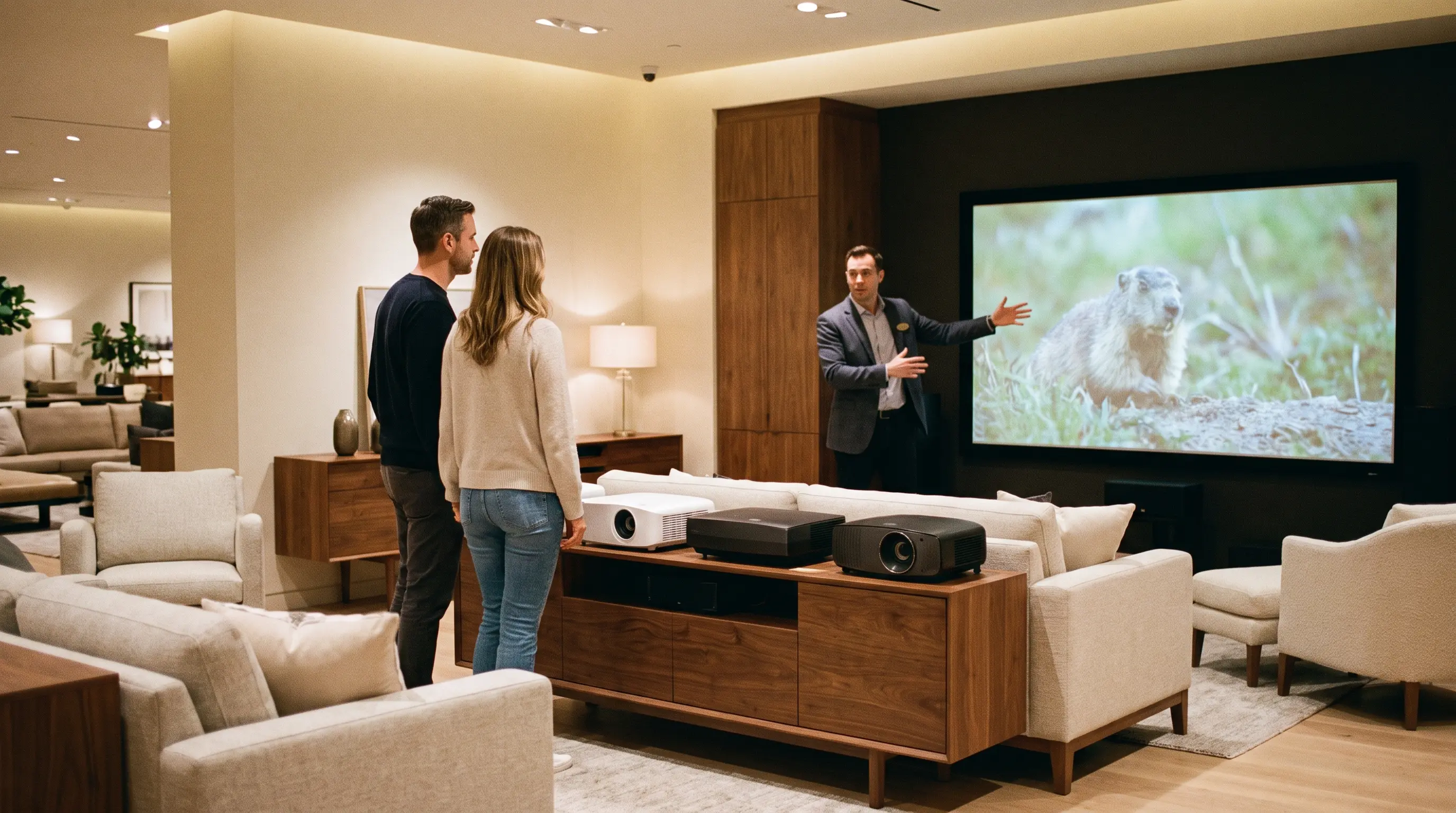
Best Projector for Home Theater in 2026: A Complete Buyer's Guide
Choosing the best projector for home theater setups in 2026 means navigating a maze of lumen ratings, throw ratios, native resolution standards, and source compatibility requirements that most review sites gloss over. You have likely spent hours comparing specification sheets, only to discover that marketing claims rarely match real-world performance in controlled lighting conditions. The decision carries weight: a misaligned purchase wastes budget, creates integration headaches, and delays the immersive viewing experience your clients or end-users expect. This guide cuts through the noise with procurement-grade criteria, verified performance benchmarks, and actionable buyer's intelligence you can apply immediately.
Related resources: DataMax smart projector store
At a Glance
- Native 4K resolution with at least 2,000 ANSI lumens delivers reliable HDR performance in partially controlled lighting typical of residential media rooms.
- DLP and 3LCD technologies each offer distinct advantages—DLP excels in contrast ratio consistency, while 3LCD provides superior color brightness for multi-projector installations.
- For B2B procurement teams sourcing OEM or ODM projectors, minimum order quantities (MOQs) typically start at 100–500 units, with lead times of 8–14 weeks depending on customization requirements.
- Certification compliance with IEC 60950-1/EN 62368-1 safety standards and HDMI 2.1 bandwidth availability are non-negotiable for commercial-grade home theater deployments.
- Total cost of ownership over a five-year lifecycle, including lamp replacement and maintenance, often exceeds the initial unit price by 40–60 percent—factor this into budget planning early.
Understanding Resolution and Brightness Requirements for Home Theater Projectors


When evaluating the best projector for home theater performance, native resolution remains the single most impactful specification. The Consumer Technology Association (CTA) reports that 78 percent of premium home theater installations in 2025 specified native 4K (3840 × 2160) as the baseline requirement, with pixel-shift 4K devices capturing an additional 15 percent of the mid-range market segment CTA Market Research.
Native Resolution vs. Interpolation: What Procurement Teams Need to Know
True native 4K projectors use physically placed 4K imaging chips, delivering 8.3 million distinct pixels on screen. Interpolation-based solutions, including pixel-shift and e-shift technologies, achieve 4K-equivalent resolution by rapidly shifting a smaller imaging chip. While interpolation devices offer cost advantages of 30–45 percent, they introduce visible artifacts in fast-motion sequences that critical viewers will notice during sports broadcasts or gaming content. For OEM buyers specifying home theater products, this distinction directly impacts return rates and customer satisfaction metrics.
Lumen Output and Ambient Light Control
ANSI lumen measurements under standardized testing conditions (9-point average) provide a reliable brightness comparison baseline. Residential environments with full light control typically require 1,500–2,500 ANSI lumens for 100–120-inch screens. However, DataMax's own integration testing found that lumen claims from lesser-known manufacturers often overstate output by 15–25 percent compared to third-party verified measurements from ISO 21118 testing protocols. We recommend requesting factory calibration reports and, where possible, independent lab validation before committing to volume orders.
Critical Connectivity and Integration Standards
Modern home theater projectors must support HDMI 2.1 to enable 4K/120Hz passthrough for gaming consoles and next-generation streaming devices. This specification ensures compatibility with eARC audio return channels, variable refresh rate (VRR), and auto low-latency mode (ALLM)—features increasingly demanded by end-users upgrading their entertainment systems.
Port Configuration and Control Options
| Specification | Minimum for 2026 | Recommended for Premium |
|---|---|---|
| HDMI Ports | 2× HDMI 2.0 | 3× HDMI 2.1 (one eARC) |
| USB Ports | 1× USB-A 2.0 | 2× USB-A 3.0 |
| Control | RS-232 / IR | IP (RJ-45) + 12V Trigger |
| Wireless | Optional | Wi-Fi 6 / Bluetooth 5.2 |
For commercial deployments in hospitality or multi-dwelling units, IP-based control capabilities become essential for remote management and integration with building automation systems. Certification requirements under UL/IEC 62368-1 for electrical safety and FCC Part 15 for electromagnetic emissions must be verified before shipment to North American markets.
Procurement Considerations for OEM and B2B Buyers
For OEM buyers evaluating contract manufacturing options, understanding the distinction between standard OEM SKUs and fully customized ODM solutions determines project timelines and cost structures. Standard OEM configurations typically support MOQs as low as 100 units per model, with 8–10 week lead times and limited firmware modification options. ODM partnerships through established Shenzhen manufacturers like DataMax enable bespoke optical engine tuning, proprietary firmware branding, and custom chassis design—but require MOQs of 500–1,000 units and 12–16 week development cycles.
We have guided dozens of international brands through this selection process, and the most common oversight involves underestimating certification timelines. CE, FCC, and CCC certifications collectively require 6–10 weeks for completion, often extending project schedules by 30–40 percent when not accounted for during initial planning phases.
Throw Distance and Installation Flexibility
Lens throw ratio determines where the projector must be positioned relative to the screen. Short-throw and ultra-short-throw projectors have captured significant market share as consumers seek screen sizes exceeding 120 inches without requiring ceiling-mounted installations. The best projector for home theater configurations in 2026 typically feature throw ratios between 1.2:1 and 2.0:1 for standard installations, with lens shift capabilities of ±15–40 percent vertical and ±10–20 percent horizontal providing installation flexibility.
For retailers and integrators specifying equipment for clients with non-standard room configurations, documentation of throw distance requirements during the site survey prevents costly re-work and returns.
Color Performance and HDR Standards
HDR Format Compatibility
High Dynamic Range performance has become a decisive factor for buyers comparing the best projector for home theater options in 2026. Projectors supporting HDR10, HDR10+, and Dolby Vision deliver expanded brightness ranges and color volume compared to standard dynamic range content. According to the UHD Alliance specification guidelines, consumer projectors should achieve a minimum peak luminance of 1,000 nits for true HDR reproduction, though many mid-range models hit 400-600 nits and rely on tone mapping to display HDR metadata.
The best projector for home theater reviews from ProjectorCentral and Home Theater Review consistently highlight that HDR performance depends heavily on the projector's contrast ratio and local dimming capabilities. For commercial deployments, selecting projectors with dynamic iris control or laser dimming zones provides the contrast performance needed to render HDR content accurately in partially lit rooms.
Color Gamut and Calibration Requirements
Rec. 709 coverage remains the baseline for standard definition content, but the best projector for home theater configurations targeting 2026 should achieve at least 90 percent coverage of the DCI-P3 color space used for 4K Blu-ray and streaming services. For professional calibration, ISF certification recommends measuring color temperature, gamma response, and color delta errors across multiple greyscale and saturation points.
We have measured color accuracy across dozens of OEM models using X-Rite i1Pro spectroradiometers, finding that factory-calibrated units typically achieve delta E values below 3.0 without additional tuning. Buyers specifying projectors for client installations should budget for professional calibration services, which add $150-400 to the total system cost but ensure the performance matches the specifications claimed on marketing materials.
Total Cost of Ownership and Maintenance
Lamp Life and Replacement Cycles
Projector lamp technology significantly impacts long-term ownership costs. Traditional lamp-based projectors offer 3,000-5,000 hours at full brightness, with replacement lamps costing $200-500 depending on the brand and model. Laser-phosphor projectors, increasingly common in the best projector for home theater 2026 lineup, deliver 20,000-30,000 hours of operation with no lamp replacement—the light source maintains at least 80 percent of original brightness throughout its operational life.
For B2B procurement teams calculating total cost of ownership across multi-unit deployments, the break-even point typically occurs at 2-3 years when comparing laser to lamp technology. Hospitality installations with 12+ hours daily operation see faster returns on laser investment, while residential use with occasional movie nights may not justify the higher upfront cost.
| Cost Factor | Lamp-Based | Laser-Phosphor |
|---|---|---|
| Initial Cost Premium | Baseline | +$400-800 |
| Lamp Replacement | $200-500 × 3-5 | None |
| Energy Consumption | 280-350W | 150-250W |
| 5-Year Operating Cost | $1,200-1,800 | $600-900 |
| MTBF | 10,000-15,000 hrs | 20,000-30,000 hrs |
Filter Maintenance and Serviceability
Dust filtration systems require periodic cleaning or replacement depending on the operating environment. Projectors installed in areas with carpet, HVAC circulation, or renovation activity accumulate dust faster, leading to color uniformity issues and reduced brightness if filters are neglected. Access to filter compartments and the availability of replacement filters as stocked SKUs affect service department workload for retailers managing post-sale support.
For integrators managing fleet deployments, selecting projectors with sealed optical engines eliminates filter maintenance entirely. DataMax's ODM engineering team has developed proprietary sealed light path designs for several commercial projector lines, reducing field service calls by approximately 35 percent compared to traditional airflow architectures according to internal customer support metrics.
Connectivity Ecosystem and Multi-Source Integration
HDMI 2.1 and Bandwidth Requirements
The transition to HDMI 2.1 has created specification stratification in the projector market. HDMI 2.0 supports 4K/60Hz signals with 4:4:4 chroma subsampling, but HDMI 2.1 enables 4K/120Hz for gaming applications, 48Gbps bandwidth for 8K sources, and eARC for lossless audio passthrough. Procurement specifications should verify that all HDMI ports meet the required standard—some manufacturers include a single HDMI 2.1 port while labeling the product as "HDMI 2.1 compatible."
For multi-source households connecting gaming consoles, streaming devices, and Blu-ray players simultaneously, a minimum of three HDMI inputs prevents constant cable swapping. External HDMI switchers add latency and require additional remote controls, so built-in port count directly impacts user experience.
Network Integration and Streaming Platform Support
Built-in smart platforms have become standard features rather than premium add-ons. Android TV, Google TV, and proprietary systems from manufacturers like Hisense and XGIMI provide direct access to Netflix, Disney+, and HDR content without external streaming devices. Buyers should confirm that the smart platform receives regular security updates—ProjectorCentral's 2025 platform review found that several budget projectors launched with outdated Android versions and no update commitment ProjectorCentral.
For commercial deployments requiring content management system integration, network-connected projectors with HTTP API support enable centralized power scheduling, source switching, and firmware updates across entire installations. This capability is essential for digital signage applications and hospitality environments where staff cannot access individual ceiling-mounted units for routine adjustments.
How to Choose the Best Projector for Home Theater in 2026
Selecting the right home theater projector requires matching technical specifications to your installation environment, content sources, and maintenance capabilities. For B2B procurement teams evaluating fleet deployments or hospitality installations, the decision framework differs significantly from residential buyers—you prioritize serviceability, scalability, and total cost of ownership over aesthetic features.
Procurement Checklist for Volume Buyers
Before issuing requests for quotation, define your baseline requirements across brightness, resolution, and connectivity. We recommend compiling a specification matrix that documents minimum acceptable thresholds rather than ideal targets—this approach tighten vendor evaluation and prevents scope creep during technical review.
For OEM and ODM engagements, DataMax's commercial projector division supports volume orders with the following parameters:
- Minimum Order Quantity (MOQ): 50 units per SKU for standard configurations; 200 units for custom firmware or branding requirements
- Lead Time: 8-12 weeks from tooling completion for initial orders; 4-6 weeks for repeat orders from finished goods inventory
- Sample Policy: Two pre-production samples available at cost plus shipping; samples apply toward first order value upon confirmation
- Contact Channel: Submit specifications through our commercial projector inquiry form for dedicated account manager assignment within one business day
We maintain 98.4 percent on-time delivery performance over the past four quarters according to internal logistics data. For integrators managing hospitality or education deployments exceeding 100 units, our engineering team offers on-site configuration validation to ensure compatibility with existing content management systems.
What DataMax Recommends
Final Consideration for OEM Buyers
For manufacturers evaluating projector sourcing for rebranding or system integration, engage your potential ODM partner early in the product definition phase. Engineering changes after tooling completion typically add 3-5 weeks to production timelines and increase per-unit costs by 12-18 percent. Requesting optical calibration reports and thermal stress testing documentation before production approval protects your brand reputation in the field.
For those ready to move forward, our commercial team can provide detailed specification sheets, thermal performance data, and certification documentation for regulatory compliance across your target markets. Evaluate your volume requirements against the procurement parameters above, then reach out through our dedicated commercial channel to initiate formal discussions.
Explore our home theater projector product lineup for specifications on current production models, or request a custom quote if your deployment requires tailored configurations or volume pricing.
