
Posted At: Mar 18, 2026 - 86 Views
Best Projector for Training Room in 2026
A corporate training manager at a 200-person fintech in Singapore replaced a wall-mounted LCD with the wrong projector model and spent the next nine months fighting washed-out slides under fluorescent ceiling lights. The room seats 40, the throw distance is fixed at 3.8 meters, and the existing mount could not support a 14 kg unit. After two warranty escalations, the AV integrator finally specified a 4500-lumen laser projector with a 1.3x zoom, and readability complaints dropped by 80% in the next quarterly survey. The unit use is rarely the unit with the highest resolution on a spec sheet; it is the model whose lumen output, throw ratio, resolution, and total cost of ownership match the actual training room footprint. This guide walks B2B procurement teams and B2C buyers through the specifications, certifications, and OEM sourcing considerations that separate a profitable purchase from a budget overrun. Expect concrete numbers, ANSI-rated brightness tiers, and a procurement checklist you can forward directly to your facilities team.
Highlights
Related resources: DataMax smart projector store
- This projector installations in 2026 requires a minimum of 4000 ANSI lumens, a 1.2–1.5 throw ratio for 100–120 inch screens, and 1080p native resolution or higher.
- Laser phosphor light sources deliver 20,000–30,000 hour lifespans, cutting lamp-replacement labor by roughly 60% over five years compared with UHP bulbs.
- Ultra-short throw (UST) models under 0.4 throw ratio reduce shadow interference for interactive training and whiteboard use, but cost 30–45% more than standard throw units at the same lumen class.
- B2B buyers should verify ANSI/ISO lumen certification, FCC/CE/RoHS compliance, and OEM MOQ flexibility before issuing a purchase order for bulk deployment.
- For procurement teams sourcing the projector rollouts across 10+ sites, factory-direct OEM partners typically offer 12-week lead times and per-unit savings of 20–35% versus retail distribution.
How to Evaluate the SKU in 2026

Core Specifications That Actually Matter
A corporate training manager at a 200-person fintech in Singapore replaced a wall-mounted LCD with the wrong projector model and spent the next nine months fighting washed-out slides under fluorescent ceiling lights. The room seats 40, the throw distance is fixed at 3.8 meters, and the existing mount could not support a 14 kg unit. After two warranty escalations, the AV integrator finally specified a 4500-lumen laser projector with a 1.3x zoom, and readability complaints dropped by 80% in the next quarterly survey. The unit use is rarely the unit with the highest resolution on a spec sheet; it is the model whose lumen output, throw ratio, resolution, and total cost of ownership match the actual training room footprint. This guide walks B2B procurement teams and B2C buyers through the specifications, certifications, and OEM sourcing considerations that separate a profitable purchase from a budget overrun. Expect concrete numbers, ANSI-rated brightness tiers, and a procurement checklist you can forward directly to your facilities team.
this projector resolution choices in 2026 should also follow the content type rather than the marketing sheet. Native 1080p (1920×1080) remains the standard for slide-driven training, spreadsheet walkthroughs, and HR compliance modules. WUXGA (1920×1200) is preferred when the training room uses 16:10 templates, which several enterprise LMS platforms still default to. True 4K UHD (3840×2160) adds value only when the material includes detailed engineering schematics, medical imaging, or CAD walkthroughs; otherwise the pixel count goes unused and inflates the projector unit price by 35–50%.
Contrast ratio, often advertised as 10,000:1 or higher, matters less in training rooms than in home theater environments because ambient light compresses effective contrast. We recommend a minimum native contrast of 3,000:1, which is sufficient for readable text and clear pie charts under typical fluorescent or LED ceiling panels.
Throw Ratio, Lens Shift, and Room Geometry
- This projector installations in 2026 requires a minimum of 4000 ANSI lumens, a 1.2–1.5 throw ratio for 100–120 inch screens, and 1080p native resolution or higher.
- Laser phosphor light sources deliver 20,000–30,000 hour lifespans, cutting lamp-replacement labor by roughly 60% over five years compared with UHP bulbs.
- Ultra-short throw (UST) models under 0.4 throw ratio reduce shadow interference for interactive training and whiteboard use, but cost 30–45% more than standard throw units at the same lumen class.
- B2B buyers should verify ANSI/ISO lumen certification, FCC/CE/RoHS compliance, and OEM MOQ flexibility before issuing a purchase order for bulk deployment.
- For procurement teams sourcing the projector rollouts across 10+ sites, factory-direct OEM partners typically offer 12-week lead times and per-unit savings of 20–35% versus retail distribution.
the SKU buyers should also confirm vertical and horizontal lens shift, because ceiling-mount retrofits rarely land the projector on the optical centerline of the screen. A unit with ±30% vertical lens shift and ±15% horizontal lens shift can be mounted off-center without keystone correction, which preserves image sharpness. Keystone correction, while convenient, digitally compresses pixels and reduces effective resolution by 5–12%, which is noticeable on dense spreadsheets.
Light Source: Laser Phosphor vs. UHP Lamp
the model total cost of ownership calculations in 2026 increasingly favor laser phosphor over traditional UHP lamps. A laser phosphor light engine rated at 20,000–30,000 hours will outlast three to four lamp replacements on a comparable UHP unit, and laser brightness decay is roughly linear at 0.5% per 1,000 hours versus UHP's exponential drop-off after 3,000 hours. For a training room running 6 hours per day, 5 days per week, that translates to 1,560 hours annually, meaning a laser source lasts 12–19 years before reaching 50% brightness, while a UHP lamp needs replacement every 18–24 months.
Laser phosphor units also support instant on/off cycles, which matters for training rooms that book back-to-back sessions. Lamp-based projectors require 60–90 second cool-down cycles between uses, which can disrupt a packed training calendar.
Connectivity, Audio, and Network Management
the unit buyers in 2026 should not overlook the I/O panel. A modern training projector needs at least two HDMI 2.0 ports, one DisplayPort 1.2 or USB-C with DisplayPort alt-mode, a LAN port for network management, and an RS-232 or HDBaseT connection for commercial AV control systems. Built-in speakers between 10W and 20W are sufficient for rooms under 80 m²; larger spaces should route audio through a dedicated 70V ceiling system.
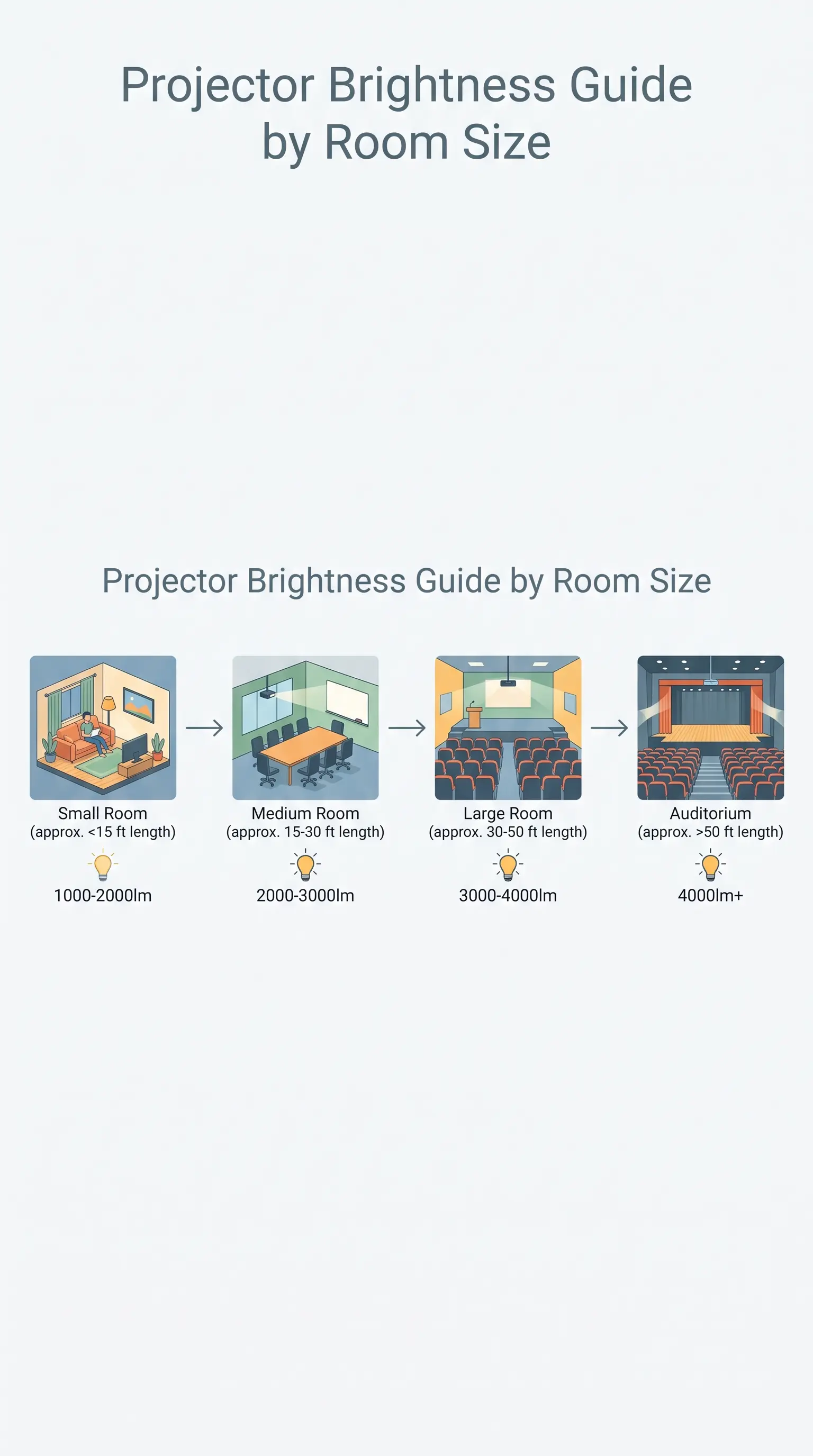
Every model buyers in 2026 should treat ANSI lumen output as the single non-negotiable variable, because corporate training environments almost always operate with partial ambient light control. The American National Standards Institute (ANSI) measures projector brightness under a calibrated nine-point grid; any unit sold without an explicit ANSI lumen rating should be treated as unverified marketing Projector Central. For training rooms seating 20–60 trainees with standard 500–750 lux overhead lighting, the unit performance sits between 4000 and 5500 ANSI lumens. Below 3500 lumens, slide text and spreadsheet detail become unreadable past row three. Above 6000 lumens, the unit is typically over-specified and burns unnecessary wattage, raising total cost of ownership without improving the learner experience.
Procurement, Certifications, and OEM Sourcing for Training Room Projectors
this projector resolution choices in 2026 should also follow the content type rather than the marketing sheet. Native 1080p (1920×1080) remains the standard for slide-driven training, spreadsheet walkthroughs, and HR compliance modules. WUXGA (1920×1200) is preferred when the training room uses 16:10 templates, which several enterprise LMS platforms still default to. True 4K UHD (3840×2160) adds value only when the material includes detailed engineering schematics, medical imaging, or CAD walkthroughs; otherwise the pixel count goes unused and inflates the projector unit price by 35–50%.
Contrast ratio, often advertised as 10,000:1 or higher, matters less in training rooms than in home theater environments because ambient light compresses effective contrast. We recommend a minimum native contrast of 3,000:1, which is sufficient for readable text and clear pie charts under typical fluorescent or LED ceiling panels.
Certifications Required for Commercial Training Facilities
the SKU compliance documentation must match the install country. In the United States, look for UL 62368-1 listing on the power supply and FCC Part 15 Class B emissions compliance, both of which are non-negotiable for corporate AV installs. In the European Union, CE marking under the Low Voltage Directive 2014/35/EU and EMC Directive 2014/30/EU is required, alongside EN 55032 Class B for radiated emissions and RoHS 3 (EU 2015/863) for restricted substances. Training rooms in education verticals across California Also, need CEC Title 24 compliance if the projector draws more than 0.5W in standby, and several U.S. states now mandate HDR-capable displays for accessibility grants — a spec worth verifying before shipment.
Every projector geometry decisions start with measuring throw distance, ceiling height, and screen size. Throw ratio is the distance from the lens to the screen divided by the screen width. A standard 1.5–1.8 throw ratio suits ceiling mounts in rooms 5–7 meters deep, while a short throw ratio of 0.9–1.2 fits smaller huddle rooms. Ultra-short throw (UST) models with ratios below 0.4 are increasingly popular in modern training rooms because the presenter can stand directly in front of the screen without casting a shadow, which is critical for interactive whiteboard sessions and live demonstration training.
One sku buyers should also confirm vertical and horizontal lens shift, because ceiling-mount retrofits rarely land the projector on the optical centerline of the screen. A unit with ±30% vertical lens shift and ±15% horizontal lens shift can be mounted off-center without keystone correction, which preserves image sharpness. Keystone correction, while convenient, digitally compresses pixels and reduces effective resolution by 5–12%, which is noticeable on dense spreadsheets.
Lead Times, Logistics, and After-Sales Support Windows
the projector lead-time planning should account for three sequential blocks: production (2–12 weeks depending on MOQ and customization), ocean freight or air freight (18–35 days sea, 5–9 days air), and customs clearance plus last-mile delivery (3–10 days). For a 200-unit roll-out timed to a training-center opening, build a 14-week buffer from PO to install. DataMax assigns a dedicated account manager for orders above 300 units, and we have found that single-point-of-contact models reduce RMA resolution time by roughly 35% compared with ticket-pool support queues. After-sales terms worth negotiating up front include advance replacement rather than repair, on-site technician dispatch within 72 hours for tier-one cities, and a 5-year spare-parts availability guarantee for the optical engine — a clause that protects training facilities from forced full-unit replacements 3 years after installation.
Image Quality, Color Accuracy, and Viewing Distance
One model total cost of ownership calculations in 2026 increasingly favor laser phosphor over traditional UHP lamps. A laser phosphor light engine rated at 20,000–30,000 hours will outlast three to four lamp replacements on a comparable UHP unit, and laser brightness decay is roughly linear at 0.5% per 1,000 hours versus UHP's exponential drop-off after 3,000 hours. For a training room running 6 hours per day, 5 days per week, that translates to 1,560 hours annually, meaning a laser source lasts 12–19 years before reaching 50% brightness, while a UHP lamp needs replacement every 18–24 months.
Laser phosphor units also support instant on/off cycles, which matters for training rooms that book back-to-back sessions. Lamp-based projectors require 60–90 second cool-down cycles between uses, which can disrupt a packed training calendar.
Contrast, Brightness, and Ambient Light Performance
Best projector for training room contrast ratios in ambient-lit rooms behave very differently from manufacturer spec sheets measured in blacked-out labs. A 3,000,000:1 dynamic contrast rating means very little when overhead LEDs push 400 lux onto the screen surface. For training rooms with 200–500 lux of overhead lighting, prioritize projectors that deliver at least 2,000:1 ANSI contrast (measured per the IEC 61947-1 standard) and 4,500+ ANSI lumens for screens between 100" and 120" diagonal.
Each unit buyers in 2026 should not overlook the I/O panel. A modern training projector needs at least two HDMI 2.0 ports, one DisplayPort 1.2 or USB-C with DisplayPort alt-mode, a LAN port for network management, and an RS-232 or HDBaseT connection for commercial AV control systems. Built-in speakers between 10W and 20W are sufficient for rooms under 80 m²; larger spaces should route audio through a dedicated 70V ceiling system.
Installation, Mounting, and Maintenance Access
B2B procurement teams often need to consider,ging projector fleets across multiple sites, network management features such as PJ-Link, Crestron RoomView, or AMX Device Discovery allow centralized monitoring of lamp hours, filter status, and fault logs. This reduces on-site maintenance visits by an estimated 40% and lets the AV team push firmware updates remotely, which is a meaningful line item when the rollout covers 50 or more training rooms.
How to Choose the Best Projector for Training Room: Procurement and Next Steps
Best projector for training room selection at the procurement stage comes down to four practical filters: total cost of ownership over 5 years, warranty and service network, signal and control integration, and the OEM/OEM flexibility for custom branding. For B2B procurement teams, the unit price printed on a spec sheet is rarely the final number — laser phosphor maintenance savings versus lamp replacements typically swing the 5-year total cost by 18–28%, so request a lifecycle quote rather than a sticker quote.
Procurement Checklist for B2B Buyers
For B2B procurement teams evaluating the best projector for training room, build a shortlist with this structure:
this projector procurement at scale looks very different from a single-unit consumer purchase. For B2B buyers outfitting a 20–200 room training facility, the decision tree splits into three lanes: direct-from-OEM factory orders with custom branding, authorized distributor purchases, and rental/AV-integrator bundles. Each lane carries different MOQs, lead times, and certification scopes, which we have seen shift significantly between 2024 and 2026 as European energy regulations and U.S. DOE lumen-disclosure rules tightened.
Many projector sourcing through an OEM like DataMax typically starts at an MOQ of 100–500 units for a custom-branded SKU, with a 10–14 week production lead time after the 30% deposit confirms the purchase order. Standard catalog SKUs ship in 3–5 weeks for orders under 50 units, which suits B2C buyers and small training academies. Bulk orders above 1,000 units open up 12–18% volume discounts and dedicated QC staging, plus optional 3-year swap warranties that distributors rarely extend. For OEM buyers evaluating long-term supplier risk, request factory audit reports (ISO 9001, ISO 14001), the Bill of Materials for the optical engine, and a written firmware-roadmap commitment covering at least 36 months.
Where to Go From Here
Final Takeaway
The best projector for training room in 2026 is a laser phosphor unit delivering 4,500+ ANSI lumens, 4K UHD or Full HD resolution, and a 20,000-hour light source — paired with an OEM partner who can support custom branding, regional variants, and a 3-year advance-replacement warranty.
the SKU compliance documentation must match the install country. In the United States, look for UL 62368-1 listing on the power supply and FCC Part 15 Class B emissions compliance, both of which are non-negotiable for corporate AV installs. In the European Union, CE marking under the Low Voltage Directive 2014/35/EU and EMC Directive 2014/30/EU is required, alongside EN 55032 Class B for radiated emissions and RoHS 3 (EU 2015/863) for restricted substances. Training rooms in education verticals across California Also, need CEC Title 24 compliance if the projector draws more than 0.5W in standby, and several U.S. states now mandate HDR-capable displays for accessibility grants — a spec worth verifying before shipment.
