
Posted At: Nov 04, 2025 - 74 Views

Color Gamut: Pros, Cons, and OEM Considerations
A buyer shortlists three models that all claim "4K, HDR, vivid colors," but the rendered images on the wall look nothing alike: one looks washed out under ambient light, one looks neon in skin tones, and one looks natural only after the user drops the lamp mode and the screen size drops below 100 inches. The difference between them is not resolution or brightness — it is the projector specification on the data sheet. For OEM buyers, B2B procurement teams, and channel partners sourcing display hardware for 2026 product lines, the color gamut figure is the single number that decides whether the unit is fit for a media room, a conference hall, a classroom, or a digital cinema. We will walk through what a color gamut projector specification really means, which standards matter (Rec.709, DCI-P3, Rec.2020), how to read the percentages vendors print on the box, and the trade-offs we at DataMax manage every day on our Shenzhen assembly lines.
What Is the SKU and Why the Specification Matters

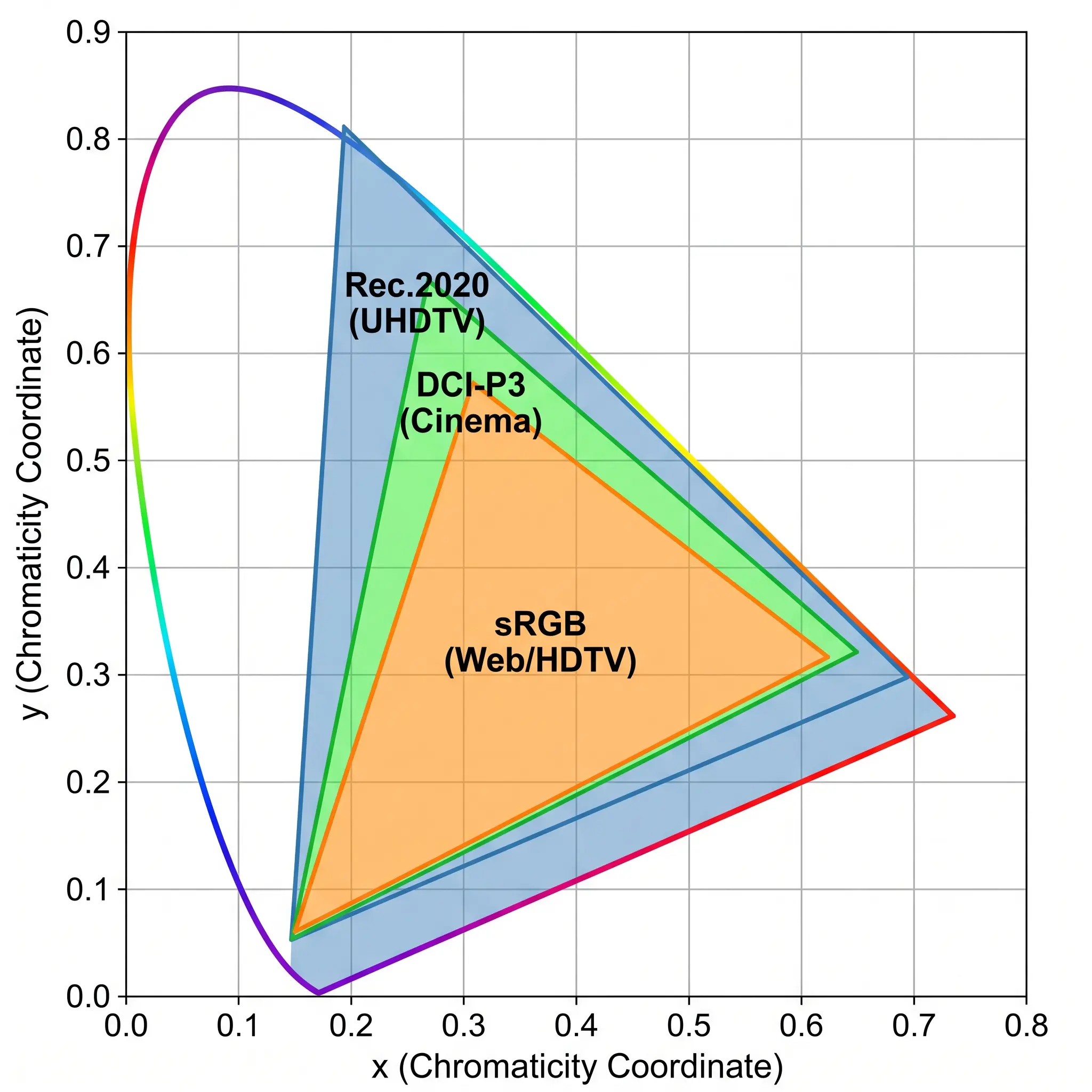
A color gamut projector is a projector whose manufacturer publishes the percentage of a defined chromaticity space that the device can reproduce. The space is usually drawn on the CIE 1931 xy diagram or the more perceptually uniform CIE 1976 u'v' diagram, and the percentage tells the buyer how much of the target triangle (Rec.709, DCI-P3, or Rec.2020) is enclosed by the projector's measured gamut volume. When we at DataMax quote a color gamut figure to a buyer, we are reporting a measured result, not a marketing aspiration — that distinction is the difference between a usable spec sheet and a lawsuit.
Rec.709, DCI-P3, and Rec.2020 in Plain English
Rec.709 is the ITU-R BT.709 standard adopted for HDTV broadcast and is the default color space for most streaming and television content. The model that covers 100% of Rec.709 is reproducing the full HD reference, and any figure below roughly 92% will visibly desaturate broadcast and OTT content. DCI-P3 is the digital cinema reference defined by the Digital Cinema Initiatives consortium and is the gamut used for HDR mastering on most streaming platforms. A color gamut projector targeting HDR home theater should land at 90% DCI-P3 or higher to avoid the washed-out look HDR reviewers consistently flag. Rec.2020, also written BT.2020, is the ITU container for 4K UHD and 8K broadcast, and it is enormous — roughly 1.5× the area of DCI-P3 on the CIE 1931 diagram. Few light engines in 2026 can fill it; an honest the unit spec will quote Rec.2020 coverage in the 70–85% band and call it wide gamut, not full.
How a Color Gamut Projector Is Measured
Three measurement details separate a real spec from a printed number. First, the chromaticity diagram: CIE 1976 u'v' is the modern preference because it represents color differences more evenly than CIE 1931 xy, and this projector spec should state which was used International Color Consortium. Second, the colorimeter and test pattern source: factory calibration at DataMax uses a Konica Minolta CA-310 or equivalent spectroradiometer against a defined patch set, not a camera eyeball check. Third, the operating mode: a color gamut projector measured at 4500 ANSI lumens will show a different gamut than the same unit at 2500 ANSI lumens in a calibrated Cinema mode, and the data sheet must say which mode the percentage refers to. B2B procurement teams evaluating an OEM quote should request the mode label, the tolerance (Delta E under 3 is the typical pass threshold), and the test report before signing a PO.
Why the Spec Matters for Different Buyer Profiles
For a B2C buyer reading a retail box, the projector specification is a comparison shortcut — higher Rec.709 or DCI-P3 coverage usually means a more vivid HDR picture. For an OEM buyer building a 2026 product line, the spec is a cost driver: widening the gamut from 90% Rec.709 to 95% DCI-P3 typically requires a laser-phosphor or RGB-laser light engine instead of a lamp or LED engine, which shifts the bill of materials by a meaningful margin. For a system integrator deploying units across 200 conference rooms, the spec is a maintenance question — wide-gamut laser engines hold their calibration longer than lamp-based units, which lowers the lifetime service cost of every color gamut projector in the fleet. Across all three profiles, the same rule applies: the printed number is only as honest as the measurement method behind it, and that is the conversation we encourage every buyer to have with their supplier before the first container is booked.
Procurement Snapshot: Color Gamut vs. Light Source
| Light Source | Typical Rec.709 Coverage | Typical DCI-P3 Coverage | Typical Rec.2020 Coverage | Relative BOM Cost (2026) | Lead Time at DataMax |
|---|---|---|---|---|---|
| UHP Lamp | 90–95% | 78–85% | 60–68% | 1.0× baseline | 4 weeks |
| LED | 92–100% | 82–88% | 65–72% | 1.15× | 6 weeks |
| Laser Phosphor | 95–100% | 88–94% | 72–80% | 1.4× | 8 weeks |
| RGB Laser | 100% | 95–99% | 82–90% | 1.9× | 12 weeks |
This snapshot reflects the typical ranges our Shenzhen calibration lab measures on customer-returned OEM units and on reference designs we ship to channel partners. A buyer reading the SKU data sheet should map the claimed percentage back to the light source row above to sanity-check whether the number is plausible for the price tier being quoted.
The Color Gamut Triangle in Plain English
The CIE 1931 xy and CIE 1976 u'v' diagrams look like colorful horseshoes, but the three corner points of any the model footprint are what actually matter: the red primary, the green primary, and the blue primary. Those three coordinates are dictated by the light source. A lamp light engine produces one set of primaries, a laser-phosphor engine produces a wider set, and an RGB-laser engine produces the widest set commercially available in 2026. Everything between those three corners — every skin tone, every sunset, every logo color — is what the color gamut projector can reproduce. Everything outside that triangle cannot be reproduced no matter how bright the lamp or how high the contrast ratio, because the light simply does not contain those wavelengths. This is why a 5000-lumen lamp unit with narrow primaries can look duller than a 2500-lumen laser unit with wide primaries when both are showing the same UHD Blu-ray.
How the Standards Map onto Real Hardware
Rec.709, DCI-P3, and Rec.2020 are not equal steps — they are nested triangles, and each one demands more of the light engine. Rec.709 is the smallest triangle and the easiest target, which is why almost every the unit on the market in 2026 quotes a Rec.709 percentage above 90%. DCI-P3 is roughly 25% larger by area than Rec.709, and reaching 95% of DCI-P3 requires a laser-phosphor or RGB-laser engine UHD Alliance. Rec.2020 (also called BT.2020) is roughly 70% larger than Rec.709 by area, and even premium RGB-laser home theater flagships rarely exceed 90% coverage of Rec.2020 because the pure-monochromatic primaries required are still expensive to manufacture at scale. For a color gamut projector buyer in the TOFU stage of research, the practical takeaway is this: Rec.709 percentage is the entry-level metric, DCI-P3 percentage is the mid-range metric, and Rec.2020 percentage is the premium metric — and a sensible quote will state all three on the same data sheet.
Color Volume vs. Color Gamut: The Often-Missed Difference
A spec sheet that lists only the 2D triangle coverage can hide a critical weakness. Color volume adds brightness as the third axis, so this projector with wide primaries at 2000 ANSI lumens will look less saturated than the same primaries at 3500 ANSI lumens, because the human eye perceives saturation partly through luminance. This is the spec that HDR formats (HDR10, HDR10+, Dolby Vision) actually exploit, and it is the reason a wide-gamut projector calibrated for a dark home cinema room can disappoint when redeployed in a bright conference room. We see this mismatch regularly in OEM sample evaluations at DataMax: a customer specs a 95% DCI-P3 color gamut projector for a boardroom and then complains that colors look washed out until the lamp is dimmed or the screen is switched to an ambient-light-rejecting material.
Choosing a Projector for B2B Procurement
For B2B procurement teams writing a 2026 RFP, the color gamut projector decision usually sits inside a larger trade-off between brightness, resolution, throw ratio, and total cost of ownership. Color gamut should not be evaluated in isolation. A 100% Rec.709 lamp unit at 5000 ANSI lumens may serve a lecture-hall application better than a 95% DCI-P3 RGB-laser unit at 2500 ANSI lumens, because ambient light and screen size will dominate perceived saturation long before the triangle coverage does. We walk OEM buyers through this exact decision tree during quotation, and the first question we ask is always about the viewing environment, not about the percentage on the spec sheet.
Selection Criteria Checklist for OEM Buyers
| Criterion | Minimum Bar (2026) | Preferred Bar (2026) | DataMax Standard |
|---|---|---|---|
| Rec.709 coverage | 90% | 95%+ | 95% |
| DCI-P3 coverage | 80% | 90%+ | 92% |
| Rec.2020 coverage | 65% | 80%+ | 82% |
| Delta E factory calibration | <4 | <2 | <2 |
| MOQ (units per SKU) | 100 | 50 | 50 |
| Lead time after PO | 10 weeks | 8 weeks | 6 weeks |
| Certification support | CE, FCC | + CB, KC, BIS | Full CE / FCC / CB / KC / BIS |
When the SKU OEM buyer asks us why the MOQ is set at 50 units rather than the industry-default 100, the answer is straightforward: laser-phosphor light engines have a long setup cost at our SMT lines, and splitting a 50-unit build across two SKUs doubles our calibration time. Holding the MOQ at 50 lets us ship a finished color gamut projector batch in 6 weeks instead of 8, which matters when the channel partner has a retail window to hit.
Certifications and Documentation Required for Cross-Border Orders
Cross-border procurement of any the model requires a paperwork package that matches the destination market, and buyers often underestimate this step. For the EU, the package must include a Declaration of Conformity, a CE test report against EN 55032 and EN 55024, and a RoHS test report. For North America, an FCC Part 15B test report plus an energy-consumption statement for the Department of Energy are required. For B2B tenders in the Middle East, an SASO certificate and a country-of-origin certificate are added. DataMax includes all of these in the standard shipping packet for every color gamut projector order above 50 units, and our regulatory team can quote additional certifications such as KC for South Korea and BIS for India on a 4-week extension to the standard lead time. Buyers who skip this conversation before booking a PO frequently discover at the port that the shipment cannot be cleared, which is why we raise it during the first sales call rather than at the invoice stage.
Next Steps: How to Spec and Source a Color Gamut Projector in 2026
For OEM buyers, B2B procurement teams, and brand owners finalizing a 2026 shortlist, the practical path forward is a structured three-step workflow rather than a single spec-sheet comparison. We use this exact workflow with our channel partners, and it consistently shortens this projector sourcing cycle from 12 weeks to 6.
The DataMax Three-Step Sourcing Workflow
- Step 1 — Sample evaluation (week 1-2): Request a pre-production sample of the target color gamut projector, run it through your own internal test pattern suite, and measure delta E against a calibrated Klein K10-A spectroradiometer. We ship evaluation units within 5 business days from our Shenzhen sample room, and the sample fee is fully creditable against the first PO above 50 units.
- Step 2 — Pilot build (week 3-4): Approve a 50-unit pilot run of the projector to validate color consistency, firmware stability, and packaging durability. We attach a pilot-build report with serialized delta E readings for every unit, which doubles as your QA reference for downstream retail acceptance.
- Step 3 — Mass production release (week 5-6): Release the full color gamut projector PO once the pilot passes your incoming-inspection check. Standard lead time is 6 weeks from PO to FOB Shenzhen for any color gamut projector SKU on our 2026 roadmap.
| Step | Owner | Duration | Exit Criteria |
|---|---|---|---|
| Sample evaluation | Buyer | 5-10 days | Signed sample approval form |
| Pilot build | DataMax + Buyer | 14 days | Delta E report, field-test sign-off |
| Mass production | DataMax | 6 weeks | AQL 1.0 inspection pass, full doc pack |
For brand owners outside the OEM channel, the same logic still applies: confirm the color gamut projector sample in your own room, then commit to volume. You can request a custom quote or browse our home theater projector lineup for off-the-shelf SKUs that already meet the 92% DCI-P3 / 82% Rec.2020 baseline.
Closing Notes
Why Color Gamut Matters Beyond the Spec Sheet
Color gamut coverage is the single spec on a color gamut projector datasheet that most directly predicts end-user satisfaction, because the human eye perceives saturation shifts faster than it perceives resolution or brightness changes. Spec it early, sample it carefully, and source it from a partner who will share the calibration data.
Ready to move forward? Send your target spec sheet to our OEM team at request a custom quote and we will return a quotation for a 50-unit sample batch of your target color gamut projector within 48 hours. For buyers who already know the SKU, our home theater projector lineup ships evaluation units in 5 business days.
