
Posted At: Apr 08, 2026 - 56 Views

Custom Smart Projector Branding: From Logo to Launch in 90 Days
If you are building a private-label projector brand, custom smart projector branding is where your factory partnership either becomes a moat or a missed opportunity. The hardware inside a 500-ANSI 1080p Android projector is largely commoditized — what makes a buyer pick yours off a Costco shelf (or click your Amazon listing first) is the entire brand presentation: the logo etched on the housing, the boot animation on first power-up, the color of the chassis, the typography on the box, and even the sound the projector makes when it wakes up. This guide is the operational playbook we share with every new B2B client — what to customize, what not to bother with, how to keep tooling costs in check, and where most first-time brands overspend.
The Four Branding Layers You Actually Own
When you launch a custom-branded projector, you are customizing four distinct layers. Each has different cost, lead time, and IP implications.
Layer 1 — Hardware Branding (Visible Physical Identity)
- Logo etching or pad printing on the top housing, the front bezel, or the remote control
- Custom housing color (matte black, white, silver, or a Pantone-matched premium finish)
- Custom button layouts on the projector and remote (rarely needed for catalog platforms)
- Custom I/O port labeling (HDMI 1 labeled "Gaming", HDMI 2 labeled "Streaming")
Layer 2 — Software Branding (User-Facing Identity)
- Boot logo animation — 2–5 second animation when the projector powers on
- Custom launcher / home screen — your wallpaper, your default apps, your category order
- Default settings — language, WiFi network hint, factory reset behavior
- Pre-installed apps — your streaming partner, your retailer's QR code, your firmware update server
- Branded OTA update channel — firmware updates come from your branded server, not ours
Layer 3 — Packaging Branding (Shelf Presence)
- Retail box design — full-color CMYK print, soft-touch matte, foil stamp, embossing
- Inner trays and foam inserts — molded pulp, EPE foam, or paper pulp alternatives
- Manuals and quick-start guides — multilingual, custom typography, your brand voice
- Accessories branding — HDMI cable bag, remote control back-print, warranty card
- Outer carton markings — FBA labels, retailer compliance stickers, your master carton label
Layer 4 — Service Branding (Long-Term Customer Experience)
- Warranty terms — 12, 24, or 36 months; your terms, not ours
- Support contact info — your phone, email, website, QR code on the housing
- RMA process — buyers ship back to your warehouse, your team triages, you place batch orders with us
- Knowledge base — setup videos, troubleshooting, FAQ on your domain
- Accessory ecosystem — carrying cases, ceiling mounts, replacement lamps sold under your brand
Where to Spend, Where to Save
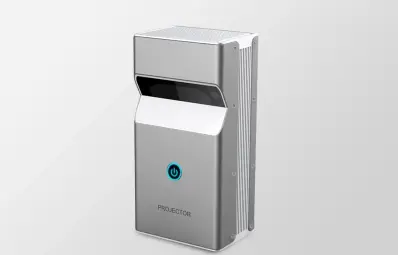
For interactive-flat-panel replacements, the DP01 UST Interactive Smart Projector with Touch Module delivers UST projection with multi-touch input at a fraction of the panel cost—an increasingly common ODM request from schools.

Buyers looking for a turnkey smart OS reference should evaluate the GP95-GTV 400 ANSI Full-Sealed Smart Projector with Google TV Built-In. Google TV is licensed and pre-integrated, eliminating months of middleware work for ODM projects.
A common mistake we see from first-time projector brands is overspending on hardware tooling before validating that there is a market. Here is our recommended allocation for a $50,000 first-launch budget:
| Branding Layer | Suggested Spend (USD) | Rationale |
|---|---|---|
| Hardware logo + color | $0–$3,000 | Often free or near-free on existing molds |
| Firmware boot logo + launcher | $2,000–$5,000 | High ROI — every customer sees it |
| Retail packaging design + first print run | $8,000–$15,000 | Where shelf differentiation actually happens |
| Manuals + accessory branding | $3,000–$6,000 | Important for retail compliance |
| Service infrastructure (website, support, RMA) | $5,000–$10,000 | Underinvested by most brands |
| Reserve for second-print run refinements | $10,000–$15,000 | First print run always has 2–3 fixes |
| Total recommended | $30,000–$50,000 | Conservative for a 1,000-unit launch |
MOQ Realities for Each Branding Layer
A frequently asked question: what is the minimum order quantity for each type of branding? The honest answer:
- Logo pad printing on existing mold: 100–300 units
- Custom housing color (pigment change): 300–500 units (small pigment batch fees apply below 500)
- Custom launcher / boot logo: 100 units (firmware flashing is per-unit cost only)
- Pre-installed custom apps: 500 units (some app licenses require minimum volume)
- Fully bespoke retail packaging: 500 units (one-time print setup fees recovered)
- New injection mold tooling: 1,000+ units (tooling amortization below this is brutal)
- Custom firmware fork: 1,000+ units (development cost recovery)
The Boot Logo — Your Free 5 Seconds of Brand Equity
The boot logo is the single most underutilized branding asset. Every single customer who turns on the projector sees it. For the cost of a 2-second animated logo and a custom splash screen ($1,500–$3,000 one-time fee), you own 5 seconds of every customer's attention — every morning, every meeting, every movie night. Multiply that by the 3–5 year product life and the lifetime impressions easily clear 1,000 per unit.
What works in a boot logo:
- 2–4 second duration (longer feels sluggish)
- 1080p resolution, no letterboxing, dark background compatible
- Sound optional but recommended (a 1-second brand sting)
- Final frame settles into the launcher (no jarring cut)
- Loud colors or animations that fight the launcher's visual identity
- Slow fade-outs that delay the user
- Auto-play video (most buyers prefer instant-on feeling)
Packaging That Sells Without Words
Retail packaging for a projector has a 3-second job: communicate category, screen size, key feature, and brand quality. The hierarchy that works:
- Hero image — projector casting a 100"+ image on a wall in a real room (lifestyle, not white background)
- Brand mark — top-left or top-right, never center
- Key spec badge — "Native 1080p", "Android TV", "WiFi 6", "Bluetooth 5.0"
- Lumen number — buyers scan for the biggest number on the box
- Throw ratio badge — "100" @ 2.5m" or "Short Throw"
- Contents list — minimal, monochrome, bottom edge
- Compliance marks — CE, FCC, RoHS, recycling, model number
Regional Customization Checklist
If you sell in multiple regions, your custom smart projector branding must adapt. The table below is the operational checklist we apply for each region:
| Element | USA | EU | India | Middle East | Latin America |
|---|---|---|---|---|---|
| Box language | English + Spanish (optional) | English + local language | English + Hindi | English + Arabic | Spanish + Portuguese |
| Adapter plug | US 2-pin | EU/UK 2/3-pin | India 3-pin (BS 546) | UK 3-pin / EU 2-pin | US 2-pin / EU 2-pin |
| Manual languages | English | English + 4 EU languages | English + Hindi | English + Arabic | Spanish + Portuguese |
| Energy star label | Required | Voluntary | Voluntary | Voluntary | Voluntary |
| BIS marking | No | No | Required | No | No |
| Recycling marks | California only | WEEE required | E-waste rules | Voluntary | Voluntary |
| Local distributor sticker | Yes | Yes | Yes | Yes | Yes |
What We Have Seen Go Wrong (So You Don't Have To)
Five recurring mistakes:
- Custom tooling before validation — a brand spent $80,000 on a custom mold for a model that did not sell. The mold sits idle. Lesson: validate first, tool later.
- Boot logo animation too long — 8-second video intro made the projector feel like a 2005 DVD player. Lesson: keep it under 4 seconds.
- Packaging print run too small — first run of 200 units was $14 per unit; second run of 1,000 units was $2.80 per unit. Lesson: print economics reward volume.
- Skipping the regional compliance review — a US-designed box failed EU WEEE marking requirements, costing 6 weeks of detention at Rotterdam. Lesson: compliance review is non-negotiable.
- Assuming software customization is free — a brand asked for a custom launcher two weeks before shipment. It cost them a 14-day delay and $4,500 in rush engineering. Lesson: lock firmware scope at sample approval, not at deposit.
Conclusion and Next Step
Custom smart projector branding is a layered system, not a single decision. The brands that win on Amazon, in Costco, and on retailer shelves are the ones that treat each layer — hardware, firmware, packaging, service — as a distinct investment with its own ROI. The smart path is to start with firmware + packaging differentiation on an existing factory platform, validate the market with a 500–1,000 unit run, then escalate to bespoke tooling once you have sell-through data.
💼 Need a custom-branded projector sample?
Request a Free Quote | View Product Catalog
Send us your brand mark, target specs, and target market. We will prepare a sample with your boot logo and branded packaging within 14 days. MOQ starts at 100 units for software-only customization, 500 units for full custom packaging.
