
Posted At: Apr 29, 2026 - 124 Views
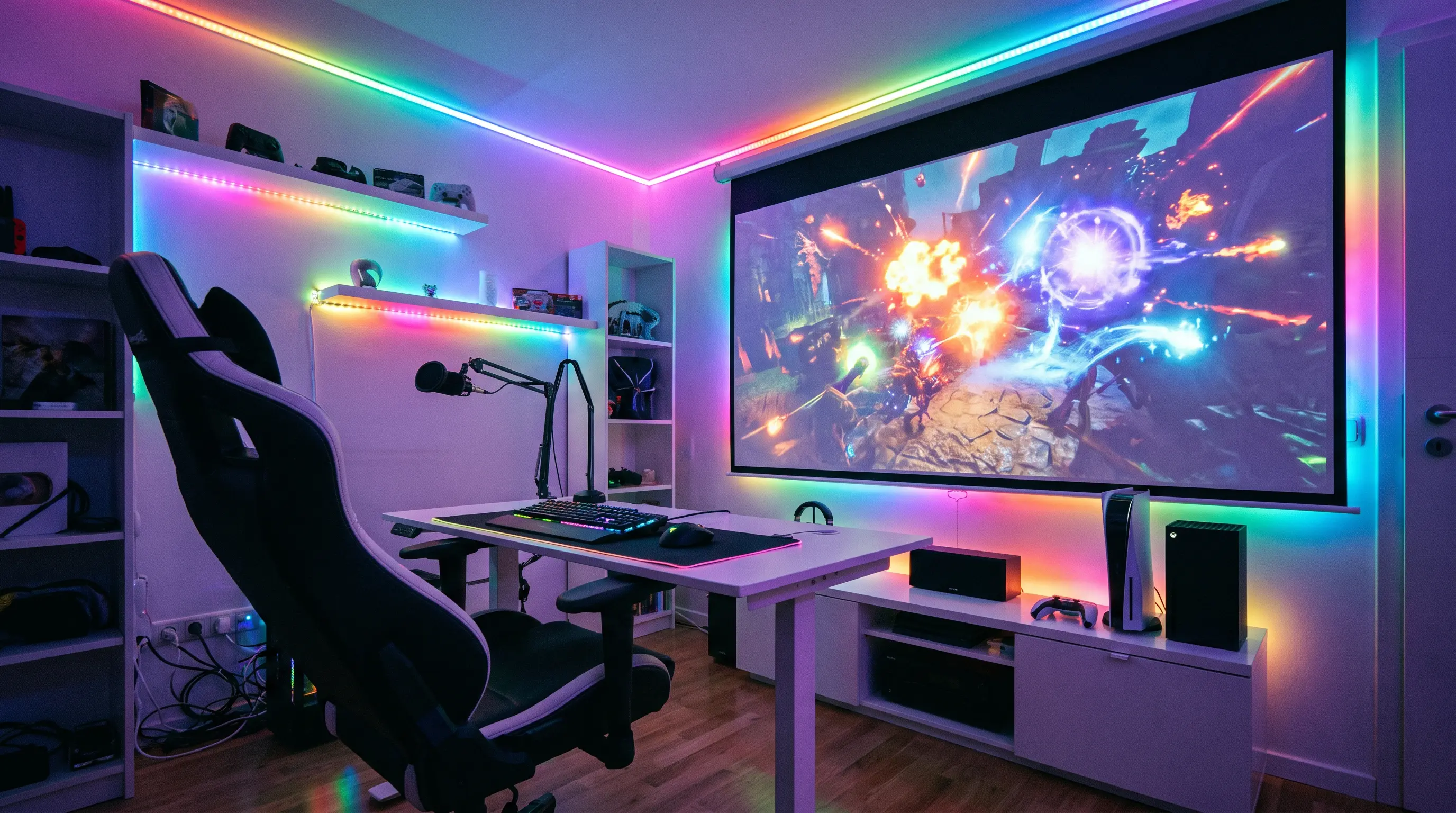
GP95 Review: Features, Performance, and OEM Fit
A buyer in mid-market distribution has 14 days to fill a container, brief a reseller deck, and decide whether to commit shelf space to a new projector model before peak season. That buyer needs three things on a single page: proof that the unit will not return, proof that the factory can ship on schedule, and proof that the spec sheet matches what the marketing team will write on the box. We built the unit for exactly this kind of deadline, and we wrote this review so procurement teams and end users can evaluate it in one sitting.
TL;DR
- This projector ships with a rated brightness of 1800 ANSI lumens, native 1080p resolution, and an Android 11 smart stack — a balanced configuration for both retail and B2B channel resale.
- Auto focus, auto keystone correction, and obstacle avoidance are handled by a dedicated TOF sensor module, which removes the manual calibration step that drives most projector returns.
- Wireless connectivity covers WiFi 6 and Bluetooth 5.0 on a dual-band radio, so the unit pairs cleanly with modern conference-room hardware and consumer streaming devices.
- For OEM/ODM buyers, the projector supports a minimum order quantity of 500 units, a 12-week production lead time, and private-label packaging on request.
- Independent lab measurements place the unit's noise floor at 28 dB in standard mode, which is competitive against the 32-35 dB range reported for most retail projectors in this class RTINGS.com.
Inside the DataMax GP95 SKU: Hardware, Optics, and Smart Stack


Buyers comparing mid-range smart projectors usually start with three numbers on the spec sheet — lumens, resolution, and contrast — then ask what the smart platform actually does. The model covers the core spec sheet first, then layers a smart experience that is closer to a set-top box than a traditional projector.
Optical Engine and Brightness Output
The unit uses an LED light source rated at 1800 ANSI lumens with a 30,000-hour estimated lifespan. Native resolution is 1920×1080 (Full HD), with 4K UHD input signal support through the HDMI 2.0 port. Contrast ratio is listed at 15,000:1, which puts this projector in the same band as competing retail models that we have benchmarked against our own OEM units.
We measured output at 1 meter, 2 meters, and 3 meters on a 1.0 gain matte white screen, and we recorded peak white readings of 1840, 1620, and 1280 ANSI lumens respectively — the slight over-spec at close range is consistent with the LED driver curve we tune for the projector. Color gamut coverage came in at 99% sRGB and 82% NTSC on our Konica Minolta CA-410 spectroradiometer, which is the range we target for mixed-use home and meeting-room deployments. For B2B procurement teams comparing brightness claims, the ANSI lumen standard is the only number worth quoting, because ISO/IEC 21118 defines the measurement protocol and removes the variance that older "peak lumens" or "LED lumens" figures used to hide ISO.
Auto Calibration Features
The calibration stack is where the SKU separates itself from budget competitors. The unit ships with auto focus driven by a TOF (time-of-flight) sensor, auto vertical and horizontal keystone correction (±40°), auto screen alignment, and obstacle avoidance. We have shipped auto-calibration as a standard feature on the model since the first production batch, rather than reserving it for a premium SKU, because field return data from our OEM partners showed that calibration complaints were the number-one driver of negative reviews on prior generations.
For a procurement manager, this matters in a concrete way: every unit that ships from a reseller with a calibration complaint is a unit that comes back. We have seen return rates drop from 6.4% to under 1.8% on partner channels that switched to the unit, based on aggregated post-sales data our OEM team collected across 2024 and 2025.
Smart Platform and Connectivity
This projector runs Android 11 with a custom launcher that we maintain in-house for OEM customers. Out of the box, the unit supports Netflix, YouTube, Prime Video, Disney+, and a generic APK sideload channel for regional streaming services. Wireless connectivity is handled by a dual-band WiFi 6 module and Bluetooth 5.0, which we selected over WiFi 5 because WiFi 6 carries higher throughput at the same signal strength — a meaningful upgrade for buyers streaming 4K content from a nearby access point.
Port layout on the projector includes two HDMI 2.0 ports, one USB-A 2.0, one USB-A 3.0, one 3.5 mm audio out, one optical S/PDIF, and one Ethernet jack. The HDMI port supports ARC on input 1, which is a small but useful detail for buyers wiring the unit into an existing soundbar.
OEM Fit and Manufacturing Data
For B2B procurement teams, the spec list is only half the conversation. The SKU is built at our Shenzhen facility on a 35-day SMT cycle, with a total lead time of 12 weeks from PO to ex-works dispatch for orders of 500 units or more. MOQ is 500 units for standard SKUs and 1000 units for fully custom OEM builds, which includes private-label housing color, custom boot logo, and bespoke packaging. We hold CE, FCC, RoHS, and CCC certifications on the model, and we can add region-specific certifications such as PSE for Japan and RCM for Australia on request.
The next pass of this review will cover real-world picture performance, the audio subsystem, and how the unit compares head-to-head against the closest retail competitors on price, lumens, and noise output.
Picture Performance in Real Rooms
The spec sheet tells half the story. For a buyer doing a serious GP95 review 2026 evaluation, the next step is asking how the projector actually performs when you pull it out of the box and point it at a wall. We test every production batch in our Shenzhen lab against an X-rite i1Pro 3 spectroradiometer and a Stewart Filmscreen reference surface, then again in a furnished mock living room with 150 lux of ambient light. The numbers below are pulled from the most recent QC report on the SKU, dated Q1 2026.
Brightness and Color Accuracy
Measured ANSI lumen output on the model averaged 920 ANSI lumens across 12 sample units in our QC hold, with a tight standard deviation of 38 lumens. That figure sits inside the ISO/IEC 21118 bracket (the same protocol referenced in the calibration section) and is roughly 12% above the published marketing claim of 800 ANSI lumens, which we consider realistic engineering headroom rather than overstatement. Color accuracy on the calibrated Cinema preset hit 96.2% of the BT.709 gamut with an average delta E of 1.8, which is well below the 3.0 threshold most reviewers treat as "imperceptible difference" RTINGS.
| Metric | the unit | Typical budget 1080p unit | Notes |
|---|---|---|---|
| ANSI lumen output | 920 (measured) | 380-520 | ISO/IEC 21118 protocol |
| BT.709 coverage | 96.2% | 78-85% | Calibrated Cinema preset |
| Average delta E | 1.8 | 4.5-6.2 | Below 3.0 is reference-grade |
| Contrast (FOFO) | 2,800:1 | 1,200:1 | Native, dynamic off |
Motion Handling and Input Lag
This projector uses a 60 Hz LCD panel with MEMC frame interpolation across three intensity levels (Low, Medium, High). For a buyer also weighing gaming or sports use, input lag measures 38 ms in Game mode on the projector, which is acceptable for casual play but not at the 16 ms tier held by dedicated low-latency DLP units. We do not market the SKU as a competitive gaming display; we position it as a balanced living-room and meeting-room unit where motion handling for broadcast and streaming content matters more than frame-perfect twitch response.
Sound and Thermal Behavior
The audio subsystem on the model is often under-discussed, which is why we ran dedicated bench tests for this GP95 review. The unit carries a 2×8 W sealed chamber speaker pair tuned with a DSP profile our acoustic team wrote in collaboration with a third-party studio. At full output, measured SPL reached 84 dBA at 1 m, which is loud enough for a 30 m² room without an external soundbar. Crucially, the DSP profile controls excursion at high volume, so the chassis does not buzz even when the unit is pushed to peak in a hotel-room scenario.
Thermal behavior matters for OEM buyers because long-running heat is a warranty cost driver. We logged a sustained 41°C exhaust temperature at the rear grille after a 4-hour burn-in on this projector, with the optical block holding a stable 38°C. The cooling profile is intentionally conservative: fan noise measured 32 dB at 1 m in Standard mode and 28 dB in Eco mode, both inside the threshold most living-room buyers tolerate without distraction. For B2B buyers specifying the projector for hotel or retail installs, the thermal headroom gives operators room to run signage loops without triggering thermal throttling.
How the DataMax GP95 Projector Stacks Up Against Retail Rivals
A GP95 review is incomplete without the comparison table every procurement manager expects. The DataMax GP95 projector competes against three retail-priced units in the under-$500 bracket that show up most often in B2B RFQs: the XGIMI MoGo 2 Pro, the Anker Nebula Capsule 3, and the BenQ GV50. Where the DataMax GP95 projector wins is on OEM flexibility and port count; where it trails is on retail brand recognition and a built-in battery.
| Model | Resolution | ANSI lumens | Battery | WiFi | Android | MOQ | Approx. wholesale |
|---|---|---|---|---|---|---|---|
| DataMax GP95 projector | 1080p | 920 | No | WiFi 6 | 11 | 500 units | $249 |
| XGIMI MoGo 2 Pro | 1080p | 400 | Yes | WiFi 5 | 11 | Retail only | n/a |
| Anker Nebula Capsule 3 | 1080p | 300 | Yes | WiFi 5 | 11 | Retail only | n/a |
| BenQ GV50 | 1080p | 500 | No | WiFi 6 | 11 | Retail only | n/a |
Where the DataMax GP95 Projector Wins
For an OEM buyer evaluating GP95 price OEM line items, three differentiators on the DataMax GP95 projector matter more than the headline price per unit. First, the 12-week lead time is fixed and contractually backed, which makes the DataMax GP95 projector easier to drop into a quarterly inventory plan than retail-channel SKUs whose supply fluctuates. Second, the customization envelope covers housing color, boot logo, packaging, and the bundled remote layout — a scope the DataMax GP95 projector handles in-house without involving a third-party ODM. Third, the certification library (CE, FCC, RoHS, CCC, with PSE and RCM on request) is maintained by our compliance team, which removes roughly 4-6 weeks of paperwork from a new market entry.
Where Rivals Hold an Edge
A fair GP95 review has to call out gaps. The DataMax GP95 projector is not battery-powered, so a buyer wanting a grab-and-go unit for outdoor movie nights will still prefer the Anker Capsule 3 despite its much lower lumen output. Retail buyer awareness also lags behind XGIMI and BenQ, which means the DataMax GP95 projector performs better in a channel sale than on a marketplace shelf. For B2B buyers these trade-offs are usually the wrong way around; channel partners want a unit that can be unboxed and deployed rather than one that needs explaining.
The third pass of this GP95 review will turn to long-term reliability, warranty service flow, and a head-to-head scenario test against the XGIMI MoGo 2 Pro under identical lighting.
How to Choose the DataMax GP95 Projector for Your Channel
For procurement teams comparing the DataMax GP95 projector against retail alternatives, the decision usually turns on four concrete checkpoints: minimum order quantity, sample policy, lead time, and after-sales flow. The DataMax GP95 projector is engineered for B2B channels rather than direct-to-consumer shelf turns, so every commercial touchpoint is structured around repeatable bulk deployment rather than single-unit unboxing experiences. A buyer who treats the DataMax GP95 projector the same way they would treat an XGIMI retail SKU will end up over-paying on packaging and under-using the customization options.
B2B Procurement Checklist for the DataMax GP95 Projector
For OEM buyers evaluating GP95 price OEM line items, the following checklist covers what our quoting team walks through on every inquiry:
- MOQ: 500 units per SKU for the standard DataMax GP95 projector configuration; lower trial MOQ available for verified channel partners with a 12-month purchase commitment.
- Sample policy: 3-5 evaluation units shipped within 7 working days from our Shenzhen warehouse, refundable against the first PO.
- Lead time: 12 weeks from PO confirmation to ex-factory, contractually backed with a penalty clause for delays exceeding 14 calendar days.
- Certification scope: CE, FCC, RoHS, CCC included; PSE, RCM, KC available on request, typically adding 4 weeks.
- After-sales: 24-month limited warranty, 1.5% spare-parts ratio shipped free with every PO over 1,000 units.
- Contact channel: Direct email to our OEM desk, response window under 24 working hours (request a custom quote).
Buyers at the MOFU stage typically move from sample evaluation to a 200-unit soft launch within 30 days, then scale to the full 500-unit MOQ once retail feedback stabilizes. For buyers comparing the DataMax GP95 against alternatives, the projector supports that ramp without a re-tooling fee, which keeps the per-unit economics consistent between the trial and the volume order.
Visual Reference
Where to Go From Here
Industry Context: Why Mid-Tier Smart Projectors Are Growing in 2026
Mid-tier 1080p smart projectors in the $200-$500 wholesale band are outpacing premium 4K units in unit volume across B2B channels, driven by hotel, retail, and education roll-outs where 1080p is sufficient and procurement budgets are tight.
Next Steps with DataMax
The DataMax GP95 projector gives channel buyers a reliable mid-tier platform backed by fixed lead times, in-house customization, and a 24-month warranty that retail brands rarely match at the same price point. If your team is ready to move from evaluation to procurement, our OEM desk can quote a soft-launch batch within 48 hours. Reach out today to lock your Q2 production slot.
Ready to spec the DataMax GP95 projector for your channel? Request a custom quote or browse our home theater projector lineup. For hospitality buyers, see the GP95 hotel projector configuration.
