
Posted At: Jun 11, 2026 - 5 Views

DMD Chip Selection Guide: Texas Instruments DLP for Projectors
Texas Instruments (TI) is the sole supplier of DMD (Digital Micromirror Device) chips for DLP projectors, making DMD selection a critical decision for any projector OEM buyer. DMD chip selection affects image quality, BOM cost, lead time, and product roadmap. This guide explains the available DMD options, the trade-offs, and how to choose the right chip for your projector SKU.

How DMD Chips Work
A DMD chip contains millions to billions of microscopic mirrors on a silicon die. Each mirror represents one pixel and tilts thousands of times per second to direct light either toward or away from the projection lens.
Key specs:
- Resolution: number of mirrors (pixels)
- Pixel pitch: distance between mirror centers
- Mirror tilt angle: typically ±12° or ±17°
- Switching speed: microsecond response time
The Current DMD Lineup

On the high-brightness side, the GP98 12400 Lumens Smart Projector for Meeting Rooms is our flagship reference platform for ODM partners—laser-phosphor light source with a sealed optical block.
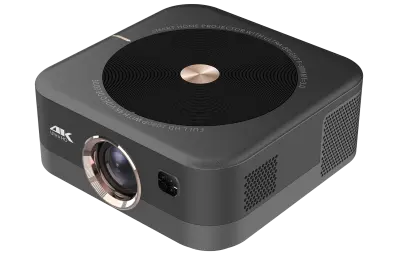
Distributors evaluating the B2B projector market can reference our GP94C Android Smart Projector for Home Theater—a production-validated platform covering Android 9 · 500 ANSI · Built-in Speakers, suitable as an OEM/ODM starting point.
TI offers DMD chips in several sizes for projector applications:
0.16" DMD (2024+)
- 640×360 (nHD) native, or higher via XPR
- Newest, smallest DMD for ultra-compact
- Targeted at pocket / wearable projectors
- Limited availability
0.23" DMD
- 960×540 (qHD) native
- 1920×1080 via XPR pixel-shifting
- Used in entry-level portable projectors
- Pixel pitch: 5.4 µm
0.33" DMD
- 1920×1080 (1080p) native
- Used in mid-tier portable and home theater
- Pixel pitch: 7.6 µm
0.47" DMD
- 1920×1080 (1080p) native OR 3840×2160 (4K) via XPR
- Most popular consumer projector DMD
- Pixel pitch: 5.4 µm (XPR) or 7.6 µm (native)
- Two versions available: 1080p native or 4K XPR
0.66" DMD
- 1920×1200 (WUXGA) native
- 3840×2160 (4K) via XPR
- Used in commercial, education, premium home
- Pixel pitch: 7.9 µm (4K XPR) or 13.6 µm (WUXGA)
1.38" DMD
- 3840×2160 (4K) native
- Premium home theater and pro-AV
- Pixel pitch: 7.9 µm
- Most expensive DMD
Choosing the Right DMD
Decision factors:
1. Target Resolution
| Target Resolution | DMD Options |
|---|---|
| 720p | 0.23" XPR to 720p |
| 1080p | 0.33" native, 0.47" native |
| 4K | 0.47" XPR, 0.66" XPR, 1.38" native |
| WUXGA | 0.66" native |
2. Target Brightness
Higher brightness can drive larger DMD selection:
- < 500 ANSI: 0.23" or 0.33" DMD
- 500–1,500 ANSI: 0.33" or 0.47" DMD
- 1,500–4,000 ANSI: 0.47" or 0.66" DMD
- 4,000+ ANSI: 0.66" or 1.38" DMD
3. Form Factor Constraints
Smaller DMD = smaller optical engine = smaller projector:
- Pocket size: 0.23" DMD
- Portable: 0.33" DMD
- Mainstream consumer: 0.47" DMD
- Commercial / premium: 0.66" or 1.38" DMD
4. BOM Cost Targets
DMD cost ranges (1,000-unit volume):
| DMD | Cost Range |
|---|---|
| 0.23" 1080p XPR | $5–$15 |
| 0.33" 1080p | $12–$25 |
| 0.47" 1080p | $15–$30 |
| 0.47" 4K XPR | $25–$60 |
| 0.66" WUXGA | $40–$80 |
| 0.66" 4K XPR | $60–$100 |
| 1.38" 4K | $150–$300 |
5. Lead Time Considerations
TI DMD lead times:
- Mainstream (0.33", 0.47"): 4–14 weeks
- Newer (0.16", 0.23"): may be longer due to allocation
- Premium (1.38"): 12–20 weeks
DMD Allocation Challenges
Texas Instruments allocates popular DMDs to its largest customers. Common scenarios:
- Allocation: DMD supply limited; customers placed on allocation
- Lead time extension: standard lead time 4 weeks becomes 14+ weeks
- Last time buy: DMD discontinued, final purchase opportunity
- Use multiple DMD options per SKU (designed to accept either 0.33" or 0.47")
- Maintain 6-month safety stock for mature SKUs
- Track TI DMD roadmap for new chip releases
The XPR Pixel-Shifting Trade-off
XPR (eXpanded Pixel Resolution) is TI's pixel-shifting technology. A 1080p DMD shifts at 240Hz to display 4 distinct positions per pixel, creating 8.3 million distinct pixel positions on screen — equivalent to 4K resolution.
Trade-offs:
| Aspect | Native 4K | XPR 4K |
|---|---|---|
| True resolution | 4K | Effectively 4K |
| Pixel visibility at close range | Negligible | Minor |
| DMD cost | $150–$300 | $25–$60 |
| Optical engine complexity | Higher | Lower |
| Consumer perception | "Real 4K" | "Pixel-shifted 4K" |
DMD Chip Roadmaps
TI regularly introduces new DMDs:
- 2024+: 0.16" DMD for ultra-compact
- Ongoing: Higher-resolution variants of existing sizes
- Premium: Improved 1.38" variants for home theater
- New chip introduction = cost reduction opportunity
- Chip EOL = migration planning required
- TI design support = free for qualified customers
The DMD Replacement Market
For long-term OEM buyers, DMD replacement (warranty / repair) matters:
- TI continues to supply mature DMDs for 5–10+ years after introduction
- Allocation may apply to replacement volumes
- For mature SKUs, plan for replacement DMD supply
- Choose DMDs with proven longevity
- Maintain tooling for DMD replacement
- Stock spare DMDs for warranty service
OEM Specification Best Practices
When specifying DMD in your RFQ:
DMD CHIP SPECIFICATION
Manufacturer: Texas Instruments (TI)
DMD model: [e.g., DLP470NE for 0.47" 1080p]
Native resolution: 1920×1080 (or specify XPR if pixel-shifted)
Pixel pitch: [µm]
Mirror tilt angle: ±17° (typical)
Operating temperature: 0–70°C (typical)
Package type: [specific TI package]

Required support:
TI DMD datasheet
Reference design availability
TI technical support contact
Allocation / lead time confirmation
EOL policy (typically 5–10 years notice)
DMD Lifetime and Reliability
DMD reliability specs:
- Operating life: > 100,000 hours (limited by light source, not DMD)
- Operating temperature: 0–70°C (chip), 0–45°C (projector ambient)
- Storage temperature: -40 to +80°C
- Mechanical shock: 1,500 G (DMD chip itself is rugged)
- Thermal damage (overheating)
- ESD damage (improper handling during manufacturing)
- Optical contamination (dust between DMD and prism)
Common OEM Mistakes
Five pitfalls:
- Specifying DMD without confirming allocation — popular DMDs on allocation
- Single-source DMD — risk if DMD goes on allocation
- Ignoring DMD EOL policy — DMD discontinued mid-product life
- Skipping ESD protection in production — DMD damage during assembly
- Insufficient thermal management — DMD overheating, mirror failure
DMD vs LCD vs LCoS
Quick comparison:
| Attribute | DLP (DMD) | LCD (3LCD) | LCoS (SXRD/D-ILA) |
|---|---|---|---|
| Native contrast | 1,500:1 to 5,000:1 | 1,000:1 to 3,000:1 | 5,000:1 to 30,000:1 |
| Response time | Microseconds | Milliseconds | Milliseconds |
| Color brightness | ~80% (color wheel) | 100% | 95–100% |
| Pixel visibility | Some | Visible | Minimal |
| BOM cost | Moderate | Low | High |
| Supplier | TI (sole) | Epson, Sony | Sony, JVC |
What We Recommend for DMD Selection
- 0.47" DMD for mainstream consumer (best balance)
- 0.33" DMD for portable / mini projectors
- 0.66" DMD for commercial / WUXGA applications
- 1.38" DMD for premium home theater only
- Track TI roadmap for new chip introductions
- Confirm allocation before committing to specific DMD
Conclusion
DMD chip selection is a strategic decision that affects cost, image quality, and supply chain. Work with a factory that has strong TI relationships, track TI roadmaps actively, and plan for allocation risk.
💼 Need DMD-based projector OEM service?
Request a Free Quote | View Product Catalog
We have direct TI relationships for mainstream DMD allocation and roadmap visibility. We will recommend the right DMD for your target specifications within 24 hours.
