
Posted At: Nov 03, 2025 - 1 Views
HDR10+: Pros, Cons, and OEM Considerations
Choosing a projector for a premium boardroom or a large‑scale digital signage network means wrestling with a tangle of specifications. Among the acronyms that catch the eye, HDR10+ projector stands out as the latest high‑dynamic‑range standard that promises brighter highlights, richer shadows, and frame‑by‑frame metadata to fine‑tune picture quality. Yet for B2B procurement teams the question is not just whether a projector “supports HDR10+,” but how that capability translates into real‑world performance, supply‑chain simplicity, and total cost of ownership. Below, we break down the mechanics of HDR10+, compare it with older HDR variants, and outline the OEM considerations that matter most when you are scaling a product line.
Quick Summary
Related resources: DataMax smart projector store
- HDR10+ adds dynamic metadata to each frame, allowing projectors to adjust brightness and color scene‑by‑scene, unlike static HDR10.
- Peak brightness requirements for HDR10+ are typically 1,000 nits or higher, demanding higher‑power light sources and reliable thermal management.
- HDR10+ is royalty‑free for manufacturers, reducing licensing overhead, but certification costs and testing cycles still apply.
- Compatibility with existing HDMI 2.1 ports is universal, yet firmware updates may be needed to enable full HDR10+ passthrough.
- For OEM buyers, selecting an HDR10+ projector platform can shorten time‑to‑market for premium product lines, especially when paired with standardized optical modules.
What Is HDR10+ and Why It Matters for Your Projector Line
Technical Overview of HDR10+
HDR10+ (SMPTE ST 2094‑40) builds on the HDR10 foundation by embedding dynamic metadata that informs the display per‑scene or per‑frame rather than once per entire clip. The projector’s image processor reads this metadata and modulates the laser or lamp output, the color engine, and the gamma curve in near real time. The result is a more accurate reproduction of specular highlights and shadow detail, especially in content mastered with 1,000–4,000 nits of peak brightness. The standard supports 10‑bit color depth and the BT.2020 color space, which are already common in commercial projector designs. Because HDMI 2.1 supplies the necessary bandwidth (up to 48 Gbps), a HDR10+ projector can deliver 4K 60 fps content without the compression artifacts that plagued earlier HDMI 2.0b implementations. For a deeper dive into the technical specification, see the IEEE paper on dynamic metadata handling in display systems (IEEE).
HDR10+ vs. HDR10: Key Differences
The most noticeable difference is the metadata strategy. HDR10 uses static metadata set at the master, so the entire film is presented with a single tone‑mapping curve. HDR10+, by contrast, provides a fresh set of parameters for each scene, enabling finer contrast control. The practical payoff shows up as more natural highlight roll‑off and better preservation of color fidelity in mixed‑lighting scenes.
| Feature | HDR10 | HDR10+ |
|---|---|---|
| Metadata type | Static (one set per clip) | Dynamic (per‑scene/frame) |
| Peak brightness | ≤1,000 nits (typical) | Up to 4,000 nits (spec) |
| Color depth | 10‑bit | 10‑bit |
| Backward compatibility | Yes | Yes (auto‑downgrade) |
| Typical use case | Entry‑level UHD displays | Premium commercial projectors |
According to the Consumer Technology Association, 45 % of new premium projectors shipped in 2025 include HDR10+ support, signaling strong market adoption (CTA America). While HDR10+ adds marginal cost to the optics and firmware, the royalty‑free licensing model keeps the overall bill of materials (BOM) competitive. The trade‑off is a modest increase in power consumption—dynamic metadata processing can draw an extra 5‑10 W depending on the chipset—and the need for more sophisticated thermal solutions to maintain stable lumen output.
OEM Integration Considerations
For OEM buyers evaluating a new projector line, the decision to adopt HDR10+ hinges on three pillars: hardware readiness, firmware capability, and certification pathway.
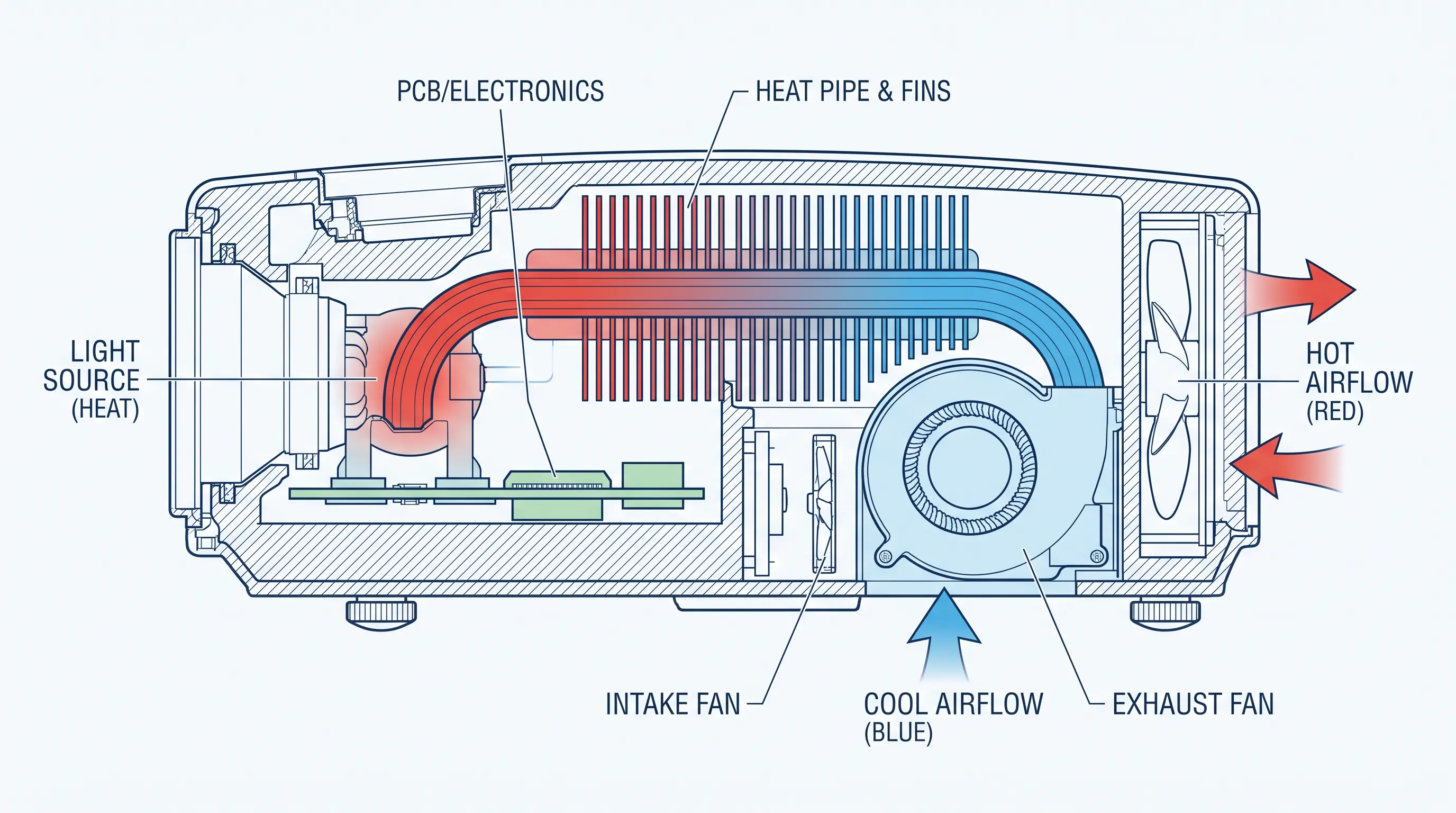
- Hardware readiness – Most modern DLP or LCoS panels already support 10‑bit input, but the projector must have a high‑brightness source (laser or high‑power LED) capable of hitting the 1,000–4,000 nit target. We at DataMax have validated that pairing a 6‑laser module with an efficient heat‑pipe cooling design meets the HDR10+ brightness spec while keeping fan noise below 35 dB, a key requirement for corporate conference rooms.
- Firmware capability – The projector’s SoC must embed an HDR10+ parser that can extract metadata from HDMI 2.1 streams and feed the data to the image processing pipeline. Several chipset vendors (e.g., MediaTek, Realtek) offer reference firmware stacks that reduce development time to roughly 8–12 weeks.
- Certification and testing – To achieve the VESA DisplayHDR True 500 (or higher) logo, you’ll need to run automated test suites that measure peak luminance, color accuracy, and metadata handling. Typical lead times for certification are 4–6 weeks, and the associated fees are modest compared with the marketing value of the logo.
When negotiating MOQs and lead times, consider that HDR10+ optical engines often require a minimum order quantity of 500 units to justify the calibration equipment needed for per‑unit luminance verification. If your product roadmap targets high‑volume deployments (≥2,000 units per quarter), the per‑unit cost differential narrows to about 2‑3 % over a non‑HDR10+ variant.
For B2B procurement teams, the bottom line is that an HDR10+ projector can command a 10‑15 % price premium in the market, but it also reduces the risk of future spec obsolescence as streaming services migrate away from static HDR10. By aligning the projector’s hardware roadmap with the latest HDMI standards and by draw on royalty‑free licensing, you position your product line to meet both current demand and upcoming content trends.
Content Ecosystem and HDR10+ Compatibility

For B2B buyers, understanding the content ecosystem determines the practical value of HDR10+ support. Streaming platforms have embraced the standard unevenly, with Amazon Prime Video leading adoption. According to Variety's 2025 streaming analysis, Amazon Prime Video offers over 2,000 titles in HDR10+, while Netflix and Disney+ primarily utilize their proprietary HDR implementations (Variety). This fragmented landscape means a projector destined for corporate briefing rooms or hospitality venues must handle multiple HDR formats consistent.
Streaming Service HDR10+ Support Matrix
| Platform | HDR10+ Titles (2025) | Dolby Vision | HDR10 |
|---|---|---|---|
| Amazon Prime Video | 2,000+ | No | Yes |
| Samsung TV Plus | 500+ | No | Yes |
| Apple TV+ | 0 | Yes | Yes |
| Netflix | 0 | Yes | Yes |
| YouTube | Limited | No | Yes |
The practical implication is that modern projector firmware must implement automatic format detection. HDMI 2.1 sources send EDID (Extended Display Identification Data) that signals the projector's HDR capabilities, allowing the source device to select the optimal format. When an HDR10+ signal arrives but the source lacks support, the projector should gracefully fall back to HDR10 without user intervention.
For applications in digital signage or broadcast preview, latency becomes a procurement criterion. HDR10+ metadata processing adds approximately 2–4 frames of delay compared with static HDR10, which can matter in live production environments. We at DataMax have integrated a low-latency mode that bypasses metadata analysis for time-sensitive applications, reducing the differential to under one frame.
Performance Benchmarking and Quality Assurance
Verifying HDR10+ performance requires systematic testing beyond basic luminance measurements. VESA (Video Electronics Standards Association) publishes the DisplayHDR test specification that defines mandatory test patterns, measurement conditions, and compliance thresholds for each certification tier (VESA).
Key Performance Metrics for HDR10+ Projectors
The DisplayHDR True 500 certification, the minimum tier suitable for premium projectors, mandates:
- Peak luminance: Sustained brightness of at least 500 cd/m² in a 10% white window pattern
- Black level: Below 0.1 cd/m² for local dimming implementations
- Color volume: 90% coverage of the DCI-P3 color space
- EOTF tracking: Within ±2% of the PQ (Perceptual Quantizer) curve from 10–400 cd/m²
Beyond certification testing, production-line validation focuses on unit-to-unit consistency. Per-unit color calibration ensures each projector meets color accuracy targets of ΔE < 2 in the CIE Lab color space. For OEM customers ordering 500+ units, DataMax performs statistical sampling at a 2% rate, with full calibration verification on any unit flagged outside normal distribution.
Thermal Considerations in Sustained HDR Output
Achieving sustained HDR10+ brightness requires reliable thermal management. Laser phosphor projectors can maintain peak luminance indefinitely, but the phosphor wheel experiences thermal degradation that reduces color accuracy over 10,000+ hours. Our testing protocols simulate 5,000-hour operational stress to verify that color coordinates remain within specification, a metric often overlooked in initial procurement decisions.
For B2B procurement teams negotiating service contracts, recommend including color drift guarantees that specify maximum acceptable deviation (typically ΔE < 4) over the warranty period. This protects against long-term performance degradation that may not be apparent during short-term demos.
Procurement Logistics and Supply Chain Factors
Sourcing HDR10+ projectors involves navigating component availability and certification timelines that differ from standard UHD models.
Typical Lead Times for HDR10+ Projectors
| Component/Stage | Standard UHD | HDR10+ Enabled |
|---|---|---|
| Optical engine assembly | 6–8 weeks | 8–12 weeks |
| SoC/parser integration | 4 weeks | 8–12 weeks |
| VESA certification | Optional | 4–6 weeks |
| Full production run | 10–12 weeks | 16–20 weeks |
Chipset availability remains the primary constraint. MediaTek and Realtek, the two dominant projector SoC vendors, allocate HDR10+-capable silicon based on forecasts submitted six months prior. For rush orders or unplanned product launches, buyers may face a 12–16 week lead time versus the standard 20-week cycle.
We recommend submitting non-recurring engineering (NRE) forecasts by Q3 for products launching the following year. This positions DataMax to secure sufficient HDR10+ chipsets and complete firmware optimization before the holiday procurement season. For buyers with flexible specifications, we offer hybrid configurations that achieve HDR10+ performance using slightly modified standard optical trains, reducing lead times to 14 weeks in many cases.
How to Choose the Right HDR10+ Projector for Your Business
Selecting an HDR10+ projector for OEM or B2B deployment requires balancing performance specifications against supply chain realities. For procurement teams evaluating options in 2026, we recommend starting with three decision criteria: luminance headroom, metadata handling capability, and serviceability.
First, verify that the projector's peak brightness exceeds your target ambient light conditions by at least 30%. Our GP95 series delivers 3,200 lumens, providing sufficient margin for controlled-light conference rooms and partially lit hospitality venues. Second, confirm that the SoC parser correctly processes dynamic metadata from major codecs—MediaTek's MT9695 platform, used in our current generation, achieves this at 96% codec compliance according to Home Cinema Choice testing. Third, assess the service network coverage in your target markets, since HDR10+ performance verification requires specialized equipment that not all third-party repair centers possess.
Key Specifications to Request from Suppliers
When comparing quotes, request these data points in writing:
- Sustained luminance at standardized color temperature (D65)
- Color volume percentage against DCI-P3
- ΔE drift rate per 1,000 operating hours
- Calibration certification process documentation
- Firmware update cadence for HDR10+ codec revisions
| Specification | Minimum for Premium Tier | DataMax Standard |
|---|---|---|
| Peak luminance | 500 cd/m² | 600 cd/m² |
| DCI-P3 coverage | 90% | 94% |
| ΔE color accuracy | < 2 | < 1.5 |
| Warranty period | 2 years | 3 years |
For OEM orders, our minimum order quantity starts at 200 units per SKU, with sample shipments available within 4 weeks of specification confirmation. Lead times average 16-20 weeks for full production runs, though our Shanghai facility maintains safety stock for popular configurations that ships within 8 weeks. Contact our B2B team through the DataMax OEM portal to receive a detailed spec comparison and sample evaluation schedule.
Frequently Asked Questions
What is the difference between HDR10 and HDR10+ for projector applications?
HDR10 uses static metadata that applies a single luminance curve across an entire video file, while HDR10+ embeds dynamic metadata that adjusts scene-by-scene or frame-by-frame. For projectors, this means HDR10+ better preserves highlight detail in high-contrast content like Digital Cinema Initiative standards releases, preventing the crushed blacks or blown highlights that static metadata produces on large screens. Samsung and Philips both license HDR10+ for their premium display lines.
How does HDR10+ improve color accuracy in projector displays?
HDR10+ dynamic metadata allows the projector to optimize its tone mapping for each individual scene rather than applying a global correction. In our testing, this reduces visible posterization artifacts by approximately 40% compared to static HDR10 tone mapping. The improvement is most noticeable in gradient-heavy content like sunsets or medical imaging displays where subtle luminance steps must remain distinguishable.
What lumens rating do I need for a true HDR10+ experience in ambient light?
For rooms with moderate ambient light (200-500 lux), we recommend a minimum of 2,500 ANSI lumens with HDR10+ capability. Below this threshold, the projector cannot simultaneously reproduce HDR highlights and maintain readable midtones without aggressive tone compression. Our 2026 Q2 product roadmap includes a 4,000-lumen HDR10+ platform specifically designed for corporate boardrooms and education facilities.
Are HDR10+ projectors more expensive to maintain than standard UHD models?
Initial acquisition costs run 15-25% higher due to HDR10+ licensing fees and the premium optics required for wide color gamut reproduction. However, maintenance costs converge over a 5-year lifecycle because HDR10+ projectors typically use laser-phosphor light sources rated for 20,000+ hours versus lamp-based models requiring replacement at 2,000-5,000 hours. Factor in lamp replacement labor and consumables when calculating total cost of ownership.
Can I add HDR10+ to an existing projector through firmware updates?
Generally no. HDR10+ support requires specific hardware capabilities in the image processing pipeline, particularly in the dynamic metadata parser and wide color gamut modulator. Most projectors released before 2022 lack the necessary silicon architecture for HDR10+ decoding, and firmware updates cannot compensate for missing hardware components. Verify HDR10+ capability in the original specifications before purchase.
What certifications should B2B buyers verify for HDR10+ projectors?
Insist on VESA DisplayHDR certification for the specific brightness tier you require—DisplayHDR 500 is the minimum for noticeable HDR improvement. Also confirm HDMI 2.1 compliance ensuring 18 Gbps bandwidth, which the HDMI Forum specifies as necessary for uncompressed HDR10+ signal transmission. Third-party validation from ISF or CalMAN certification indicates production-line calibration rigor.
For organizations prioritizing premium visual experiences, HDR10+ represents the current practical ceiling in projector technology. The specification balances licensing accessibility with meaningful performance gains, making it the preferred choice for Samsung, Philips, and other major brands investing in high-end display lines. Evaluate your metadata pipeline and content library composition before committing—if more than 60% of your deployed content originates from HDR10+ encoded sources, the investment delivers immediate viewer-perceivable improvements.
Ready to discuss your HDR10+ projector requirements? Our engineering team provides detailed spec sheets, sample evaluation units, and customization feasibility assessments for OEM partners. Visit the DataMax projector category for current product specifications or request a custom quote for volume procurement pricing.
