
Posted At: May 04, 2026 - 57 Views
How to Choose a Projector ODM Manufacturer: A 12-Point Due Diligence Checklist
Choosing the right projector ODM manufacturer is the single highest-leverage decision in your hardware launch. Get it right, and your product arrives on time, on spec, and on budget. Get it wrong, and you burn 6–18 months of runway chasing delays, quality issues, and IP disputes. This guide gives you a structured 12-point due diligence framework based on a decade of OEM/ODM engagements across 60+ countries — the same framework we walk our own new clients through.
Why the ODM Choice Matters So Much
A projector ODM manufacturer is not just an assembly shop. They are your engineering team, your supply chain, your compliance department, and your warranty backend for the next 5–10 years. The wrong factory will:
- Miss sample deadlines by 4–12 weeks
- Deliver products that fail retailer incoming inspection
- Refuse to honor warranty claims on field failures
- Reverse-engineer your firmware and sell it to your competitors
- Lock your tooling so you cannot switch factories
- Hit sample deadlines within ±3 days
- Pass retailer incoming inspection at >97% acceptance rate
- Triage warranty claims within 48 hours
- Honor tooling ownership clauses and IP assignment
- Help you scale from 500 to 50,000 units without re-tooling
The 12-Point Checklist
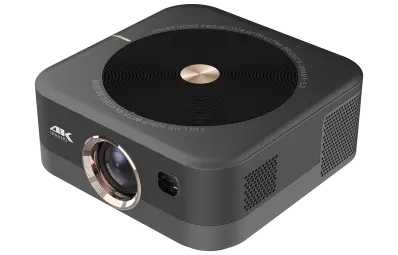
Distributors evaluating the B2B projector market can reference our GP94C Android Smart Projector for Home Theater—a production-validated platform covering Android 9 · 500 ANSI · Built-in Speakers, suitable as an OEM/ODM starting point.

Buyers looking for a turnkey smart OS reference should evaluate the GP95-GTV 400 ANSI Full-Sealed Smart Projector with Google TV Built-In. Google TV is licensed and pre-integrated, eliminating months of middleware work for ODM projects.
1. Years in Smart Projector Manufacturing
Target: 8+ years. We have seen 3-year-old projector factories fold mid-engagement. The market is competitive and consolidation is constant. A factory with 10+ years has weathered at least one industry downturn and emerged stronger.
How to verify:
- Business license registration date
- Export license history
- Tax registration record
- Industry association membership
- Reference customers from 5+ years ago
2. In-House Optical Engine Capability
Target: yes. Optical engine design is the most specialized skill in projector manufacturing. A factory that buys engines from external suppliers cannot troubleshoot field failures or support ODM customization.
How to verify:
- Ask: "Do you design optical engines in-house, or do you source from [Coretronic, Young Optics, Appotronics]?"
- Request photos of the optical lab
- Request a list of optical patents or utility models
- Ask which DMD chips the factory has integrated into production models
3. Documented QC Process (IQC, IPQC, OQC)
Target: written, audited, current. Quality control is the single most common failure point in OEM/ODM relationships. A factory without documented QC is gambling on every shipment.
How to verify:
- Request the QC manual (most factories will share at least the AQL table)
- Ask which IQC sampling standard they follow (ISO 2859-1 is standard)
- Ask for the IPQC frequency on optical alignment
- Request a sample QC report from a recent shipment
4. Transparent BOM Pricing
Target: willing to share component sources, even if exact prices are confidential. A factory that hides component sources is hiding margin at your expense.
How to verify:
- Ask: "Who supplies your DMD chips? LED modules? SoCs?"
- Ask: "What is the gross margin on this model?" (40–55% is typical for OEM; 25–40% for ODM)
- Request an itemized BOM cost breakdown (in percentages, not absolute dollars)
5. Sample Program with Refundable Cost
Target: sample cost refundable against first PO. This is the global B2B standard. A factory that insists on non-refundable sample fees is either desperate for cash flow or hiding something.
How to verify:
- Request a sample order quote
- Confirm refundability against first PO of $X
- Confirm sample lead time (7–14 days for catalog SKUs, 25–35 for custom)
6. NDA and Tooling Ownership Clauses
Target: standard contracts with both. NDAs protect your firmware, your industrial design, your brand specifications. Tooling ownership clauses protect your mold investment.
How to verify:
- Request a sample NDA
- Request the standard ODM contract
- Look for: IP assignment clause, tooling ownership clause, exclusivity clause, warranty clause
7. Compliance Certifications
Target: CE, FCC, RoHS at minimum. BIS for India, GMS for Android TV, INMETRO for Brazil, KC for Korea — all depending on your target markets.
How to verify:
- Request copies of current CE, FCC, RoHS certificates
- Ask: "Which certifications do you maintain in-house, and which require external lab testing?"
- Confirm: "Can you co-manage certification for new SKUs we develop together?"
8. Reference Customers in Your Target Market
Target: 2+ references in your specific market vertical (consumer, education, hospitality, etc.). A factory strong in consumer may be weak in education, and vice versa.
How to verify:
- Request customer references
- Ask for specific buyer contact information (or testimonials)
- Search for the factory's brand on LinkedIn, Alibaba, or industry directories
- Look at the factory's customer concentration — if 80% of revenue is from one buyer, that is concentration risk
9. 24-Hour Engineering Response
Target: yes, with named engineer. Communication lag is the #1 source of frustration in OEM/ODM relationships. A 24-hour response time with a named engineer is the gold standard.
How to verify:
- Send a technical question by email
- Time the response (ignore auto-replies, count the substantive answer)
- Ask: "Who is my dedicated engineer for this project?"
- Ask: "What is your after-hours response for urgent production issues?"
10. Realistic Lead Times
Target: written, with buffer. A factory that promises "30 days for everything" is either lying or has no idea what they are doing.
How to verify:
- Ask for lead times in writing, broken down by phase
- Confirm: "What happens if you miss the lead time — what is your liability?"
- Ask for references who can confirm typical actual lead times
- Look for: at least 20% buffer between factory promise and your retail launch date
11. Production Capacity and Scalability
Target: 5–10× your peak order volume. A factory that is at 80% capacity today may not be able to handle your 5,000-unit seasonal order in Q4.
How to verify:
- Request monthly production capacity by product category
- Ask: "What is your peak-season capacity utilization?"
- Ask: "How do you handle capacity expansion if our orders grow?"
- Look for: at least 5× your peak volume in available capacity
12. Financial Stability
Target: profitable or well-funded. A factory in financial distress will cut corners on components, delay your production, and possibly disappear mid-engagement.
How to verify:
- Request 2–3 years of audited financials (rare but possible for major accounts)
- Ask for trade references (their component suppliers)
- Search for any public records of liens, lawsuits, or bankruptcy
- Look for: stable headcount (no mass layoffs in the last 12 months)
Using the Checklist in Practice
A practical workflow:
- Long list — start with 5–10 candidate factories from Alibaba, Made-in-China, industry directories, and referrals
- Quick filter — apply the first 4 checklist items (years, optical engine, QC, BOM transparency) to narrow to 3–5 candidates
- RFQ — send your detailed spec brief to the shortlist. Ask for pricing, lead time, sample cost.
- Sample order — order samples from 2–3 finalists. Test in your own lab.
- Factory visit — fly to Shenzhen or hire a third-party auditor for the top 1–2 candidates.
- Contract — sign NDA + master supply agreement before placing production PO.
- Pilot run — start with a 100–500 unit pilot run before committing to volume.
Red Flags That Disqualify a Factory
Five patterns that should make you walk away:
- No willingness to share QC documentation — "trust us" is not a quality system
- Pressure to skip NDA or sample phase — legitimate factories welcome both
- Lead times that seem too good — 30-day custom ODM is not realistic
- Resistance to factory audit — credible factories welcome auditors
- Significant customer concentration — if one buyer is 60%+ of revenue, that buyer can shut you out
The Site Visit: What to Look For
If your order is over $50,000, an on-site visit is mandatory. Either fly to Shenzhen yourself (plan 2–3 days) or hire AsiaInspection, QIMA, or Bureau Veritas for a 1–2 day audit.
What to inspect:
| Area | What to Look For |
|---|---|
| Production line | Organized workflow, ESD protection, calibrated equipment |
| Optical lab | Integrating sphere, spectroradiometer, dark room |
| SMT line | Modern pick-and-place machines, AOI, X-ray |
| Aging test area | Racks of powered-on projectors, hours-counter visible |
| Warehouse | FIFO stock, climate control for sensitive components |
| Quality station | AQL tables posted, calibrated instruments |
| Engineering office | Engineers present, CAD stations, optical design software |
| HR / training | Worker onboarding records, safety training |
Beyond the Checklist: Cultural Fit
The 12 points above cover capability. They do not cover cultural fit — and cultural fit matters as much over a 5–10 year relationship. Look for:
- Communication style — does the factory answer questions directly, or deflect?
- Transparency about issues — when problems arise (and they will), does the factory hide or escalate?
- Reasonable pushback — a factory that agrees to everything is not protecting your interests
- Long-term thinking — are they optimizing for this order or for the 10-year partnership?
Conclusion and Next Step
Choosing a projector ODM manufacturer is a multi-month evaluation, not a one-week RFQ. Apply the 12-point framework rigorously, visit the top candidates, and resist pressure to skip steps. The 4–8 weeks you invest in evaluation will save you 4–8 months of production headaches.
💼 Looking for a projector ODM partner?
Request a Free Quote | View Product Catalog
We host over 80 buyer audits per year at our Shenzhen facility. Our engineering team responds within 24 hours with feasibility, sample plan, and tiered pricing. MOQ starts at 500 units for catalog SKUs.
