
Posted At: Apr 06, 2026 - 69 Views
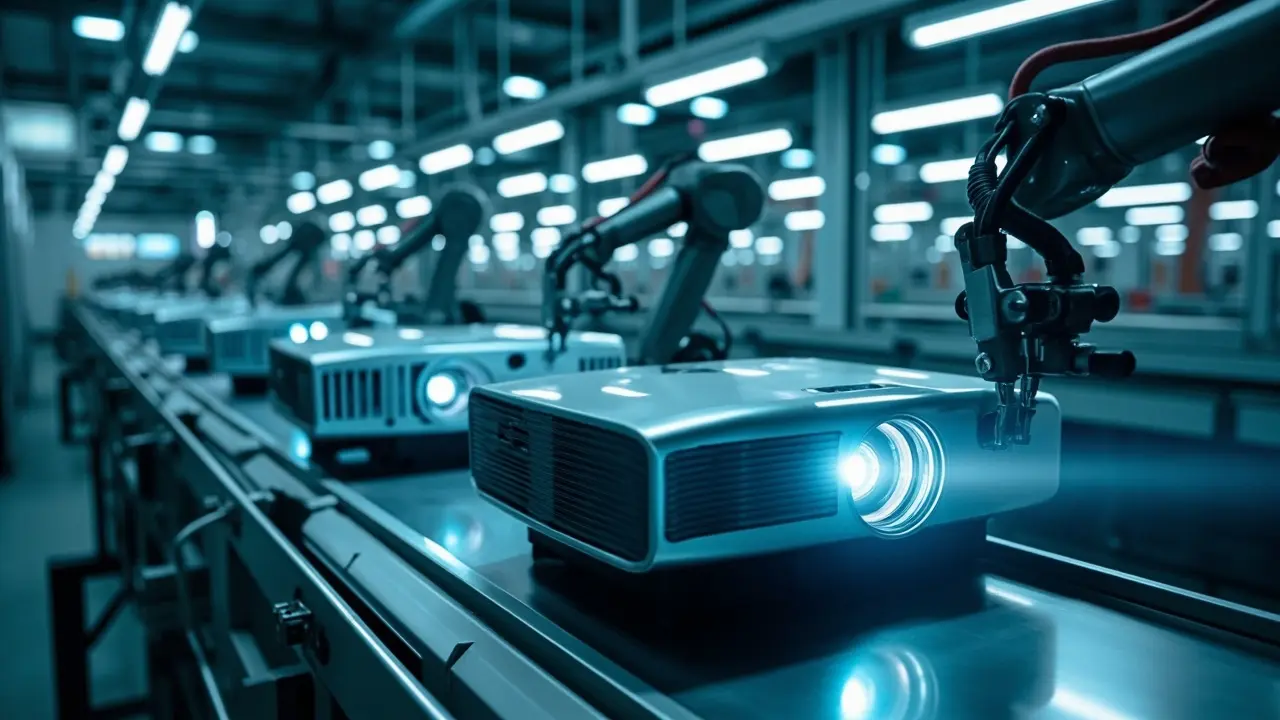
Smart Projector OEM Services: The Complete Guide for Global B2B Buyers
If you are evaluating smart projector OEM services for a private-label launch, a retail expansion, or a vertical-specific product line, this guide walks you through the full manufacturing lifecycle — from initial concept and ID design to mass production, certification, and global delivery. As a Shenzhen-based OEM/ODM factory with a 295-SKU catalog and a decade of smart-projector experience, we serve brand owners, distributors, and procurement teams in over 60 countries. Below, you will learn exactly what a complete OEM engagement looks like, the milestones you should expect, the documentation you need to prepare, and the levers you can pull to control cost, lead time, and risk.
What "Smart Projector OEM" Actually Means in 2026
OEM (Original Equipment Manufacturer) in the projector industry refers to a factory producing finished projectors that carry your brand name, your model number, your packaging, and your firmware configuration. The factory owns the underlying product design and tooling, while your brand owns the customer-facing identity. Most global brands that sell under their own logo on Amazon, Costco, MediaMarkt, or Reliance Digital buy from a smart projector OEM partner rather than designing chips and optics from scratch.
The scope of OEM services typically includes:
- Hardware sourcing (DMD chip, light source, SoC, WiFi/BT module, speakers, housing tooling)
- SMT (Surface Mount Technology) and final assembly on the OEM factory's production line
- Firmware flashing with your boot logo and default settings
- Private-label packaging, manuals, inserts, and serial number labeling
- Compliance pre-testing and certification co-management (CE, FCC, RoHS, BIS, GMS, REACH)
- Export documentation (commercial invoice, packing list, certificate of origin, HS code assignment)
The Six Phases of a Smart Projector OEM Engagement

Buyers looking for a turnkey smart OS reference should evaluate the GP95-GTV 400 ANSI Full-Sealed Smart Projector with Google TV Built-In. Google TV is licensed and pre-integrated, eliminating months of middleware work for ODM projects.

On the high-brightness side, the GP98 12400 Lumens Smart Projector for Meeting Rooms is our flagship reference platform for ODM partners—laser-phosphor light source with a sealed optical block.
Every serious smart projector OEM project moves through six distinct phases. Understanding them helps you set realistic expectations and identify weak signals early.
Phase 1 — Inquiry and Feasibility (Days 1–7)
You send us a brief — typical fields include target lumen output, native resolution, preferred light source (LED/Laser/Lamp), throw ratio, intended operating system (Android/Linux), target unit price band, and target market countries. Our engineering team responds within 24 hours with:
- A shortlist of 2–4 reference models from our 295-SKU catalog that already meet ~80% of your brief
- A feasibility memo flagging spec gaps, certification gaps, and BOM risks
- A preliminary MOQ, FOB Shenzhen unit cost, and lead time estimate
Phase 2 — Sample and Evaluation (Days 8–35)
Once you confirm a reference platform, we produce a functional sample. For most models, sample cost is refundable against your first production PO. You receive the sample within 7–14 days for in-stock platforms, or 25–35 days for a fully customized unit.
What to test on the sample:
- Image quality — ANSI lumen output vs. claim, contrast in ambient light, color accuracy, motion handling
- Acoustic performance — fan noise at full brightness vs. eco mode
- Thermal behavior — chassis surface temperature after 4 hours of continuous use
- Smart features — auto-focus speed, keystone correction range, obstacle avoidance accuracy
- Software stability — app launch time, WiFi reconnection reliability, OTA update success rate
Phase 3 — Commercial Alignment (Days 30–45)
Once the sample is approved, we issue a formal quotation with:
- Tiered pricing based on order quantity (typical breaks at 500, 1,000, 3,000, 5,000 units)
- Payment terms (commonly 30% T/T deposit, 70% balance before shipment)
- Trade terms (EXW, FOB Shenzhen, CIF, or DDP — we support all four)
- Validity period (typically 30 days for spot raw material pricing)
Phase 4 — Mass Production (Days 45–80)
After deposit confirmation and PO issuance, we kick off mass production. A typical timeline for 1,000 units of a custom-finished projector:
| Step | Duration | Notes |
|---|---|---|
| Raw material procurement | 7–10 days | Long-lead items: DMD chip, laser diode, custom tooling |
| SMT and PCBA | 3–5 days | Automated optical inspection (AOI) and X-ray on BGA |
| Sub-assembly | 3–5 days | Optical engine calibration, lens mounting |
| Final assembly | 4–6 days | Housing, speakers, I/O ports, labeling |
| Aging test | 2–3 days | 4–8 hour burn-in per unit, ~2% random QC deep-dive |
| QC inspection | 1–2 days | AQL 1.0 / 2.5 sampling per ISO 2859-1 |
| Packaging | 2–3 days | Private label boxes, manuals, master cartons |
| Pre-shipment audit | 1 day | Buyer-arranged or third-party (SGS, BV, TÜV) |
Phase 5 — Quality Assurance and Pre-Shipment
Quality assurance for a smart projector OEM order is multi-layered:
- IQC (Incoming Quality Control) — every batch of DMD chips, laser diodes, and PCBAs is sampled before going to the line
- IPQC (In-Process Quality Control) — optical engine alignment is verified every 50 units
- OQC (Outgoing Quality Control) — final functional test, appearance inspection, drop test, packaging integrity
- Pre-shipment inspection — buyer-arranged or third-party
Phase 6 — Logistics and After-Sales (Days 80–90+)
We support EXW, FOB Shenzhen, CIF, and DDP shipping terms. For buyers new to importing from China, CIF or DDP removes a layer of complexity because we handle ocean freight, customs clearance, and last-mile delivery to your warehouse. Lead times after production:
| Trade Term | What We Handle | Transit Time (Typical) |
|---|---|---|
| EXW Shenzhen | Factory gate handoff | Buyer arranges |
| FOB Shenzhen | Export clearance, port handoff | 25–40 days sea to EU/US |
| CIF | Sea freight + insurance to destination port | 30–45 days |
| DDP | All duties, customs, last-mile | 35–50 days door-to-door |
How to Control Cost Without Sacrificing Quality
The three largest BOM (Bill of Materials) line items in a smart projector are the optical engine (DMD chip + lens + prism), the light source (LED or laser module), and the SoC + WiFi/BT module. Cost-control levers:
- Light source choice — LED is cheapest up-front but limited to ~30,000 hours; laser is 3–5× more expensive but lasts 25,000–50,000 hours with better color gamut
- Native resolution vs. pixel-shifting — a native 1080p DLP with 4K pixel-shifting saves 30–40% versus native 4K, with marginal perceived difference at typical viewing distances
- Housing material — ABS + PC blend vs. full aluminum affects tooling cost by $15,000–$40,000
- OS choice — AOSP Android is free; GMS-certified Android adds $8–$15 per unit license + $5,000–$15,000 certification cost per SKU
Compliance and Certification: Built In, Not Bolted On
Every smart projector OEM order we ship carries the certifications required by the destination market. The most common certificates we co-manage: CE (EMC + LVD + RED), FCC (Part 15B/15C), RoHS 2.0 + REACH, BIS for India, INMETRO for Brazil, KC for South Korea, and GMS for Android-based models targeting Google Play distribution. We maintain a dedicated compliance team in-house, which typically shaves 4–8 weeks off the certification timeline versus managing it independently.
What Makes a Smart Projector OEM Partner Reliable
A short checklist to apply to any factory you evaluate:
- ✅ 10+ years in smart projector manufacturing
- ✅ In-house optical engine design (not just assembly)
- ✅ Documented QC processes with AQL sampling tables
- ✅ Willing to share factory audit reports (BSCI, Sedex, ISO 9001)
- ✅ Reference customers in your target market
- ✅ Sample program with refundable sample cost
- ✅ NDA + tooling ownership clauses offered proactively
- ✅ Transparent BOM pricing with named component sources
- ✅ 24-hour response time on technical queries
- ✅ Realistic lead times (not "30 days for everything")
Conclusion and Next Step
Choosing the right smart projector OEM partner is the single highest-leverage decision in your hardware launch. A good partner compresses your time-to-market by 4–6 months and protects your brand reputation over a multi-year product life cycle. A bad partner costs you a launch window, a season of sell-through, and potentially a permanent dent in retailer confidence.
💼 Ready to scope a smart projector OEM project?
Request a Free Quote | View Product Catalog
Our engineering team responds within 24 hours. Sample units ship within 7–14 days for in-stock platforms. MOQ starts at 500 units for most models, with lower MOQ negotiable for partial customization.
