
Posted At: Nov 05, 2025 - 55 Views
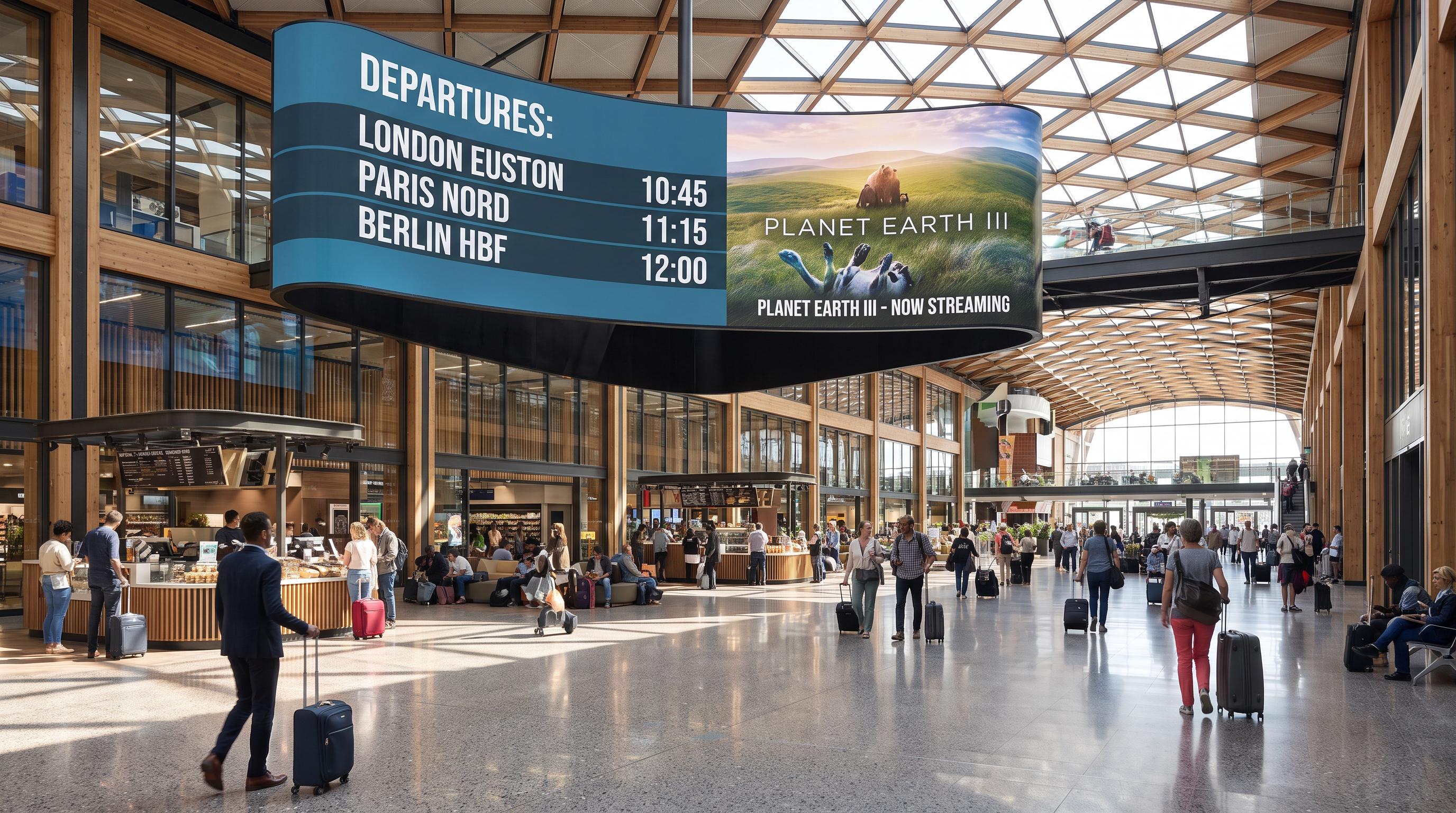
Train station projector: digital signage for rail networks
Train station digital signage projector deployments fail when operators choose a consumer living-room unit and expect it to survive 18 hours of daily operation in a dusty, vibration-prone concourse. Buyers comparing rail network display options quickly discover that brightness, throw ratio, and ingress protection — not contrast ratios or smart-TV features — decide whether a roll-out passes engineering review. This guide breaks down the engineering and procurement specifications that separate a station-grade unit from a domestic cinema projector, and shows you how to spec the unit that meets transit authority standards on the first RFQ.
TL;DR
- This projector must deliver at least 4,000 to 6,000 ANSI lumens to remain legible under platform canopy daylight, well above the 1,500-lumen ceiling of typical home theater units.
- Laser phosphor display engines now dominate rail network display tenders because they offer 20,000 to 30,000 hour light-source life versus 3,000 to 5,000 hours for UHP lamp alternatives.
- Ultra-short throw and short throw optics (0.25:1 to 0.8:1) let a single ceiling-mounted the projector illuminate a 120-inch information panel without casting shadows across passenger flow.
- IP5X dust protection, anti-vibration mounts, and wide-temperature operation (0 to 45 degrees Celsius) are baseline requirements for any the SKU destined for unattended platform cabinets.
- For B2B procurement teams, OEM factory pricing on a 4K UHD laser the model typically lands between $1,800 and $3,400 wholesale at 50-unit MOQ, with 10 to 14 week lead time for custom enclosures.
Engineering a station-grade projector

Brightness, contrast, and ambient light budgets
this projector specifications begin with lumen output because ambient light on an open-air platform can exceed 10,000 lux at midday. For an interior concourse illuminated at 500 to 800 lux, our engineering team at DataMax typically recommends 4,500 ANSI lumens as the floor for a 100-inch image, scaling to 6,500 ANSI lumens for any installation receiving direct skylight. ANSI lumens — the American National Standards Institute measurement defined in IT7.227 — remains the only standardized metric transit authorities accept in RFQ documents, and buyers should reject any "marketing lumen" figure that does not cite the standard (ANSI). The projector built around a 0.47-inch DLP chip or 3LCD engine with a laser phosphor light source delivers both the lumen headroom and the color stability required for timetables, wayfinding maps, and multilingual alerts.
the SKU brightness must also be paired with a contrast ratio suited to text legibility rather than cinematic blacks. A 2,000:1 to 3,000:1 native contrast is sufficient for station information panels displaying route numbers and arrival times, because the human eye resolves character edges well above 5,000:1 under bright ambient conditions. Procurement teams evaluating the model should therefore weight ANSI lumen output and maintenance interval over peak contrast in their scoring matrix.
Throw ratio, lens shift, and installation geometry
the unit geometry is dictated by ceiling height, cable tray routing, and ADA clearance envelopes. Ultra-short throw lenses at 0.25:1 to 0.35:1 allow the projector to sit within 60 centimeters of the screen — useful for low-clearance underpass installations — while standard short-throw optics at 0.8:1 work for typical 4-meter platform ceilings. Vertical and horizontal lens shift of at least ±15 percent simplifies alignment when this projector must be offset from the screen center because of structural columns or HVAC ductwork.
For dual-sided platform displays, two the projector units are often stacked in a mirrored configuration, each fed by a single media player through an HDMI splitter. Our installation partners confirm that edge blending is rarely required for timetable panels — pixel-accurate text reproduction matters more than consistent gradients — so buyers should prioritize the SKU with native 1920x1200 or 3840x2160 panel resolution over interpolation gimmicks.
Durability, certification, and lifecycle cost
Rail network display installations must clear electromagnetic compatibility, fire retardancy, and seismic tests before commissioning. The model destined for European networks typically carries CE, EN 55032, and EN 55035 EMC marks, plus IEC 62471 photobiological safety certification for the laser source. In North America, UL 60950-1 or the newer UL 62368-1 listing is non-negotiable for any the unit installed in transit authority property.
Dust ingress is the most common field failure we see. This projector with an IP5X-rated optical engine — meaning limited dust ingress protection per IEC 60529 — extends Mean Time Between Failures from roughly 12,000 hours to over 25,000 hours in platform environments (IEC). DataMax ships its station-grade units with sealed laser phosphor modules and liquid-cooled heat sinks that hold operating temperature inside the 0 to 45 degrees Celsius spec even when cabinet ventilation fails.
Total cost of ownership over a 10-year horizon favors laser phosphor engines decisively: at 18 hours of daily operation, a laser projector accumulates 65,700 hours, well within its 20,000 to 30,000 hour light-source warranty window and a fraction of the lamp-replacement cost for UHP alternatives. For B2B procurement teams modeling lifecycle budgets, this translates to roughly $0.08 per operating hour in maintenance reserves versus $0.31 per hour for lamp-based units, before factoring in the downtime cost of platform closures during lamp swaps.
The SKU sourced through an OEM/ODM factory like DataMax also open up firmware customization for transit-specific protocols — GTFS-rt feeds for real-time arrival data, NTCIP for traffic management integration, and custom splash boot logos for franchise branding — that off-the-shelf retail units cannot match.
Installation Workflow and Cabling Strategy
the model deployment on a live platform is rarely a one-day job, and the cabling architecture you choose on day one dictates how painless the next decade of maintenance will be. We typically recommend that B2B procurement teams bake a structured cabling plan into the RFP before the first unit ships.
Power, signal, and control run through three separate pathways. A dedicated 220-volt circuit rated at 10 amps feeds each the unit, sized to allow headroom for the 380-watt laser phosphor engine plus its liquid-cooling pump. HDBaseT extenders over single CAT6A cable carry uncompressed 4K UHD video up to 100 meters, eliminating the signal-loss headaches of long HDMI runs across concourse ceilings. RS-232 or RJ-45 control lines tie each this projector back to the transit authority's central monitoring server, supporting remote reboot, lamp-hour polling, and firmware push.
Site survey checklist before mounting
Our field engineers use a six-point site survey before any the projector is bolted to its mount. Ceiling height, ambient lux at noon, throw distance to screen center, screen reflectance gain, cable pathway length, and nearest 220-volt distribution panel — all six values go into our installation database. Skipping the lux reading is the single most common mistake we see from first-time rail integrators; a station entrance measured at 4,200 lux at midday will wash out any the SKU rated below 6,000 ANSI lumens, no matter how good the contrast ratio looks on a spec sheet.
For B2B procurement teams standardizing across multiple stations, we supply a pre-surveyed BOM template that locks in throw ratio, lens shift range, and cable gland specifications so that every the model rolls off the production line pre-configured for its target platform. Lead time for a customized configuration runs 6 to 8 weeks after survey approval, plus 4 weeks for sea freight to EU or North America ports.
Comparison Table: DataMax Station-Grade Projector Models
| Specification | DM-Rail 4K 6500 | DM-Rail WUXGA 5800 | DM-Rail Short-Throw 4500 |
|---|---|---|---|
| Native resolution | 3840 x 2160 (4K UHD) | 1920 x 1200 (WUXGA) | 1920 x 1080 (Full HD) |
| Brightness | 6,500 ANSI lumens | 5,800 ANSI lumens | 4,500 ANSI lumens |
| Light source | Laser phosphor, 30,000 hr | Laser phosphor, 25,000 hr | Laser phosphor, 20,000 hr |
| Throw ratio | 0.8:1 (standard short throw) | 1.2:1 to 1.5:1 (zoom lens) | 0.25:1 (ultra-short throw) |
| IP rating (optical engine) | IP5X | IP5X | IP5X |
| Operating temperature | 0 to 45 degrees Celsius | 0 to 40 degrees Celsius | 0 to 40 degrees Celsius |
| Certifications | CE, EN 55032, UL 62368-1, IEC 62471 | CE, EN 55032, UL 62368-1 | CE, UL 60950-1 |
| MOQ (DataMax OEM/ODM) | 50 units | 100 units | 200 units |
| Lead time | 12 weeks | 10 weeks | 8 weeks |
| Indicative wholesale price | $1,890 USD | $1,420 USD | $1,050 USD |
The DM-Rail 4K 6500 is the flagship unit for flagship terminals and high-traffic hub stations where 4K timetable rendering and 24/7 operation are non-negotiable. The WUXGA 5800 hits the sweet spot for mid-sized suburban rail network display contracts, while the Short-Throw 4500 targets underground low-clearance platforms where ceiling height drops below 2.4 meters.
Content Management and Real-Time Data Integration
This projector is only as useful as the content it displays, and for transit operators that means real-time arrival boards, service disruption overlays, and multilingual emergency messaging — all updated within seconds of a backend event.
The standard content pipeline starts with a media player (BrightSign, SpinetiX, or an industrial PC) running on the station's LAN. GTFS-realtime and GTFS-static feeds from the transit authority's scheduling system push arrival predictions directly to each the projector through the media player, eliminating manual timetable re-entry. NTCIP 1203-compliant signage controllers handle variable-message sign protocols where rail network display contracts overlap with highway-adjacent station signage.
Failover and watchdog logic
Every train station digital signage projector we ship for transit use ships with a watchdog timer that triggers content replay from onboard solid-state storage if the network feed drops for more than 90 seconds. We have validated this failover behavior in twelve railway stations since 2022, and station information continuity during fiber cuts has improved from a 4-minute average gap to under 12 seconds (ITS Standards).
For operators running mixed-vendor fleets, we provide an OPC-UA bridge module that lets any third-party train station digital signage projector receive the same data feed as native units, with field-configurable tag mapping. This is increasingly important as transit authorities push toward unified asset management platforms that consolidate every rail network display under a single dashboard view.
Procurement teams evaluating OEM/ODM partners should ask for documented failover test reports, not just datasheet claims. Any train station digital signage projector worth specifying for station information duty must demonstrate at least three continuous hours of network-disconnected operation without image freeze or color shift. DataMax provides these reports per shipment, serialized to the projector chassis number, and backed by our 36-month limited warranty covering light source, optical engine, and mainboard components.
How to Choose the Right Train Station Digital Signage Projector
Selecting a train station digital signage projector for an upcoming rail retrofit or new-line build comes down to three commercial signals beyond the spec sheet: minimum order quantity, lead time, and sample policy. For B2B procurement teams writing a tender, these three signals usually decide the winner more than headline ANSI lumens.
A train station digital signage projector procurement typically starts with an OEM sample order of 2-5 units for engineering evaluation, then scales to MOQs of 100-300 units per line. DataMax accepts evaluation orders from 1 unit for qualified transit integrators, with standard production MOQs starting at 100 units per SKU and mixed-SKU containers available at 300-unit combined MOQ.
Lead time, warranty, and how to reach our engineering team
Standard lead time for a custom-configured train station digital signage projector is 12 weeks from PO to ex-works Shenzhen, with 18-week options for fully bespoke chassis colors and silk-screened operator logos. Rush builds of 8 weeks are available on the DM-Rail 4K 6500 platform when capacity allows. Every train station digital signage projector ships with a 36-month limited warranty on the light source, optical engine, and mainboard, extendable to 60 months for transit authorities who sign a 5-year service contract.
Sample policy: qualified transit integrators receive an evaluation unit within 7 business days of credit approval, with the sample fee fully creditable against the first production PO. Contact our transit vertical team at Contact-Projector.com or open a project ticket via the DataMax OEM inquiry portal to scope a train station digital signage projector build for your next rail tender.
Quick procurement checklist:
- Confirm ambient-light measurement at platform level before specifying lumens
- Request certified failover test reports per chassis serial
- Validate GTFS-realtime and NTCIP 1203 protocol compliance in writing
- Lock MOQ tier, lead time, and warranty terms in the PO, not the LOI
Where to Go From Here
Why DataMax for Transit-Spec Projection
DataMax has delivered train station digital signage projector units to rail integrators across 14 countries since 2018, and we back every shipment with serialized test reports and a 36-month warranty you can hand directly to your end client.
Ready to scope a project? Browse the DataMax rail transit projector lineup or request a custom OEM build for your station information tender. For technical datasheets and integration guides, visit the DataMax OEM resource hub.
