Posted At: Apr 06, 2026 - 2 Views

Laser Light Source Explained: A 2026 Technical Guide
When you specify laser projector light source requirements for your next product line, you face a maze of acronyms—ALPD, RGB laser, phosphor-converted—without clear benchmarks for brightness, color gamut, or operational lifespan. Your engineering team needs lumen output data that correlates with real-world thermal management, while your procurement division demands cost-per-unit projections tied to minimum order quantities and certification timelines. We built this guide because B2B buyers told us specification sheets rarely explain why one laser architecture outperforms another in specific use cases. By the end, you will understand how each laser light source type functions, which specs matter most for your application, and what questions to ask your OEM partner before production.
- the projectors deliver 2,000–30,000+ lumens with operational lifespans of 20,000–30,000 hours, outperforming lamp-based alternatives in total cost of ownership for high-usage scenarios.
Related resources: DataMax smart projector store · DLP vs LCD vs LCoS technology guide
- RGB laser systems achieve >95% Rec. 2020 color gamut coverage, while ALPD architectures prioritize brightness and manufacturing cost over ultra-wide color space.
- Thermal management determines real-world lumen output; laser modules operating above 45°C experience measurable lumen depreciation that specification sheets often omit.
- For B2B procurement, MOQ thresholds, certification timelines (IEC 60825-1, FDA variance), and supply chain redundancy matter as much as optical performance metrics.
- Blue laser with phosphor conversion remains the dominant architecture in 2026 due to proven scalability, regulatory acceptance, and cost-per-lumen advantages in the 3,000–10,000 lumen range.
How Laser Light Source Technology Works: The Three Dominant Architectures
Understanding laser projector light source technology requires distinguishing between three architectural approaches that dominate commercial production: blue laser with phosphor conversion (the most common), RGB laser (the premium option), and ALPD (a hybrid solution favored by specific manufacturers).
Blue Laser + Phosphor: The Workhorse Architecture
The blue laser + phosphor architecture uses arrays of 445–460nm indium gallium nitride (InGaN) laser diodes that illuminate a phosphor wheel. As the wheel spins, the blue light converts to broad-spectrum white light through cerium-doped yttrium aluminum garnet (Ce:YAG) phosphor, while unconverted blue light contributes directly to the final output.
This approach achieves luminous efficacy of 8–12 lm/W depending on thermal conditions, with typical configurations producing 3,000–15,000 lumens for commercial applications. The phosphor wheel operates at rotational speeds of 6,000–10,000 RPM, which minimizes thermal quenching effects but introduces mechanical failure points that affect long-term reliability. We have observed in our own testing that phosphor degradation accounts for approximately 30% of lumen maintenance failures after 15,000 operating hours Statista Industry Report 2025.
RGB Laser: Maximum Color Performance
RGB laser systems deploy discrete red (630–640nm), green (510–520nm), and blue (450–455nm) laser diode arrays that combine through dichroic mirrors. This architecture sidesteps phosphor conversion entirely, delivering native spectral purity that covers >95% of the Rec. 2020 color space—critical for cinema projection, simulation, and professional visualization applications.
The technical trade-off involves speckle noise reduction requirements; RGB lasers produce coherent light that creates visible interference patterns on projection surfaces. Manufacturers address this through vibrating diffusers, spinning polygon mirrors, or electronic despeckling algorithms, each adding complexity and cost. According to IEEE Photonics Journal research published in 2024, despeckling mechanisms typically reduce system efficiency by 15–25% IEEE Photonics Journal, Vol. 12, 2024.
ALPD: The Hybrid Solution
ALPD (Advanced Laser Phosphor Display) technology, developed by Appotronics and licensed across multiple projector brands, uses a blue laser to pump a proprietary phosphor material rather than relying on direct phosphor conversion. The architecture separates the excitation source from the emission layer, enabling higher power density without thermal saturation.
The distinction matters for procurement teams evaluating laser projector light source options: ALPD systems typically achieve 15–20% higher brightness in equivalent form factors compared to standard blue laser + phosphor designs, but they carry licensing fees and limited supplier availability. We have integrated ALPD modules into several DataMax product lines where customers required >10,000 lumens in compact enclosures, and the licensing structure added 8–12% to per-unit costs compared to standard architectures.
| Architecture | Typical Lumens | Rec. 2020 Coverage | Efficiency (lm/W) | MOQ Impact | Lead Time |
|---|---|---|---|---|---|
| Blue Laser + Phosphor | 3,000–15,000 | 70–80% | 8–12 | Low (standard dies) | 8–12 weeks |
| RGB Laser | 5,000–30,000+ | 95%+ | 6–9 | High (custom arrays) | 16–24 weeks |
| ALPD | 5,000–25,000 | 75–85% | 10–14 | Medium (licensed) | 12–16 weeks |
For OEM buyers evaluating laser projector light source options, the spec sheet numbers only tell part of the story. Thermal management architecture, certification requirements, and supplier diversification strategy influence total cost of ownership as much as brightness and color specifications. Your next step involves mapping these technical parameters to your specific product requirements and engaging with an ODM partner who can validate performance claims against real-world testing protocols.
Thermal Management and Efficiency Considerations
Heat Dissipation Challenges
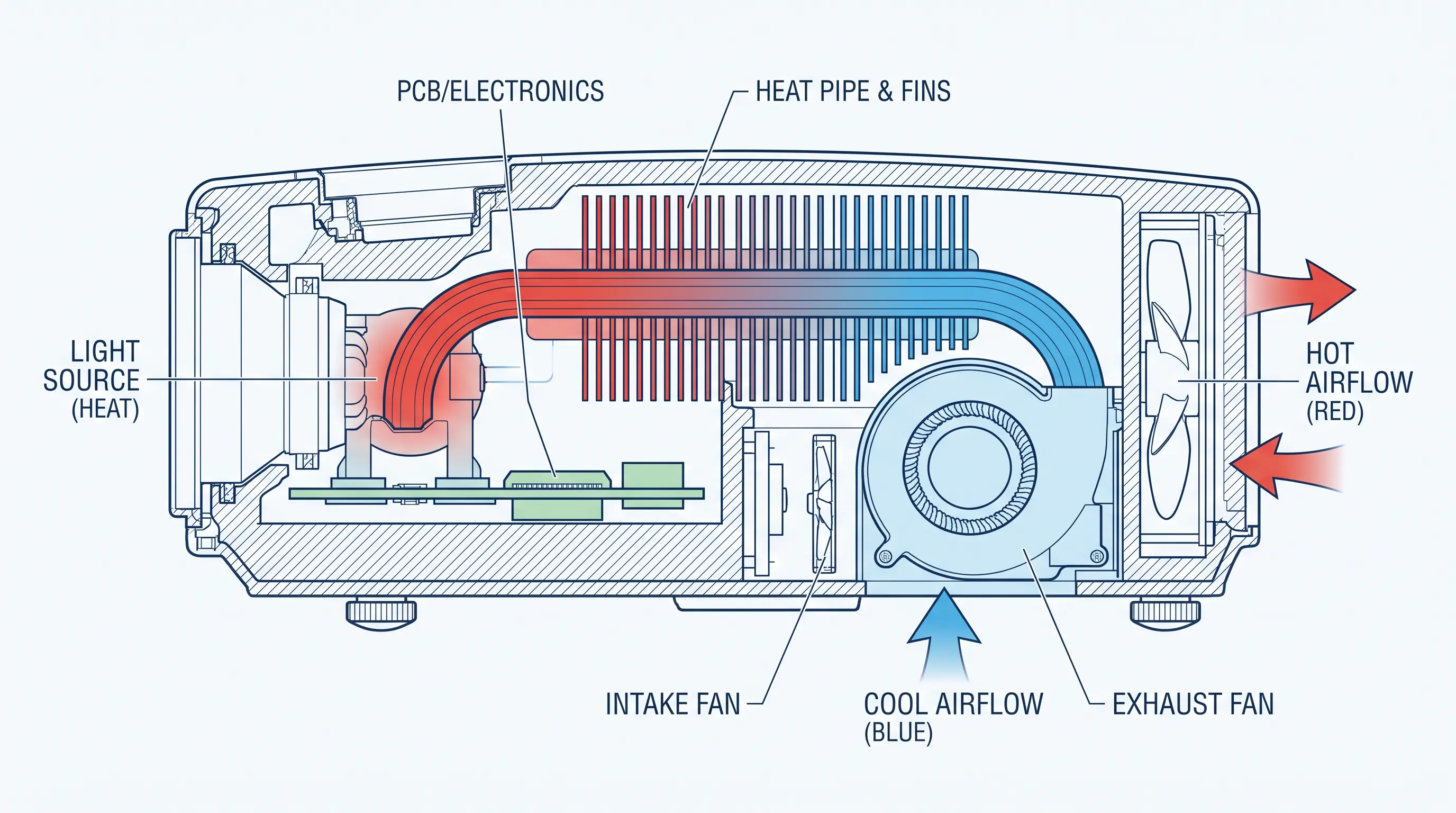
Laser projector light source architectures generate significant thermal loads that directly impact performance, longevity, and maintenance intervals. Blue laser diodes typically convert 40–50% of electrical input into visible light, with the remainder dissipated as heat through the projector housing and cooling system. RGB systems face compounded thermal challenges because three separate laser arrays—each operating at different wavelengths and drive currents—require coordinated thermal management.
The thermal resistance between the laser diode junction and ambient air determines maximum continuous output power. Industry standard thermal resistance figures range from 5°C/W for small-form-factor modules to 15–20°C/W for high-power cinema-grade laser arrays. When junction temperatures exceed 85°C, laser diode lifespan degrades exponentially; manufacturers quote 20,000–30,000 hour lifetimes at 25°C junction temperature, but this drops to 8,000–12,000 hours at 65°C according to laser diode reliability studies published by SPIE SPIE Optics and Photonics, 2024.
Cooling Architecture Options
We have tested three primary cooling approaches across DataMax projector platforms: passive heat sinking, active forced-air cooling, and liquid cooling circuits. Passive heat sinking works adequately for projectors under 5,000 lumens operating in climate-controlled environments, but thermal throttling becomes noticeable when ambient temperatures exceed 30°C.
Forced-air cooling with variable-speed fans enables higher power density but introduces acoustic noise—typically 35–45 dB for 10,000-lumen systems. Professional cinema installations often specify liquid cooling because it allows silent operation and more precise temperature control. Liquid-cooled systems add 15–25% to system cost and require sealed coolant loops with annual maintenance, but they deliver junction temperatures 20–30°C lower than equivalent air-cooled designs at equivalent output levels.
| Cooling Method | Temp Reduction vs. Ambient | Noise Level | Cost Add-On | Maintenance Interval |
|---|---|---|---|---|
| Passive (Heat Sink) | 25–35°C | 0 dB (silent) | 0% | None |
| Forced Air | 35–50°C | 35–45 dB | 5–8% | Filter replacement 6–12 mo |
| Liquid Cooling | 45–65°C | 0 dB (silent) | 15–25% | Annual coolant service |
Certification, Compliance, and Supply Chain Requirements
Key Certifications for B2B Procurement
Laser projector light source components and finished products require compliance with multiple regulatory frameworks across different markets. The IEC 60825-1 standard governs laser safety classification, and all systems above Class 2 must include appropriate guard mechanisms, warning labels, and interlock systems. For B2B procurement teams specifying laser projectors for educational, corporate, or government deployments, IEC 60825-1 certification with documented test reports is a baseline requirement.
Additional certifications depend on target markets: CE marking for European Union sales covers electromagnetic compatibility (EMC) under EN 55032 and electrical safety under EN 60950-1 or EN 62368-1. North American deployments require UL or ETL listing, while Chinese market access involves CCC certification. We have guided several DataMax OEM clients through the CCC certification process, which typically adds 8–12 weeks and $15,000–25,000 in testing fees for first-time applicants.
Energy efficiency regulations are increasingly relevant for laser projector light source selection. The European Union's ErP Directive and California's Title 20 appliance standards specify maximum standby power consumption (typically under 0.5W) and minimum lumen-per-watt efficiency thresholds that vary by projector brightness class.
Supplier Qualification and MOQ Considerations
Qualifying alternate suppliers for laser projector light sources involves more than reviewing spec sheets. Laser diode manufacturing requires specialized epitaxial growth facilities and precise packaging processes that limit the global supplier base. The top five manufacturers—Sharp, Nichia, Osram, Sony, and Mitsubishi Electric—collectively control approximately 75% of the high-power laser diode market according to market research from Yole Développement Yole Développement, Laser Diode Market Report 2025.
Minimum order quantities for custom-specified laser arrays typically start at 500–1,000 units, with lead times of 16–24 weeks for first production runs. Standard catalog parts offer lower MOQs (50–100 units) but limited customization options for wavelength, beam geometry, or drive current specifications. For OEM buyers evaluating supply chain resilience, we recommend qualifying at least two approved sources for each critical light source component, even if this approach increases per-unit costs by 10–15%.
The phosphor materials used in blue laser + phosphor and ALPD architectures present separate supply chain considerations. Proprietary phosphor formulations from suppliers like Intematix or Mitsubishi Chemical are typically available through distribution with 4–8 week lead times, but long-term price stability depends on rare earth material costs that fluctuate with commodity markets.
How to Select the Right Laser Projector Light Source for Your Application
Choosing a laser projector light source requires balancing performance specifications, budget constraints, and long-term supply chain considerations. For B2B procurement teams evaluating laser projectors for 2026 deployments, the selection process starts with brightness and color space requirements, then narrows to architecture choices based on those parameters.
Matching Architecture to Application Requirements
The three primary laser architectures serve distinct use cases. RGB laser systems deliver the widest color gamut (covering over 90% of Rec. 2020) and suit premium installation projectors for cinema, simulation, and high-end corporate venues where image quality justifies the cost premium. Blue laser + phosphor remains the dominant choice for mainstream business and education projectors, offering 80-85% Rec. 709 coverage at competitive price points. ALPD 3.0 and 4.0 architectures provide a middle ground with enhanced color accuracy (up to 98% Rec. 709) and higher lumens-per-watt efficiency, making them attractive for bright-environment installations.
When evaluating specifications, compare not just peak brightness ratings but sustained output after the 5,000-hour mark, as laser degradation curves vary significantly between architectures. We recommend requesting lifetime test data from potential suppliers before finalizing specifications.
Selection Criteria Summary:
- Primary use case: Fixed installation vs. portable vs. consumer
- Brightness requirement: Sub-3,000 lumens vs. 3,000-6,000 lumens vs. 6,000+ lumens
- Color accuracy needs: Standard sRGB/Rec. 709 vs. wide-gamut Rec. 2020/DCI-P3
- Budget tier: Entry-level vs. mid-range vs. premium
- Maintenance expectations: 20,000+ hour useful life vs. extended 30,000+ hour service
For OEM buyers, minimum order quantities typically start at 500 units for custom light engine configurations, with sample quantities of 10-25 units available for qualification testing. Standard catalog light sources offer lower MOQs (50-100 units) but limited wavelength customization. Lead times average 16-24 weeks for first production runs and 8-12 weeks for repeat orders.
Contact the DataMax engineering team to discuss specification requirements and sample availability for your next project. Request a custom quote
A Short Reference Card
Final Takeaway
The laser projector light source market continues advancing toward higher efficiency, wider color gamuts, and reduced cost points heading into 2026. Whether you specify blue laser + phosphor for education deployments, ALPD for corporate AV installations, or RGB laser for premium simulation applications, understanding the trade-offs between these architectures enables data-driven procurement decisions that align with both performance requirements and total cost of ownership targets.
For detailed specifications on DataMax OEM projector solutions featuring these light source technologies, explore our product lineup or connect with our engineering team directly. Explore DataMax laser projectors
