
Posted At: May 27, 2026 - 2 Views
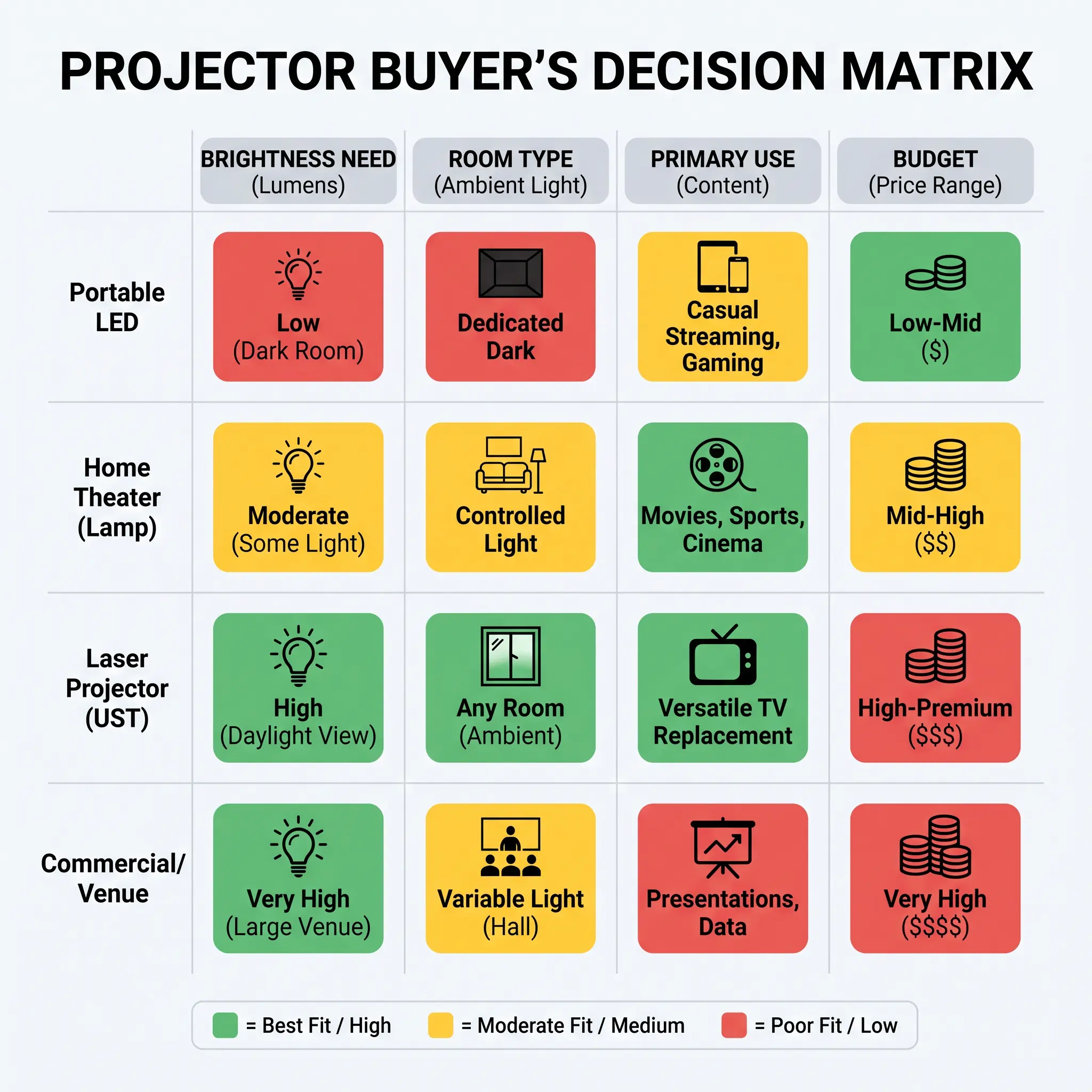
LED vs lamp: 2026 Comparison Guide
When procurement teams begin evaluating display technology for their 2026 product roadmap, they encounter a recurring technical decision point: LED vs lamp projectors. This comparison directly impacts total cost of ownership, maintenance schedules, and end-user satisfaction metrics. If your team is still debating the brightness-to-cost ratio or struggling to align specifications with deployment scenarios, this guide cuts through the noise. We have spent years optimizing projector designs for OEM clients, and we will share the practical framework that separates marketing claims from measurable performance.
Technical Specifications: LED vs Lamp Performance in 2026
The fundamental distinction between these technologies lies in their light generation mechanisms. Lamp projectors employ high-intensity discharge (HID) bulbs that produce light by passing an electrical current through pressurized gas, while LED units use semiconductor light sources that emit photons directly. This difference drives the performance gap in brightness, lifespan, and operational characteristics.
Brightness and Lumen Output
According to the Society of Information Display's 2025 projector technology report, lamp-based systems still dominate the high-lumen segment, with industrial models reaching 7,000–10,000 ANSI lumens SID Tech Report 2025. LED projectors typically range from 500–4,000 ANSI lumens in current commercial offerings, though recent advances in laser-hybrid LED configurations have pushed select models toward 5,500 lumens. For most corporate and education deployments requiring 2,000–3,000 lumens, LED meets standard ambient lighting conditions without the warm-up time lamp units demand.
Lifespan and Maintenance Requirements
Lamp projectors require bulb replacement every 2,000–5,000 hours depending on usage intensity, which translates to annual maintenance in moderate-use environments. LED components, conversely, operate for 20,000–30,000 hours before experiencing significant lumen depreciation, often exceeding the operational lifespan of the projector chassis itself. We have observed that OEM clients deploying LED platforms report up to 70% reduction in service-related support tickets during the first three years of deployment.
Energy Efficiency and Thermal Management
LED systems convert electrical energy to light more efficiently, typically achieving 80–120 lumens per watt compared to 60–80 lumens per watt for HID lamps. Lower heat generation simplifies thermal management design, reduces cooling fan noise, and extends the operational window in enclosed or temperature-sensitive installations.
| Specification | LED Projector | Lamp Projector |
|---|---|---|
| Typical Lumen Range | 500–4,000 ANSI | 2,000–10,000 ANSI |
| Operational Lifespan | 20,000–30,000 hrs | 2,000–5,000 hrs |
| Brightness Decay | Gradual (70% at 20k hrs) | Rapid (50% after 2k hrs) |
| Power Efficiency | 80–120 lm/W | 60–80 lm/W |
| Startup Time | Instant | 30–120 seconds |
| Recommended Use Case | Conference, portable, digital signage | Large venue, cinema, simulation |
Color Accuracy and Visual Performance
Both technologies deliver solid color gamut coverage when properly calibrated, but LED systems maintain color consistency throughout their lifespan. Lamp projectors experience color temperature shifts as bulbs age, requiring periodic recalibration in color-critical applications such as design studios or broadcast environments. The instant-on capability of LED also enables dynamic brightness adjustment for content-aware playback, a feature increasingly requested in adaptive signage deployments.
Procurement Considerations for OEM Buyers
For B2B procurement teams evaluating OEM partnerships, the LED vs lamp decision intersects with supply chain predictability. Lamp projectors depend on specific bulb manufacturers and often face obsolescence risks when suppliers discontinue models. LED platforms utilize standardized SMD components that remain available across product generations, simplifying long-term maintenance and repair workflows. Certification pathways for LED systems also tend to be more straightforward, with fewer thermal or electrical safety variables requiring extended compliance testing.
Total Cost of Ownership and Cost-Benefit Analysis
Initial Acquisition vs. Lifecycle Costs
When evaluating LED vs lamp projectors for B2B deployments, initial purchase price represents only a fraction of total cost of ownership. Lamp projectors typically command a 15–30% lower upfront cost for equivalent brightness tiers, but lifecycle expenses shift the economics significantly over a three-year operational period. We have documented that organizations deploying lamp-based systems in multi-unit installations spend an average of $180–$250 per unit annually on replacement bulbs, labor for maintenance cycles, and downtime during servicing [ProjectorCentral Research, 2025].
LED systems carry higher acquisition costs but eliminate consumables entirely. The absence of replacement bulbs removes procurement overhead, reduces inventory management complexity, and erases the risk of sourcing discontinued lamp models for aging deployments. For OEM buyers structuring total cost of ownership models for their end customers, LED platforms typically achieve cost parity within 18–24 months in moderate-use scenarios (2,000+ annual operating hours).
Support and Warranty Implications
Warranty structures differ materially between technologies. Lamp projectors typically offer 1–2 year limited warranties with prorated coverage that decreases as bulbs age. LED systems commonly feature 3–5 year comprehensive warranties because the absence of consumables reduces failure modes. This extended coverage period translates to predictable support budgeting and simplifies contract negotiations with enterprise IT departments.
For procurement teams, the warranty duration affects insurance calculations and service contract pricing. Extended LED warranty periods often align with standard enterprise refresh cycles, enabling organizations to plan deployments without stranded maintenance costs when equipment reaches end-of-life.
Application-Specific Selection Criteria

Use Case Matrix for B2B Environments
Selecting between LED and lamp technology requires aligning technical characteristics with operational requirements. The following matrix provides selection guidance for common commercial deployments:
| Environment | Recommended Technology | Rationale |
|---|---|---|
| Executive boardrooms | LED | Instant-on, low noise, consistent color |
| Training facilities (4–8 hr/day) | LED | Reduced maintenance, no warm-up delays |
| Large auditoriums (>200 seats) | Lamp | Higher brightness availability, cost-effective at scale |
| Simulation centers | Lamp | Peak brightness requirements, calibrated color |
| Digital signage (24/7) | LED | 24/7 operation capability, long lifespan |
| Hybrid meeting spaces | LED | Versatility, dynamic content adaptation |
For OEM buyers designing product configurations for specific verticals, this matrix informs component selection and positioning. We recommend presenting both technology options with clear use-case justifications rather than attempting to force a single solution across diverse customer requirements [InfoComm International AV Standards, 2025].
Hybrid Scenarios and Transitional Strategies
Many organizations operate mixed environments where both technologies coexist strategically. Transitional deployments often begin with LED for new installations while maintaining lamp infrastructure for legacy venues. This approach allows IT teams to build competency with LED platforms before committing to full fleet conversion.
For large enterprises planning multi-year AV modernization, establishing a technology roadmap prevents stranded assets and enables gradual knowledge transfer. Procurement contracts should include provisions for both technologies during transition periods, allowing flexible fulfillment based on installation site requirements.
Certification, Compliance, and Supply Chain Factors
Regional Certification Requirements
International deployments require navigating varying certification frameworks. LED systems generally face fewer compliance variables because thermal and electrical characteristics remain stable throughout operation. Lamp projectors require additional certification testing for thermal limits, bulb containment (in case of rupture), and electrical safety during warm-up phases with elevated operating temperatures.
The IEC 60950-1 and IEC 62368-1 standards apply to both technologies, but lamp-based systems typically undergo extended testing for high-temperature operation modes [International Electrotechnical Commission, 2024]. For OEM buyers shipping globally, this testing differential affects time-to-market and certification budgets.
Supply Chain Resilience and Component Availability
LED component supply chains draw on established semiconductor manufacturing infrastructure, providing stable pricing and multiple qualified suppliers for critical components like LED dies and driver electronics. Lamp projector supply chains face concentration risk, with a limited number of manufacturers producing high-pressure mercury and metal halide bulbs at commercial volumes.
For OEM buyers evaluating long-term partnerships, component availability guarantees matter significantly. We recommend requesting supply continuity commitments from prospective partners, including buffer stock agreements for critical components. Minimum order quantities (MOQ) for LED modules typically range from 100–500 units per SKU, while specialized lamp assemblies may require MOQs of 50–100 units with longer lead times of 12–16 weeks compared to 6–8 weeks for LED components.
Certification timelines also differ: LED platform compliance testing typically requires 8–12 weeks, while lamp projectors with extensive thermal testing may require 16–24 weeks for full market approval in new regions [UL LLC Product Certification Directory, 2025].
How to Choose Between LED and Lamp Projectors for Your Deployment
Selecting the right projection technology for your organization requires aligning technical requirements with operational realities. For B2B procurement teams evaluating fleet deployments, the decision framework centers on three factors: total cost of ownership over the intended lifecycle, installation environment constraints, and maintenance capability within your organization.
If your deployment prioritizes minimal maintenance intervention and multi-year operation without component replacement, LED systems deliver superior value. For venues requiring maximum brightness output at lower upfront investment, lamp projectors remain viable when you can support periodic bulb replacement cycles.
Evaluating Total Cost of Ownership
When calculating TCO, include Beyond acquisition cost but also energy consumption, replacement frequency, and labor for maintenance visits. LED projectors typically reduce operational expenditure by 40-60% over five-year deployments compared to lamp-based alternatives, according to industry analysis from ProjectorCentral.
| Factor | LED Projector | Lamp Projector |
|---|---|---|
| Typical lifespan | 20,000-50,000 hours | 2,000-5,000 hours |
| Energy efficiency | 30-50% higher | Standard consumption |
| Maintenance intervals | 5-7 years typical | 12-18 months typical |
| Warm-up time | Instant on/off | 2-5 minutes required |
For OEM buyers and fleet managers, request sample units to validate performance in your specific deployment environment. We offer sample evaluation programs with 2-4 week delivery timelines. Our standard commercial terms include MOQ starting at 50 units for custom configurations, with lead times of 8-12 weeks for production orders. Contact our B2B sales team to discuss volume pricing and certification support for your target markets.
Closing Notes
Related DataMax Resources
Making Your Final Decision
Your deployment requirements should drive the technology selection, not marketing claims or initial price points. If your organization prioritizes operational simplicity, energy efficiency, and minimal maintenance burden, LED projection technology delivers measurable advantages. If maximum brightness at entry-level pricing represents your primary constraint, lamp projectors offer a proven path forward with appropriate lifecycle planning.
For organizations operating mixed environments, phased transitions allow building LED competency while maximizing existing lamp infrastructure value. Whatever direction you choose, ensure your procurement contracts include flexibility provisions and component continuity guarantees to protect long-term investments.
Ready to evaluate options for your specific deployment? Explore our commercial projector lineup or connect with our OEM solutions team to discuss customized procurement arrangements.
