
Posted At: Jun 02, 2026 - 56 Views

Portable Mini Projector Design: A B2B OEM Technical Guide
The portable mini projector category is one of the fastest-growing in consumer electronics, with sub-1kg form factors, battery operation, and casual-use simplicity. For B2B buyers, mini projectors offer recurring volume (consumers buy multiple units for different rooms and travel) and lower BOM than full-size projectors. This design guide explains the engineering trade-offs, component selection, and OEM sourcing strategy for portable mini projectors.

The Portable Mini Projector Market in 2026
Market dynamics:
- Annual global volume: ~5–7 million units
- Average retail price: $80 (entry), $180 (mid), $350+ (premium)
- Typical weight: 0.3–1.5 kg
- Refresh cycle: 18–30 months (faster than TV/laptop categories)
- Key use cases: travel (35%), bedroom (30%), casual living room (20%), kids (10%), business travel (5%)
Key Design Constraints

Distributors evaluating the B2B projector market can reference our GP94A Android Smart Projector for Home Theater—a production-validated platform covering Android OS · Home Theater Reference, suitable as an OEM/ODM starting point.
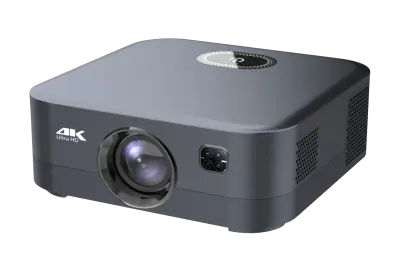
Distributors evaluating the B2B projector market can reference our GP94B 500ANSI Smart Projector for Hotels with Android 9—a production-validated platform covering 500 ANSI · Hotel-grade Android 9, suitable as an OEM/ODM starting point.
Four design constraints shape every portable mini projector:
1. Size and Weight
The smaller, the better — within reason:
- Pocket size (< 0.5 kg): 200–300 ANSI lumens, 720p, $80–$150
- Compact (0.5–1 kg): 300–500 ANSI lumens, 1080p, $150–$300
- Portable (1–1.5 kg): 500–1,000 ANSI lumens, 1080p, $250–$450
2. Brightness vs Battery
Brightness and battery runtime are inversely related:
| Brightness | Battery Runtime (60 Wh) |
|---|---|
| 100 ANSI | 4–5 hours |
| 300 ANSI | 2–2.5 hours |
| 500 ANSI | 1.5–2 hours |
| 1,000 ANSI | 0.8–1 hour |
3. Cooling and Noise
Mini projectors have limited space for cooling. Design constraints:
- Small fans (30–40mm) at high RPM
- Noise: 25–32 dB at 1 meter (quieter than full-size)
- Heat dissipation: 30–80W (much less than full-size)
- Auto brightness reduction when hot (thermal protection)
4. Audio
Mini projectors have limited space for speakers. Design trade-offs:
- Single 3W speaker: acceptable for personal use
- Dual 3W speakers: better for shared viewing
- Bluetooth audio out: pair with portable speaker for better sound
Optical Engine for Mini Projectors
Mini projectors use specific DMD chip sizes:
| DMD Size | Native Resolution | Typical Brightness |
|---|---|---|
| 0.23" | 540p (960×540) | 100–200 ANSI |
| 0.23" | 1080p via XPR | 200–400 ANSI |
| 0.33" | 1080p native | 300–600 ANSI |
| 0.47" | 1080p native | 500–1,500 ANSI |
LED Light Source
Mini projectors use LED exclusively (lamp and laser are too big/hot):
| LED Type | Brightness Range | Color Performance |
|---|---|---|
| Single white LED | 100–300 ANSI | Basic |
| RGB LED | 200–600 ANSI | Better |
| Blue + phosphor | 300–1,000 ANSI | Best balance |
Battery Design
Battery is critical for portable mini projectors:
Battery Capacity
- 40–60 Wh: 2 hours runtime at 200–300 ANSI (entry mini)
- 60–100 Wh: 2.5–4 hours at 300–500 ANSI (mid-tier)
- 100–150 Wh: 4–6 hours at 300–500 ANSI (premium)
Battery Technology
- Li-ion: most common, 500+ cycles, $0.20–$0.30 per Wh
- LiFePO4: longer cycle life (2,000+), safer, 2× cost, larger form factor
- Lithium polymer: similar to Li-ion, slightly more flexible form factor
Tier-1 Cell Suppliers
For OEM buyers, specify tier-1 battery cells:
- CATL (China)
- LG Energy Solution (Korea)
- Samsung SDI (Korea)
- BAK Battery (China)
- Eve Energy (China)
Connectivity in Mini Projectors
Mini projectors typically have:
- HDMI (mini-HDMI or micro-HDMI for size)
- USB-C (charging + display input)
- USB-A (media playback)
- 3.5mm audio out
- WiFi (mirroring, casting, app updates)
- Bluetooth (speaker pairing, remote control)
- USB-C Power Delivery (60W+ for fast charging)
- WiFi 6 (faster streaming)
- Bluetooth 5.0+ (better range)
Auto-Focus and Auto-Keystone
Mini projectors especially need auto features because users move them frequently:
- TOF laser autofocus — measures distance, adjusts lens in <1 second
- Camera-based keystone — uses built-in camera to align to screen
- Obstacle avoidance — recognizes objects, shifts image
- Screen fit — auto-detects screen borders
Audio Output
Options for mini projector audio:
| Solution | Cost | Sound Quality |
|---|---|---|
| Built-in 2×3W speakers | $2–$4 BOM | Acceptable for personal use |
| Built-in 2×5W speakers | $5–$8 BOM | Better for shared viewing |
| Audio co-brand (Harman Kardon, JBL) | $15–$30 BOM + royalty | Premium sound |
| Bluetooth speaker pairing | $1 BOM | External speaker required |
BOM Cost Structure (1,000-unit order, 0.7 kg portable)
| Component | % of BOM | Cost Range |
|---|---|---|
| Optical engine (0.33" DMD + lens) | 20–26% | $24–$40 |
| LED light source | 12–16% | $14–$25 |
| SoC + WiFi/BT | 10–14% | $12–$22 |
| Battery + power management | 14–18% | $16–$28 |
| Housing (lightweight plastic) | 8–12% | $10–$18 |
| Speakers + audio amp | 4–6% | $5–$10 |
| PCBA + I/O | 6–10% | $7–$15 |
| Cooling (fan + heat sink) | 3–5% | $4–$8 |
| Cables + accessories | 2–4% | $3–$7 |
| Assembly labor | 3–5% | $4–$8 |
| Packaging | 3–5% | $4–$8 |
| Total FOB | 100% | $100–$185 |
Common OEM Mistakes
Five pitfalls in portable mini projector design:
- Cheap battery cells — field failures, return rate soars
- Insufficient cooling — thermal throttling, brightness drops
- Slow auto-focus — consumers expect instant focus
- Weak speakers — outdoor use impossible
- Heavy weight — defeats "portable" positioning
Design Trade-Offs
Key design decisions OEM buyers should make explicitly:
| Decision | Trade-off |
|---|---|
| Brightness vs Battery | Higher brightness = shorter runtime |
| Weight vs Brightness | Lighter = lower brightness ceiling |
| Speaker quality vs Cost | Better audio = higher BOM |
| Auto features vs Cost | More features = higher BOM |
| Battery size vs Weight | Larger battery = heavier |
What We Recommend for Portable Mini Projector OEM
- Target 0.5–0.8 kg form factor for the sweet spot of brightness, battery, and portability
- Specify tier-1 battery cells with UN38.3 certification
- Include TOF autofocus + auto-keystone as standard
- Add Bluetooth audio out for consumer flexibility
- Consider audio co-brand at $200+ retail price point
- Plan 90–120 day production timeline for new SKUs
Conclusion
Portable mini projector design requires balancing size, weight, brightness, battery, and cost. Win on auto-features, battery quality, audio quality, and overall weight. The right partner factory with proven mini projector experience is essential.
💼 Need portable mini projector OEM service?
Request a Free Quote | View Product Catalog
We ship mini projectors from 0.3 kg pocket size to 1.5 kg portable, with tier-1 battery cells and proven auto-focus systems. Engineering team will recommend the right configuration within 24 hours.
