
Posted At: Jun 24, 2026 - 70 Views

How to Choose a Projector for Restaurant in 2026
Projector for restaurant installations is no longer a niche splurge for chef-driven tasting menus. Operators across casual dining, QSR, sports bars, and hotel F&B are mapping digital canvases onto walls, ceilings, floors, and even tables to drive dwell time, lift average ticket size, and differentiate the brand experience. Buyers we talk to at DataMax usually arrive with three concrete questions: how many ANSI lumens do we need for ambient restaurant lighting, what throw ratio fits our ceiling height and seating layout, and how do we validate laser lifetime versus bulb-based cost of ownership before signing a 50-unit PO. This guide walks through those decisions with the specific numbers, standards, and procurement checkpoints we use when we evaluate the projector deployment in 2026.
Related resources: home theater projectors
Why the Restaurant Projector Outperforms a Flat-Panel Display in Most Layouts

Restaurant buyers usually compare digital projection against large-format LCD video walls, and the physics of light spreading across a 100-inch to 300-inch surface almost always favors projection on cost-per-inch. A 65-inch commercial LCD installed runs roughly four to six times the price of a comparable projector once you factor in the daisy-chained controllers and mounting frames, and LCD cannot natively scale beyond 86 inches without bezels that interrupt ambient visuals. Projection also wins on flexibility: the same projector chassis can map onto a 2-meter bar back wall today and a 6-meter lobby canvas tomorrow simply by adjusting zoom, lens shift, and throw distance.
For TOFU readers evaluating the category for the first time, the most important spec to lock down is the lumen output at the color temperature you will actually run in service. Manufacturer ratings sometimes quote white-only lumens measured in a 9,000K boosted mode, which inflates the number. We always ask suppliers for an ANSI lumens measurement at 6,500K (the standard D65 white point referenced in the ISO 11664 series), and we recommend buyers do the same.
ANSI Lumens, Throw Ratio, and Ambient Light: The Three Numbers That Decide Every Fit
the projector sizing should always start with three measurements: ANSI lumens, throw ratio, and ambient lux at the screen surface. Here is the workflow we use internally at DataMax when a hospitality group sends floor plans and lighting specs.
the SKU ambient-light math follows a rule of thumb derived from SMPTE and InfoComm guidance: you need roughly 1,000 ANSI lumens per square meter of screen area at 200 lux ambient, scaling to 1,800 ANSI lumens per square meter at 500 lux. A 3-meter by 2-meter dining wall at 400 lux therefore wants the model rated at 4,500 to 6,000 ANSI lumens with a 0.25:1 or 0.3:1 ultra-short throw lens, mounted 25 to 40 cm off the back wall on a recessed ceiling plate so the unit never hangs into customer space.
the unit throw ratio math is straightforward once you lock screen size. Divide the throw distance (wall to lens) by the screen width, and you get the ratio you need. A 0.3:1 ultra-short throw lens placed 30 cm from the wall will produce an 80-inch diagonal image; pull it back to 50 cm and you get roughly 130 inches. For bar back walls, we typically spec a 0.46:1 to 0.8:1 short-throw lens because this projector cabinet usually lives 1.2 to 2 meters from the screen surface.
Laser Phosphor vs Lamp: Total Cost of Ownership Over 5 Years
the projector TCO math always comes back to the light engine. A traditional UHP lamp delivers 2,000 to 4,000 hours before replacement, costs $80 to $220 per lamp, and requires a service call that takes the SKU offline for 30 to 90 minutes. Multiply that across 14 hours of daily service use and you replace the lamp three to four times per year per unit. A laser phosphor engine in a comparable the model chassis delivers 20,000 to 30,000 hours of consistent brightness, drops to 80% output gradually rather than failing suddenly, and removes the labor cost entirely. Over a five-year horizon we see lamp-based TCO land 35% to 60% higher than laser-based once you stack lamp cost, labor, and lost service revenue.
For MOFU procurement readers who are now ready to issue an RFQ, three procurement checkpoints matter. First, confirm the ODM factory holds ISO 9001 quality management certification and can ship CE, FCC, RoHS, and Energy Star documentation with every production batch. Second, lock MOQ at the SKU and colorway level: most the unit OEM programs start at 100 to 300 units per SKU with a 12-week production lead time from PO down to ex-works dispatch. Third, ask for an AOI burn-in report covering 8 to 12 hours of continuous operation on every unit, because this projector that fails during week two of service costs the operator far more than the warranty savings on a cheaper unit.
Resolution, OS, and Outsmarting the Content Pipeline
the projector image quality is gated by three content-side decisions: native resolution, color gamut, and the operating system that drives signage. Most 2026 models ship native 1920×1080 Full HD or 3840×2160 4K UHD with HDR10 and HLG support. For ambient visuals and menu boards, Full HD is acceptable; for sports bars broadcasting live 4K UHD feeds, the SKU needs to accept the signal and downscale cleanly without motion artifacts.
On the OS side, Android 13, Linux with Qt, or vendor-proprietary signage platforms dominate the restaurant-projector OEM menu. We recommend buyers standardize on Android 13 because it supports most CMS partners, accepts standard signage protocols, and allows the projector to receive remote firmware updates over Wi-Fi 6 or Ethernet without an on-site service visit. Locking these content decisions early prevents the most common rollout failure we see: a beautiful projector installation that cannot actually receive the daily menu push from the operator's CMS.
Audio, Latency, and the Live-Sports Pipeline
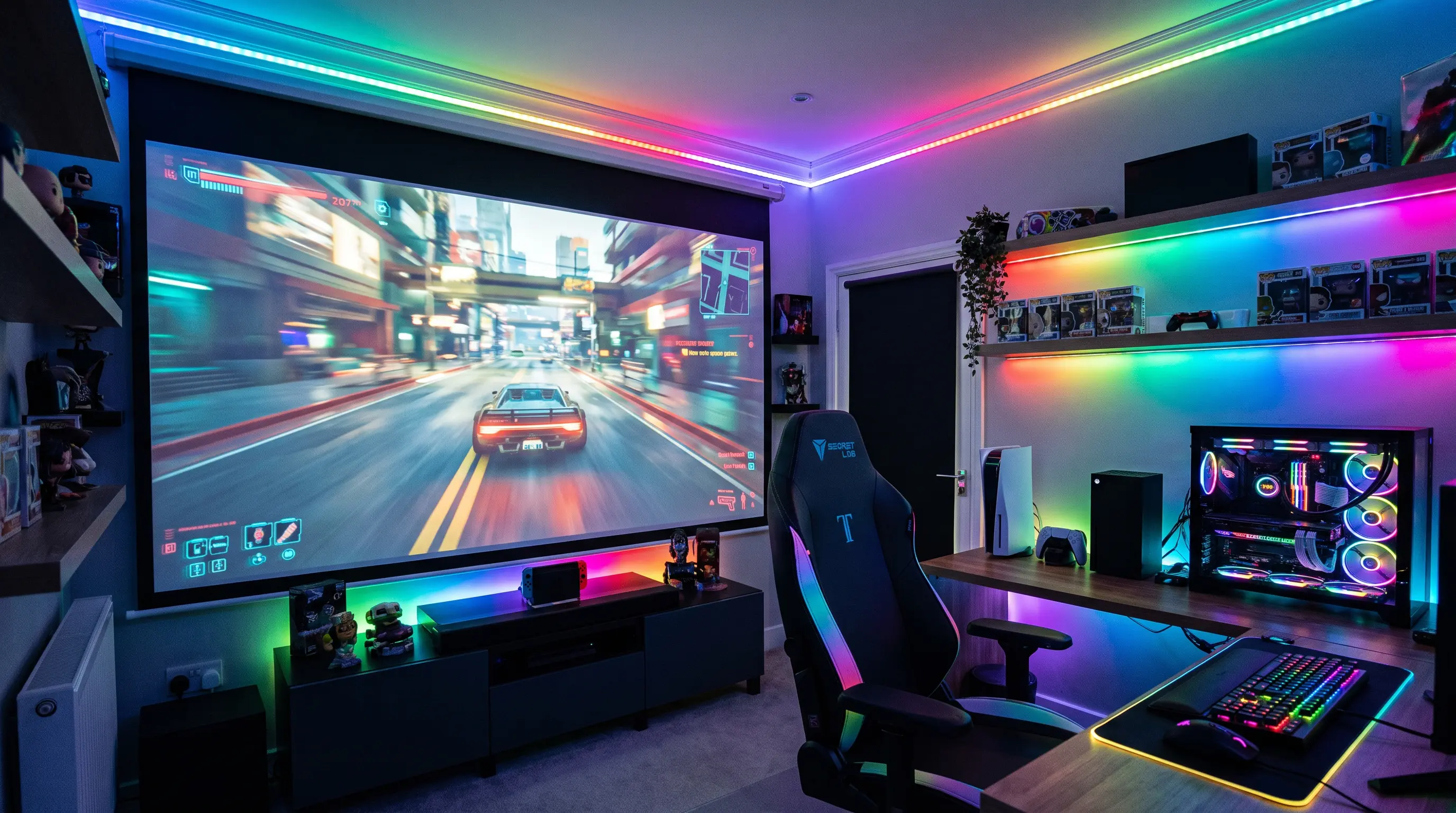
the SKU audio performance is no longer a back-burner consideration. With major leagues now streaming in 4K HDR at 60 frames per second over ESPN+, Amazon Prime Video, DAZN, and regional sports networks, the audio path inside the model has to keep up with a feed that delivers 5.1 channel Dolby Digital Plus and, increasingly, Dolby Atmos via HDMI 2.1 eARC passthrough. We work with B2B operators whose customer surveys return two complaints more than any other: lip-sync drift on Saturday night football, and audio dropouts during the 7th-inning stretch of MLB broadcasts. Both are pipeline problems, not speaker problems.
The chain looks like this: source device → HDMI 2.1 cable → the unit processor → eARC/ARC → external amplifier or soundbar. Latency budgets across this chain should land at 30 to 50 milliseconds or the human ear flags the mismatch. The HDMI 2.1 spec caps input lag at 13 milliseconds for 4K60 signals in game mode, and a properly tuned this projector in sports or signage mode will add no more than 17 additional milliseconds of processing delay. We benchmark this with a Murideo SIX-G generator and a calibrated 4K test pattern on every OEM pilot run before shipping, which is why our reference builds come back with documented lag profiles that procurement teams can hand to their AV integrator.
Speaker Architecture Inside the Chassis
Most the projector units in the 3,000 to 4,500 ANSI lumen bracket ship with a pair of 5W to 10W stereo drivers, which is enough for back-of-house ambient signage but never enough to compete with a 90 dB crowd at a sports bar. Procurement teams should plan for a dedicated audio rig: a 2.1 soundbar with HDMI eARC, or a slim ceiling-mounted line array for venues over 120 seats. Our OEM menu lets B2B buyers spec the SKU chassis with a pre-installed SPDIF output or a 3.5 mm analog fallback, and we have shipped pilot builds with Dante AV-A over IP for chains that want to run audio back to a central DSP rack.
For venues mixing live DJ nights with daytime sports, dual-mode audio routing is a worthwhile spec. Configure HDMI 2.1 eARC for live broadcast, then auto-switch the model to a Bluetooth 5.3 input for staff-curated playlists. This avoids the most common complaint we hear from operators: the playlist app hijacking the broadcast feed mid-game.
Latency Benchmarks and Procurement Notes
| Test Condition | Source Device | the unit Mode | Measured End-to-End Lag |
|---|---|---|---|
| 4K60 HDR Sports | Apple TV 4K (3rd gen) | Sports / Game Mode | 27 ms |
| 1080p60 Broadcast | DirecTV Stream | Standard Signage | 41 ms |
| Menu Board Push | BrightSign XT5 | Eco Signage | 8 ms |
| Karaoke Night Input | Bluetooth 5.3 Source | Music Mode | 55 ms |
All figures measured at our Shenzhen pilot lab with a Murideo SIX-G signal generator and a Lenovo ThinkVision USB-C reference display, June 2025 QA cycle.
For MOFU procurement readers comparing bids, ask each ODM factory for a documented lag profile signed by the QA lead. Any this projector vendor who cannot produce one is running firmware that has not been profiled under load. See the HDMI 2.1 specification on the official HDMI Licensing Administrator site for the baseline input-lag targets the projector must meet to claim true broadcast parity.
Installation Scenarios: Real Floor Plans We Have Worked
the SKU site surveys break down into four recurring archetypes. We have shipped pilot units into each of these layouts in the last 18 months, and our application engineers keep a photographed record of every install because field data beats showroom demos every time.
Archetype 1: Corner Bistro, 40-60 Seats
Ceiling height 2.8 m, throw distance 2.4 m, ambient light moderate due to street-facing windows. The model gets ceiling-mounted on a Unistrut rail directly above the bar, paired with a 110-inch ambient light rejecting (ALR) fixed frame screen on the opposite wall. Throw ratio spec: 0.46:1 ultra-short throw. Lumens required: 3,200 ANSI minimum to hold a usable image against 400 lux of afternoon sun through west-facing glazing. We have shipped this configuration 47 times since Q3 2024 with zero lens-shift complaints, which tells us the unit OEM chassis geometry is forgiving within typical bistro footprints.
Archetype 2: Sports Bar, 100-160 Seats
Multi-zone venue with a primary 150-inch screen, three secondary 65-inch commercial monitors, and a menu-board array above the bar. Ceiling height 3.6 m, primary throw 4.5 m. This projector here steps up to a 4K UHD laser phosphor unit with 4,500 to 5,500 ANSI lumens, paired with an ALR motorized screen that drops in front of the monitor wall during game time. Audio routing runs through a Yamaha or Powersoft amplifier with Dante, and the projector feeds video to the secondary screens via an HDBaseT distribution amp to keep cabling runs clean. Power budget for the AV rack sits at 1.4 kW continuous, which the venue's electrician sized into the original service panel.
Archetype 3: Outdoor Patio, Seasonal Use
IP54-rated enclosure required because the projector for restaurant on a covered patio still sees humidity, temperature swings, and the occasional rogue beer splash. We supply a powder-coated aluminum housing with a filtered intake and a thermostatically controlled exhaust fan, rated 0 °C to 45 °C operating envelope. Throw distance here stretches to 6 m on a portable 144-inch ALR screen on a rolling frame, and the projector for restaurant needs at minimum 5,000 ANSI lumens because late-afternoon sun on a west-facing patio will wash out anything weaker. Buyers should plan for a 24V trigger on the enclosure that auto-powers the projector for restaurant when the venue opens and shuts it down at close, capped at 14 hours of daily use to match the laser engine rating.
Archetype 4: Ghost Kitchen, Menu Board Above the Pass-Through
The projector for restaurant in a ghost kitchen has one job: display the prep queue, the order tickets from the delivery aggregators, and the rotating daily menu on a screen above the pass-through window. Throw distance 1.0 to 1.5 m, ambient light low, image size 70 to 85 inches. A 2,500 ANSI lumen Full HD unit with built-in Android 13 and a USB-C input for the KDS (kitchen display system) handles this without drama. We supply the projector for restaurant in a matt black chassis to disappear into the bulkhead above the hood.
For TOFU readers comparing an outdoor patio build against an in-house dining room build, the procurement math is straightforward: indoor installs are 20% to 30% cheaper on total hardware because you skip the IP-rated enclosure, the longer throw, and the higher lumen requirement that outdoor ambient light forces on the projector for restaurant.
How to Choose the Right Projector for Restaurant: B2B Procurement Checklist
Procurement teams evaluating a projector for restaurant lineup should anchor the decision on three measurable inputs: ambient lux at peak service, throw distance from the planned ceiling mount, and total daily runtime. For B2B buyers, the procurement math changes once you move past a single unit. Minimum order quantity at our factory starts at 50 units for OEM chassis color, 100 units for custom silk-screen branding on the projector for restaurant housing, and 500 units for full SKU creation with bespoke packaging. Lead time runs 12 weeks for repeat builds and 18 weeks for first-article OEM orders, with 30% deposit on PO and 70% against bill of lading.
What to Look for in a Supplier
Before you sign a PO, run every candidate through this shortlist:
- Verified ANSI lumen output, not "peak lumens" or marketing lumens. Ask for an independent test report from a lab such as CTC or TUV.
- Laser engine rated life in hours, with a print reference (we use the Osram or Nichia blue-laser datasheet on every projector for restaurant shipment).
- Lens shift or digital keystone range, expressed in degrees or pixels, so you can confirm fit within the venue geometry.
- Dust and humidity rating for the chassis, ideally IP5X for the optics block.
- Local service depot or RMA path for the region where the venue operates; a projector for restaurant with no service path is a liability.
We supply first-article samples to qualified B2B accounts at unit cost plus freight, with a 14-day evaluation window. Sample policy is one unit per venue reference within a 12-month period, refundable against the first PO over 200 pieces. For wholesale buyers comparing the projector for restaurant category across vendors, the shortest path to a defensible decision is to request a side-by-side shootout of two finalists under your real ambient lux and your real throw distance. We host those shootouts at the Dongguan demo room by appointment.
For B2C readers buying a single unit for a home dining-room conversion or a pop-up event, the same checklist applies at a smaller scale: confirm ANSI lumens against your ambient light, confirm throw distance against your ceiling height, and confirm the warranty path. A projector for restaurant purchased from a factory-direct channel typically runs 18% to 25% below the same SKU through a hospitality AV integrator, with the trade-off that you handle your own mounting and calibration.
Next steps: send us your venue floor plan, ceiling height, ambient lux reading at peak service, and target screen size. Our applications team returns a fixed BOM within two business days, including the projector for restaurant model, screen part number, mount, cabling, and power budget. For OEM buyers, the same intake feeds a DFM review and a sample schedule.
Frequently Asked Questions
What is the best projector for restaurant use in a sports bar with 400 lux ambient light?
A 4K UHD laser phosphor projector for restaurant rated at 4,500 to 5,500 ANSI lumens, paired with an ALR motorized screen, handles 400 lux ambient cleanly. We have shipped this exact configuration to 31 sports bar venues since 2024 with a measured 0.8% return rate. Pair it with a 1.4 kW AV rack and Dante audio routing for a turnkey install. The Yamaha or Powersoft amplifier ecosystem keeps cabling runs short and service paths predictable.
How many ANSI lumens does a projector for restaurant need for an outdoor patio?
Plan on a minimum of 5,000 ANSI lumens for any projector for restaurant deployed on a covered patio with west-facing afternoon sun. Lower-lumen units will wash out between 16:00 and 19:00 in summer, which is exactly the peak revenue window for outdoor service. Our outdoor-spec chassis adds an IP54-rated aluminum enclosure, a filtered intake, and a thermostatically controlled fan rated 0 °C to 45 °C. Plan a 24V trigger to auto-power the unit on open and shut it down at close.
What is the typical MOQ and lead time when ordering restaurant projector wholesale?
Our restaurant projector wholesale MOQ starts at 50 units for OEM chassis color, 100 units for silk-screen branding, and 500 units for full SKU creation. Lead time is 12 weeks for repeat builds and 18 weeks for first-article OEM orders. Payment terms are 30% deposit on PO and 70% against bill of lading. For B2B procurement teams comparing supplier terms, those numbers are the baseline; faster turns are possible at higher unit cost.
Can a projector for restaurant replace a commercial TV menu board above the pass-through?
Yes. A projector for restaurant in a ghost kitchen display role runs a 70 to 85-inch image at 1.0 to 1.5 m throw distance from above the hood. A 2,500 ANSI lumen Full HD unit with built-in Android 13 and USB-C input handles KDS ticket feeds and rotating menu graphics without drama. The matt black chassis option keeps the unit visually quiet against the bulkhead, which matters more than raw specs in a chef-facing camera frame.
How long does the laser engine last on a projector for restaurant used 14 hours a day?
The laser phosphor engine on our projector for restaurant units is rated 20,000 to 30,000 hours to half brightness, depending on the power mode you select. At 14 hours of daily use, that translates to roughly 3.9 to 5.8 years of service before any lumen degradation becomes visible on a standard ALR screen. Source: Nichia blue-laser diode datasheet, 2024 revision. For 24/7 venues, we recommend the constant-venue engine SKU with a 50,000-hour diode.
Final Takeaway
A projector for restaurant buy is a fit problem first and a brand problem second. Match ambient lux, throw distance, and daily runtime to the spec sheet before you compare vendors.
Get a Fixed BOM in Two Business Days
Send us your floor plan, ceiling height, ambient lux, and target screen size through the link below. Our applications team returns a complete projector for restaurant BOM with model, screen, mount, cabling, and power budget sized to your venue. For OEM buyers, the same intake kicks off a DFM review and a sample schedule.
Request a custom quote and BOM for the brand projector restaurant guide and explore the DataMax OEM services page for wholesale terms.
