
Posted At: Apr 17, 2026 - 95 Views

Short Throw vs Long Throw Projector: A B2B Guide to Throw Ratios
The short throw vs long throw projector decision is one of the most consequential in any B2B sourcing brief, because throw ratio determines the room size, the mounting options, the screen size, and even the use case your customer can deploy the projector in. A wrong throw ratio means your customer returns the unit. A right throw ratio means they buy another one. This guide explains the difference, the BOM implications, the OEM cost delta, and the scenarios where each type fits best.
What Throw Ratio Actually Means
Throw ratio is the relationship between the distance from the projector lens to the screen (the "throw distance") and the width of the projected image. It is expressed as a ratio: a throw ratio of 1.2:1 means the projector needs to be 1.2 units away from the screen for every 1 unit of image width.
A 100" diagonal screen (16:9) is about 87" wide (2.2 meters). With a 1.2:1 throw ratio, the projector must sit 2.64 meters (8.7 feet) from the screen.
Common throw ratio classifications:
| Classification | Throw Ratio | Typical Use Case |
|---|---|---|
| Ultra-short throw (UST) | < 0.4:1 | Living room (projector on TV stand, against wall) |
| Short throw | 0.4:1 – 0.9:1 | Classroom, conference room |
| Standard / long throw | 1.0:1 – 1.5:1 | Home theater, conference room |
| Long throw | 1.5:1 – 2.5:1 | Large venue, hall |
| Ultra-long throw | > 2.5:1 | Cinema, stadium |
Image Size Math Made Simple
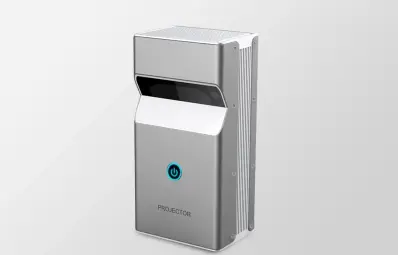
For interactive-flat-panel replacements, the DP01 UST Interactive Smart Projector with Touch Module delivers UST projection with multi-touch input at a fraction of the panel cost—an increasingly common ODM request from schools.

Buyers looking for a turnkey smart OS reference should evaluate the GP95-GTV 400 ANSI Full-Sealed Smart Projector with Google TV Built-In. Google TV is licensed and pre-integrated, eliminating months of middleware work for ODM projects.
For a 100" diagonal screen (16:9), the throw distances are:
| Throw Ratio | Throw Distance | Mounting |
|---|---|---|
| 0.23:1 (UST) | 0.5 m (1.6 ft) | On TV stand, 30 cm from wall |
| 0.4:1 (short) | 0.9 m (3 ft) | On ceiling, near front of room |
| 0.8:1 (short) | 1.8 m (6 ft) | On ceiling, near front of room |
| 1.2:1 (standard) | 2.6 m (8.7 ft) | On ceiling, middle of room |
| 1.5:1 (long) | 3.3 m (11 ft) | On ceiling, back of room |
| 2.0:1 (long) | 4.4 m (14.5 ft) | Back of large room |
Use Case Fit
| Scenario | Recommended Throw | Why |
|---|---|---|
| Living room / home theater (no ceiling mount) | UST or short throw | No installation required |
| Bedroom | Short throw or UST | Place on bedside table, project to opposite wall |
| Classroom | Short throw (0.4:1 – 0.8:1) | Teacher stands without casting shadow |
| Conference room (small) | Short throw | Avoid ceiling installation |
| Conference room (medium) | Standard (1.2:1) | Ceiling-mountable |
| Conference room (boardroom) | Standard or short throw | Aesthetic ceiling mount |
| Lecture hall | Long throw (1.5:1 – 2.0:1) | Mount at back, screen at front |
| House of worship | Short or standard | Depends on architecture |
| Outdoor | Standard | Tripod-mounted |
| Gaming | Short throw | Place on coffee table |
| Hotel room | Short throw or UST | No installation |
Optical Engine Differences
The throw ratio is determined by the lens, and the lens is the most precision-sensitive component in the optical engine.
- Standard / long throw lens — relatively simple glass elements, larger focal length, lower cost
- Short throw lens — more complex aspherical elements, larger front element, higher cost, more sensitive to misalignment
- UST lens — extremely complex multi-element design with large-diameter aspheric or freeform elements, often manufactured by specialized optical houses (Young Optics, Coretronic, Appotronics)
OEM Cost Comparison
Realistic OEM unit cost (FOB Shenzhen, 1,000-unit order) for 1080p Android LED projectors:
| Throw Type | Throw Ratio Range | Unit Price Range | Notes |
|---|---|---|---|
| Standard throw | 1.2:1 – 1.5:1 | $48–$72 | Baseline |
| Short throw | 0.4:1 – 0.9:1 | $72–$110 | +30–50% over standard |
| Ultra-short throw | < 0.4:1 | $180–$320 | Premium tier |
| Long throw | 1.5:1 – 2.5:1 | $52–$82 | Slight premium for larger lens |
- Lens complexity — multi-element aspherical designs
- Lens supplier premium — fewer qualified suppliers (3–5 globally for UST)
- Assembly precision — UST lens alignment tolerances are 5–10× tighter
- Calibration time — UST takes 3–5× longer to calibrate in production
- Test equipment — UST requires specialized optical benches for verification
Keystone, Focus, and Image Adjustment
Throw ratio affects how the projector handles image geometry:
- Standard throw — keystone correction usually < 30° tilt. Auto-keystone common.
- Short throw — keystone correction typically < 15–20°. Auto-keystone required because placement is more sensitive.
- UST — keystone correction typically < 5–10°. Even small tilt causes visible distortion. Auto-focus and auto-keystone are mandatory.
- TOF laser autofocus — measures distance and adjusts lens in <1 second
- Camera-based keystone — uses a built-in camera to align to a screen or wall pattern
- Obstacle avoidance — recognizes objects in the projection area and shifts the image
- Screen fit — auto-detects screen borders and fits image inside
Common Mistakes in B2B Specs
We see five recurring errors:
- Specifying "short throw" without a number — short throw covers 0.4:1 to 0.9:1. The wrong end of that range may not fit the customer's room.
- Assuming ceiling-mountable = standard throw — some customers want table-mountable, which favors short throw.
- Forgetting about rear projection — long throw projectors can be used in rear-projection setups (projector behind a translucent screen). Short throw projectors usually cannot.
- Overlooking vertical lens shift — for venues with high ceilings, vertical lens shift is essential. Not all short throw lenses support it.
- Confusing throw ratio with throw distance — throw ratio is the multiplier, throw distance is the absolute measurement. Buyers sometimes send us a room dimension thinking it is a throw ratio.
Decision Framework
For your next private-label projector brief, ask these questions:
- Where will your customer place the projector? — TV stand, ceiling, tripod, table?
- What is the typical room size? — small bedroom vs. conference room vs. lecture hall
- Will the projector be installed once or moved frequently? — fixed = any throw; portable = short throw
- What is the retail price band? — short throw costs 30–50% more than standard
- Will shadow be an issue? — classroom, conference, presenter scenarios = short throw
- Does the customer need 100"+ screen from close distance? — UST
What We Recommend for Common OEM Programs
| Program | Recommended Throw |
|---|---|
| Entry-level consumer home theater | 1.2:1 standard |
| Mid-range home theater (premium brand) | 0.8:1 short |
| Living room UST (TV-replacement) | 0.23:1 UST |
| Education classroom | 0.4:1 – 0.6:1 short |
| Conference room | 1.2:1 standard (ceiling) or 0.6:1 short (wall) |
| Portable outdoor | 1.2:1 standard (tripod) |
| Gaming | 0.8:1 short |
Conclusion and Next Step
Throw ratio is one of the few specs that is genuinely about customer use case, not about features. Choose wrong and your customer returns the projector. Choose right and they come back for accessories, replacement bulbs, and additional units for other rooms.
💼 Need help matching throw ratio to your target use case?
Request a Free Quote | View Product Catalog
We ship standard, short, and ultra-short throw projectors across LED and laser configurations. Send us your target screen size, typical room dimensions, and mounting preferences — we will recommend the right throw ratio within 24 hours.
