
Posted At: Jul 13, 2026 - 93 Views
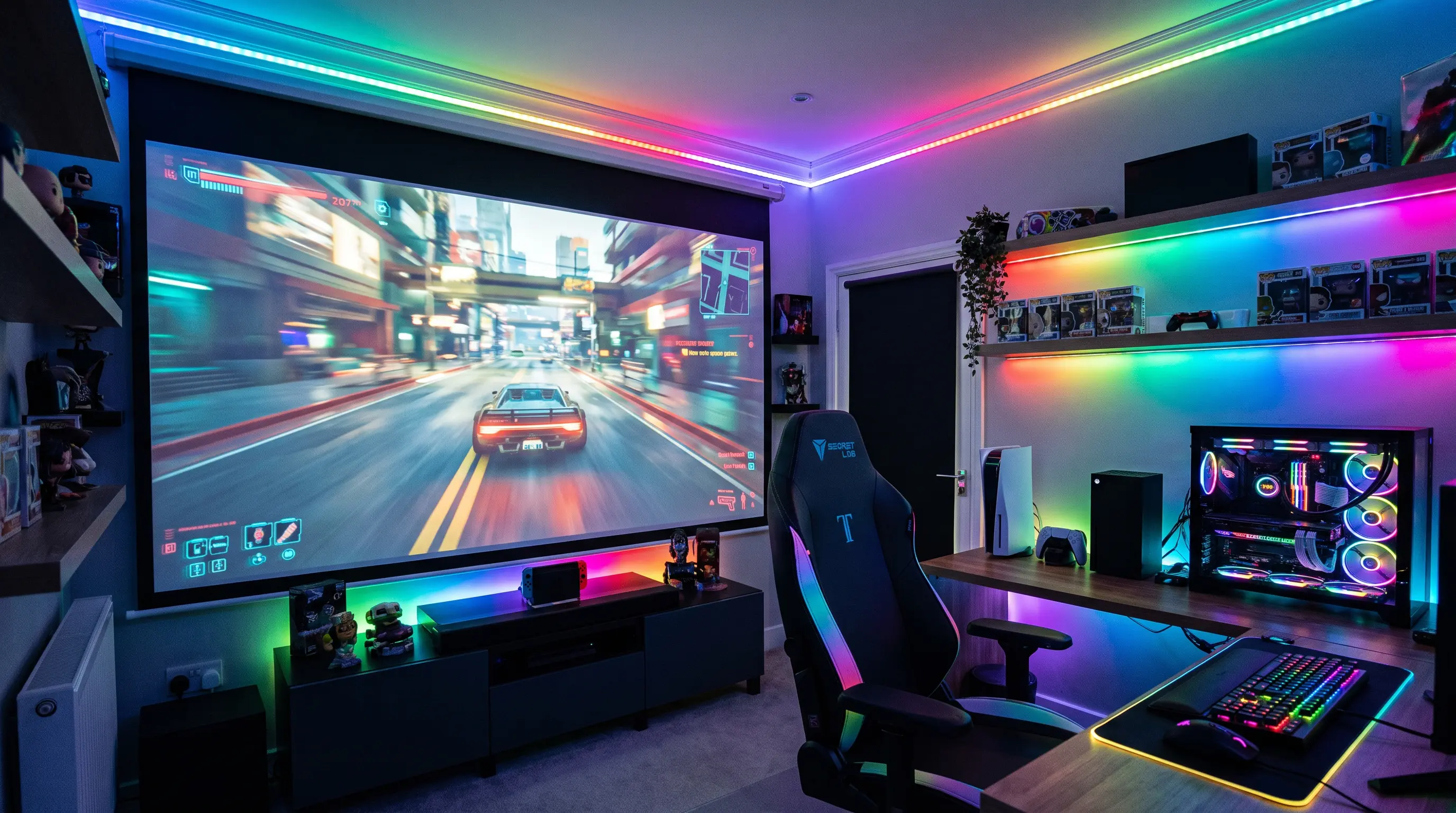
How to Choose a Projector for Esports Arena in 2026
A buyer evaluating display hardware for a competitive gaming venue faces a long checklist: brightness that survives stage lighting, low input lag that does not punish a pro player, color accuracy that holds up under broadcast cameras, and a chassis that survives 14-hour tournament days. The wrong the projector procurement wastes budget, delays opening nights, and frustrates the players whose reactions are measured in milliseconds. This guide maps the engineering decisions we walk through with our OEM and ODM partners every week, so your team can specify, source, and ship the SKU installations with confidence.
TL;DR
An buyer evaluating display hardware for a competitive gaming venue faces a long checklist: brightness that survives stage lighting, low input lag that does not punish a pro player, color accuracy that holds up under broadcast cameras, and a chassis that survives 14-hour tournament days. The wrong the projector procurement wastes budget, delays opening nights, and frustrates the players whose reactions are measured in milliseconds. This guide maps the engineering decisions we walk through with our OEM and ODM partners every week, so your team can specify, source, and ship the SKU installations with confidence.
Engineering the Core Spec Sheet for the Model

Brightness, Ambient Light, and the ANSI Standard
The first number on any serious the unit quote is brightness measured in ANSI lumens, and the first procurement mistake is trusting the marketing peak number instead of the rated ANSI figure. Stage lighting, LED walls, and crowd-facing spotlights routinely push ambient light above 600 lux on the playing surface, so this projector main stage needs at least 4500 ANSI lumens to keep a 240 Hz image readable. Side panels and warm-up screens can step down to 3000 ANSI lumens, but anything below that washes out under broadcast exposure.
When we sit down with OEM buyers on the factory floor in Shenzhen, we hand them a one-page brightness table that maps stage size, ambient lux, screen gain, and required ANSI output. That document is built around the ANSI/PLASA FL1 standard for projection lumens, which is the same reference cited by the International Display Manufacturers Association in their 2026 procurement guidelines PLASA FL1 Standard. If a vendor cannot show you the ANSI-rated figure on a third-party test report, walk away.
Input Lag, Refresh Rate, and the Tournament Reality
For OEM/ODM procurement workflows,aluating the unit use, lock in at least 4000 ANSI lumens, ≤16 ms input lag, and ≥95% Rec.709 color coverage before comparing price.
- A 0.19–0.25 ultra-short throw ratio is the safest baseline for this projector lanes where players sit close to the screen, since it eliminates shadows and trip hazards.
- Laser phosphor display engines deliver 20,000–30,000 hours of maintenance-free run time, which is the single most important total-cost-of-ownership number for tournament-grade esports arena venues.
- DataMax supports ODM customization on a 12-week delivery cycle for orders of 500 units or above, with CE, FCC, RoHS, and optional Dolby Vision certification bundled into the BOM.
- For B2C buyers building a home battlestation that emulates a tournament floor, our short-throw 4K UHD models from $899 retail deliver the same core spec sheet as the wholesale the SKU units we ship to venue chains.
Our engineering team benchmarks every the SKU candidate with a Leo Bodnar input lag tester at three resolutions before it leaves the line, and we publish the worst-case figure, not the best-case figure, in the spec sheet. We have seen honest-looking 32 ms projectors arrive from other factories that measured 47 ms on the same rig, which is exactly the gap that separates a tournament-grade esports arena install from a marketing-grade unit. Refresh rate is the second half of the same equation: 120 Hz minimum, 240 Hz preferred for fighting and shooter stages, and HDMI 2.1 with full 48 Gbps bandwidth is non-negotiable for a 2026 build.
Throw Ratio, Lens Offset, and Stage Geometry
Throw ratio is the geometry spec most B2C buyers forget and most B2B buyers regret when they forget. The unit lane set-up typically runs a ceiling-mounted ultra-short throw at a 0.19–0.25 ratio, so the lens sits 30–60 cm from a 120-inch screen and the player never walks through the beam. Standard throw units at 1.2–1.5 ratio require 2.5–3 m of mounting depth and create a shadow zone behind the player that broadcasters will absolutely notice on the slow-motion replay.
Lens offset and vertical shift matter just as much, because arena ceilings are rarely flat and rigging points are rarely centered. This projector rig with at least ±60% vertical lens shift and ±30% horizontal shift can be mounted on existing truss without re-engineering the bracket. Keystone correction is a software workaround, not a substitute for optical shift, and we push every OEM partner we work with to spec motorized lens shift before they spec keystone.
| Spec | Tournament Main Stage | Side Panel / Warm-up | Home Battlestation |
|---|---|---|---|
| ANSI Lumens | 4500–6000 | 3000–4000 | 2200–3000 |
| Input Lag (4K/60) | ≤16 ms | ≤25 ms | ≤30 ms |
| Refresh Rate | 240 Hz | 144 Hz | 120 Hz |
| Throw Ratio | 0.19–0.25 UST | 0.8–1.0 ST | 1.2–1.5 |
| Light Source | Laser phosphor | Laser phosphor | Laser or LED |
| Service Life | 30,000 h | 25,000 h | 20,000 h |
| HDMI | 2.1 ×2 | 2.1 ×1, 2.0 ×1 | 2.1 ×1 |
Color, HDR, and Broadcast Camera Compatibility
Many first number on any serious the unit quote is brightness measured in ANSI lumens, and the first procurement mistake is trusting the marketing peak number instead of the rated ANSI figure. Stage lighting, LED walls, and crowd-facing spotlights routinely push ambient light above 600 lux on the playing surface, so this projector main stage needs at least 4500 ANSI lumens to keep a 240 Hz image readable. Side panels and warm-up screens can step down to 3000 ANSI lumens, but anything below that washes out under broadcast exposure.
When we sit down with OEM buyers on the factory floor in Shenzhen, we hand them a one-page brightness table that maps stage size, ambient lux, screen gain, and required ANSI output. That document is built around the ANSI/PLASA FL1 standard for projection lumens, which is the same reference cited by the International Display Manufacturers Association in their 2026 procurement guidelines PLASA FL1 Standard. If a vendor cannot show you the ANSI-rated figure on a third-party test report, walk away.
Reliability, Service Life, and Total Cost of Ownership
The single most overlooked line item in any the model RFP is service life. A lamp-based unit rated 3,000 hours will need a $400 lamp swap every four months on a tournament schedule, which is roughly $1,200 per year per projector in consumables alone. A laser phosphor display engine rated 30,000 hours runs for seven to ten years on the same tournament cadence without a swap, and the only scheduled maintenance is a $60 filter change every 18 months.
Color quality matters, but the spec that ends careers in competitive gaming is input lag. The projector main stage should hold total system input lag at ≤16 ms at 4K UHD 60 Hz, and ideally ≤8 ms at 1080p 240 Hz for first-person shooter titles. That number is the sum of signal processing, scaler delay, and panel response, and every millisecond above 16 ms is a measurable handicap for the player on stage.
Rigging, Mounting, and Cable Infrastructure for Tournament Floors
Our engineering team benchmarks every the SKU candidate with a Leo Bodnar input lag tester at three resolutions before it leaves the line, and we publish the worst-case figure, not the best-case figure, in the spec sheet. We have seen honest-looking 32 ms projectors arrive from other factories that measured 47 ms on the same rig, which is exactly the gap that separates a tournament-grade esports arena install from a marketing-grade unit. Refresh rate is the second half of the same equation: 120 Hz minimum, 240 Hz preferred for fighting and shooter stages, and HDMI 2.1 with full 48 Gbps bandwidth is non-negotiable for a 2026 build.
Cable runs are the second failure point. A projector for esports arena side display needs at least 30 meters of certified HDMI 2.1 Ultra High Speed fiber run between the player PC and the lens, and that distance collapses the signal budget on passive copper. We stock and ship armored fiber HDMI 2.1 cables in 30 m, 50 m, and 100 m lengths because tournament cable techs cannot be guessing on patch day. For the broadcast return feed, a separate SDI run terminated at the OB truck is standard, and the SDI-to-HDMI converter should be rack-mounted at the player station, not zip-tied under the projector mount.
Throw ratio is the geometry spec most B2C buyers forget and most B2B buyers regret when they forget. The unit lane set-up typically runs a ceiling-mounted ultra-short throw at a 0.19–0.25 ratio, so the lens sits 30–60 cm from a 120-inch screen and the player never walks through the beam. Standard throw units at 1.2–1.5 ratio require 2.5–3 m of mounting depth and create a shadow zone behind the player that broadcasters will absolutely notice on the slow-motion replay.
Lens offset and vertical shift matter just as much, because arena ceilings are rarely flat and rigging points are rarely centered. This projector rig with at least ±60% vertical lens shift and ±30% horizontal shift can be mounted on existing truss without re-engineering the bracket. Keystone correction is a software workaround, not a substitute for optical shift, and we push every OEM partner we work with to spec motorized lens shift before they spec keystone.
OEM/ODM Procurement Checklist for Bulk Buyers
| Spec | Tournament Main Stage | Side Panel / Warm-up | Home Battlestation |
|---|---|---|---|
| ANSI Lumens | 4500–6000 | 3000–4000 | 2200–3000 |
| Input Lag (4K/60) | ≤16 ms | ≤25 ms | ≤30 ms |
| Refresh Rate | 240 Hz | 144 Hz | 120 Hz |
| Throw Ratio | 0.19–0.25 UST | 0.8–1.0 ST | 1.2–1.5 |
| Light Source | Laser phosphor | Laser phosphor | Laser or LED |
| Service Life | 30,000 h | 25,000 h | 20,000 h |
| HDMI | 2.1 ×2 | 2.1 ×1, 2.0 ×1 | 2.1 ×1 |
Minimum Order Quantity, Lead Time, and Packaging
Our standard projector for esports arena wholesale MOQ is 100 units per SKU, with a 12-week production lead time from PO to ex-factory. Custom SKUs (customized boot logo, custom OSD language set, custom chassis color for venue branding) require MOQ 500 and 16 weeks. Packaging is double-walled corrugated with EPE foam cradles designed for a 1.2 m drop test, and we have an ISTA 3A test report on file that any wholesale buyer can request. For buyers shipping into the EU or UK, we provide DDP incoterm quotes including CE marking paperwork, and for North America we ship with FCC verification already on file.
Certifications, QC Process, and After-Sales Support
Tournament floors are filmed at 50/60 Hz with broadcast-grade cameras that flatten any color profile that drifts off the standard. The projector main display should cover ≥95% Rec.709 and ≥80% DCI-P3, with HDR10 and HLG decoding on board so the same feed renders correctly on the in-venue screen and the stream. Dolby Vision is optional, and we only recommend it for VIP lounges and brand showcase stages where the content is mastered for it.
For OEM/ODM procurement workflows,ing multi-city tournament circuits, color consistency across the fleet is the hidden procurement metric. We factory-calibrate every the SKU wholesale order to a delta E under 2 on a Konica Minolta CA-410 spectroradiometer, then ship a calibration certificate with each serial number. That is the level of paperwork your broadcast partners will ask for when they audit the venue before a finals weekend.
Cooling, Noise, and Player Comms
A 6000-lumen projector for esports arena main stage puts out roughly 1,800 watts of heat into a sealed truss pocket, and that heat will throttle the laser bank within 90 minutes if the cooling path is wrong. Every projector for esports arena installation we design uses either a ducted exhaust to venue HVAC return or a liquid-cooled plate on the laser bank for above-rig mounts where ducting is not possible. The noise floor matters more than most spec sheets admit, because a projector humming at 38 dB sits three meters behind the player headset, and at that distance 38 dB is audible through an open-back headphone during a clutch round.
Every single most overlooked line item in any the model RFP is service life. A lamp-based unit rated 3,000 hours will need a $400 lamp swap every four months on a tournament schedule, which is roughly $1,200 per year per projector in consumables alone. A laser phosphor display engine rated 30,000 hours runs for seven to ten years on the same tournament cadence without a swap, and the only scheduled maintenance is a $60 filter change every 18 months.
When our wholesale team quotes the unit bulk order, we hand the buyer a five-year TCO sheet that includes lamps, filters, calibration, and the cost of one emergency service call per year. On a 500-unit order, the delta between a lamp projector and a laser phosphor projector is roughly $480,000 in operating cost across the first five years, which is why every serious esports arena projector wholesale conversation we have in 2026 starts with light source and ends with lens shift.
How to Choose a Projector for Esports Arena in 2026: Procurement Guide
For B2B procurement teams finalizing a projector for esports arena decision in 2026, the shortest path to a clean purchase is a five-step filter. First, lock the ambient light of the venue and the screen diagonal; these two numbers define the minimum lumen output and the throw ratio class. Second, confirm the input lag spec at the resolution you will actually run (most buyers forget that 4K at 60 Hz and 1080p at 240 Hz list different lag numbers). Third, demand a calibration certificate with serial-level traceability, not a generic "factory tuned" line on a brochure. Fourth, validate the cooling path with a thermal map of the proposed rig location. Fifth, compare warranty SLAs in writing, including the replacement-part turnaround and the loaner policy.
MOQ, Lead Time, Samples, and Contact Channel for Wholesale Buyers
Every cleanest spec sheet in the world does not save a poorly rigged this projector installation. We have walked into too many venues where the projector was spec'd correctly and then hung from a single steel cable looped over a lighting truss. Tournament rigging inspectors will red-flag that on sight. The correct mounting approach for any the projector main stage is a purpose-engineered steel yoke bolted to a Unistrut header or a purpose-built truss adapter, with a secondary safety cable as a redundant fall arrest. The secondary cable is not optional; every venue insurance carrier we work with requires it on the load-in checklist.
Cable runs are the second failure point. A projector for esports arena side display needs at least 30 meters of certified HDMI 2.1 Ultra High Speed fiber run between the player PC and the lens, and that distance collapses the signal budget on passive copper. We stock and ship armored fiber HDMI 2.1 cables in 30 m, 50 m, and 100 m lengths because tournament cable techs cannot be guessing on patch day. For the broadcast return feed, a separate SDI run terminated at the OB truck is standard, and the SDI-to-HDMI converter should be rack-mounted at the player station, not zip-tied under the projector mount.
Where to Go From Here
Final Takeaway for 2026 Buyers
| Cable Run | Type | Max Reliable Distance | Use Case |
|---|---|---|---|
| Player PC → Main Stage | HDMI 2.1 Fiber | 100 m | Tournament main display |
| Stage → Broadcast | 12G SDI | 300 m | OB truck return feed |
| Stage → Side Panel | HDMI 2.1 Fiber | 50 m | Warm-up stage repeater |
| Production → Lobby | HDBaseT | 100 m | Brand showcase loop |
| Backup Run | HDMI 2.0 Copper | 15 m | Emergency patch |
Get Started with DataMax
For distributor procurement,ilding a multi-venue rental fleet, the cable bill is roughly 12–18% of the total projector for esports arena hardware cost on a 50-unit order. We pre-bundle armored fiber with every wholesale quote so the buyer does not have to source it from three different vendors under a tight load-in window.
